Tax Lien List North Carolina: Why the Upset Bid Process Changes Everything

Tax Lien List North Carolina: Why the Upset Bid Process Changes Everything
TL;DR: North Carolina is a tax deed state — it does not sell tax lien certificates at auction. Instead, counties foreclose directly on delinquent properties and sell them through a court-supervised process with a unique "upset bid" window. Investors looking for the NC tax lien list need to access county tax offices and GIS portals to find delinquent accounts before foreclosure starts — and understand that once bidding opens, a 10-day upset bid window can reset the final sale price multiple times before the court confirms a deed.

North Carolina is one of the most misunderstood states in tax-sale investing. Most out-of-state investors arrive expecting a lien certificate auction — the kind where you pay the delinquent taxes, earn 8–36% interest, and wait for the owner to redeem. That's not how it works here.
North Carolina does things differently. And once you understand the actual process, you'll see why it rewards investors who do their homework before the auction — not at it.
What Is the NC "Tax Lien List" (And Why It's Not What You Think)
North Carolina does not issue tax lien certificates. Period.
In states like Florida, Arizona, or New Jersey, investors bid on tax lien certificates at annual auctions — you pay the delinquent taxes, earn interest on that investment, and the property owner has a redemption period to pay you back. NC skips that step entirely.
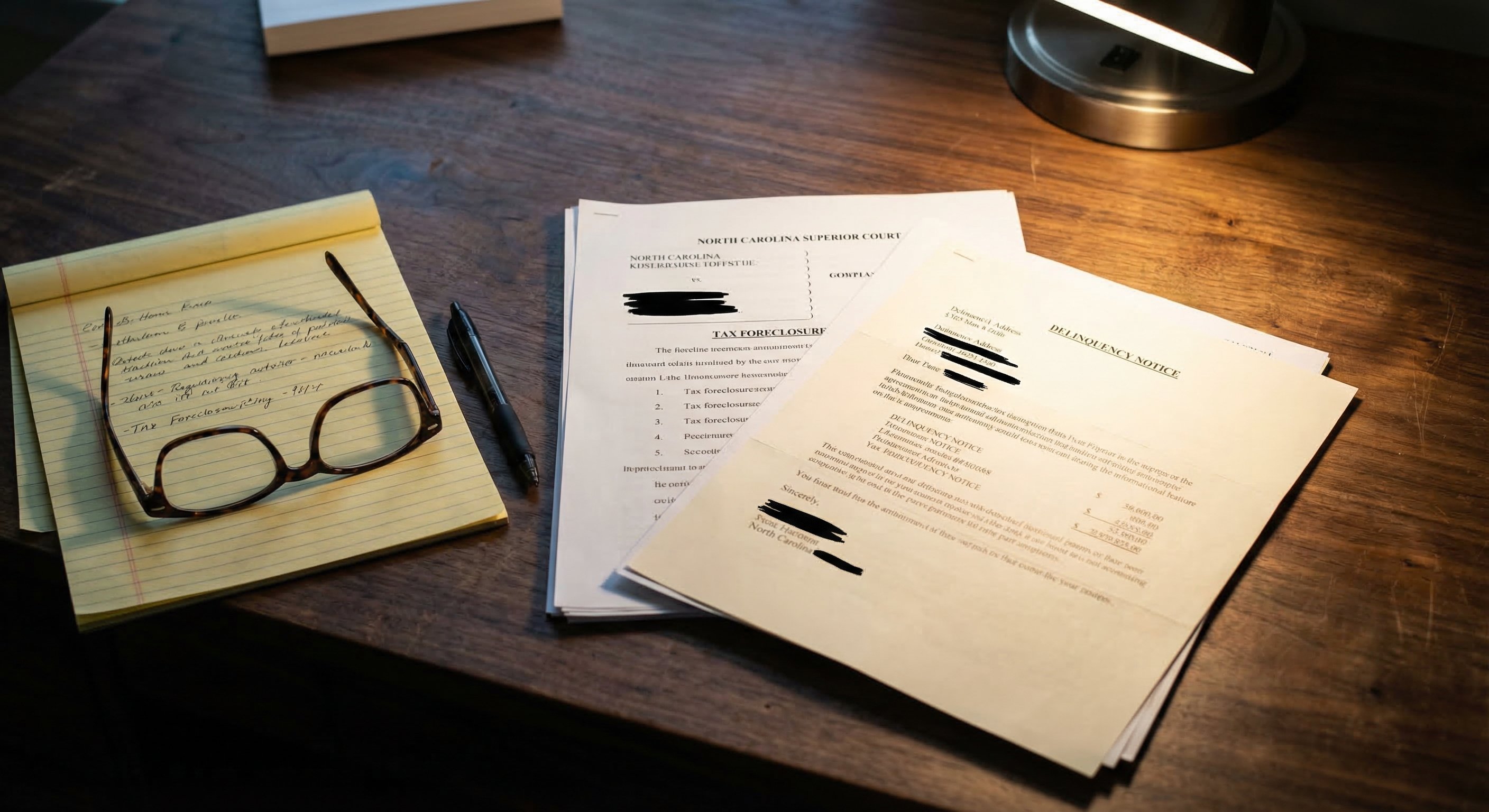
When a property owner falls behind on taxes and doesn't pay for two to three years, the county has the right to file a tax foreclosure lawsuit directly in Superior Court. There is no lien certificate to buy. The county forecloses, and if successful, the property is sold at public auction — where the winning bidder receives a tax deed, not a certificate.
So when investors search for a "tax lien list North Carolina," what they actually mean is: the list of properties currently in tax foreclosure or approaching foreclosure — the pre-foreclosure window where deals can still be negotiated directly with the owner.
That distinction matters enormously for your strategy.
Two key lists to track:
- Delinquent property tax lists — accounts with unpaid taxes, available from county tax offices before foreclosure begins. This is where pre-foreclosure investors work.
- Active tax foreclosure filings — properties where the county has already initiated the foreclosure process, accessible through county court records or the NC eCourts portal. This is where auction investors compete.
Both represent real opportunities. The first is where you can still reach the owner before they lose everything. The second is where you'll show up with a cashier's check.
How the NC Tax Foreclosure Process Works (Step-by-Step Timeline)
Understanding the timeline before you start pulling lists is non-negotiable.
Year 1–2: Delinquency accumulates Property taxes become due January 5th each year. After that date, interest begins accruing at 2% for the first month, then 3/4% per month thereafter. Most counties don't initiate legal action until a property is at least two to three years delinquent — partially because they're managing hundreds of accounts at a time.
Year 2–3: Attorney referral Counties typically refer significantly delinquent accounts to an attorney (or their in-house legal team) who files a foreclosure action in Superior Court. At this stage, the owner receives formal notice and has a window to cure the debt.
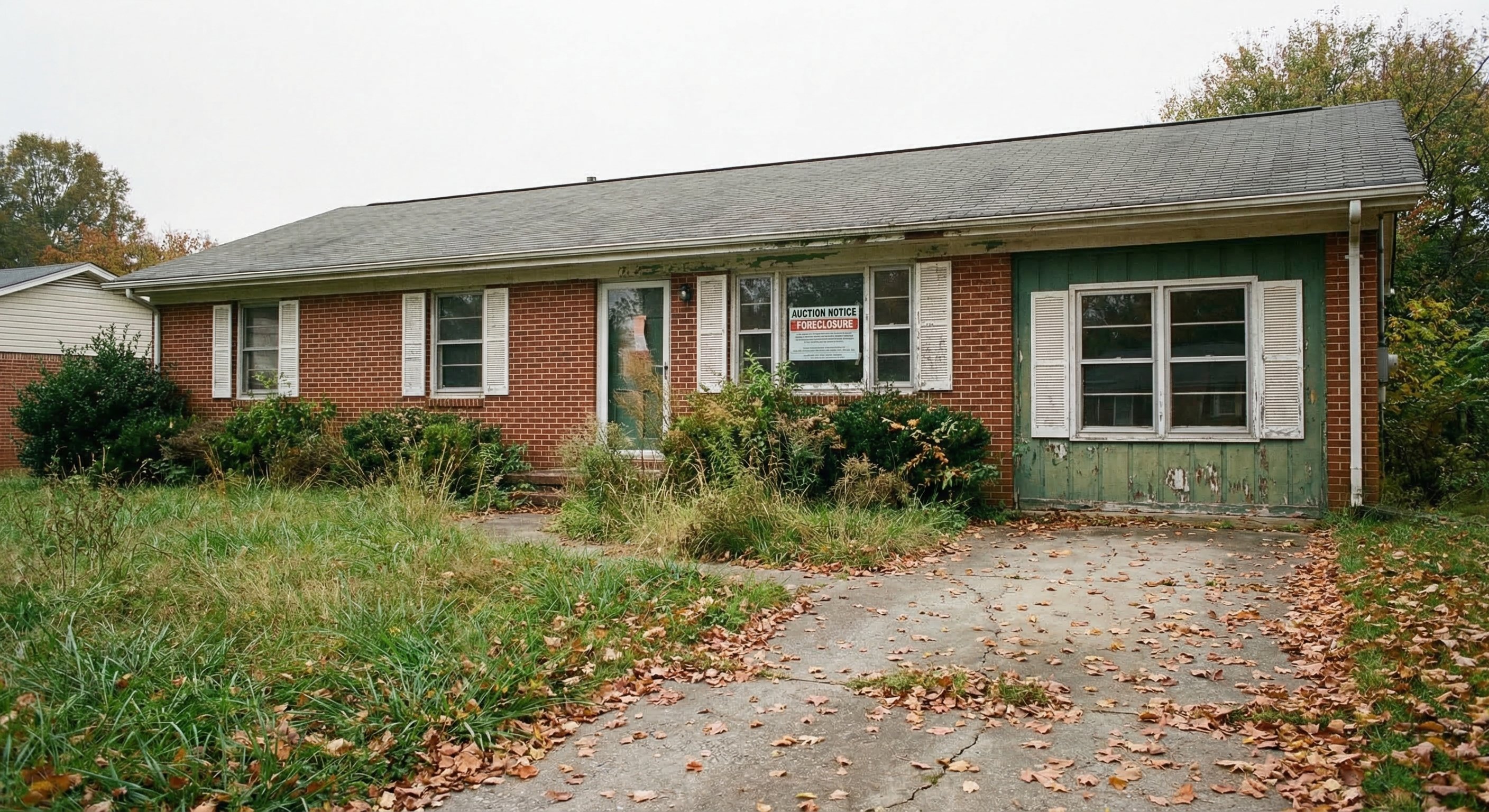
Foreclosure filed: Public notice and auction Once the court schedules the sale, the property is advertised publicly and sold at a public auction. The opening bid typically starts at the amount of delinquent taxes plus court fees, attorney costs, and accrued interest — often well below market value.
The Upset Bid Window — NC's Most Important Feature Here is where North Carolina gets interesting — and where uninformed investors get burned. After the initial auction sale, a 10-day "upset bid" period opens. During this window, anyone can file a new bid that is at least 5% higher than the winning bid (with a $750 minimum increase). If an upset bid is filed, a fresh 10-day window resets.
This can happen up to four rounds — meaning a property that sold for $15,000 at the initial auction can climb to $30,000 or more through successive rounds of competitive bidding. If you're planning to win at the initial auction and walk away, that's not a complete plan.
After the final window: Court confirmation and deed Once the final 10-day window expires with no new upset bids, the court confirms the sale and issues a tax deed. There is no post-sale redemption period. Unlike many states, once the NC tax foreclosure deed is confirmed, the former owner cannot reclaim the property by paying the sale price. The sale is final.
Where to Find the NC Tax Delinquent Property List by County
Each of North Carolina's 100 counties maintains its own delinquent property list. There is no single statewide registry. Here's how to navigate the most active investor markets:
Wake County (Raleigh) Wake County Tax Administration publishes delinquent real property accounts through its online portal. Active foreclosure filings appear on the Wake County Clerk of Court's electronic records. Key submarkets: Raleigh, Cary, Apex, Fuquay-Varina, Wake Forest.
Mecklenburg County (Charlotte) Mecklenburg maintains a robust GIS property portal and publishes delinquent accounts. Charlotte's investor community is active — expect more competition at courthouse auctions than in smaller counties. Surrounding suburbs like Matthews, Concord, and Huntersville often offer better value.
Guilford County (Greensboro) One of NC's better-documented tax foreclosure counties. Guilford publishes delinquent lists and holds regular sales. Greensboro and High Point have significant legacy housing stock with above-average distress rates.
Forsyth County (Winston-Salem) Active tax foreclosure docket. Winston-Salem carries distressed inventory from decades of manufacturing sector contraction — investors who know the neighborhoods can find strong buy-and-hold opportunities.
Durham County Durham County publishes its delinquent list through the tax office. Urban core properties can be attractive but competition has increased as the Research Triangle gentrifies. Look toward the county's eastern edge for lower competition.
Buncombe County (Asheville) Western NC's most active investor market. Asheville's short-term rental boom has pushed values, but surrounding Buncombe County communities and neighboring counties (Henderson, McDowell, Madison) offer legitimate distressed inventory.
Smaller NC counties to watch — Johnston, Cabarrus, Iredell, Alamance, Catawba, and Rowan often combine meaningful inventory with significantly lower auction competition. If you're willing to operate outside the top 5 counties, your deal economics improve substantially.
🔍 Finding the lists: Search "[County Name] NC delinquent property tax list" directly or visit the county's official tax office website. Active court foreclosure cases across all 100 counties can be searched at the NC eCourts portal (eservices.nccourts.org). For pre-foreclosure delinquent accounts before legal action begins, many counties maintain Excel or PDF lists updated quarterly.
Free Weekly Alerts
See What's Distressed in Your Market
Get free weekly alerts — new distressed properties, motivation scores, and hot neighborhoods in your area. Addresses and contact info available inside DistressIQ.
Free forever · No credit card · Unsubscribe anytime
The Real Opportunity: Working the Delinquency Window Before Foreclosure
The tax foreclosure auction is where retail investors compete. The better play — for off-market investors and wholesalers — is contacting the owner while they are still delinquent but before the county has filed.
Property owners in this window are often dealing with compounding problems. Tax delinquency rarely shows up alone. In DistressIQ's county-verified data across all 100 NC counties, delinquency is frequently stacked with:
- Lis pendens — an active court case (divorce, creditor action, or another foreclosure)
- Code violations — code enforcement has been actively writing up the property
- Absentee ownership — the owner no longer lives there, hasn't for years
- Probate status — an inherited property where heirs are not managing or maintaining it
When two or three of those signals appear on the same property, owner motivation is almost always substantially higher than a single delinquency flag would suggest. That's where the real off-market negotiations happen — not at the courthouse steps.
DistressIQ tracks 31 signal types across 3,200+ counties — including all 100 NC counties — updated multiple times daily from county assessor and court records. Instead of spending weeks manually working through 100 individual county portals, you get a filtered view of the highest-priority distressed properties in any NC county, sorted by signal count and recency.
NC Tax Foreclosure vs. Tax Lien States: The Key Differences
| Factor | NC (Tax Deed / Foreclosure) | Tax Lien States (FL, AZ, NJ) |
|---|---|---|
| What you buy at auction | Property deed | Tax lien certificate |
| Investment type | Direct property purchase | Interest-bearing lien |
| Post-sale redemption period | None after confirmation | 1–3 years typically |
| Returns | Property value / appreciation | 8–36% interest on lien |
| Upset bid process | Yes — 10-day reset windows | No — bids are typically final |
| Entry cost | Full purchase price | Amount of delinquent taxes |
| Typical competition | County-by-county variation | Often online, broader reach |
When NC works for you:
- You want to own the property outright (not hold a passive lien)
- You're a buy-and-hold investor or a wholesaler assigning contracts
- You're prepared to do title work before bidding and understand potential encumbrances
- You have cash or confirmed hard money financing before you walk in
When NC doesn't fit your model:
- You're targeting a passive interest return on a lien certificate (you need a lien state for that)
- You want a low-capital entry without taking on direct property ownership
Three Investor Traps in NC Tax Sales
Trap 1: Assuming the tax deed is fully clean NC tax deeds extinguish most junior liens — but not all. IRS federal tax liens survive for 120 days after proper IRS notification. If the IRS was not properly notified during the foreclosure, their lien may remain viable. Some municipal special assessments for sewer connections or street paving can also survive. Always complete a full title examination before you bid, not after.
Trap 2: Treating the initial auction as the final sale If you win at the initial auction and haven't budgeted for potential upset bids, you may find your "winning" bid bumped by a competitor within 10 days. Know your maximum ceiling for every property before you bid, and have capital positioned to respond to an upset bid if you want to protect your position.
Trap 3: Competing at auction instead of preempting it The most successful NC investors are reaching owners 6–18 months before the county files. By the time a property reaches the courthouse auction, you're competing with experienced cash buyers who know the upset bid game. Pre-foreclosure outreach — when the owner still has options and is still motivated to avoid losing the property — is where leverage and deals are made.
Key Takeaways
- NC is a tax deed state — no lien certificates are sold; the county forecloses directly to deed
- The upset bid process resets every 10 days and can substantially increase the final sale price — never walk in without knowing your ceiling
- No post-sale redemption — once the court confirms the deed, the former owner has no recourse
- The best opportunity is in the delinquency window before the county files — not at the courthouse
- Stacked signals (delinquency + code violation + absentee + lis pendens) identify the highest-probability off-market opportunities
- All 100 NC counties maintain their own lists — no statewide portal, but DistressIQ aggregates them all
If you're serious about NC distressed properties, you can spend weeks manually pulling through 100 county portals — or you can see every high-signal property across the state in one filtered view.
DistressIQ covers all 100 NC counties with daily-updated tax delinquency, lis pendens, probate, code violation, and 27 additional distress signals. Founding member pricing is still available — fewer than 50 spots remain. Starter $89/mo, Pro $174/mo, Elite $349/mo, locked for life at those rates. Start your free trial at distressiq.ai
Frequently Asked Questions
Q: Does North Carolina sell tax lien certificates?
No. North Carolina is a tax deed state, not a tax lien state. The county forecloses directly on delinquent properties through Superior Court and sells the deed at public auction. There are no tax lien certificates to purchase in NC — this is a common misconception among out-of-state investors.
Q: What is the NC upset bid process?
After a property sells at a tax foreclosure auction, a 10-day window opens during which any party can file a new bid that is at least 5% higher than the current winning bid (with a $750 minimum increase). If a new upset bid is filed, another 10-day window resets. This process can occur up to four rounds before the Superior Court confirms the final sale and issues the deed.
Q: How long before a county can foreclose for delinquent taxes in NC?
North Carolina law generally permits counties to begin tax foreclosure after a property has been delinquent for approximately two to three years. Under G.S. § 105-369, counties may publish delinquent lists and initiate the foreclosure process, but most counties wait longer — often until the debt reaches a threshold that justifies attorney fees and court costs.
Q: Is there a redemption period after a NC tax foreclosure sale?
No. Unlike many states, once the Superior Court confirms a NC tax foreclosure sale and the deed is issued, there is no statutory right of redemption for the former owner. The transfer is final.
Q: Where can I find the NC tax delinquent property list?
Each of the 100 NC counties maintains its own list. Most larger counties — Wake, Mecklenburg, Guilford, Forsyth, Durham — publish delinquent account information online through their tax administration office or GIS portal. Active court foreclosure cases can also be searched through the NC eCourts portal at eservices.nccourts.org. For pre-foreclosure accounts before legal action begins, many counties publish periodic reports upon request.
Q: Are there risks to buying at a NC tax foreclosure sale?
Yes — primarily title-related. While NC tax deeds extinguish most junior liens, federal IRS tax liens survive for 120 days following proper IRS notice and may require additional handling. Municipal special assessments for infrastructure improvements can also survive in some circumstances. A full title search prior to bidding is essential.
Q: What is the difference between in rem foreclosure and judicial tax foreclosure in NC?
Most NC counties use the standard judicial tax foreclosure process through Superior Court. Municipalities (cities and towns) can also use "in rem" foreclosure — a faster administrative process that does not require a full court case for each property. Both processes result in a public auction and potential deed transfer; in rem foreclosure tends to move faster and is commonly used in larger cities like Charlotte, Raleigh, and Greensboro.
Sources: North Carolina General Statutes § 105-369 (advertisement and in rem foreclosure), North Carolina Association of County Commissioners tax collection guidance, Urban Institute distressed housing research.
Related: Pre-Foreclosure Leads in North Carolina | Tax Delinquent Properties in North Carolina | Foreclosure Leads in North Carolina
The data behind this article
DistressIQ Monitors These Signals in Real Time
Pre-Foreclosures
NOD + NTS filings
Tax Delinquency
County treasurer records
Code Violations
Municipal inspection filings
Probate Filings
Superior Court records
Every lead is scored 0–100 for seller motivation based on signal type, duration, severity, and stacking. Nationwide coverage — every US county, updated daily.
Ready to find deals in your market?
See Live Distress Signals in Your County
Stop calling dead leads. Every lead in DistressIQ is scored 0–100 for seller motivation, with verified contact info included. Browse the free tier to see what's active in your market right now.
Browse Free Leads — No Credit Card