Vacant Property Leads: Why Vacancy Alone Doesn't Predict Motivation (And What Actually Converts)
Vacant Property Leads: Why Vacancy Alone Doesn't Predict Motivation (And What Actually Converts)
TL;DR: There are roughly 16 million vacant housing units in the US — and most of them are owned by people who aren't motivated sellers at all. Seasonal vacancies, estate holds, rental turnover, and investor-held inventory make up the bulk of that number. The vacant properties worth pursuing share one thing: a secondary distress signal layered on top of vacancy. Tax delinquency, a lis pendens filing, a code violation notice, or an absentee owner with multiple indicators — that's when vacancy becomes a lead. This guide explains how to find vacant properties systematically, which signals separate hot leads from dead ends, and how to prioritize the ones worth calling first.
Every investor has a story like this: 200 mailers to a "vacant property list," 4 callbacks, none converted.
The list wasn't wrong. The properties were vacant. The problem is that vacancy is the most overused and least predictive single filter in real estate lead generation. Every data company sells it. Every guru teaches it. And because everyone's working the same lists, you're competing with 30 other investors for the same handful of properties that have any genuine urgency behind them.
Here's the actual problem: vacant is a characteristic, not a distress signal.
A property can be vacant because the owner bought it as a rental, had a tenant move out last month, and is actively screening new applicants. It can be vacant because someone lives in Florida half the year. It can be vacant because a property management company is coordinating a renovation. None of those are motivated sellers — they're just empty buildings.
The vacant properties that convert are the ones where vacancy is stacked with something else.

Why the US Has 16 Million Vacant Units — And Why Most Don't Matter to Investors
The Census Bureau's American Community Survey consistently puts vacant housing units in the US at 15-17 million, depending on the year. That number sounds like an investor's dream. It's mostly noise.
Break it down:
- Seasonal and recreational vacancies — about 4.1 million units. Beach houses, lake cabins, snowbird properties. Owner is perfectly fine, just not there year-round.
- For-rent vacancies — 2.4 million units. Normal landlord turnover. Owner is looking for a tenant, not a buyer.
- For-sale vacancies — 800,000+ units. Already on the market, MLS or FSBO. Not off-market deals.
- Held off-market by investors — renovation projects, buy-and-hold inventory, development parcels.
- Other vacancies — foreclosures in process, probate holds, estate situations, extended maintenance.
The last category is where motivated sellers live. That's a fraction of the 16 million headline number — but it's the fraction that matters.
The investors who succeed with vacant property leads aren't chasing all vacant properties. They're finding the subset where vacancy coincides with a verifiable distress event.
The Signals That Actually Make a Vacant Property Worth Pursuing
When a property is vacant AND shows at least one of the following signals, motivation to sell climbs substantially:
1. Tax Delinquency
An owner who hasn't paid property taxes for 2+ years on a property they're not occupying is dealing with a real financial or logistical problem. They're not a seasonal homeowner who'll be back in April. They're either in financial distress, have forgotten the property exists (genuinely happens with inherited land), or have already mentally walked away from it.
Tax delinquency on a vacant property is one of the highest-converting signal combinations in the business. Across markets with 18+ month delinquency timelines, vacant + tax delinquent properties convert to conversations at roughly 2-3x the rate of vacancy alone.
2. Lis Pendens or Pre-Foreclosure Filing
A lis pendens on a vacant property means a lender has started foreclosure proceedings — and there's nobody living there to fight it. The owner is either gone, unable to act, or both. The timeline is ticking and the owner's incentive to find an exit is high.
These leads often have a third element: the absentee owner is hard to reach. They may have moved without updating their address. Skip tracing a vacated property with a foreclosure filing takes more effort — but the motivation when you DO reach them is usually genuine.
3. Code Violations
Municipal code enforcement is actively writing violations on an occupied property — imagine the state of a vacant one. Code violation notices on vacant properties frequently accumulate over time, with daily or weekly fines that compound until they become municipal liens.
An owner with a vacant property carrying 6 active code violations and $40,000 in accrued municipal fines is motivated. They may not even know how bad it's gotten if they haven't been checking on the property. When you call and walk them through the math, the exit strategy you offer looks very attractive.
4. Extended Vacancy with Absentee Owner
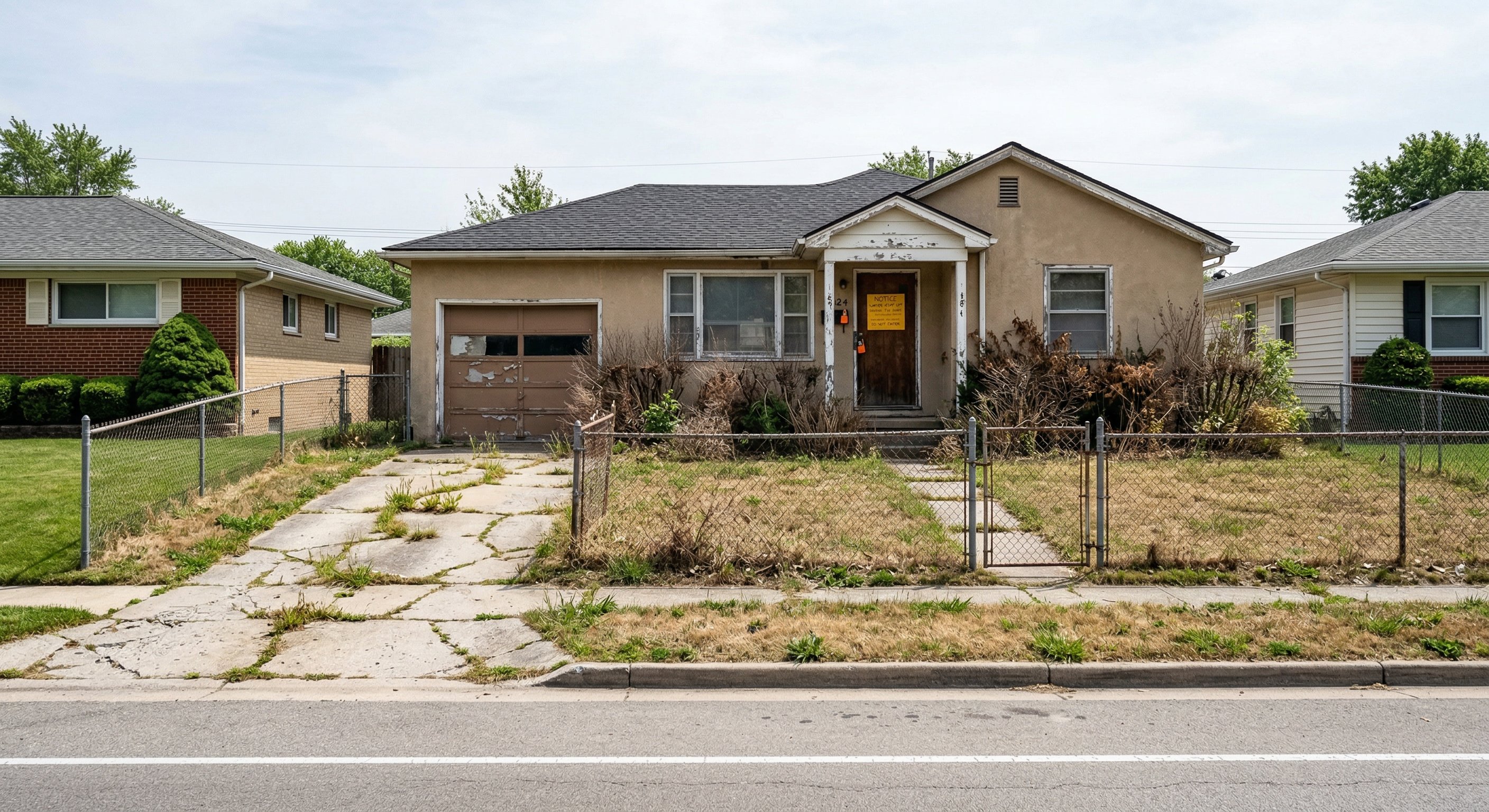
Not every vacant property generates a formal filing. Some slip through county systems for years without triggering tax delinquency (the owner keeps paying taxes remotely but has fully abandoned the property otherwise). If public records show absentee ownership — a different mailing address than the property address — combined with extended vacancy and property condition signals, that's worth pursuing even without a formal distress event.
The combination of absentee owner + vacant + deteriorating condition consistently outperforms "just vacant" by a significant margin.
How to Find Vacant Properties — The Actual Methods
Driving for Dollars (and Its Limitations)
The DeFi of real estate lead gen: everyone talks about it, most people do it wrong. Driving for dollars works for one specific use case — identifying property condition that isn't captured in any database. Overgrown yard, boarding on windows, a chain-link fence around a stripped shell — these are real signals that predict neglect, and they don't show up in any county record.
The problem is that driving covers territory slowly, requires constant manual data entry, and produces unfiltered results. You'll log 50 properties in a day and have no idea which ones are actually vacant vs. just in renovation vs. weekend getaways.
Driving for dollars is best used as a secondary research method — not a primary lead generation channel. Use it to add condition data on properties you've already identified through county signals. Drive the ones that already have a tax delinquency or code violation on file. That trip now has an agenda.
County Records: The Actual Source of Truth
The fastest way to build a vacant property lead list is through county-direct public records — specifically:
County assessor records — the parcel data often includes a mailing address separate from the property address. When these don't match, you've got an absentee owner. Cross that against properties in certain condition codes or assessed value anomalies and you start to narrow toward true vacancy.
Code enforcement records — most municipalities are now making these accessible online. A property with 3+ active citations for exterior maintenance, high grass, or securing issues (broken windows, unsecured entry) is a strong vacancy indicator without ever driving past it.
Tax delinquency rolls — public record in most states, searchable by county. Properties 2+ years delinquent are your primary filter. Narrow to those with absentee owner addresses and you've got a list worth working.
Water/utility shutoffs — some counties share utility shutoff data with investors or make it accessible via public records requests. A property with no active water utility is either vacant or living at a level of distress that amounts to the same thing.

Free Weekly Alerts
See What's Distressed in Your Market
Get free weekly alerts — new distressed properties, motivation scores, and hot neighborhoods in your area. Addresses and contact info available inside DistressIQ.
Free forever · No credit card · Unsubscribe anytime
Why Lists Fail: The "Vacant" Filter Problem on Data Platforms
Most real estate data platforms let you filter for "vacant" status — but that status comes from a data aggregator who compiled it from a variety of sources with varying lag times. The problems:
Stale data. A property flagged as vacant six months ago may have been rented since then. You're mailing the wrong person a message they have no reason to respond to.
False vacancies. Seasonal properties, properties under renovation, and properties with PO Box owners often get misclassified as vacant. These aren't leads — they're wasted mailers.
No context. A raw vacancy flag tells you nothing about why the property is vacant or how long it's been that way. Duration and cause are what actually matter for motivation scoring.
No signal stacking. A platform that marks 150,000 properties as "vacant" in a state and hands you a spreadsheet has given you a starting point, not a lead list. The work of filtering down to motivated sellers — cross-referencing delinquency, court filings, code violations, and absentee status — has to happen somewhere. Most platforms don't do it for you.
This is where real property intelligence separates itself from a data dump. DistressIQ shows only verified distress signals sourced from county records — including vacancy indicators cross-referenced against tax delinquency, lis pendens filings, and code violations. Each lead carries a motivation score 0-100 based on 20+ signal types stacked together, so you're not sorting through 150,000 vacancies to find the 200 that matter.
Browse vacant leads in your market free — only pay when you want contact info for the owners you decide to pursue.
Prioritizing Vacant Leads: The Signal Stack That Predicts Motivation
Given that vacancy alone is a weak signal, here's a practical framework for prioritizing your vacant property list:
Tier 1 — Work these first:
- Vacant + tax delinquent (2+ years) + code violation
- Vacant + lis pendens/pre-foreclosure filing + absentee owner
- Vacant + absentee owner + multiple code violations + any utility lien
Tier 2 — Worth pursuing:
- Vacant + tax delinquent (1-2 years) + absentee owner
- Vacant + probate filing on record
- Vacant + lis pendens alone (no confirmed tax issue)
Tier 3 — Low priority:
- Vacant + absentee owner only (no delinquency, no filing, no code violations)
- Vacant with local owner address (may just be a rental transition)
The difference between Tier 1 and Tier 3 isn't the property — it's the depth of the owner's situation. Tier 1 owners have multiple things going wrong simultaneously. That's where urgency lives.

Reaching Vacant Property Owners: What Works
The owner of a vacant distressed property often has a non-obvious contact situation. Their mailing address may be outdated. They may be going through an estate, a divorce, or a relocation that disrupted their normal contact methods. Here's what experienced investors report working:
Skip tracing with phone and email, not just address. A property sitting vacant with a tax delinquency often has an owner who's lost track of that address as a reliable contact point. Push to mobile number and email — those travel with the person even when the mailing address doesn't.
Lead with empathy, not urgency. The vacant property owner whose situation has accumulated into what you see on the record is often dealing with something difficult — an estate, a financial setback, a property they inherited from someone else and have no idea what to do with. "I noticed the property at [address] and wanted to reach out to see if you'd want to talk about options" lands better than any urgency framing.
Multi-touch, patient cadence. These owners may not respond to the first mailer or the first call. A 4-6 touch sequence over 45-60 days — direct mail, phone, text, possibly door — performs better than a single-blast approach.
Don't waste touches on Tier 3. Save the multi-channel effort for your Tier 1 stacked leads. Tier 3 vacancies might get one mailer and nothing more. Allocate effort according to signal depth.
The Math on Vacant Property Leads in 2026
A few honest benchmarks from experienced investors working vacancy stacks:
- Response rate on vacancy alone: 0.5-1.5% on mailers, <2% on cold calls. Competitive markets are at the low end.
- Response rate on vacancy + delinquency stacked: 3-6% on mailers, higher on direct phone.
- Conversion to closed deal from stacked vacancy leads: typically 1:80-100 for new investors building their process, 1:30-50 for experienced investors with established outreach.
The math changes dramatically when you eliminate the bottom tier. If your list is 200 properties but only 40 have secondary signals, marketing only to those 40 with a higher-touch approach will outperform a single-blast to all 200.
That's not a data hack — it's just prioritization. The investors who figure this out stop complaining about response rates and start building reliable deal pipelines.
Finding Vacant Property Leads: Where to Start Today
Manual approach (low cost, high time): Pull tax delinquency rolls from your target county's tax assessor website. Filter for properties where the mailing address differs from the property address. Cross-reference against your municipality's code enforcement portal for active violations. This takes hours per county but gives you the rawest, most current data available.
Platform approach (faster, costs money): A distressed property intelligence platform that cross-references vacancy with tax status, court filings, and code violations gives you the stacked list without the manual work. The question to ask any platform: where does your vacancy data come from, and how often is it updated? If the answer is a third-party aggregator on a 90-day refresh cycle, factor that staleness into your workflow.
DistressIQ pulls from county records directly — tax assessor data, court filings, code enforcement — and updates daily. Browse the vacant distressed leads in your target market at no cost, see every signal stacked on each property, and only pay when you decide a lead is worth pursuing.
Frequently Asked Questions
Q: What's the difference between vacant and abandoned properties?
Vacant means no one is currently living there. Abandoned means the owner has effectively given up legal and practical control — they're not paying taxes, not responding to notices, and the property is deteriorating. All abandoned properties are vacant, but most vacant properties are not abandoned. For investor purposes, "vacancy + at least one distress signal" is a better filter than chasing the "abandoned" label, which doesn't have a precise legal definition in most jurisdictions.
Q: How do I find vacant properties without driving every neighborhood?
Start with county records. Tax assessor databases often flag properties with mailing addresses that differ from the property address — that's an absentee owner flag, which correlates strongly with vacancy. Code enforcement portals in most municipalities now publish active violation lists online. A property with active exterior-maintenance violations is almost certainly vacant or under extreme neglect. You can build a qualified list through records research before ever getting in your car.
Q: Are vacant property lists worth buying from data vendors?
It depends on the source and age of the data. Lists compiled from utility data or mail forwarding requests can be accurate. Lists built from old county filings or third-party aggregators with 60-90 day refresh cycles may include a significant percentage of false vacancies. Always ask about data source and update frequency. Better yet, build your own lists from county records or use a platform that sources from county data directly.
Q: How does vacancy status affect outreach?
The owner of a vacant property often has a non-obvious mailing situation — they may have moved, be managing the property remotely, or be going through a life transition. Skip trace to mobile number and email, not just mailing address. A direct mail piece to a stale address is wasted. Start with phone and text for Tier 1 leads; layer in mail as a secondary touch.
Q: How many distress signals should a vacant property have before I pursue it?
As a rule of thumb: two or more verifiable signals = worth pursuing with a full outreach sequence. One signal (vacancy alone) = low-priority mailer at most. Three or more signals (vacant + tax delinquent + code violation, for example) = top of your call list, highest-touch approach, fastest follow-up. More signals mean more motivation — that's the basic premise behind stacking.
The data behind this article
DistressIQ Monitors These Signals in Real Time
Pre-Foreclosures
NOD + NTS filings
Tax Delinquency
County treasurer records
Code Violations
Municipal inspection filings
Probate Filings
Superior Court records
Every lead is scored 0–100 for seller motivation based on signal type, duration, severity, and stacking. Nationwide coverage — every US county, updated daily.
Ready to find deals in your market?
See Live Distress Signals in Your County
Stop calling dead leads. Every lead in DistressIQ is scored 0–100 for seller motivation, with verified contact info included. Browse the free tier to see what's active in your market right now.
Browse Free Leads — No Credit Card