How to Find Pre-Foreclosure Leads in Colorado (2026 Investor Guide)
How to Find Pre-Foreclosure Leads in Colorado (2026 Investor Guide)
TL;DR: Colorado's Public Trustee system creates a 110 to 125 day pre-foreclosure window that most out-of-state investors misunderstand entirely. The filing to track is the Notice of Election and Demand (NED), not a lis pendens, and it runs through a county-level official found only in Colorado. El Paso County leads the state in volume with over 3,500 active pre-foreclosures in early 2026, followed by Pueblo, Weld, and the Denver metro counties.
Every state has a foreclosure mechanism. Colorado's is built around something most investors have never heard of: the Public Trustee. Not a judge. Not a private trustee company. A county-level government official who administers the entire non-judicial foreclosure process from filing to auction.
That structure shapes everything about how pre-foreclosure leads surface in Colorado. The triggering document isn't a lis pendens filed in court. It's a Notice of Election and Demand, filed with the Public Trustee and recorded in the county clerk's office. The timeline runs 110 to 125 calendar days from recording to sale. And because every county has its own Public Trustee, the data comes from 64 separate sources, each with its own publishing format and schedule.
Investors who understand this structure have a real edge. Those who don't waste time chasing the wrong filings in the wrong places.
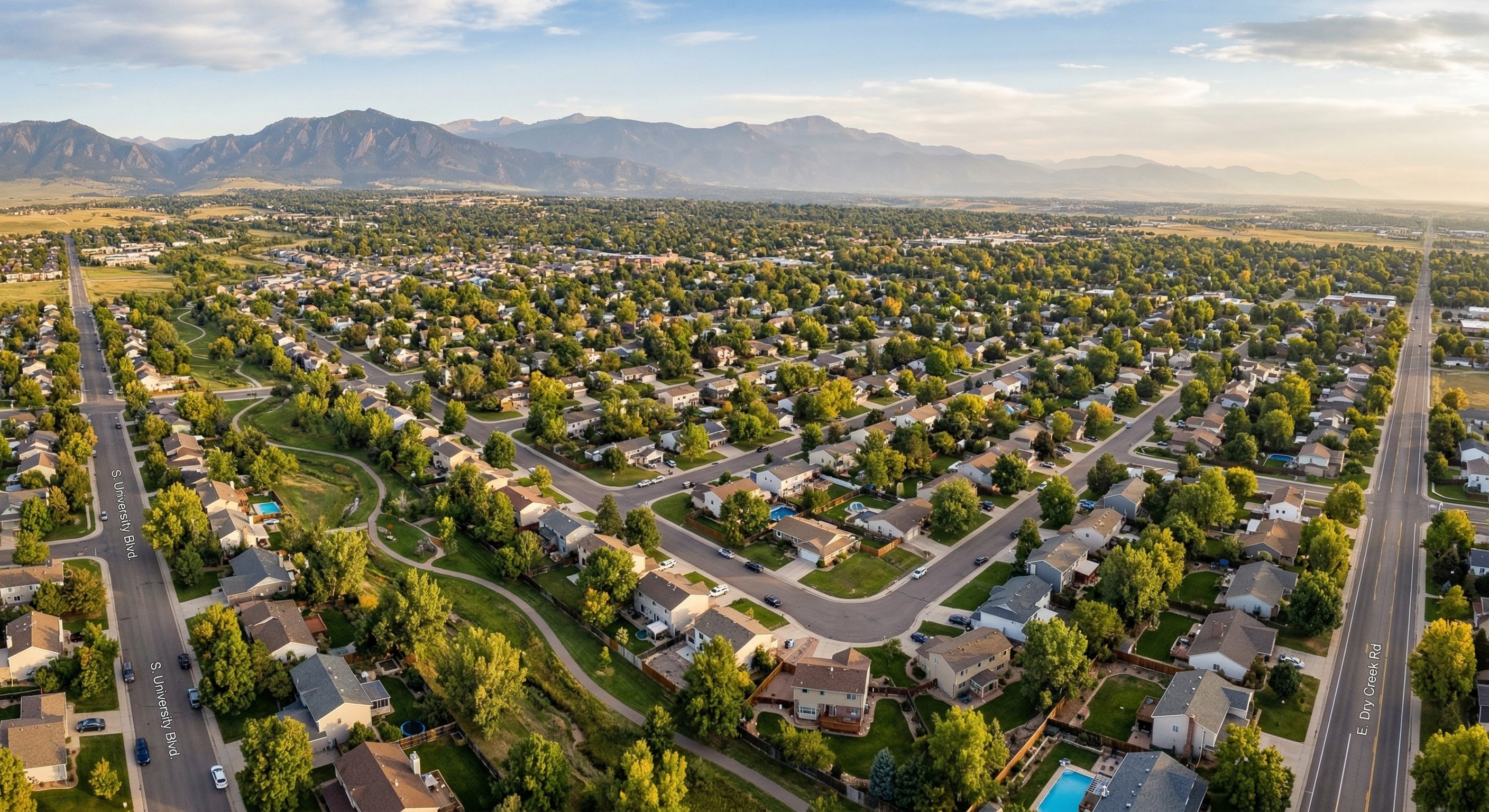
How the Public Trustee System Works
Colorado Revised Statutes Title 38 governs the foreclosure process. Under this framework, each of Colorado's 64 counties has a Public Trustee appointed to handle non-judicial foreclosures. When a borrower defaults, the lender's attorney files a Notice of Election and Demand (NED) with the county Public Trustee, who records it with the clerk and recorder. That recording date starts the clock.
For residential and commercial properties, the Public Trustee sets a sale date 110 to 125 calendar days out. Agricultural properties get a longer runway at 215 to 230 days, but those are rarely investor targets.
Once the NED is recorded, the borrower receives formal combined notice within 20 days. The notice also runs in a local newspaper for four consecutive weeks. The homeowner can file a Notice of Intent to Cure up to 15 days before the sale, then pay the full cure amount by noon the day before auction. The lender must obtain an Order Authorizing Sale through a Rule 120 hearing at least 16 days before the sale date. Rule 120 is a brief court proceeding that confirms the lender's right to foreclose. It is not full litigation, though homeowners can contest the foreclosure through separate legal action if they have grounds.
After the auction, the Public Trustee issues a Certificate of Purchase to the winning bidder. Junior lienholders have 8 business days to file a notice of intent to redeem. If no redemption occurs, a Confirmation Deed is issued after 15 or more business days.
For investors, the actionable window runs from the NED recording date to roughly 30 days before the scheduled sale. That is when the homeowner still owns the property, still has options, and is most receptive to a conversation about selling.
Where the Volume Is: County by County
Colorado's pre-foreclosure activity clusters along the Front Range, but each county has distinct dynamics that affect how investors should approach the market.
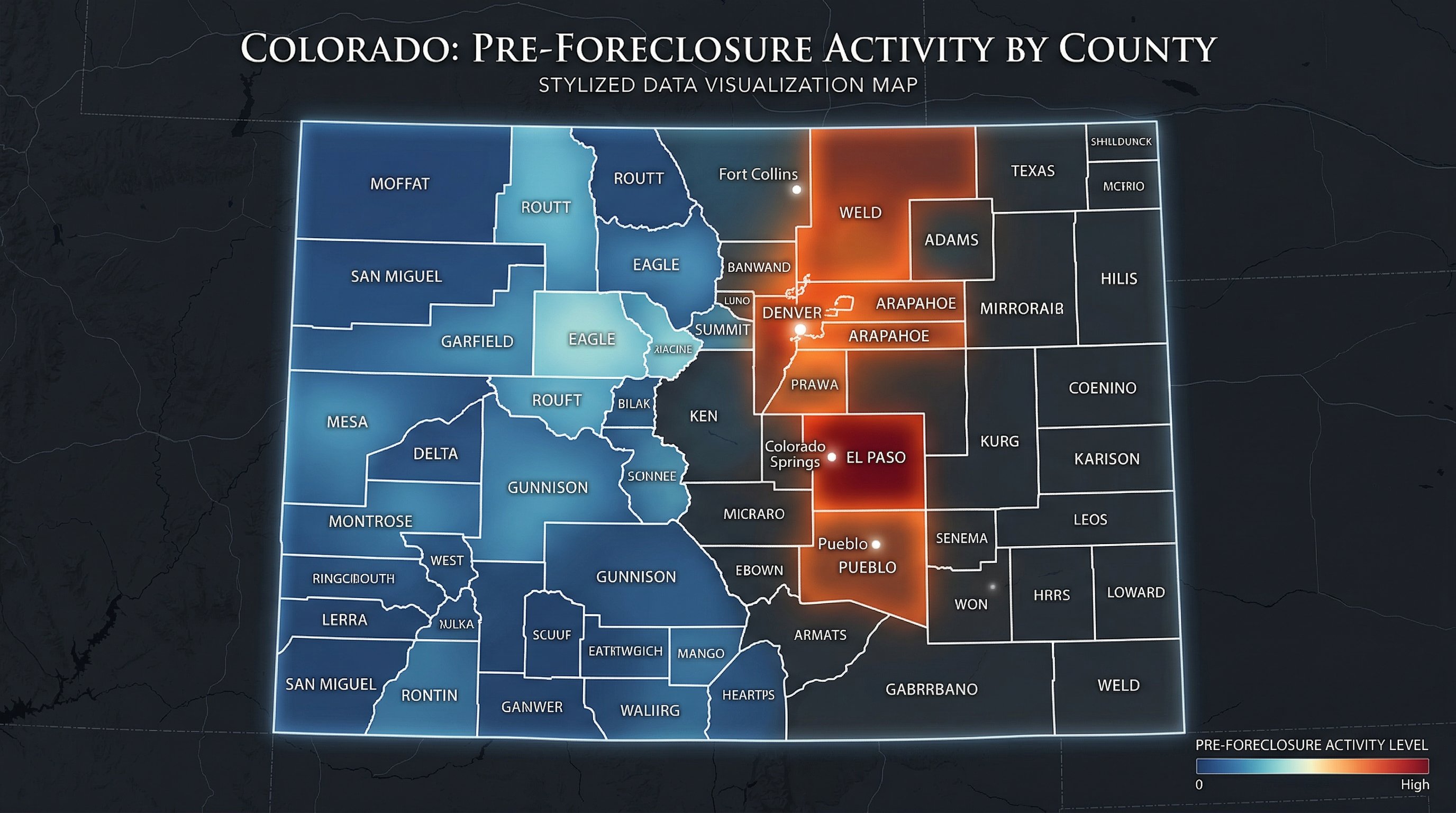
El Paso County (Colorado Springs) leads the state in pre-foreclosure volume. Over 3,500 active listings were tracked in early 2026, with filings running roughly 50 percent above the prior year. The county's military-heavy economy plays a role. Fort Carson, Peterson Space Force Base, Schriever SFB, and NORAD all sit in or near Colorado Springs. VA loans dominate the market, and Permanent Change of Station orders sometimes leave homeowners unable to sell fast enough to avoid default. The gap between what is owed and what the market will bear creates motivated seller situations that investors can help resolve.
Pueblo County consistently posts a high foreclosure rate relative to its population. Pueblo's median home price trails the rest of the Front Range by a wide margin, which limits refinancing options when borrowers fall behind. Nearly 2,000 pre-foreclosure listings were tracked in early 2026.
Weld County (Greeley area) carried over 1,600 pre-foreclosure listings. Weld's agricultural base and oil and gas exposure create cyclical distress that tracks commodity prices. The county is also absorbing spillover growth from the Denver metro, which adds housing stock and, with it, more loan defaults.
Arapahoe County (Aurora, Centennial) had more than 1,100 active listings. Higher home values mean many of these properties carry meaningful equity, and sellers often prefer a fast private sale over a foreclosure auction that wipes out their position.
Adams County (Aurora, Thornton, Commerce City) saw just over 1,000 listings. Dense population, competitive pricing, and an active investor community make it one of the faster-moving markets.
Denver County held around 900 listings. Strict regulation and strong tenant protections complicate some strategies, but high property values create equity-rich pre-foreclosures where homeowners want out without losing everything.
Jefferson County (Lakewood, Arvada, Golden) carried approximately 770 listings. Strong resale values and a deep buyer pool make this a solid middle market.
Mesa County (Grand Junction) logged over 820 listings despite its position on the Western Slope. Investor competition is thinner there than along the Front Range, making it an overlooked opportunity for investors willing to work outside the metro corridor.
Sourcing NED Filings Across 64 Counties
The NED becomes public record the moment the county clerk records it. That is the good news. The challenge is that Colorado has 64 counties, each with a different system for publishing the data.
El Paso County's Public Trustee publishes a weekly NED list through its online records portal, including property address, borrower name, original loan amount, and scheduled sale date. Denver's Public Trustee website posts NED recordings and scheduled sales with relatively consistent digital access. Weld and Adams counties make filings available through their county recorder systems, though formatting varies and regular monitoring is required to catch new filings promptly.
Rural counties often publish through legal notice sections of local newspapers rather than digital portals. The time lag between filing and online availability varies widely. Some smaller counties still rely on physical filings at the Public Trustee's office.
Manually monitoring 64 separate county systems on different schedules and in different formats is a full-time research job. That is why most serious investors in Colorado use a platform that aggregates county-direct NED data statewide, updates it daily, and cross-references it against other distress signals to surface the leads with the highest motivation.
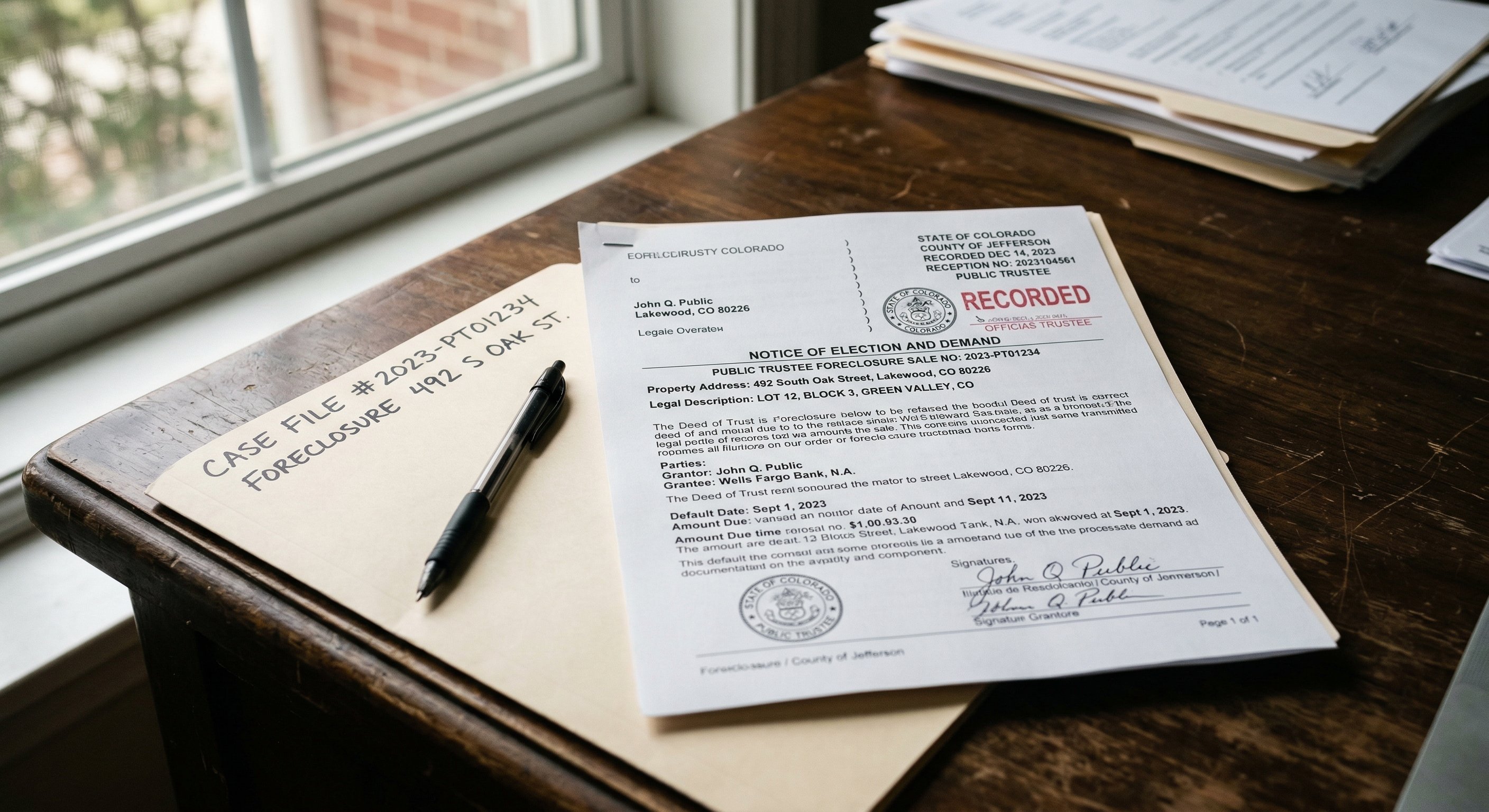
DistressIQ pulls NED-based pre-foreclosure data directly from county sources across all 64 Colorado counties, updated daily. Each lead is scored against 20 or more signal types. A property with a recent NED filing, a concurrent tax delinquency, and an absentee owner address scores very differently from one with a clean tax record and an owner-occupant. That scoring gap tells investors who to call first and who to skip.
Free Weekly Alerts
See What's Distressed in Your Market
Get free weekly alerts — new distressed properties, motivation scores, and hot neighborhoods in your area. Addresses and contact info available inside DistressIQ.
Free forever · No credit card · Unsubscribe anytime
Frequently Asked Questions
What is a Notice of Election and Demand in Colorado?
A Notice of Election and Demand (NED) is the document that initiates a non-judicial foreclosure in Colorado. The lender's attorney files it with the county Public Trustee, who records it with the clerk and recorder. Once recorded, the NED sets the sale date at 110 to 125 calendar days out for residential properties. The NED is distinct from a lis pendens, which is the filing used in judicial foreclosure states. In Colorado, tracking NED filings rather than court filings is the correct approach for identifying pre-foreclosure opportunities. The NED is public record upon recording and includes the property address, borrower name, original loan amount, and scheduled sale date.
How long does the pre-foreclosure period last in Colorado?
The standard pre-foreclosure window in Colorado runs 110 to 125 calendar days from the NED recording date to the Public Trustee sale. Homeowners can file a Notice of Intent to Cure up to 15 days before the sale and pay the full cure amount by noon the day before the auction. Agricultural properties receive a longer period of 215 to 230 days. For investors, the most productive outreach window falls within the first 60 to 90 days after NED recording, when homeowners still have multiple options available and the timeline pressure has not yet peaked. After the 90-day mark, cure options narrow and the homeowner's choices become more constrained.
Which Colorado counties have the most pre-foreclosure activity?
El Paso County (Colorado Springs) leads the state with over 3,500 active pre-foreclosure listings in early 2026, driven in part by a military-heavy economy where VA loan defaults and PCS orders create recurring distress. Pueblo County follows with approximately 2,000 listings, reflecting its lower median home prices and limited refinancing options. Weld County (Greeley) carries over 1,600 listings tied to agricultural and energy sector cycles. The Denver metro counties of Arapahoe, Adams, Denver, and Jefferson collectively account for thousands more. Mesa County (Grand Junction) on the Western Slope offers over 820 listings with significantly less investor competition than the Front Range markets.
Is Colorado a judicial or non-judicial foreclosure state?
Colorado operates primarily as a non-judicial foreclosure state, but with a unique twist. The process is administered by county Public Trustees rather than private trustee companies or courts. The only court involvement is a brief Rule 120 hearing, held at least 16 days before the scheduled sale, where the lender obtains an Order Authorizing Sale. This hearing confirms the lender's right to foreclose but is not a full litigation proceeding. Homeowners can challenge the foreclosure through separate legal action if they have grounds, such as procedural errors or disputed loan terms, but this is uncommon in standard mortgage defaults. The Public Trustee system is found only in Colorado and makes the state's foreclosure process structurally different from every other state.
What is the Rule 120 hearing in Colorado foreclosure?
The Rule 120 hearing is a Colorado-specific court proceeding that takes place before a non-judicial foreclosure sale can proceed. Named after Colorado Rule of Civil Procedure 120, it requires the lender to appear before a judge and demonstrate that the borrower is in default and that the lender has the right to foreclose. The hearing is typically brief and occurs at least 16 days before the scheduled sale date. Homeowners can contest the foreclosure at this hearing if they have legitimate grounds, such as proof that the default has been cured, that the loan terms were misrepresented, or that the lender failed to follow proper notice procedures. If the judge issues the Order Authorizing Sale, the foreclosure proceeds to auction.
How can investors find NED filings in Colorado?
Each of Colorado's 64 counties publishes NED filings through its Public Trustee office and county clerk. El Paso County and Denver offer the most accessible digital portals with weekly updated lists. Weld and Adams counties provide access through county recorder systems, though the formatting is inconsistent. Rural counties often publish NEDs through legal notice sections in local newspapers, with variable digital availability and time lags. For investors covering multiple counties, manually monitoring all 64 systems is impractical. Platforms like DistressIQ aggregate county-direct NED data statewide, update daily, and cross-reference filings against tax delinquency, code violations, ownership status, and other signals so investors can prioritize outreach rather than spend hours on research.
DistressIQ tracks pre-foreclosure signals across all 64 Colorado counties, updated daily from county Public Trustee and recorder records. Browse Colorado distressed leads free at distressiq.ai to see which properties have stacked signals before spending on outreach.
The data behind this article
DistressIQ Monitors These Signals in Real Time
Pre-Foreclosures
NOD + NTS filings
Tax Delinquency
County treasurer records
Code Violations
Municipal inspection filings
Probate Filings
Superior Court records
Every lead is scored 0–100 for seller motivation based on signal type, duration, severity, and stacking. Nationwide coverage — every US county, updated daily.
Ready to find deals in your market?
See Live Distress Signals in Colorado
Stop calling dead leads. Every lead in DistressIQ is scored 0–100 for seller motivation, with verified contact info included. Browse the free tier to see what's active in your market right now.
Browse Free Leads — No Credit Card