Tax Delinquent Properties in Florida: How to Find and Buy Them in 2026
Tax Delinquent Properties in Florida: How to Find and Buy Them in 2026
TL;DR: Florida has one of the most investor-friendly tax delinquency systems in the country — tax lien certificates earn up to 18% interest and convert to tax deed auctions after just two years. The best counties for volume are Miami-Dade, Broward, Hillsborough, Palm Beach, and Orange. But raw delinquency lists aren't enough — properties stack other distress signals (lis pendens, code violations, probate filings) that reveal who's actually ready to sell versus who just forgot to pay. The investors getting deals today aren't working from static county lists. They're working leads ranked by multiple verified signals.

Florida has 8.4 million parcels. Roughly 3-5% go delinquent in any given year. That's potentially 250,000+ properties statewide where the owner stopped paying taxes — which means something went wrong financially, personally, or both.
That's a massive pool of motivated sellers. But here's the thing most investors miss: Florida's tax delinquency process is completely different from most states, and if you don't understand how it works, you'll waste months chasing leads that aren't investable — or miss the window when they are.
This is the guide that tells you how it actually works, which counties to target, and how to separate the hot leads from the noise.
How Florida's Tax Delinquency Process Works
Florida runs a tax lien certificate system, which is different from a tax deed state. Here's the sequence:
April 1: Property taxes become delinquent if not paid by the end of March.
May–June: The county holds a tax certificate sale — typically the first week of June for most Florida counties. Investors bid on the delinquent tax debt, effectively paying the county what the owner owes. The winning bid earns interest ranging from 0% to 18% annually (the investor who accepts the lowest interest rate wins).
Two-year hold: The certificate sits for a mandatory two-year redemption period. The owner can pay off the debt (plus your interest) and redeem their property. Most do — redemption rates run 90%+ in Florida. That's why tax lien investing in FL is mostly a yield play, not an acquisition strategy.
After two years: If the property isn't redeemed, the certificate holder can apply for a tax deed. The county schedules a public auction where the property sells to the highest bidder.
The investor opportunity is at this auction stage — and before it, when owners realize they're about to lose the property and become highly motivated to negotiate a direct sale.
Why Florida Tax Delinquent Leads Convert Better Than You Think
The two-year timeline seems long. But that two-year window is actually when distress peaks.
At month 18-20 post-delinquency, owners who didn't redeem early face a reality check: a tax deed application is coming. Some of them have been avoiding the problem, hoping it goes away. It doesn't. That's when phone calls get answered, offers get considered, and deals get made.
The other reason Florida delinquencies convert well: climate-related financial pressure. Florida has the highest homeowner insurance rates in the country — some coastal markets have seen premiums triple since 2021. Add that to unpaid taxes, and you've got a homeowner dealing with multiple financial obligations at once — often someone who would genuinely benefit from a clean sale.
A delinquent property in a flood zone with a recent insurance cancellation and a lis pendens filing? That's not a tired lead. That's a motivated seller who needs out.
Florida's Biggest Counties for Tax Delinquent Properties
Volume matters — you want to work markets with enough inventory to stay selective.
Miami-Dade County Florida's largest county with 2.8 million people. Highest raw delinquency volume in the state. Urban density means you'll see everything from neglected rental properties to inherited condos to vacant lots with code violations. The market is competitive, but the volume justifies the effort. Delinquency rates in some Zip codes run 6-8%.
Broward County (Fort Lauderdale) Dense suburban market directly north of Miami. Strong rental investment community. Delinquency patterns often track with absentee landlords who got overextended during the rate spike. Look for multi-family properties in the Hollywood, Pompano Beach, and Lauderhill corridors.
Hillsborough County (Tampa) Tampa's home county has seen dramatic population growth alongside a surge in distress signals. Pre-pandemic investors who stretched into speculative purchases are now showing up on delinquent rolls with lis pendens filings attached. The combination of a hot underlying market with stressed ownership makes this one of the best hunting grounds in the state right now.
Palm Beach County Higher-end market but don't dismiss it. Probate situations, divorce filings, and estate properties in Palm Beach go delinquent at lower absolute rates but at higher dollar values — fewer deals but potentially larger spreads.
Orange County (Orlando) Tourist-market dynamics create unusual delinquency patterns. Short-term rental properties that underperformed show up here frequently, often with unpaid taxes layered onto mortgage distress. The investor pool is large but so is the volume.
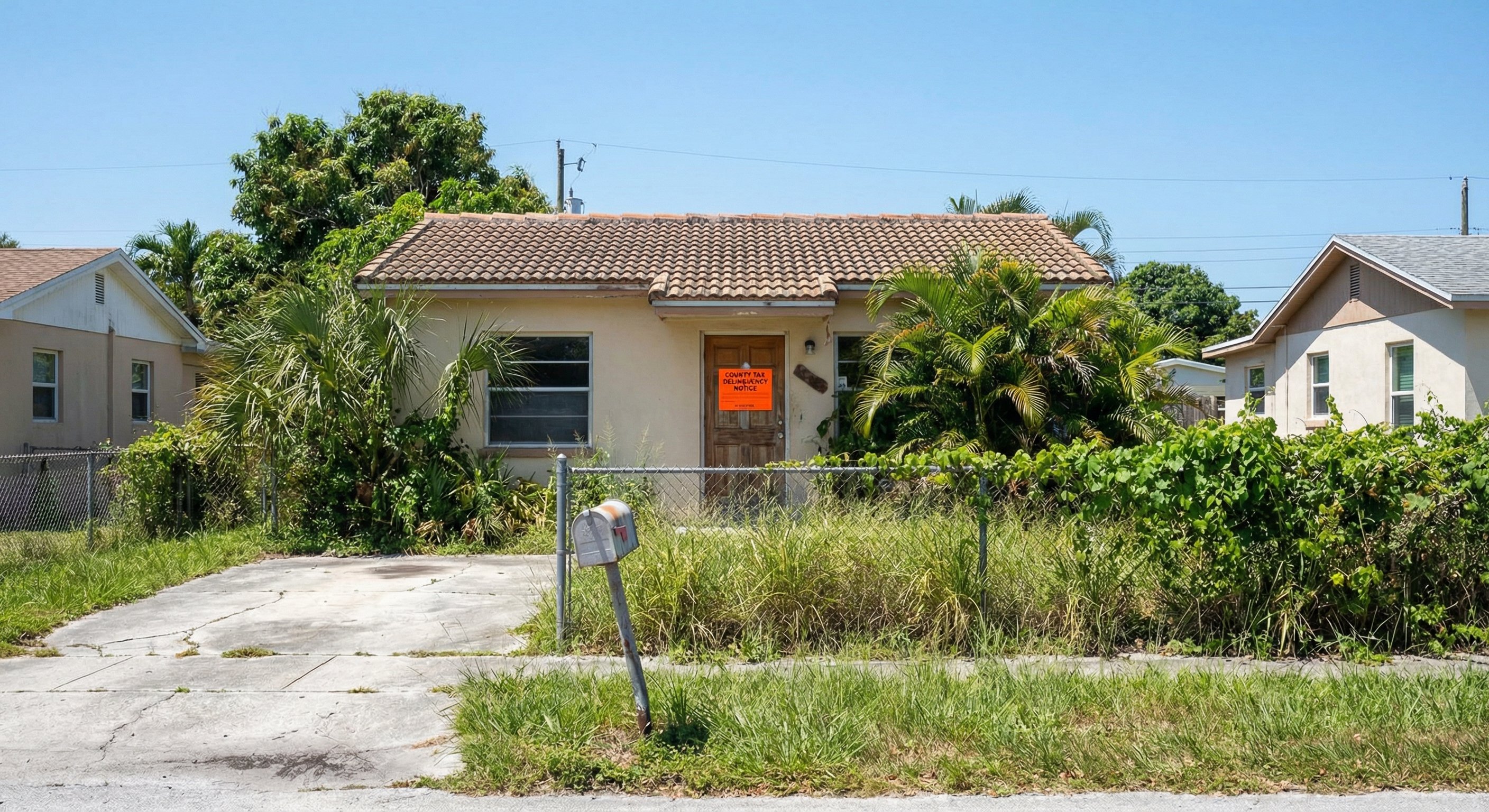
Other counties worth watching:
- Pinellas County (St. Pete) — Beach-adjacent market with aging housing stock and a high proportion of retired homeowners on fixed incomes who fall behind when insurance costs spike
- Duval County (Jacksonville) — Florida's largest city by area, lower prices but strong investor fundamentals, high delinquency volume in urban corridors
- Lee County (Fort Myers/Cape Coral) — Ian recovery has created a complex distress picture: insurance payouts resolved some situations, but unrepaired damage properties are showing up delinquent as owners exhaust resources
- Polk County — Lakeland area, high delinquency rates, affordable price points, solid for wholesalers targeting sub-$200K deals
- Volusia County (Daytona Beach) — High volume of absentee owners and vacation properties
Free Weekly Alerts
See What's Distressed in Your Market
Get free weekly alerts — new distressed properties, motivation scores, and hot neighborhoods in your area. Addresses and contact info available inside DistressIQ.
Free forever · No credit card · Unsubscribe anytime
What You WON'T Find on Florida's Public Delinquency Lists
Here's the problem with going straight to the county list: everyone else has the same list.
Florida is a sunshine state — public records are aggressively public. Every county publishes delinquency data. There are entire businesses built around reselling these lists. By the time you're mailing a postcard to a property on the county's delinquent roll, you're competing with every other investor, direct mail company, and list broker who pulled the same data.
The list tells you someone stopped paying taxes. It doesn't tell you:
- Is the owner actually ready to sell? Some people are late on taxes for a month before catching up. Others are 18 months deep with three other judgment liens attached.
- What's the underlying pressure? Tax delinquency alone converts differently than tax delinquency plus a recent probate filing plus a code violation plus a lis pendens. The stack matters.
- Is the property even investable? Some delinquent properties are underwater on their mortgage, in a flood zone with no active insurance, or structurally compromised — not worth pursuing regardless of the owner's motivation.
The investors who are closing deals in Florida's tax delinquency market aren't working raw county lists. They're working verified signals layered by multiple data points — and they're calling the properties ranked highest by probable motivation first.

The Florida Signals That Stack With Tax Delinquency
When a property appears on the delinquent tax roll AND has one or more of these additional signals, motivation probability multiplies:
Lis pendens filing — A lawsuit affecting the property title, often a foreclosure filing. Tax delinquency + lis pendens means the property is in danger from two directions. The owner can't easily sell without addressing both.
Probate filing — When a property enters probate, heirs sometimes stop paying taxes while the estate is being sorted out. Probate + delinquent taxes + out-of-state heirs is one of the most reliable high-motivation combinations in Florida.
Code violations — Florida municipalities are aggressive about code enforcement, especially in areas targeted for neighborhood revitalization. Multiple violations attached to a delinquent property often signal an owner who has checked out entirely.
Divorce filing — Court records show when a homeowner files for divorce. A property in a contested divorce plus tax delinquency means neither party wants to be responsible for maintenance, and both want out.
Absentee ownership — The mailing address differs from the property address. Absentee owners are 2-3x more likely to negotiate on price and timeline compared to owner-occupants.
When multiple signals hit on the same property, you're not looking at a lead — you're looking at a conversation that's likely to happen.
Finding Florida Tax Delinquent Properties: Your Practical Options
Option 1: Direct from county websites Every Florida county publishes delinquency data, but the format varies wildly. Miami-Dade has a decent online search. Polk County's interface is clunky. Lee County's export options are limited. You're looking at significant manual effort to pull and normalize data across multiple counties, and then you have to layer in all the other signals manually from court records, code enforcement portals, and property appraiser sites.
This approach works if you're focused on one county and have time to build the workflow. It doesn't scale.
Option 2: Data aggregators and list brokers Companies like ListSource or PropertyRadar will sell you a tax delinquent list. The data quality varies and the lists are being sold to many buyers simultaneously. You're getting the same commodity data as everyone else.
Option 3: Intelligence platforms with multi-signal data DistressIQ sources tax delinquency data directly from county records across 3,000+ US counties — updated daily, not batch-delivered quarterly. More importantly, it cross-references each delinquent property against 12+ other distress signals, scoring each lead 0-100 based on probable motivation.
Instead of calling through a list of 500 tax delinquent properties in Hillsborough County and hoping for callbacks, you start with the 50 properties scoring highest — the ones where delinquency stacks with lis pendens, probate, or code violations. Your skip trace budget goes further. Your outreach conversion rate goes up.
Florida Tax Delinquent Timeline: When to Move
The Florida tax cycle creates specific windows of maximum motivation:
November–February: Taxes are due in November with discounts for early payment (4% in November, 3% December, 2% January, 1% February). Most compliant owners pay during this window. Properties still delinquent after March are real signals.
April–May: The county prepares its delinquency roll. Pull lists here and you're getting genuinely delinquent owners — not just late payers who forgot.
Late spring (Year 1-2 post-delinquency): The sweet spot for direct outreach. Owners know a tax certificate has been sold against their property. The clock is ticking, but they still have time to act.
Month 18-24: Peak motivation window for owners approaching the tax deed application threshold. This is when the most distressed sellers are most receptive.
Understanding this cycle tells you which leads to prioritize based on where they are in the timeline — and why a lead that's been delinquent for 20 months is worth more of your time than one that missed its first payment two months ago.
Florida's Unique Complications
A few things specific to Florida that affect deal structure:
Homestead exemption — Florida's homestead protection is among the strongest in the US. A primary residence has significant legal protections, and homeowners who file for homestead exemption can't easily sell certain liens. This doesn't block deals, but it complicates your title research if the property has been homesteaded and owner-occupied.
Flood zone exposure — Coastal and inland Florida properties frequently carry FEMA flood zone designations (AE, VE, X-500). A delinquent property in a high-risk flood zone with lapsed flood insurance is a different calculation than the same property on high ground. Check flood zone designations before committing to skip trace.
Hurricane damage — Lee, Charlotte, and Collier counties have properties with post-hurricane damage that owners never repaired. What looks like a delinquent undervalued property may have structural damage not reflected in the assessor's value. Pull permit history before making offers in southwest Florida.
Tourist market volatility — In Osceola (Disney area), Walton, and Bay counties, short-term rental properties that went delinquent during travel disruptions now have owners whose financial picture has partially recovered with tourism rebound. These require more nuanced motivation assessment.
How DistressIQ Handles Florida's Complexity
The state-specific complications above are exactly why raw county lists underperform.
DistressIQ tracks all 67 Florida counties daily. Each delinquent property is cross-referenced against court filings (lis pendens, probate, divorce), code enforcement records, and assessor data — scored by the combined motivation pressure rather than any single signal.
The result: when you browse Florida tax delinquent leads on DistressIQ, you're looking at properties scored by the full picture. The score isn't just "this property is tax delinquent." It's "this property is tax delinquent, has a lis pendens filed, is absentee-owned, and has two open code violations" — distilled into a single priority number so you know which 50 to call from the list of 500.
Property details come from county tax assessor records — not MLS listings — so the square footage, year built, and assessed value reflect what the county actually measured, not what a seller's agent entered.
Conclusion
Florida's tax delinquency market is deep, it's genuinely public, and it's consistently generating deals for investors who work it right. The state's unique tax certificate system creates a predictable two-year window when sellers move from "ignoring the problem" to "willing to negotiate."
The investors converting leads in Miami-Dade, Hillsborough, and Broward aren't the ones with the biggest mailing budget. They're the ones who called the right 50 properties first — the ones stacking signals, not just scanning the county delinquent list.
Start with the signals that matter. DistressIQ pulls verified tax delinquency data across all 67 Florida counties, layered with lis pendens, probate, code violations, and 9 other distress signal types. Browse free — pay only when you want contact info. See Florida's distressed properties ranked by motivation.
Frequently Asked Questions
Q: Where can I find the official tax delinquent list in Florida?
Each of Florida's 67 counties publishes its own delinquency data. For Miami-Dade, check the Miami-Dade Tax Collector's website. For Hillsborough, visit the Hillsborough County Tax Collector portal. Most counties publish lists prior to the annual tax certificate sale, which typically occurs in late May or early June. For statewide coverage with additional signal data, platforms like DistressIQ aggregate all 67 counties in one searchable interface.
Q: How long does Florida take to go from delinquent taxes to tax deed?
Florida law requires a minimum two-year waiting period after a tax lien certificate is sold before the certificate holder can apply for a tax deed. In practice, with administrative processing time, properties rarely move to tax deed auction in under 2.5 years from initial delinquency. Owners can redeem their property (by paying the outstanding taxes plus interest) at any point before the tax deed is issued.
Q: What interest rate do Florida tax lien certificates earn?
Florida tax lien certificates earn between 0% and 18% annually. At the annual auction, investors bid down the interest rate — meaning the winning bidder accepts the lowest rate. In competitive counties like Miami-Dade, winning bids often come in near 0.25% to 2%. In less competitive counties, rates of 10-15% are still winnable. The statutory maximum is 18%.
Q: Can I buy a tax delinquent property directly from the owner in Florida?
Yes, and this is often more profitable than waiting for a tax deed auction. Once a tax certificate has been sold, many owners become aware they're at risk of losing their property. Proactive investors reach out during the redemption window — typically months 12-20 post-delinquency — when owners are motivated to negotiate a discounted sale in exchange for clearing their financial situation before a public auction occurs.
Q: Which Florida counties have the most tax delinquent properties?
By raw volume, Miami-Dade, Broward, Palm Beach, Hillsborough, and Orange counties generate the most delinquent properties annually due to population density. For percentage-of-parcels delinquent (a better measure of distress concentration), counties like Polk, Volusia, Putnam, Levy, and Highlands tend to rank higher. Rural and semi-rural counties often have proportionally more delinquency, though with smaller absolute deal volume.
Q: Does DistressIQ cover all Florida counties?
Yes — DistressIQ covers all 67 Florida counties. Tax delinquency data is sourced directly from county tax collectors and updated daily. Each property is cross-referenced against court records (lis pendens, probate, divorce filings) and code enforcement databases, then scored 0-100 by estimated seller motivation. Browsing is free — contact info is unlocked per lead.
The data behind this article
DistressIQ Monitors These Signals in Real Time
Pre-Foreclosures
NOD + NTS filings
Tax Delinquency
County treasurer records
Code Violations
Municipal inspection filings
Probate Filings
Superior Court records
Every lead is scored 0–100 for seller motivation based on signal type, duration, severity, and stacking. Nationwide coverage — every US county, updated daily.
Ready to find deals in your market?
See Live Distress Signals in Florida
Stop calling dead leads. Every lead in DistressIQ is scored 0–100 for seller motivation, with verified contact info included. Browse the free tier to see what's active in your market right now.
Browse Free Leads — No Credit Card