Tax Delinquent Properties in North Carolina: How to Find and Buy Them in 2026
Tax Delinquent Properties in North Carolina: How to Find and Buy Them in 2026
TL;DR: North Carolina's tax delinquent market is genuinely unique — the state's "upset bid" system means the highest bid at auction isn't necessarily the winning bid, giving savvy investors a 10-day window to top any sale. The largest opportunity is in Mecklenburg, Wake, and Guilford counties, but the real edge comes from layering tax delinquency with other distress signals (probate, lis pendens, code violations) to find properties where the seller has multiple reasons to resolve quickly. This guide covers how NC tax sales work, what the upset bid process means for your strategy, and how to build a pipeline across the state's most active counties.
Most investors working NC tax delinquent leads are playing the same game: pull a list from the county, mail it with everyone else, wait for callbacks that mostly don't come. The investors consistently closing deals in North Carolina are doing something different — and it starts with understanding why tax delinquency alone is rarely enough.
How North Carolina Tax Delinquency Actually Works
North Carolina counties use two primary legal mechanisms to recover unpaid property taxes: judicial tax foreclosure and in rem tax foreclosure. Most counties lean heavily on judicial foreclosure, which moves through the court system and can take 12–18 months from filing to sale. In rem (also called "tax deed") foreclosures are faster — typically 6–9 months — and used by counties processing high volumes of delinquent properties.
The timeline matters to investors. A property that just hit the delinquent rolls is not the same opportunity as one that's been delinquent for 18 months with a foreclosure action already filed. Recency and legal stage both predict urgency.
The Upset Bid Process: North Carolina's Wildcard
Here's what competitors writing about NC tax sales almost always gloss over: North Carolina has a 10-day upset bid period after every tax sale.
After the initial auction, any party can submit a higher bid within 10 days — increasing the last bid by at least 5% or $750, whichever is greater. After each new bid, the 10-day clock resets. The property doesn't officially transfer until 10 full days pass with no new bids.
What this means for investors:
- You don't have to win the auction. You can watch, then upset bid on properties that went under your target price.
- You can get upset bid yourself. Build this into your pricing — don't bid your maximum at auction.
- Most casual bidders don't know this rule. They assume they won. Then you upset them at Day 9.
The upset bid window creates a second market that sits entirely outside the auction room. Experienced investors use it deliberately.
North Carolina's Tax Sale Landscape by County
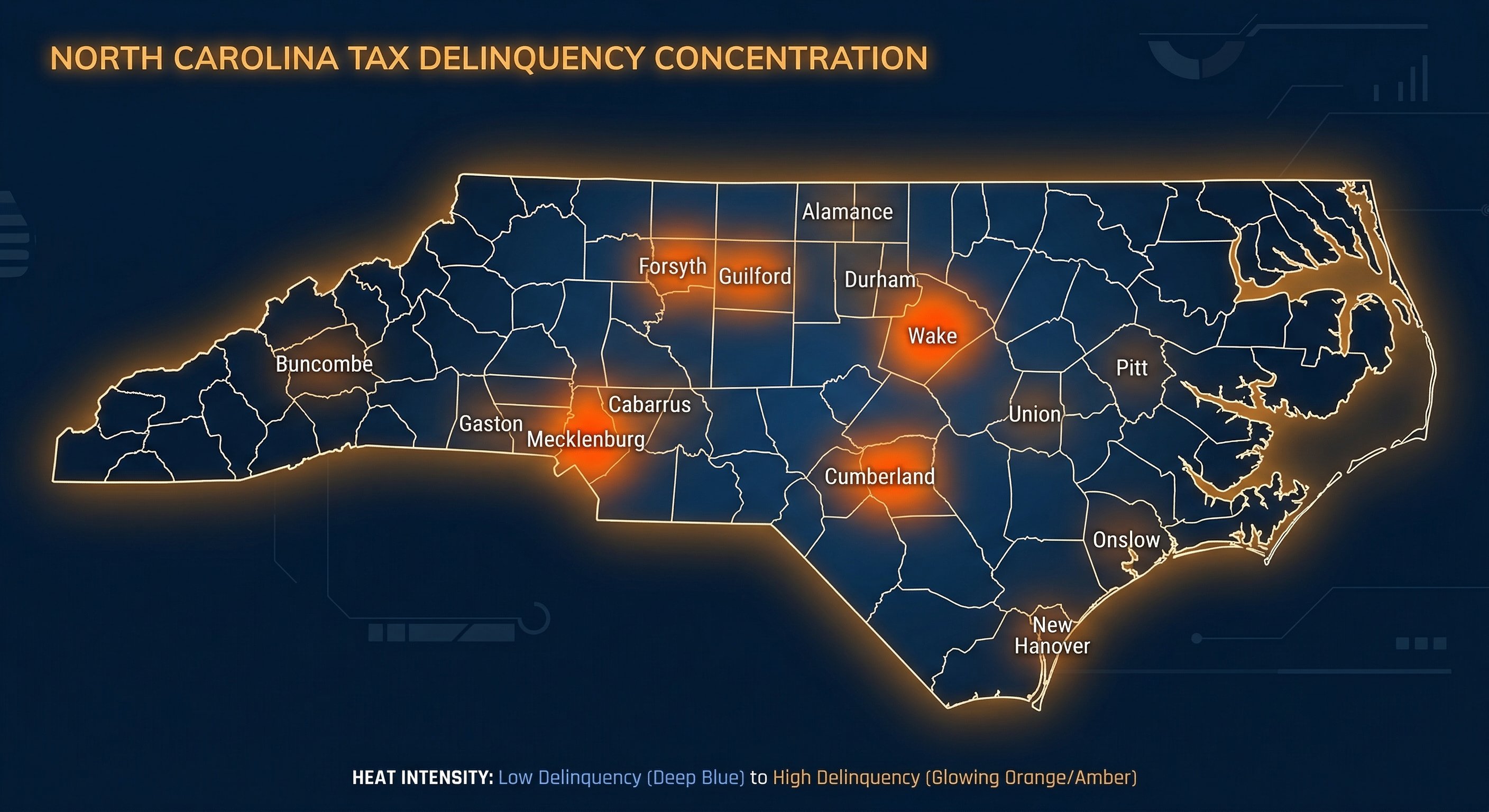
North Carolina has 100 counties. Most have minimal auction volume. The opportunity concentrates in a handful of high-growth, high-turnover markets.
Mecklenburg County (Charlotte)
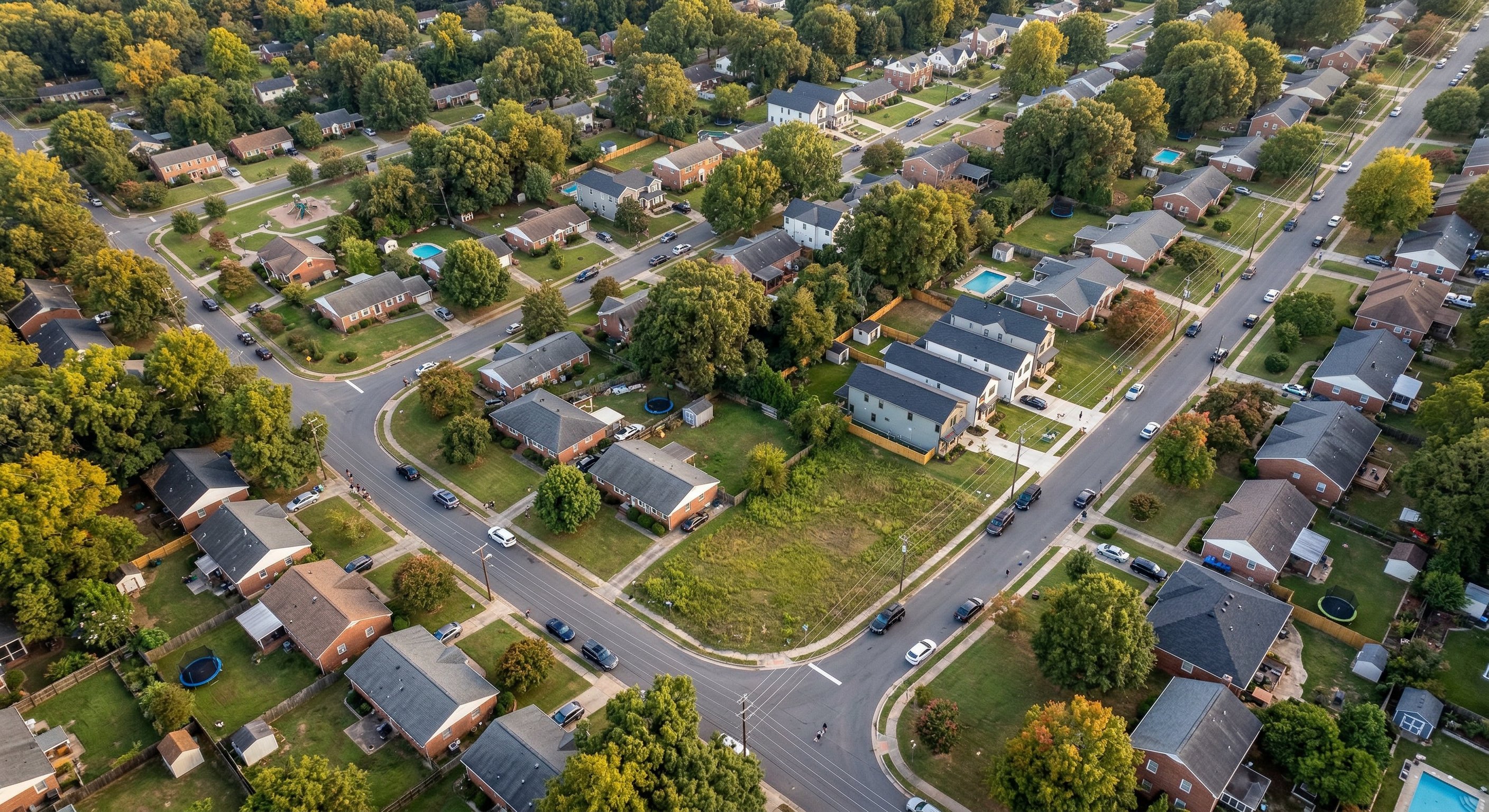
The largest county by population with 1.1M+ residents and one of the fastest-growing metros in the Southeast. Mecklenburg runs judicial foreclosures and lists properties on its county website and through online platforms. The Charlotte metro's rapid appreciation means delinquent owners sometimes don't realize their distressed property has significant equity — creating both negotiated and contested sale scenarios.
Watch: West Charlotte corridors (Beatties Ford, Brookshire, West Boulevard) have historically high concentrations of tax delinquency with strong ARV upside. East Charlotte (near the airport expansion corridor) is an emerging play.
Wake County (Raleigh/Cary)
Wake County is North Carolina's second-largest market and arguably its hottest for real estate overall. Tax delinquency volume is lower relative to Mecklenburg, but quality tends to be higher — properties here carry more equity and the owner demographics skew toward out-of-state investors who've stopped managing, not families in hardship.
Watch: East Raleigh and South Raleigh pockets with older housing stock see the most consistent tax delinquency. Cary's volume is minimal (high household income = low delinquency).
Guilford County (Greensboro/High Point)
One of the state's most investor-friendly counties for tax delinquent strategy. Guilford has a large inventory, lower price points than Charlotte or Raleigh, and significant numbers of absentee landlords who've abandoned their management responsibilities. High Point specifically has dense pockets of delinquency in neighborhoods transitioning from industrial to residential use.
Durham County
A smaller market but high-value. Durham's Bull City real estate boom has created a dynamic where some owners bought during the down cycle and now owe back taxes on properties worth 3–4x what they paid. The delinquency-to-equity ratio is unusually favorable.
Cumberland County (Fayetteville)
Military-adjacent market with high turnover from active-duty families PCSing out. Absentee ownership rates are high, delinquency volume is steady, and purchase prices are the lowest of any major NC metro — making it a strong buy-and-hold play.
Forsyth County (Winston-Salem)
Solid secondary market with consistent delinquency inventory. Winston-Salem has a stabilizing medical and university employer base but persistent pockets of distress in older west-side and northeast neighborhoods.
Why Tax Delinquency Alone Is Usually Not Enough
Pull a raw tax delinquent list in any NC county and you'll find properties at every stage of motivation:
- Owners who just forgot to pay and will catch up next week
- Owners under financial pressure but months from resolution
- Owners who are genuinely motivated to exit — right now
The list doesn't tell you which is which. That's the core problem with single-signal lead generation.
Tax delinquency has an average distress-to-motivation conversion rate. But when you stack it with additional signals, you start isolating the right tier:
Tax delinquent + probate filing: An heir who inherited a property they don't want, can't afford, and haven't managed is under simultaneous financial and legal pressure. These leads convert at significantly higher rates than tax delinquency alone.
Tax delinquent + lis pendens: A lis pendens means a legal action is pending against the property. When combined with tax delinquency, you're looking at an owner facing the courthouse from two directions. Urgency is real.
Tax delinquent + code violations: Multiple code violations on a delinquent property signal neglect and abandonment — the owner has checked out. Physical condition and financial pressure together create motivated sellers who want a simple exit.
Tax delinquent + extended duration (18+ months): Time matters. A property 3 months delinquent is not the same as one with a 24-month delinquency history. Longer duration = less likely to be a simple administrative oversight.
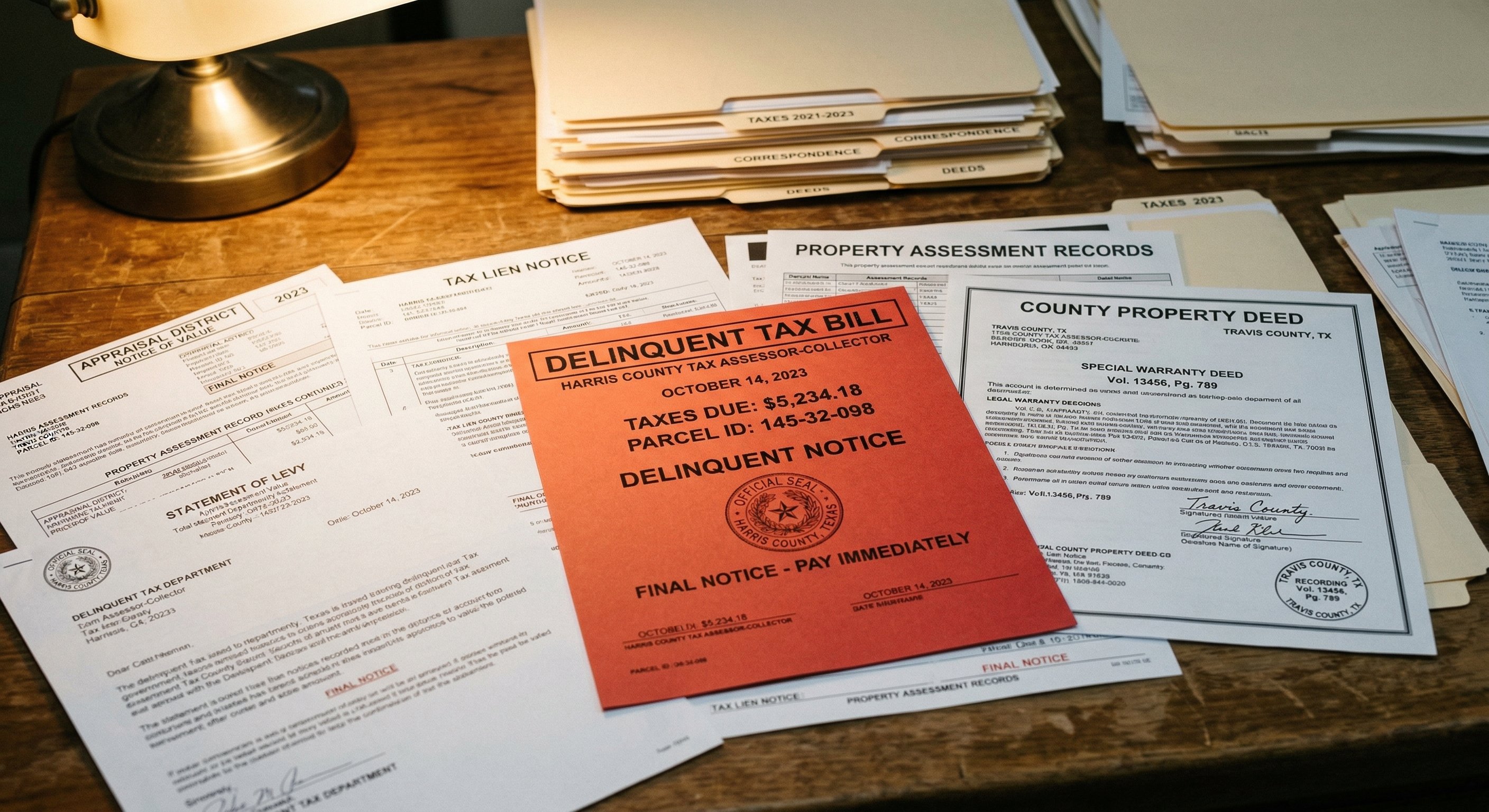
The difference between investors who consistently find deals in NC and those who blow their marketing budget on non-responsive lists isn't hustle — it's the quality of the filter before the first dollar of outreach gets spent.
DistressIQ tracks tax delinquency across every NC county, updated daily from county records, and cross-references it against probate filings, lis pendens, code violations, and 17+ other distress signals. Every lead gets a motivation score (0–100) so you know who to call first — not just that they owe back taxes.
Browse tax delinquent leads in North Carolina, scored by motivation — free on DistressIQ →
Free Weekly Alerts
See What's Distressed in Your Market
Get free weekly alerts — new distressed properties, motivation scores, and hot neighborhoods in your area. Addresses and contact info available inside DistressIQ.
Free forever · No credit card · Unsubscribe anytime
How to Access NC Tax Delinquent Lists Manually
If you want to build your own list before using a platform, here's the manual process — and why it's painful.
Mecklenburg County: Tax delinquent data is available through the county tax office website. You can request a delinquent roll, but it's provided as a PDF or spreadsheet without property details baked in. You'll cross-reference assessor data in a separate system to get ownership and property info.
Wake County: Online search via the county Revenue Department. Delinquent status is searchable property-by-property, not bulk-downloadable without a formal public records request (which takes 1–3 business days to process).
Guilford County: Similar to Wake — individual property lookup is available; bulk extraction requires a formal records request. Some investors contract directly with title companies to run quarterly pulls.
The pattern across all 100 NC counties: Data is public, but not unified. Every county has its own system, its own format, its own update cadence. Some post weekly. Some monthly. Some require an in-person request to the county clerk's window.
Investors working NC manually are typically running 5–6 browser tabs per county, reconciling incompatible formats, and manually deduplicating records that show up in multiple systems. Per-lead research time runs 10–20 minutes before the first skip trace. Across a 100-property list, that's a full week of administrative work before a single call gets made.
The Outreach Equation: Approaching Distressed Property Owners Respectfully
This matters more than most investor content acknowledges: many NC tax delinquent property owners are in genuine financial difficulty. Some are elderly homeowners on fixed incomes who fell behind. Some are heirs who inherited a property they can't afford to maintain. Some are recent job losses or health crises.
How you approach them determines both your deal rate and your reputation.
What actually works:
- Lead with empathy, not urgency. "I noticed the property at [address] has some code issues and I was wondering if you've had a chance to think about what you want to do with it" lands differently than "I hear you owe back taxes and need to sell fast."
- Offer information first. If you know the upset bid timeline or the foreclosure court date, sharing that context positions you as someone trying to help them understand their options — not someone trying to exploit a deadline.
- Be clear about what you offer: a fast, certain close, cash, as-is, no repairs required. For owners who want the process handled cleanly, that's a real solution.
Investors who build a reputation for fair dealing in a specific NC market get referrals from attorneys, title companies, and even county staff. That's a long-term advantage that outperforms any list strategy.
Building a NC Tax Delinquent Pipeline: A Practical Approach
The investors consistently closing NC tax delinquent deals aren't buying a list and blasting postcards. They're running a pipeline with defined stages:
1. Filter by signal stack, not just delinquency. Start with properties showing 2+ distress signals. Tax delinquent alone gets you a list. Tax delinquent + probate + code violations gets you a pipeline.
2. Prioritize by motivation score and delinquency duration. A property with an 18-month delinquency history, an active probate filing, and three code violations is fundamentally different from one that's 60 days delinquent. Work the high-score leads first.
3. Check the upset bid calendar. Properties already in the auction pipeline have a forced timeline. If you're in the game anyway, knowing when the upset bid period opens and closes lets you work negotiations with a real deadline.
4. Run skip traces on the top tier only. Don't burn contact credits on the full list. Skip trace the top 20–30% by motivation score. Your contact rate will be higher and your cost-per-deal will drop significantly.
5. Segment outreach by signal type. Tax delinquent + probate owners get empathy-forward messaging about navigating an inherited property. Tax delinquent + lis pendens owners get urgency-forward messaging about their options before the court date. Different signals warrant different conversations.
6. Build county-specific knowledge. Knowing that Guilford County posts new delinquency rolls the first Tuesday of each month — and that motivated sellers in High Point tend to respond better to direct mail than cold calls — is the kind of operational detail that comes from market repetition, not a generic lead list.
What DistressIQ Tracks in North Carolina
DistressIQ sources property data from county records across all 100 NC counties, updated daily. Every lead shows:
- Distress signals — tax delinquency, lis pendens, probate filings, code violations, pre-foreclosure status, and more
- Motivation score (0–100) — stacks all active signals into a single priority ranking
- Assessor-verified property data — where available, property details from county tax assessor records (the legal source, not MLS estimates)
- Street View & aerial imagery — see the property's condition before you ever pick up the phone
- Owner contact unlocking — skip trace on demand, only pay when you need the contact
Browsing is free. You see the signals, the location, the score. You only pay when you unlock the contact to make the call.
Browse NC tax delinquent properties on DistressIQ — free, scored, and updated daily →
Frequently Asked Questions
How does North Carolina's tax sale process work?
North Carolina counties use two methods: judicial foreclosure (through the court system, typically 12–18 months) and in rem foreclosure (faster, 6–9 months). After any tax sale, North Carolina law provides a 10-day "upset bid" period during which anyone can submit a higher bid — increasing the last bid by at least 5% or $750. The upset bid window resets with each new bid. Properties don't transfer until 10 full days pass with no new bids.
Which North Carolina counties have the most tax delinquent properties?
Mecklenburg (Charlotte), Wake (Raleigh), Guilford (Greensboro/High Point), and Cumberland (Fayetteville) have the highest volumes. Forsyth (Winston-Salem) and Durham also have consistent delinquency inventory. High Point in Guilford County is particularly active for investors targeting lower price points.
Can I get a free tax delinquent property list in North Carolina?
Yes — tax delinquency data is public record in NC. Individual counties post delinquent rolls on their tax office websites, though formats vary widely. Bulk extraction typically requires a formal public records request, which can take 1–3 business days. The data will be raw property/ownership info without distress signal cross-referencing or motivation scoring.
How long can a property be tax delinquent in North Carolina before it goes to sale?
NC allows counties to begin the foreclosure process once taxes are more than 30 days past due (January 6 is the official delinquency date for prior-year taxes). In practice, most counties begin foreclosure proceedings after 2+ years of delinquency, though this varies. Judicial foreclosures can take an additional 12–18 months to reach auction after filing.
Is tax delinquent investing in NC competitive?
Competition varies significantly by county and price tier. Charlotte and Raleigh metros attract national investors and competition at auction can be intense, particularly since many sales moved online. Smaller counties (Guilford, Cumberland, Forsyth) have less institutional competition and more room for direct-to-owner negotiation before properties reach auction. Stacking signals to find multi-distress properties before they go to auction is where the real edge lives.
What's the difference between a tax lien state and a tax deed state?
North Carolina is a tax deed state — meaning the county forecloses and conveys the actual property, not just a lien certificate. You get ownership, not a lien you need to eventually convert to ownership. This is generally simpler for investors but means the process moves faster and you need to act earlier in the timeline.
The data behind this article
DistressIQ Monitors These Signals in Real Time
Pre-Foreclosures
NOD + NTS filings
Tax Delinquency
County treasurer records
Code Violations
Municipal inspection filings
Probate Filings
Superior Court records
Every lead is scored 0–100 for seller motivation based on signal type, duration, severity, and stacking. Nationwide coverage — every US county, updated daily.
Ready to find deals in your market?
See Live Distress Signals in North Carolina
Stop calling dead leads. Every lead in DistressIQ is scored 0–100 for seller motivation, with verified contact info included. Browse the free tier to see what's active in your market right now.
Browse Free Leads — No Credit Card