Tax Delinquent Properties in Georgia: How to Find and Buy Them in 2026
Tax Delinquent Properties in Georgia: How to Find and Buy Them in 2026
TL;DR: Georgia is a hybrid state — counties can issue tax liens (certificates) OR conduct tax deed sales depending on local policy, which creates two distinct investor paths. The strongest opportunities are in Atlanta-metro counties (Fulton, DeKalb, Gwinnett, Cobb) where transaction volume is high and motivated sellers surface months before any public auction. Properties with stacked distress signals — tax delinquency plus a lis pendens or code violation — convert at far higher rates than single-signal lists. DistressIQ tracks tax-delinquent leads across all 159 Georgia counties, scored by motivation so you know who to call first.
Georgia has nearly 159 counties, 10.8 million residents, and one of the most active investor markets in the Southeast. It also has a property tax delinquency process that most out-of-state investors get wrong — because Georgia doesn't fit neatly into the "lien state" or "deed state" box.
That ambiguity is your edge, if you understand it.
How Georgia's Tax Delinquency System Actually Works
Georgia is technically a tax deed state — when a county can't collect delinquent taxes, it conducts a tax deed sale where the winning bidder takes title outright. But the execution varies dramatically by county, and Georgia law also allows counties to issue tax lien certificates before proceeding to deed sale.
Here's the typical Georgia timeline:
Year 1 — Delinquency begins. Property taxes are due by December 31. If unpaid, the county tax commissioner marks the property delinquent.
Year 1-2 — Demand and levy. The county issues a tax execution (called a Fi.Fa., short for fieri facias) — a legal judgment recorded in the deed records. This is the moment the distress signal appears. At this stage, the owner can still pay and redeem.
Year 2-3 — Tax sale. If the debt isn't paid, the county sheriff (or tax commissioner) schedules a public tax sale — typically held the first Tuesday of the month at the county courthouse. The winning bidder receives a Sheriff's Deed (or Tax Deed), but this deed is NOT clear title. The original owner has a 12-month right of redemption to reclaim the property by paying the back taxes, penalties, and a 20% premium on the purchase price.
Year 4+ — Barring the right of redemption. After the 12-month period, the tax deed holder can file a Quiet Title Action to extinguish the owner's redemption rights and obtain clear, insurable title. This is the expensive and time-consuming step — quiet title in Georgia can take 6-12 months and cost $3,000-8,000+ in legal fees.
What this means for investors: Most buyers at Georgia tax sales are not looking to flip properties quickly. The 12-month redemption period and quiet title requirement make the traditional tax sale investment a 2-3 year play. The better strategy is contacting owners BEFORE the sale — when they're motivated to sell but still have equity and legal title to transfer cleanly.
Why Pre-Sale Contact Is Where the Real Deals Are
The moment a Fi.Fa. is recorded, a motivated seller profile emerges. This owner:
- Owes back taxes (often 2-4 years of delinquency by the time you find them)
- Is being charged interest and penalties (18% per year in Georgia)
- Has a public legal record of financial distress
- Faces a forced public auction with potential equity destruction
That's not a cold lead. That's someone who may genuinely need an exit. Your job is to reach them before:
- They pay off the debt (happens more than you'd expect — a tax bill reminder often motivates payment)
- Another investor calls them
- The county holds the sale and they lose all equity
The window is narrow. The seller's motivation is high. The competition is whoever else pulled the same delinquent tax list this month.
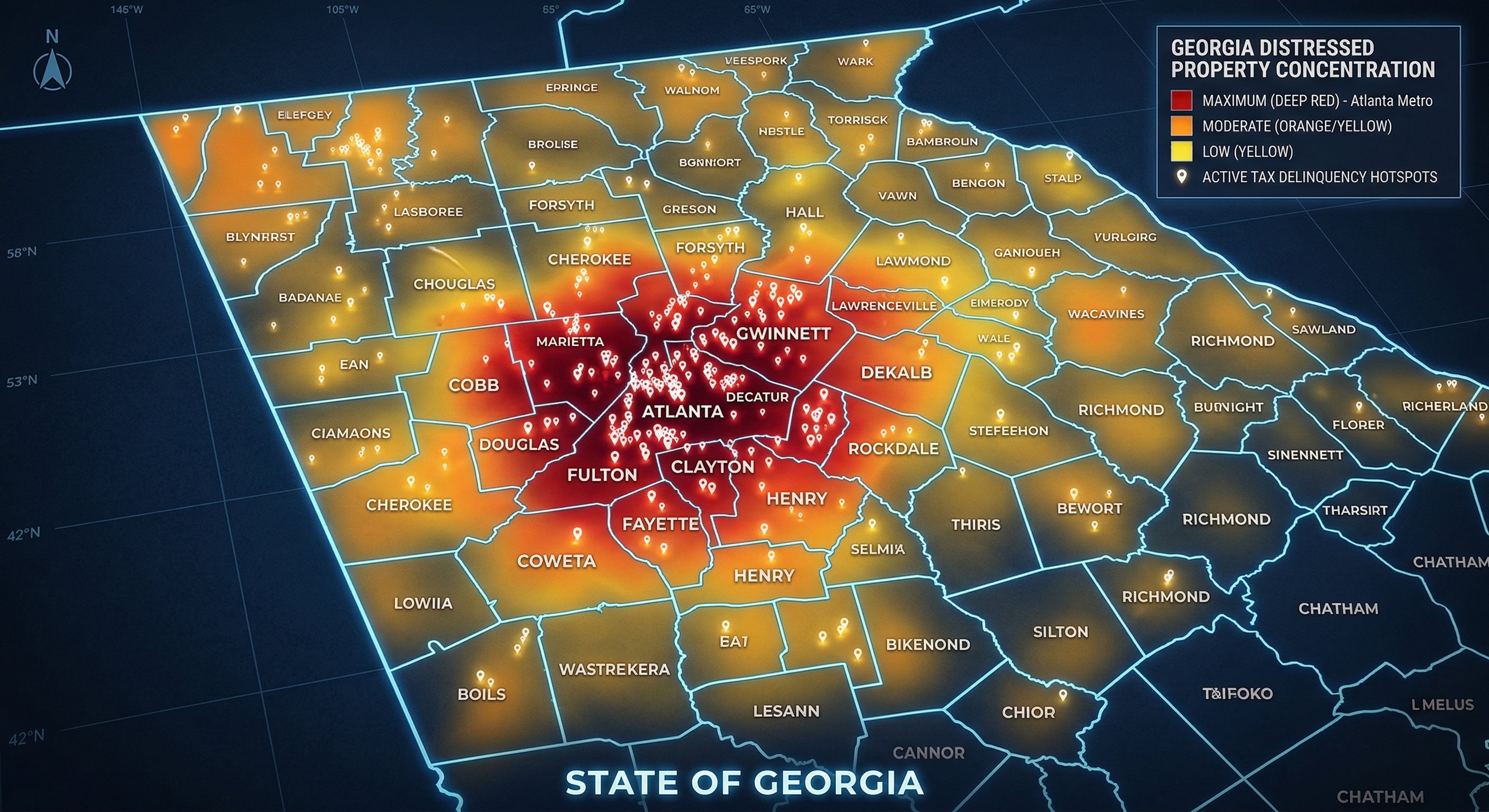
Which Georgia Counties Have the Most Tax Delinquent Leads
Georgia's 159 counties span from dense urban core to rural agricultural land. For investors, the volume and deal velocity concentrate heavily in metro Atlanta — but secondary markets are often underserved.
Tier 1 — Highest volume, most competitive:
- Fulton County — Atlanta's core county. Highest absolute number of tax delinquencies, massive transaction volume, but also the most investor competition.
- DeKalb County — East Atlanta suburbs (Decatur, Tucker, Stone Mountain). Strong distress volume, slightly less competition than Fulton.
- Gwinnett County — Northeast Atlanta suburbs. One of the fastest-growing counties in Georgia, large housing stock, active tax sale calendar.
- Cobb County — Northwest suburbs (Marietta, Smyrna, Kennesaw). High owner-occupancy rate means motivated sellers who actually need an exit.
Tier 2 — Strong markets, less investor saturation:
- Clayton County — South Atlanta suburbs (Jonesboro, Forest Park). High distress rates, lower median prices, faster deal cycles.
- Henry County — Southeast metro (McDonough, Stockbridge). Growing fast, high homeownership, good inventory.
- Forsyth County — North Atlanta suburbs. Wealthier, but large housing stock means occasional motivated sellers at good equity levels.
- Chatham County — Savannah metro. Second-largest market in Georgia, active investor community but less crowded than Atlanta.
Tier 3 — Smaller markets, but less competition:
- Richmond County (Augusta) — Solid rental market, predictable distress volume, lower acquisition costs.
- Muscogee County (Columbus) — Military-heavy market, steady transaction volume.
- Bibb County (Macon) — Mid-Georgia hub, moderate distress inventory.
For most investors, the Atlanta metro counties are where you start — volume is high and deal velocity is fast. Once you've built a system for Fulton and DeKalb, the secondary markets become interesting for lower-competition opportunities.
Free Weekly Alerts
See What's Distressed in Your Market
Get free weekly alerts — new distressed properties, motivation scores, and hot neighborhoods in your area. Addresses and contact info available inside DistressIQ.
Free forever · No credit card · Unsubscribe anytime
Finding Georgia Tax Delinquent Property Records Manually
If you want to source this data yourself, here's what you're dealing with.
County Tax Commissioner websites. Each of Georgia's 159 counties maintains its own system. Most publish delinquency lists — but the format, accessibility, and update frequency are all different. Fulton County posts pending tax sales online. Gwinnett has an online property tax search. But many rural counties still require you to visit in person or call the office.
Georgia Superior Court records. Fi.Fa. executions are recorded with the county clerk as public documents. You can search these through Georgia's Clerk of Courts online portal (https://www.gsccca.org/), which has decent coverage — but cross-referencing Fi.Fa. records against property addresses requires additional work.
Courthouse steps lists. Counties publish upcoming tax sale lists, typically 4 weeks in advance, in the legal organ (official newspaper) for that county. Finding and parsing these lists for 159 counties, every month, is significant work.
The logistics cascade quickly: 159 counties, each with different systems and formats, publishing on different schedules. Even limiting yourself to the top 20 metro counties, you're looking at several hours per month just to compile a current list — before you've done any analysis, filtering, or outreach.

The Signal-Stacking Advantage in Georgia
Tax delinquency alone tells you an owner is financially distressed. But it doesn't tell you how motivated they are to sell right now.
An owner who's 18 months behind on taxes might be negotiating a payment plan with the county. An owner who's behind on taxes AND has a lis pendens filing AND has open code violations is dealing with three overlapping problems at once — and a single transaction that resolves all of them is genuinely valuable. Those are two very different seller profiles.
The properties worth calling first are the ones where tax delinquency stacks with other distress signals:
- Tax delinquent + lis pendens: Mortgage foreclosure in progress while taxes are also delinquent. Both the bank and the county are coming for this property simultaneously.
- Tax delinquent + code violations: Owner can't afford to maintain the property AND can't pay the taxes. Physical and financial distress together.
- Tax delinquent + probate: Estate property where the heirs are responsible for back taxes. Classic motivated-seller scenario — they didn't want the property, they definitely don't want the tax bill.
- Long-duration delinquency (3+ years): Owner has watched penalties compound to 50%+ of the original debt. At some point, the math of selling becomes far better than the math of staying.
DistressIQ's motivation score (0-100) combines these signals automatically. A property sitting at 85+ usually has multiple overlapping distress indicators — tax delinquency is one of them, and the others compound the motivation. Those are the leads you work first.
What to Say When You Call a Tax Delinquent Owner in Georgia
Most investors blow this call. They lead with "I know you're behind on taxes" and immediately put the seller on the defensive.
A better frame: you're calling about the property. You've been looking in the area. You're a cash buyer. Is the owner open to selling?
Let the conversation reveal the motivation. If they bring up the tax situation — and many will, because it's weighing on them — you can address it: "Yeah, I've actually helped a few homeowners in that situation. We can cover the delinquent taxes at closing. It comes out of the proceeds, not out of pocket for you."
That's not a trick. That's often genuinely the cleanest path for a seller with equity. Back taxes get paid from closing proceeds, seller gets clean cash, you get a property with clear title.
The goal is not to pressure. It's to be the investor they already wanted to call — they just didn't know you existed.

Georgia Tax Delinquent vs. Buying at the Tax Sale
Both are valid strategies — but they're very different plays.
Pre-sale contact (what this guide covers):
- Buy directly from the owner, standard deed transfer
- Clear title immediately
- Negotiated price — potentially at discount to market
- Owner gets equity preservation (better for them, better for your reputation)
- Requires lead sourcing, skip tracing, and outreach effort
Buying at the Georgia tax sale:
- Competitive bidding, typically on courthouse steps
- Minimum bid is back taxes + interest + costs
- 12-month redemption period — you don't have full control
- Quiet title action required (expensive, time-consuming)
- Occasionally excellent deals on abandoned/vacant properties where no redemption is likely
- Requires title insurance knowledge, quiet title attorney relationship, patience
Most active Georgia investors do both — they work the pre-sale list aggressively (higher conversion, clear title) and occasionally bid at tax sales on properties that look truly abandoned.
If you're newer to the Georgia market, start with pre-sale contact. The quiet title process adds complexity that's worth avoiding until you have a few deals under your belt.
How DistressIQ Tracks Georgia Tax Delinquent Leads
DistressIQ pulls tax delinquency data directly from county sources across all 159 Georgia counties, updated daily. Each property record includes:
- Distress signal type (tax delinquent, lis pendens, code violation, probate, etc.)
- Duration of delinquency where available
- Motivation score (0-100) based on signal stacking
- Owner information for skip-tracing on demand
- Assessor-verified property data (where available from county tax records)
Browse distressed properties in Georgia on the map — the filter lets you target by county, signal type, and motivation score. Browsing is free and unlimited. You only pay for contact info when you're ready to reach out.
If you're working the Atlanta metro, start with Fulton and DeKalb filtered by motivation score 70+. Those are the properties where multiple signals are stacking and time pressure is real.
Find tax delinquent properties in Georgia — browse free on DistressIQ →

Frequently Asked Questions
Q: How do I find the Georgia tax delinquent property list for my county?
Each county tax commissioner maintains its own list. Most Georgia counties publish upcoming tax sales on the county website, typically 30 days in advance. You can also search recorded Fi.Fa. executions (the formal tax judgment) through the Georgia Superior Court Clerks' Cooperative Authority at gsccca.org. For a consolidated view across all counties, DistressIQ aggregates these records daily.
Q: What is a Fi.Fa. in Georgia property tax law?
Fi.Fa. stands for fieri facias — it's the Latin term for the tax execution Georgia counties file when property taxes go unpaid. It's a legal judgment recorded in the county deed records. Once a Fi.Fa. is filed, the public record reflects active tax delinquency. Investors often search county deed records for Fi.Fa. entries to build motivated seller lists.
Q: How long does a property owner have to redeem after a Georgia tax sale?
In Georgia, the original property owner has 12 months after the tax deed sale to redeem the property. To redeem, they must pay the full amount of back taxes, interest, penalties, and a 20% premium on whatever the winning bidder paid at auction. After 12 months, the deed holder can file a Quiet Title Action to extinguish redemption rights.
Q: Is Georgia a tax lien or tax deed state?
Georgia is primarily a tax deed state — meaning the county sells the actual property (not just a lien against it) when taxes go unpaid long enough. However, Georgia law also allows for the issuance of tax lien certificates in certain situations. The practical result is that most Georgia counties conduct tax deed sales, not tax lien certificate sales like Florida or New Jersey. The right of redemption period is 12 months.
Q: What is the penalty rate on delinquent property taxes in Georgia?
Georgia charges 1% per month on unpaid property taxes, compounding to roughly 12% per year. There are additional administrative fees and legal costs layered on top. By the time a property reaches the tax sale stage, the total debt often exceeds the original tax bill by 40-60%. This creates strong seller motivation — every month they wait costs more.
Q: Which Georgia counties have the most tax delinquent properties?
Metro Atlanta counties have the highest absolute volume: Fulton, DeKalb, Gwinnett, and Cobb. Clayton County and Henry County also have notable distress inventory. For investors targeting rural markets with less competition, look at Richmond (Augusta), Muscogee (Columbus), and Bibb (Macon) counties.
The data behind this article
DistressIQ Monitors These Signals in Real Time
Pre-Foreclosures
NOD + NTS filings
Tax Delinquency
County treasurer records
Code Violations
Municipal inspection filings
Probate Filings
Superior Court records
Every lead is scored 0–100 for seller motivation based on signal type, duration, severity, and stacking. Nationwide coverage — every US county, updated daily.
Ready to find deals in your market?
See Live Distress Signals in Georgia
Stop calling dead leads. Every lead in DistressIQ is scored 0–100 for seller motivation, with verified contact info included. Browse the free tier to see what's active in your market right now.
Browse Free Leads — No Credit Card