The Hidden Cost of Bad Property Data: How Wrong Numbers Are Quietly Killing Investor Returns
The Hidden Cost of Bad Property Data: How Wrong Numbers Are Quietly Killing Investor Returns
TL;DR: Bad property data — wrong square footage, incorrect bedrooms, stale comps — directly inflates your ARV and causes investors to overpay. The MLS is self-reported and largely unverified; county assessor records are the legally validated source of truth. According to NAR research, MLS-reported prices differ from final settlement data by an average of 8.75%. On a $250,000 house, that's $21,875 of invisible risk baked into every offer. Using property data sourced from county assessor records instead of MLS copies eliminates this error category before it hits your bottom line.
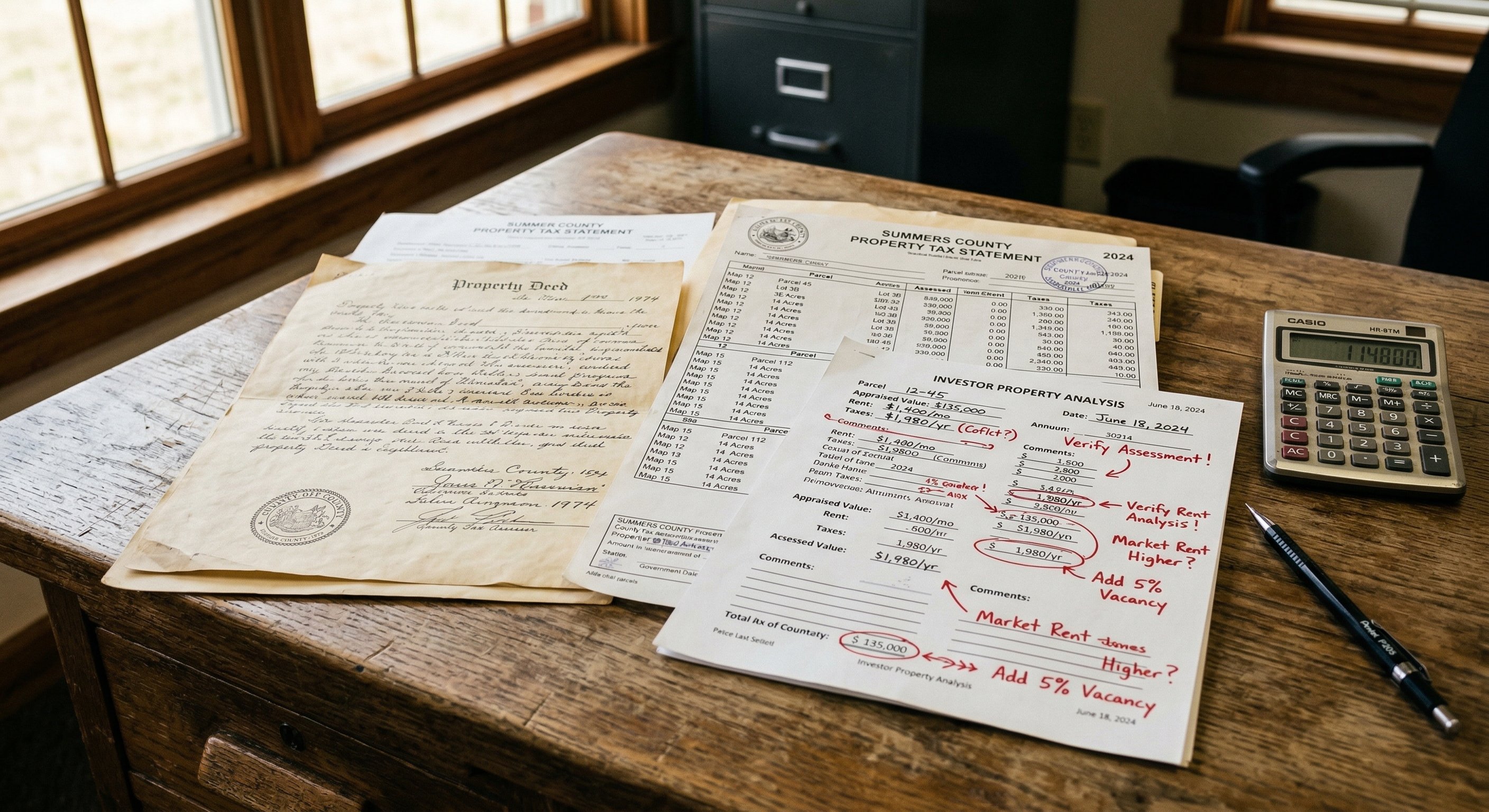
The deal looked clean on paper.
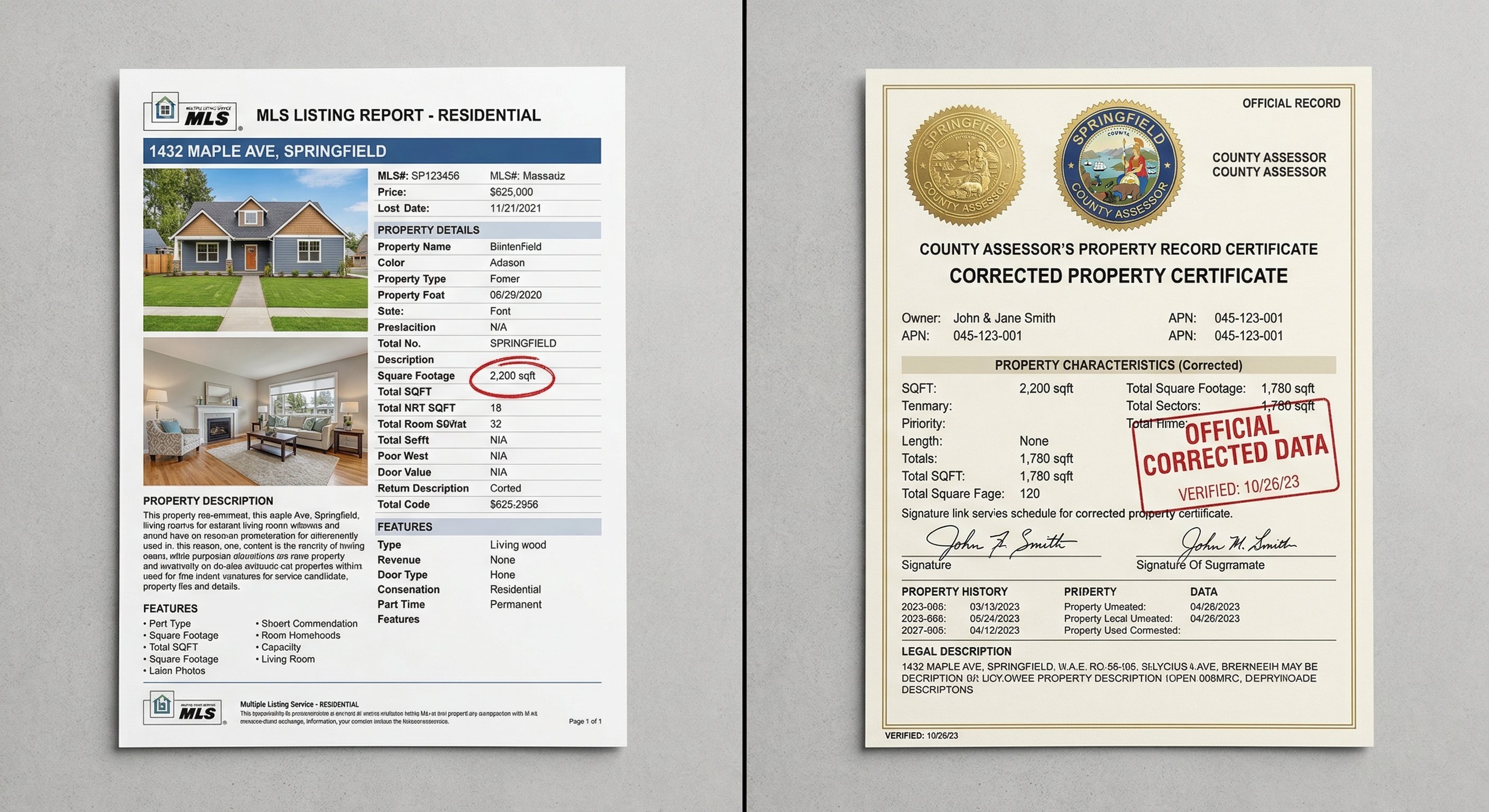
An investor in Kansas City bought a single-family — MLS listed it at 2,200 sqft, 3 bed/2 bath, built 1987. She ran comps against similar-size homes in the zip. ARV came out at $215,000. She offered $128,000 and won.
At closing, she pulled the county tax assessor record. Actual square footage: 1,780 sqft. The MLS had been wrong for at least three years, carried over from a 2019 listing agent who eyeballed the floor plan.
Her comp set was now invalid. Every comparable she'd used was 400+ sqft larger. She'd priced it like a 2,200 sqft house. Running correct comps against the actual footprint, the ARV landed at $176,000.
She'd overpaid by $28,000. And she wouldn't find out until she tried to sell.
This isn't a freak accident. It's structural — built into how most property data platforms work.
Why MLS Data Is Often Wrong (And Nobody Is Checking)
The MLS is not a government database. It's a cooperative listing service that runs on the honor system.
When a listing agent enters a property, they type in the bedrooms, the square footage, the year built. Nobody verifies those numbers against anything. No inspector, no surveyor, no government record. The MLS assumes the agent is right. Then the next agent copying that listing to another platform assumes the first agent was right. Three platforms later, Zillow is showing the same square footage that someone guessed — or inflated — eight years ago.
Reddit's real estate investing communities have documented this extensively. One investor cross-referenced 3,800 Kansas City MLS listings against county records and found a significant portion had square footage figures that were, in his words, "straight up fiction." Bedrooms and bathroom counts were equally unreliable — unpermitted additions, garage conversions, and sunroom buildouts routinely get counted in MLS data but don't exist in legal records.
The National Association of Realtors' own research found that MLS-reported prices differ from HUD-1 settlement statement data by an average of 8.75%. That spread partially reflects data quality problems baked into the system.
On a $250,000 acquisition, 8.75% is $21,875.
On a $400,000 deal, it's $35,000.
That's not a data footnote. That's a line item on your P&L.
The ARV Cascade: How One Bad Number Becomes Five
Every investor knows the formula: ARV minus repairs minus profit equals your maximum allowable offer. What most investors underestimate is that ARV is a derived number — it's only as good as the data underneath it.
Here's how one bad input cascades:
Step 1 — Wrong sqft on the subject property. MLS says 2,200. Assessor says 1,780. You filter comps for "2,000–2,400 sqft homes."
Step 2 — Wrong comp set. Your comparables are now anchored to homes 400+ sqft larger. You're comparing a 1,780 sqft house to comps that sold for $215,000+.
Step 3 — ARV inflated by $30,000–50,000. In markets at $90–$120/sqft, a 420-sqft comp error produces a $38,000–$50,000 ARV inflation.
Step 4 — MAO is wrong. You offer more than the deal supports.
Step 5 — You win. Sellers and agents rarely correct you when you offer too much.
Step 6 — Margin compression shows up after close. At inspection, at assignment, or at resale — the real numbers surface. By then, your options are limited.
The insidious part: you don't lose money in a single moment you can point to. You lose it in the gap between the offer you made and the offer you should have made. That gap looks like a negotiation failure or a renovation overrun. It was a data problem from the start.
The Fields That Hurt Most
Not all data errors are created equal. Here's where the investment damage concentrates:
Square footage — The most consequential because it directly anchors comp selection and price-per-sqft calculations. Inflated sqft is especially common in older listings where additions were built without permits. The addition shows up in MLS photos and agent counts. It doesn't exist in assessor records until a permit is filed.
Bedroom and bathroom count — A 3/2 versus a 3/1.5 changes your comp pool meaningfully in most markets. Garage conversions, sunroom additions, and finished bonus rooms get counted differently across platforms depending on who entered the data.
Year built — Affects comparable selection, insurance rates, and renovation scope assumptions. Some agents update "year built" to reflect major renovations, which sounds helpful but makes historical comp analysis unreliable. The assessor records the original construction date.
Lot size — Often off by 10–20% in residential properties. Matters when you're calculating density potential, setback requirements, or ADU feasibility.
Property type — Condos misclassified as single-family; multi-units listed as single-family; mixed-use with residential components. Each has different comp pools and valuation logic.
The common thread: MLS data is entered by humans for marketing purposes and almost never corrected. County assessor data is maintained for tax calculation purposes, legally audited, and updated when permits are pulled and ownership transfers.
Free Weekly Alerts
See What's Distressed in Your Market
Get free weekly alerts — new distressed properties, motivation scores, and hot neighborhoods in your area. Addresses and contact info available inside DistressIQ.
Free forever · No credit card · Unsubscribe anytime
Why the County Assessor Record Is Different
Every parcel of real property in the US is tracked by the county tax assessor. This isn't optional — it's how property taxes are calculated, which means governments have a direct financial interest in keeping these records accurate.
When a permit is pulled for an addition, the assessor updates the record. When a conversion is made legally, the assessor records it. When a property is sold, the deed goes to the county recorder and the assessor updates ownership and transfer price. The assessor's record is the legal description of the property. Courts, lenders, and title companies use it — not MLS data — when anything legally consequential happens.
Several practical implications for investors:
- Sqft is measured, not guessed. Most jurisdictions use on-site measurement or permit-based calculation, not agent estimates.
- Bedrooms and bathrooms reflect legal, permitted spaces. Not whatever the last agent decided to include.
- Year built is original construction. Effective year (for insurance purposes) may differ, but you know the baseline.
- Data is stable. It doesn't change based on who's marketing the property.
Is assessor data perfect? No. There are counties with outdated records, clerical errors, and properties that haven't been formally updated in decades. But assessor errors are errors of omission — missing information, outdated entries. MLS errors are often errors of commission — actively wrong numbers that benefit whoever was selling.
When the two sources disagree significantly, that gap is itself information worth investigating before you offer.
The Comp Contamination Problem You're Not Thinking About
Bad subject-property data is half the problem. The other half: the same bad data is in your comp set.
When you run comps on a house, you're comparing it to other houses that were also listed on the MLS with MLS-quality data. If your subject property's sqft is inflated, there's a reasonable chance some of your comps have similar issues — especially in older markets where the same data has been recycled through multiple listing cycles.
This creates a scenario where two properties with legitimate assessor-recorded sqft of 1,800 both appear as 2,200 in MLS data. Your comp analysis looks clean — apples to apples — but it's based on a systematically inflated dataset.
The error surfaces when you finance or resell. Appraisers use county records, not MLS listings. If the appraised value comes in below your contract price, you find out at the worst possible moment: after you've already committed.
What This Means for Distressed Property Investors Specifically
For buy-and-hold investors buying at or near retail, bad data costs margin. For distressed property investors — flippers, wholesalers, BRRRR investors working thin deals — it can eliminate the entire profit or put you in a loss position.
The math gets tight fast:

- Distressed property with MLS-reported sqft of 1,950
- Assessor sqft: 1,600
- Market: $95/sqft comparable sales
- MLS-based ARV: ~$185,000
- True ARV: ~$152,000
- MAO at 70%: MLS-based $129,500 vs. assessor-based $106,400
- Difference: $23,100 in your offer price
If your ARV is inflated by $33,000 because of bad data, your entire deal structure is wrong. The assignment fee you modeled is a loss position at close.
Most investors don't find this out until they try to assign the deal, get pushback from a cash buyer who ran their own numbers, or receive an appraisal that doesn't support the contract price.
The fix isn't a complicated workflow change. It's using property data that starts from the county record — the legal source of truth — rather than from a listing agent's unchecked estimate.
DistressIQ uses property data verified against county tax assessor records — not MLS copies — for every lead on the platform. Browse distressed properties with assessor-verified data — free on DistressIQ.
The Incremental Loss Problem
Here's what most investors never realize: bad data rarely produces one catastrophic blow-up. It produces a slow drain.
You lose $8,000 here on an ARV that was optimistic. You lose $15,000 there on a deal where the sqft came in lower than expected at inspection. You lose another $12,000 on a wholesale that your end buyer wouldn't close at your assignment fee because their ARV didn't match yours.
It doesn't show up as a data problem in your post-mortems. It shows up as "the business isn't as profitable as the spreadsheet said." Renovation overruns. Soft assignments. Deals that needed extra work.
If you're doing 10 deals a year and your average ARV error is $15,000 per deal — conservative in markets with older housing stock — that's $150,000 per year in inflated ARV. At a 70% MAO, that's $105,000 in offers that were too high. That's where the margin quietly went.
A Simple Audit Protocol
You don't have to overhaul your workflow to materially reduce data quality risk. Start here:
1. Pull the county assessor record on every acquisition before you offer. Most county assessor portals are free and searchable by address. Verify sqft, bedrooms, and year built against your MLS data. A 10-minute check before submitting an offer catches the worst errors.
2. Use assessor sqft to anchor comp selection when possible. Filter your comp searches by assessor-recorded sqft rather than MLS sqft. This narrows your pool to properties with verified similar characteristics.
3. Run a sensitivity analysis. Before submitting any offer, ask: "If the sqft is 15% lower than listed, what is my ARV?" Model the downside. If the deal still works at a lower sqft, the offer is sound.
4. Cross-check permit history. Most county building departments have searchable permit records. Unpermitted additions are MLS fixtures and assessor omissions — the classic source of sqft inflation. If there's no permit for the addition, the assessor doesn't count it.
5. Work with platforms that source from assessors, not MLS. At scale, manually pulling county records on every lead isn't practical. The cleanest solution is using property intelligence tools that go to the county record as the primary data source rather than copying from MLS downstream.
Frequently Asked Questions
Q: Is MLS data always wrong?
A: Not always, but it's structurally unverified. MLS data is self-reported by listing agents, and errors are rarely corrected across the platforms that copy it downstream. For legally consequential decisions — offers, ARV calculations, financing applications — the county assessor record is the reliable baseline. Use MLS data for what it's good at (market activity, price trends, days on market) but verify key property characteristics against the county assessor before you make any investment decision.
Q: How much does wrong square footage actually affect ARV?
A: It depends on your market's price-per-sqft. In markets at $100/sqft, a 400-sqft error equals $40,000 in ARV. At $150/sqft, it's $60,000. In secondary markets where distressed property investors are most active — often $80–$120/sqft — a systematic 300-sqft inflation across a year of deals adds up to material six-figure ARV errors. The damage compounds because the same bad data affects both your subject property and your comparable sales.
Q: Why don't PropStream and other platforms fix this?
A: Most large platforms aggregate from multiple sources, and MLS data is the most accessible because it's updated frequently for active listings. County assessor data is more accurate but harder to maintain at scale — formats and update cadences vary county by county. Platforms optimized for broad coverage (100M+ records) typically trade accuracy for breadth. Platforms built for distressed property intelligence, where users are making purchase decisions, need the accuracy.
Q: What if the county assessor record is also wrong?
A: It happens — especially in older properties or under-resourced jurisdictions. But assessor errors and MLS errors are different in character. Assessor errors are typically omissions or outdated records — missing information, not inflated information. MLS errors can be actively wrong in the direction that benefits the seller. When the two sources diverge significantly, treat it as a due diligence flag: pull the permit history, physically measure at inspection, and price the uncertainty into your offer.
Q: Where can I access county assessor data for free?
A: Most county assessors maintain free online search portals — search "[county name] assessor property search" to find yours. Availability and quality vary considerably: some counties have modern searchable systems updated monthly, others have scanned PDFs or require in-person visits. Platforms like DistressIQ aggregate assessor-verified property data across thousands of US counties, so you're not pulling each record manually before every offer.
Every lead on DistressIQ is matched to county assessor records — not recycled from MLS. Browse verified distressed properties in your market, free. Start at DistressIQ.
The data behind this article
DistressIQ Monitors These Signals in Real Time
Pre-Foreclosures
NOD + NTS filings
Tax Delinquency
County treasurer records
Code Violations
Municipal inspection filings
Probate Filings
Superior Court records
Every lead is scored 0–100 for seller motivation based on signal type, duration, severity, and stacking. Nationwide coverage — every US county, updated daily.
Ready to find deals in your market?
See Live Distress Signals in Your County
Stop calling dead leads. Every lead in DistressIQ is scored 0–100 for seller motivation, with verified contact info included. Browse the free tier to see what's active in your market right now.
Browse Free Leads — No Credit Card