Property Data Sources Compared: Which Records Should Real Estate Investors Actually Trust?

Property Data Sources Compared: Which Records Should Real Estate Investors Actually Trust?
TL;DR: County assessor records, MLS listings, third-party data aggregators, and distressed property intelligence platforms serve fundamentally different purposes. County assessor data is the most current and legally authoritative, while MLS was built for marketing, not investing. Understanding which source to trust for which purpose is what separates investors who consistently find off-market deals from those who consistently overpay for stale or inaccurate data.

Every real estate investor makes the same mistake early on. They subscribe to a platform with millions of records and feel confident because the spreadsheet is enormous. Then they run the numbers on a deal and lose money because the square footage was wrong, the lot size was wrong, and the last sale date was three years old.
That loss comes from trusting the wrong data sources. The property data landscape is not a commodity market. Understanding the differences between how each source operates separates investors who consistently find off-market deals from those who consistently work with stale or inaccurate data.
The Four Property Data Sources Every Investor Encounters
County assessor records are the government databases that determine property tax liability. Every county maintains an assessor database covering every parcel, including assessed value, property characteristics, owner information, tax payment status, and sale history. Counties have a direct financial incentive to maintain accurate records because assessed value drives tax bills. That incentive structure is why no private data source can match assessor accuracy.
MLS (Multiple Listing Service) data is the real estate agent database that powers Zillow, Realtor.com, and every consumer-facing property site. When a property is listed for sale, the listing agent enters the details into the local MLS. MLS was designed to help agents match buyers to listed properties. It reflects what sellers are asking, not necessarily what properties are worth, and it deliberately excludes off-market distressed properties.
Third-party data aggregators like PropStream, DataTree, and RealQuest license data from multiple sources and compile it into unified databases. The aggregation model creates convenience, but it also compounds the weaknesses of each underlying source. When the county assessor has an error, that error propagates into the aggregator's database and stays there.
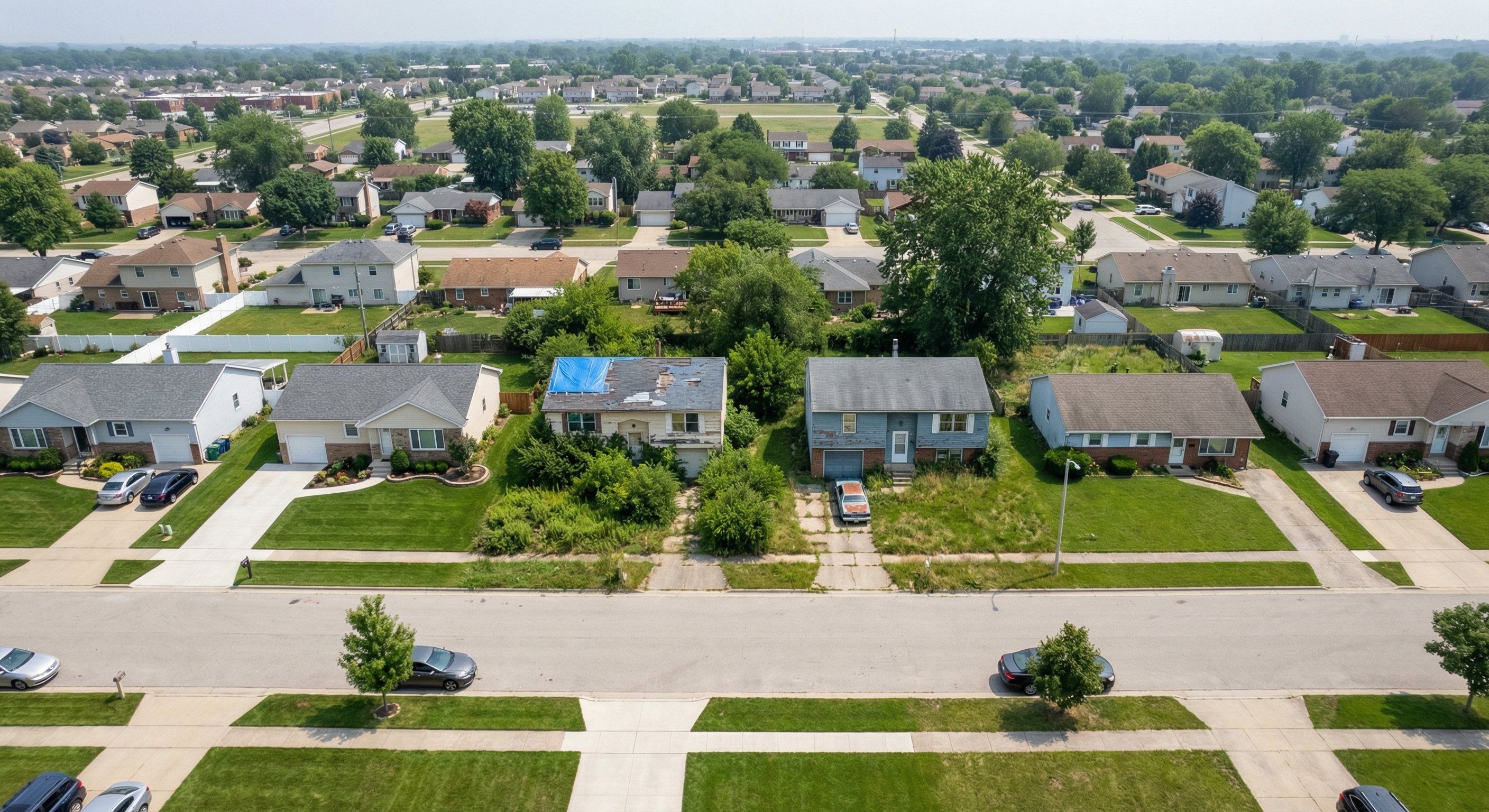
Distressed property intelligence platforms like DistressIQ focus specifically on properties with verified distress signals: tax delinquency, pre-foreclosure, lis pendens, code violations, and probate filings. Data is sourced from county-direct records and each lead includes at least one confirmed distress signal.
Comparison Dimension 1: Data Recency
County assessor records in most counties are updated within 30 to 60 days of a transaction closing. When a property sells, the deed is recorded with the county recorder, and the assessor updates the parcel record. This is a legal requirement, which means the update is mandatory.
MLS data is very current for active listings. The problem is the other side of that coin: when a property goes off-market, MLS data becomes stale immediately. A property in pre-foreclosure, a sheriff sale, or a tax sale has no mechanism to appear on MLS.
Third-party aggregators typically update weekly or monthly. In slower counties, an aggregator may be working with data that is 60 to 90 days old even on a weekly refresh cycle. Some platforms advertise daily updates, but the underlying county data does not always flow consistently.
Distressed property intelligence platforms that pull directly from county sources can update daily or more frequently. When a lis pendens is filed, a code violation is recorded, or a property hits the tax delinquency list, the signal appears as soon as the county publishes it. For investors competing on off-market deals, this recency advantage is the difference between making an offer first and making an offer last.
Comparison Dimension 2: Data Accuracy
County assessor data is legally significant. The assessed value determines the property tax bill, so counties have a direct financial incentive to maintain accurate records. That said, assessor records are not perfect. In counties with older systems, data may have been transcribed incorrectly during digitization, and lot sizes or square footage figures are occasionally outdated for properties modified without a permit.
MLS data accuracy is a documented problem. A National Association of Realtors study found that property characteristic data in MLS records differs from county assessor records in roughly 15 to 20 percent of active listings (https://www.nar.realtor/research-and-statistics). Square footage gets rounded up. Lot sizes get approximated. Bedroom counts include rooms that do not qualify as bedrooms under local zoning rules. Listing agents entering MLS data are optimizing for getting a property sold, not for maintaining an accurate government record.
Third-party aggregator accuracy is compounded by the aggregation model. Aggregators do not independently verify data. When county assessor records contain an error, it enters the aggregator's database. When MLS data contains inflated square footage, that inflated figure gets pulled into the aggregator's records. Studies have documented error rates in basic property characteristics in 25 to 30 percent of records in some aggregated databases.
The investor consequence is concrete. An overestimated square footage leads to an overestimated ARV, which leads to an offer that wins a deal that does not pencil out. One bad ARV calculation on a $200,000 deal can mean the difference between a $15,000 profit and a $15,000 loss.
Free Weekly Alerts
See What's Distressed in Your Market
Get free weekly alerts — new distressed properties, motivation scores, and hot neighborhoods in your area. Addresses and contact info available inside DistressIQ.
Free forever · No credit card · Unsubscribe anytime
Comparison Dimension 3: Coverage of Distressed Properties
For investors targeting distressed properties, coverage is the make-or-break metric.
MLS does not cover distressed properties by design. A property in pre-foreclosure is not on MLS because the owner is not actively trying to sell at market price. A property heading to a sheriff sale is not on MLS because the lender is not marketing it through an agent. MLS coverage of distressed inventory is essentially zero by definition.
Third-party aggregators include distressed properties, but with a significant lag. A property entering pre-foreclosure today may not appear in an aggregator's database for 30 to 60 days. In fast-moving markets, that lag is enough for a motivated seller to work out an alternative, the property to go to auction, or a competing investor to close.
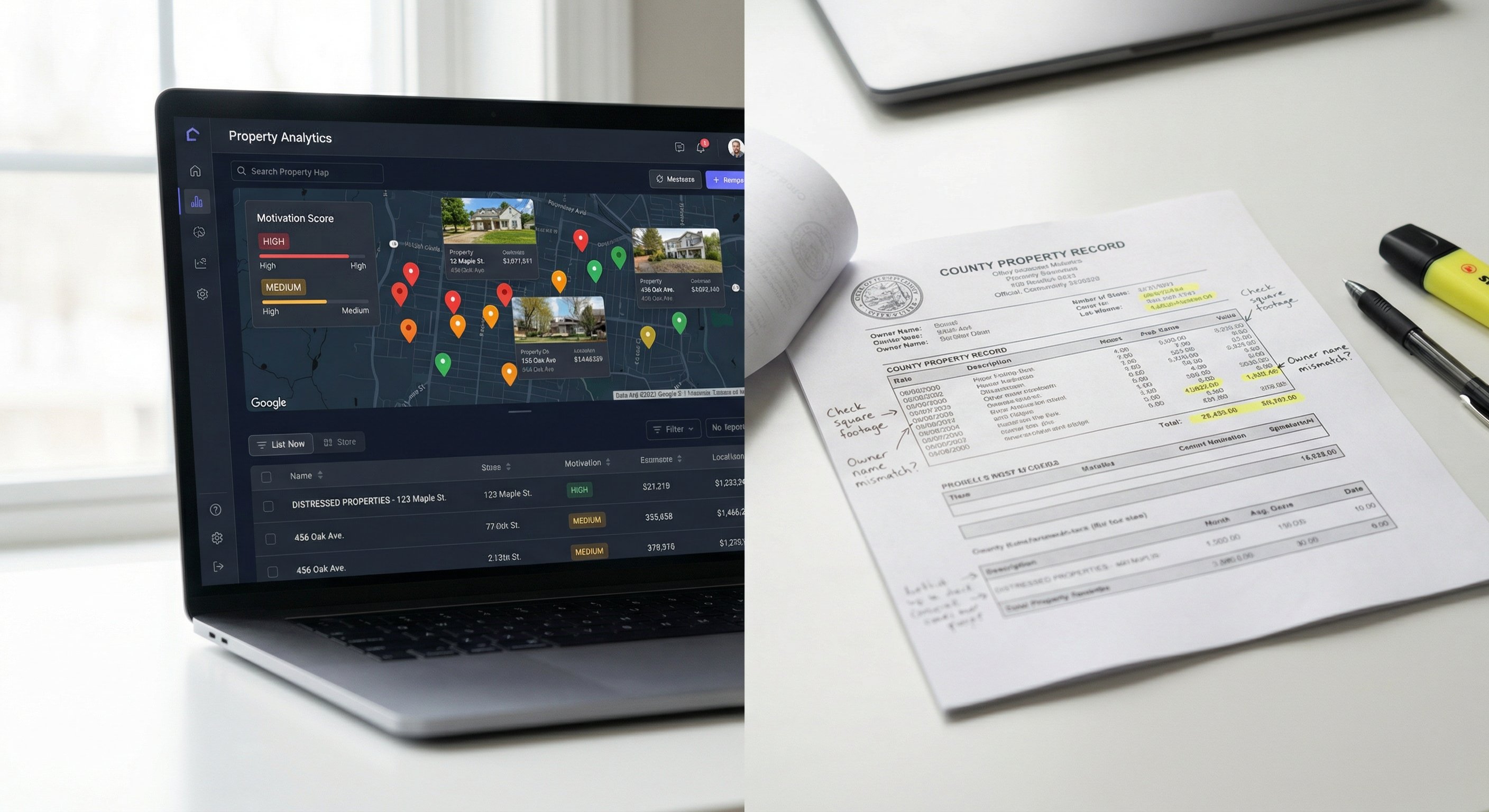
County assessor records include distressed properties because every parcel is in the assessor database regardless of market status. A pre-foreclosure property still has an owner, a legal description, an assessed value, and a tax account. The gap is that assessor records do not flag which properties are distressed. An investor using raw county data must identify distress signals manually by cross-referencing multiple county sources.
Distressed property intelligence platforms solve this by pulling from county assessor records, county court records, and county recorder filings to identify properties with verified distress signals and present them in a ranked, prioritized format. The speed and automation make county-direct research accessible without spending hours per county navigating incompatible government databases.
Comparison Dimension 4: Cost and Workflow Efficiency
MLS access requires a real estate license in most states, with subscription costs running $300 to $1,200 per year. For investors who are not licensed agents, accessing MLS requires working through an agent.
Third-party aggregator subscriptions for serious investors run $100 to $500 per month. PropStream, one of the better-known platforms, starts at approximately $99 per month for basic access, with advanced features running $300 to $500 per month. These platforms offer large datasets but require significant time to filter and prioritize for specific investment strategies.
County assessor access is free or low-cost in most counties. The challenge is time. Every county has a different database interface and search functionality. Building a working knowledge of even 10 county assessor databases takes weeks.
Distressed property intelligence platforms price their products based on the value of the service rather than raw data volume. A platform that surfaces only verified distressed properties with motivation scores is selling a different product than a platform delivering 160 million generic property records that still requires extensive sorting before producing actionable leads.
The Practical Data Stack for Distressed Property Investors
Professional investors who generate consistent deal flow do not rely on a single data source. They build a stack that uses each source for its strength.
County assessor data is the foundation for property characteristics. Square footage, lot size, year built, assessed value, and tax payment history come from the county assessor. These are the inputs for calculating ARV, land-to-improvement ratios, and offer prices. No other source has the same legal authority for these data points.
A distressed property intelligence platform handles deal sourcing. It pulls directly from county sources and surfaces verified distress signals, scored by motivation level. This replaces the hours spent navigating individual county databases and provides the prioritization that helps investors know which leads to pursue first.
MLS data validates market value. Use it to understand what similar properties are selling for in the subject neighborhood and to validate ARV estimates. Do not use MLS as a deal-sourcing tool because it will not show distressed inventory.
A third-party aggregator serves as a secondary backup when county-direct access is not practical. Treat aggregator data as potentially stale and verify critical characteristics against the county source before making offer decisions.
County assessor access is free. DistressIQ starts at $129 per month for verified distressed property signals across 3,200-plus counties. MLS access comes through a licensed agent or broker.

Frequently Asked Questions
Q: Are county assessor records free to access?
Yes. County assessor databases are public records in every US state, with most counties providing online access through their assessor or tax collector websites at no charge. Functionality varies widely: some counties offer robust search tools while others provide only basic parcel data. Most investors find that the time cost of navigating multiple county databases outweighs the monetary cost of a distressed property intelligence platform that aggregates this data across counties.
Q: Why is MLS data frequently inaccurate for investment analysis?
MLS data is designed for marketing purposes, not investment analysis. Listing agents enter property data to attract buyers, not to maintain an accurate government record. Square footage figures are not always measured by a professional appraiser. Lot sizes may include common areas rather than the actual lot. Bedroom counts sometimes include rooms that do not meet local zoning definitions. NAR research documented significant discrepancies between MLS-listed property characteristics and actual recorded data, particularly in older properties (https://www.nar.realtor/research-and-statistics).
Q: Which distressed property signals are most reliable for finding motivated sellers?
Tax delinquency is the strongest single distress signal because it carries a financial consequence (potential loss of the property to a tax sale) and a county-published legal record. Pre-foreclosure signals from lis pendens filings indicate an active legal process. Probate filings often create motivated sellers among heirs who want to settle an estate. Code violations indicate local government involvement and often precede more serious enforcement actions. The most effective approach stacks multiple signals: a property that is both tax delinquent and has a code violation is materially more motivated to sell than one with only a single signal.
Q: How do I verify property data before making an offer?
Start with the county assessor database. Compare the listed square footage, lot size, year built, and property type against what the listing or aggregator database shows. If there are discrepancies, defer to the county assessor record as the authoritative source. For distressed properties, verify the distress signal by pulling the underlying county record directly from the appropriate county office.
Q: Can distressed property data cover commercial or multi-family properties?
Yes, though the coverage and signal types differ from residential properties. County assessor records include commercial and multi-family parcels, and distress signals for commercial properties include special assessment districts, code enforcement actions, and bankruptcy filings. Commercial analysis is more complex than residential, typically involving additional due diligence on income-producing capacity, tenant leases, and environmental conditions.
The Bottom Line
Not all property data sources are equal, and the differences compound as deal volume increases. County assessor data is the foundation because it is the most accurate and legally authoritative record available. Distressed property intelligence platforms that pull directly from county sources are the most efficient way to identify motivated sellers before they reach the open market. MLS is a comp tool, not a lead source. Aggregators are a convenience product with a known accuracy discount.
Build a data stack that uses each source for what it does best, and verify critical data points against the county source before every offer.
See verified distressed property signals from county-direct sources across every US county at DistressIQ. Browse free, pay only when you need contact info and detailed property records.
The data behind this article
DistressIQ Monitors These Signals in Real Time
Pre-Foreclosures
NOD + NTS filings
Tax Delinquency
County treasurer records
Code Violations
Municipal inspection filings
Probate Filings
Superior Court records
Every lead is scored 0–100 for seller motivation based on signal type, duration, severity, and stacking. Nationwide coverage — every US county, updated daily.
Ready to find deals in your market?
See Live Distress Signals in Your County
Stop calling dead leads. Every lead in DistressIQ is scored 0–100 for seller motivation, with verified contact info included. Browse the free tier to see what's active in your market right now.
Browse Free Leads — No Credit Card