How to Find Probate Leads in Washington State (2026 Investor Guide)
How to Find Probate Leads in Washington State (2026 Investor Guide)
TL;DR: Washington is a community property state, which changes the probate equation for investors. Fewer properties go through full probate than in non-community-property states — but the ones that DO are often high-equity, under-maintained, and held by out-of-state heirs who want a clean exit. Probate leads in Washington are found through Superior Court filings in each of 39 counties. King, Pierce, Snohomish, and Spokane counties hold the most volume. King County Superior Court (Seattle) records are searchable online via the LINX system. DistressIQ surfaces verified probate signals across all Washington counties, updated daily from court records.
Washington State throws a curveball that catches most out-of-state investors off guard. They pull up a list of probate filings and wonder why the numbers look lower than comparable-population states like Michigan or Indiana.
The answer is two words: community property.
Washington is one of nine community property states in the US. When married spouses die, the surviving spouse typically inherits their share of marital property automatically — no probate required. That's a significant chunk of potential cases that simply never reach the courthouse. Add in TEDRA agreements, Transfer on Death (TOD) deeds, community property agreements, and joint tenancy arrangements, and Washington families have more tools than most states to move assets without court involvement.
But here's what that actually means for investors: the probate cases that DO make it through the Washington Superior Court system are disproportionately complex situations — sole owners who died intestate, properties with unclear title, out-of-state families who inherited real estate they didn't ask for and don't want to manage. These aren't incidental distress situations. They're properties where the motivation to find a straightforward exit is real.
How Washington Probate Actually Works
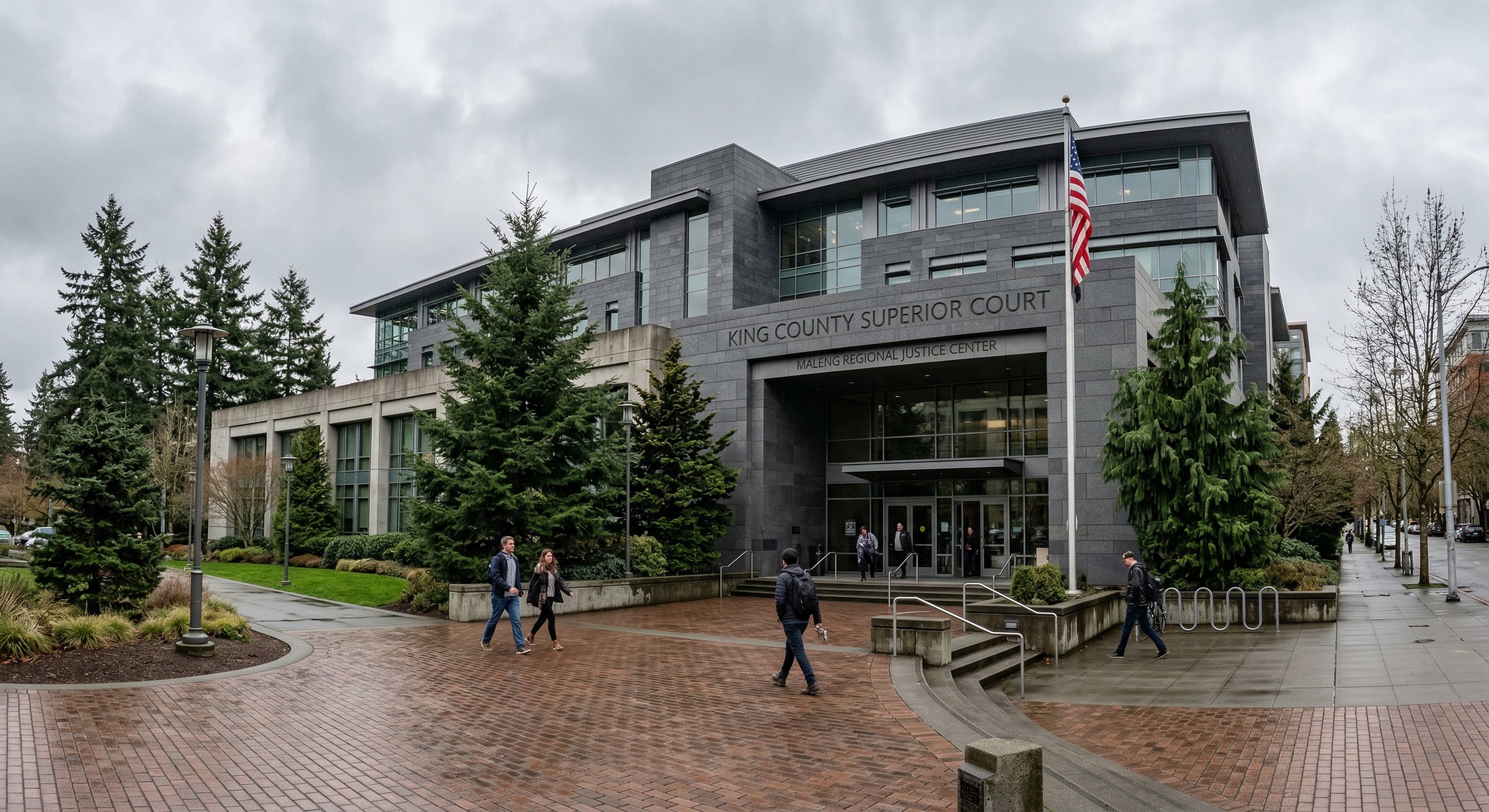
Probate in Washington is governed by RCW Title 11 and handled in Superior Court — one for each of the state's 39 counties. There's no centralized statewide probate registry. Each county runs its own system, with wildly different levels of online access.
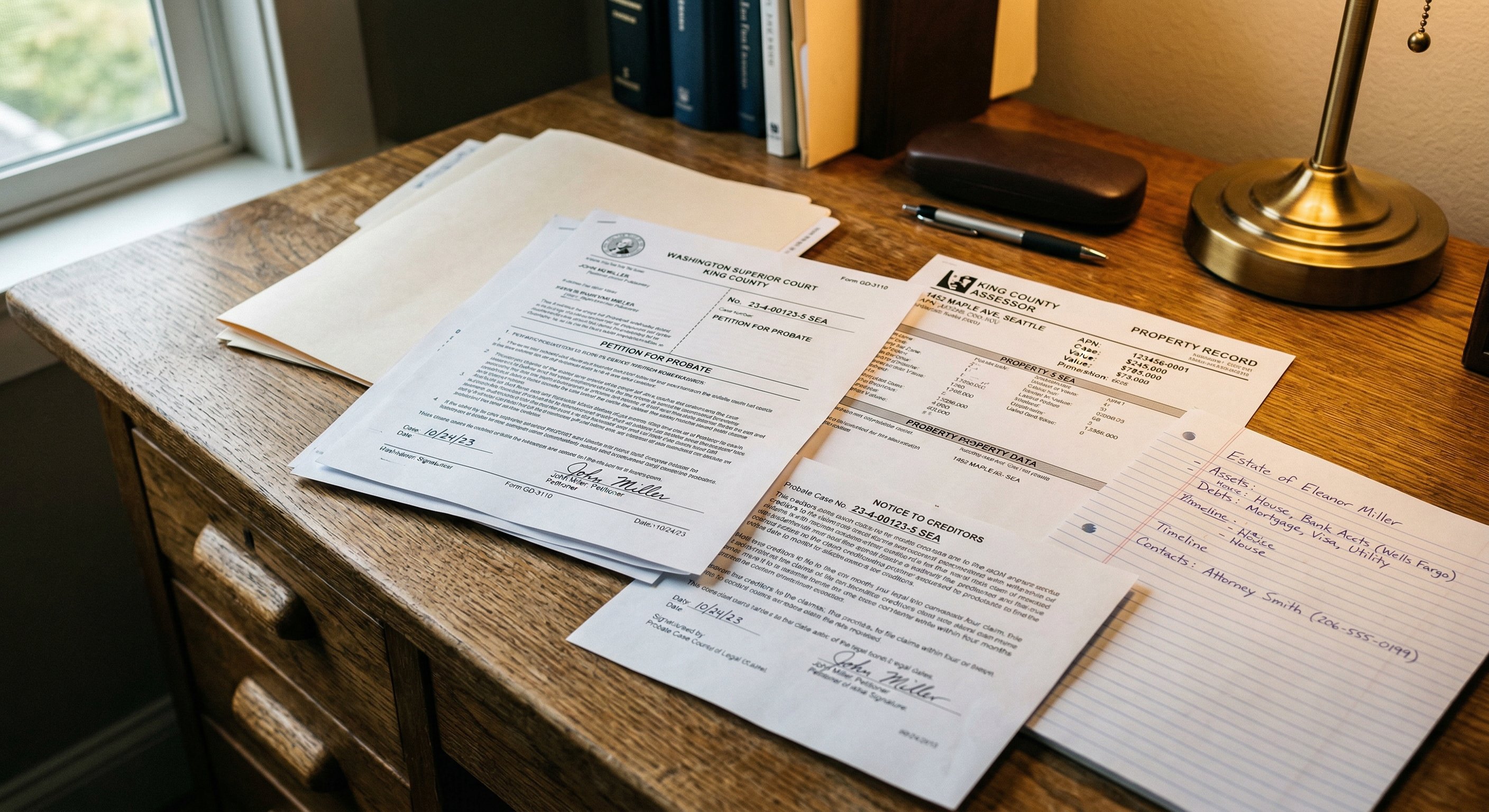
When a Washington resident dies and their estate needs to go through probate, an executor or personal representative petitions the county Superior Court to open a probate proceeding. The court assigns a cause number, and from that point forward, key filings — inventory of assets, real property descriptions, notices to creditors — become part of the public record.
Washington uses a relatively streamlined Independent Administration system. Under RCW 11.68, an executor with "nonintervention powers" can manage and sell estate assets without court approval for every transaction. This matters to investors because it means a properly authorized personal representative can close a sale faster than in states requiring judicial confirmation of every step. No waiting six months for a judge to approve your purchase price.
The Washington probate timeline typically runs 4-12 months, depending on estate complexity and whether heirs agree on next steps. The critical investor window is the middle stretch — after the Notice of Creditors period closes (4 months) but before the family decides whether to list conventionally or settle the estate another way.
What Investors Should Look for in Washington Probate Filings
Not every probate property is worth pursuing. The high-value targets in Washington probate searches share these characteristics:
- Out-of-state personal representatives — a Seattle property where the executor lives in Phoenix or Minneapolis means no emotional attachment, no desire to manage a renovation, and strong motivation for a fast sale
- Multiple heirs listed — when three or four heirs split an estate, unanimous agreement on listing price, repairs, and timeline is rare. A clean cash offer that avoids the coordination headache converts disproportionately well
- Properties held without mortgage — Washington's probate inventory skews older (estates of people who owned before the 2010s tend to be free-and-clear). No mortgage assumption, no lender approval needed
- Properties in markets where investors can add value — South King County (Renton, Kent, Auburn), Tacoma and Pierce County, Spokane — markets where post-rehab spreads justify the acquisition

Where to Find Probate Filings by County
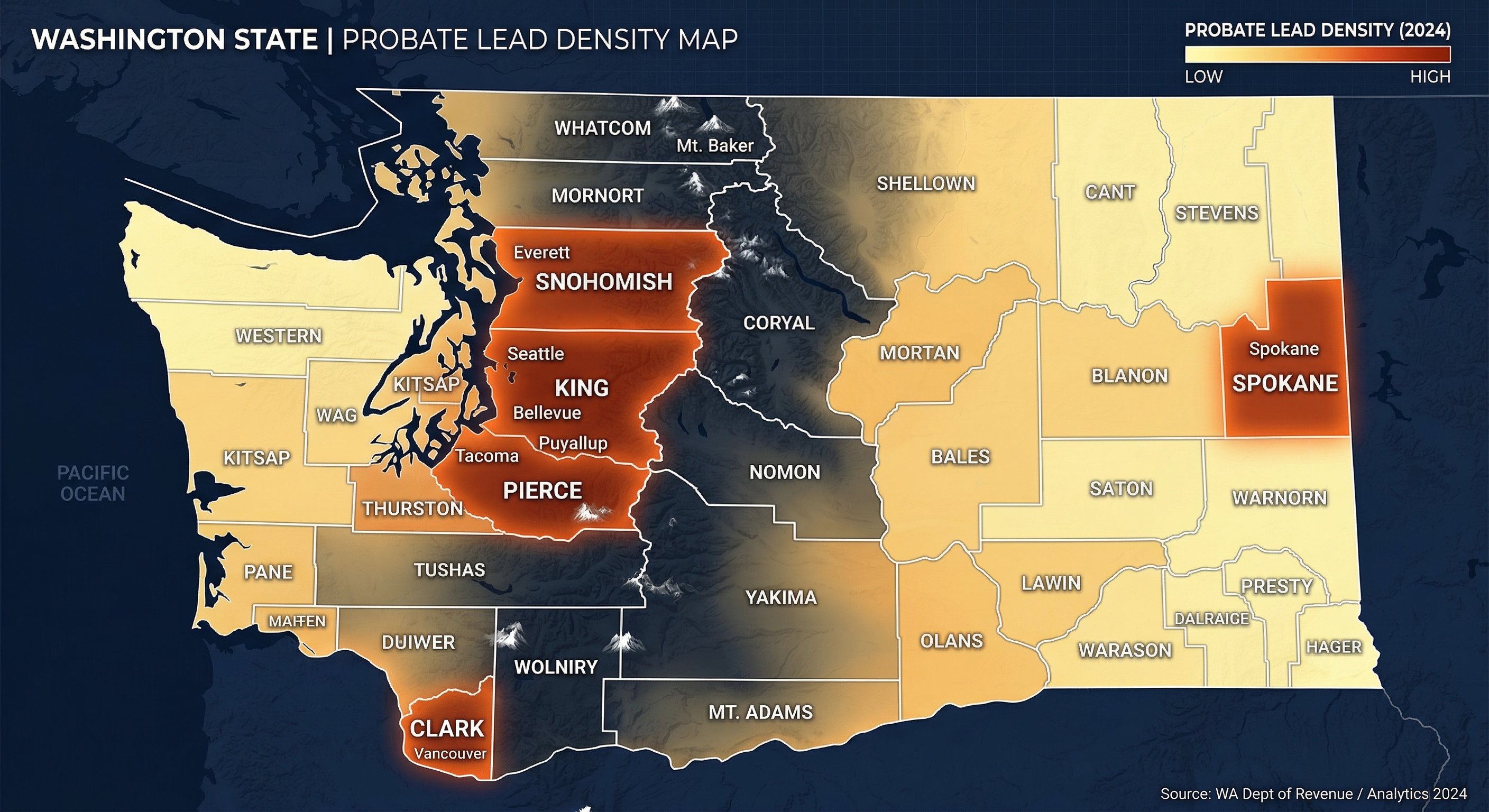
Washington's 39 counties each handle probate records independently. Here's where the volume actually is:
King County (Seattle metro) — by far the largest probate market in the state. King County Superior Court uses the LINX system (Legal Index for Superior Court), accessible at kingcounty.gov. Probate cases appear under the "Probate/Guardianship" cause type. You can search by name or cause number, and many documents are available for download without visiting the courthouse. Given Seattle's median home values north of $850,000, even a modest probate estate here carries significant equity.
Pierce County (Tacoma) — second-largest market, with more working-class neighborhoods that pencil for investors at lower acquisition costs. Pierce County Superior Court has online case access through the Washington Courts portal at docket.courts.wa.gov. Tacoma proper has seen increased interest from investors priced out of Seattle.
Snohomish County (Everett, Bellevue suburbs) — suburban density north of Seattle. Snohomish has online case lookup through the statewide courts portal. Strong appreciation over the past decade means probate properties here have significant equity, even those showing deferred maintenance.
Spokane County — Eastern Washington's population center. Spokane runs a more traditional real estate market (lower prices, longer DOM), which changes the investor calculus. Value-add opportunities exist but spreads are tighter.
Clark County (Vancouver, WA) — directly across the Columbia River from Portland, Oregon. Clark County attracts investors from both Oregon and Washington because of its proximity to the Portland metro without Oregon income tax. Probate properties here often appeal to buyers who work in Portland but want lower Washington prices.
For smaller counties — Whatcom (Bellingham), Thurston (Olympia), Kitsap (Bremerton) — probate volume is lower but competition is dramatically thinner. A well-sourced probate list in Whatcom County might surface a dozen legitimate leads with two or three other investors aware of them. In King County, you're working against the machine.
The Community Property Angle (What Changes Your Strategy)
Understanding Washington's community property rules isn't just legal trivia — it directly shapes what you'll find in probate searches and how you approach outreach.
Under RCW 26.16, assets acquired during marriage are generally community property. When one spouse dies, their half of the community property passes to the surviving spouse under a community property agreement — no court process required. This eliminates a significant portion of the cases that would flow through probate in states like Florida or Ohio.
What survives to probate in Washington:
- Property owned by a single person who dies without a surviving spouse
- Separate property (pre-marital assets, inheritance, gifts) that wasn't community property
- Community property where both spouses are deceased and no community property agreement was in place
- Situations with no valid will and contested heirship
- Estates where TOD deeds weren't established before death
Washington also authorized Transfer on Death deeds for real property in 2014 (RCW 64.80). Any Washington homeowner who executed a TOD deed can transfer property directly to a named beneficiary at death — no probate, no investor window. Adoption of TOD deeds has been gradual, so many older estates still run through the courts.
The investor takeaway: Washington probate leads skew toward specific scenarios. Solo owners who died without estate planning. Properties with title complications. Families in conflict. These aren't always the easiest deals — but they're the highest-motivated sellers in the pool.
If you're approaching a Washington probate lead, the community property context matters when you're researching ownership history. A property showing two owners on title where one recently died may not be in probate at all — it may have passed automatically. Your outreach should reflect that nuance.
If you want all Washington probate filings surfaced and scored in one place — without building your own county-by-county research workflow — DistressIQ tracks probate signals across every Washington county, updated daily from court records and cross-referenced with property data. Browse verified Washington probate leads free at DistressIQ.ai.
Free Weekly Alerts
See What's Distressed in Your Market
Get free weekly alerts — new distressed properties, motivation scores, and hot neighborhoods in your area. Addresses and contact info available inside DistressIQ.
Free forever · No credit card · Unsubscribe anytime
How to Approach Washington Probate Sellers
The families you reach through probate leads are dealing with real loss. Every approach protocol here starts from that fact.
Timing matters in Washington. The earliest contact point is after the Notice to Creditors is filed (required for at least four months after opening probate, per RCW 11.40). Reaching out before that period closes is premature and often counterproductive — the personal representative can't make any decisions until creditors have their window.
The most effective contact method for Washington probate leads:
- Identify the personal representative from the Superior Court filing — their name, and often their attorney, appears in the petition documents
- Send a handwritten letter to the personal representative's address (not the estate property) — keep it brief, respectful, and focused on providing a solution rather than landing a deal
- If the attorney is representing the estate, contacting through the attorney's office is appropriate and often appreciated — it signals you're a professional buyer, not a predatory one
- Follow up once after 30 days if no response. Two contacts maximum before moving on
Washington probate personal representatives have a fiduciary duty to the heirs — meaning they're legally obligated to act in the estate's best interest. A below-market lowball offer gets dismissed quickly. Come in with a credible price based on assessor data and comparable sales, clear proof of funds, and a realistic close timeline.
Families who inherited a King County property they don't want often face property taxes of $12,000-$25,000 per year on estates that are generating zero income. That carrying cost is real motivation. Acknowledge it. Offer to close on their timeline. Make the transaction as frictionless as possible for people who are already navigating grief while managing an estate they didn't anticipate.

Building a Washington Probate Pipeline
Running a systematic probate lead operation in Washington requires monitoring multiple county court systems. Here's a practical framework:
Manual approach (viable for 1-2 counties): Set up weekly searches in King County LINX and Pierce County's courts portal. Download new probate case numbers, cross-reference with property records at the county assessor's office, filter for real property, and build your outreach list. Expect 4-6 hours per week per county if you're covering more than one system.
Scaled approach: Use a platform that aggregates Washington probate data across all 39 counties so you're not rebuilding the research wheel each week. The critical feature is cross-referencing probate signals with property data — address, estimated value, ownership history — so you can prioritize without pulling individual assessor records for every case.
The filtering criteria that matter most in Washington:
- Properties where the deceased was the sole owner (no surviving spouse)
- Personal representatives with out-of-state addresses
- Properties with no existing mortgage (free-and-clear equity)
- Estates that have been open 3-6 months (creditor period resolved, decision imminent)
Washington's larger markets — King and Pierce counties especially — generate enough probate volume to support a focused acquisition strategy. Smaller counties work as opportunistic additions, not primary targets.
Key Numbers for Washington Investors
Some context for sizing the Washington probate market:
- Washington sees approximately 55,000-60,000 deaths per year (Washington State DOH)
- Not all result in probate — community property agreements, TOD deeds, and joint tenancy divert a meaningful portion
- Estimated 15,000-20,000 probate filings annually statewide, with real property in a fraction of those
- King County accounts for roughly 30% of statewide volume
- Washington has no county-level estate tax (but does have a state estate tax on estates over $2.193 million as of 2026)
The absence of state income tax makes Washington attractive for out-of-state investors doing 1031 exchanges who want an investment property without Oregon's 9.9% income tax across the river.
Frequently Asked Questions
How do I access probate filings in Washington state?
Washington probate records are public and handled by each county's Superior Court. King County uses the LINX system at kingcounty.gov/courts. Pierce, Snohomish, and most other counties use the Washington Courts portal at docket.courts.wa.gov. Search for "Probate" or "Estate" under the cause type filter and review new filings weekly.
Does Washington's community property law reduce probate opportunities?
Yes, community property rules mean married spouses often inherit without full probate. However, estates involving sole owners, intestate deaths with multiple heirs, or properties without TOD deeds do still flow through Superior Court. The cases that reach probate in Washington tend to involve above-average motivation from heirs who didn't plan for estate transfer.
How long does probate take in Washington state?
Washington's Independent Administration system (nonintervention powers) allows most estates to resolve in 4-12 months. Simple, uncontested estates with nonintervention powers can close faster. Complex estates with heir disagreements or title issues take longer. The active investor window is typically months 4-8 after filing.
Can a personal representative sell a property quickly in Washington?
Yes — under RCW 11.68, a personal representative with nonintervention powers can sell estate real property without court confirmation. This is a significant advantage over states like California that require court approval of sales. Washington probate sales can proceed at the same pace as conventional transactions once the personal representative has authority.
Where are the best markets for probate investing in Washington?
King County (Seattle, Bellevue, Renton), Pierce County (Tacoma, Puyallup), and Snohomish County have the highest volume. For less competition with solid returns, Spokane County and Clark County (Vancouver) offer opportunity in markets where investor saturation is lower than the Seattle metro.
How does DistressIQ help with Washington probate leads?
DistressIQ tracks probate signals across all 39 Washington counties, updated daily from court records. Every lead includes assessor-verified property data and a motivation score that ranks estates by likelihood of conversion. Browse Washington probate leads free — you only pay when you unlock owner contact details. Start at DistressIQ.ai.
The data behind this article
DistressIQ Monitors These Signals in Real Time
Pre-Foreclosures
NOD + NTS filings
Tax Delinquency
County treasurer records
Code Violations
Municipal inspection filings
Probate Filings
Superior Court records
Every lead is scored 0–100 for seller motivation based on signal type, duration, severity, and stacking. Nationwide coverage — every US county, updated daily.
Ready to find deals in your market?
See Live Distress Signals in Washington State
Stop calling dead leads. Every lead in DistressIQ is scored 0–100 for seller motivation, with verified contact info included. Browse the free tier to see what's active in your market right now.
Browse Free Leads — No Credit Card