How to Find Probate Leads in New York (2026 Investor Guide)
How to Find Probate Leads in New York (2026 Investor Guide)
TL;DR: New York probate is filed in Surrogate's Court — one per county, 62 counties statewide. The five NYC boroughs generate the most filings (Manhattan, Brooklyn, Queens, the Bronx, Staten Island), but Westchester, Nassau, and Suffolk are equally strong for higher-value estates. Probate typically takes 6 months to 2+ years in NY depending on estate complexity. Investors find probate leads by monitoring Surrogate's Court dockets, sourcing county-direct filings, and building relationships with estate attorneys. DistressIQ tracks verified probate signals across all 62 NY counties, updated daily.
New York is the hardest real estate market in the country to crack — and one of the most rewarding for investors who do the work.
Most wholesalers and flippers focus on NYC boroughs and give up when prices seem impossible. They're looking at the wrong numbers. The real opportunity in New York probate isn't in the listing price — it's in the timeline pressure, the out-of-state heir problem, and a probate system that generates thousands of estate filings per year that most investors never see.
Here's what actually matters for finding probate leads in New York in 2026.
How New York Probate Works (The Investor's Cheat Sheet)
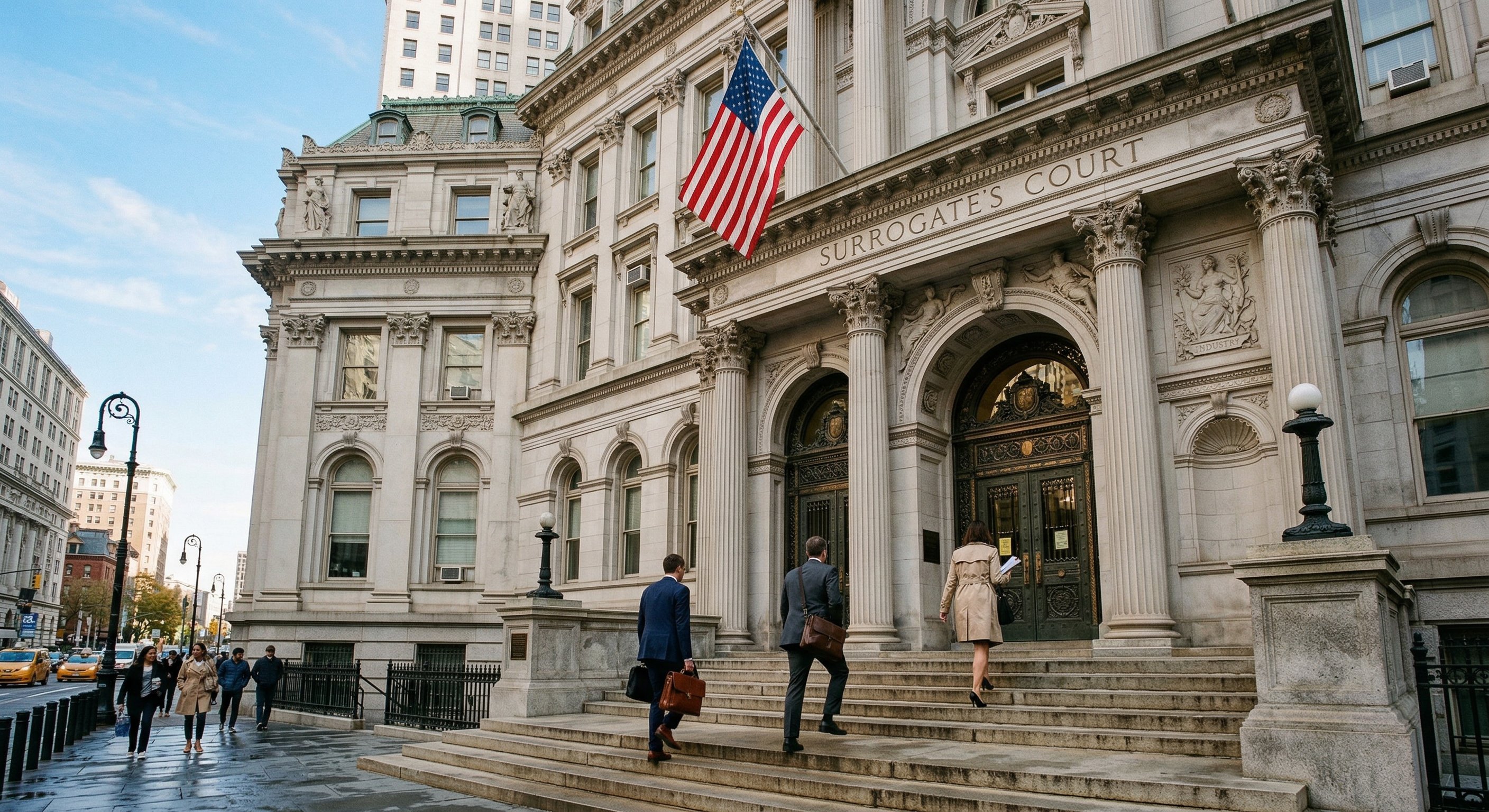
New York is a Surrogate's Court state. Every county has its own Surrogate's Court — the dedicated probate court that handles wills, estate administration, and heir disputes. There are 62 Surrogate's Courts statewide, one per county.
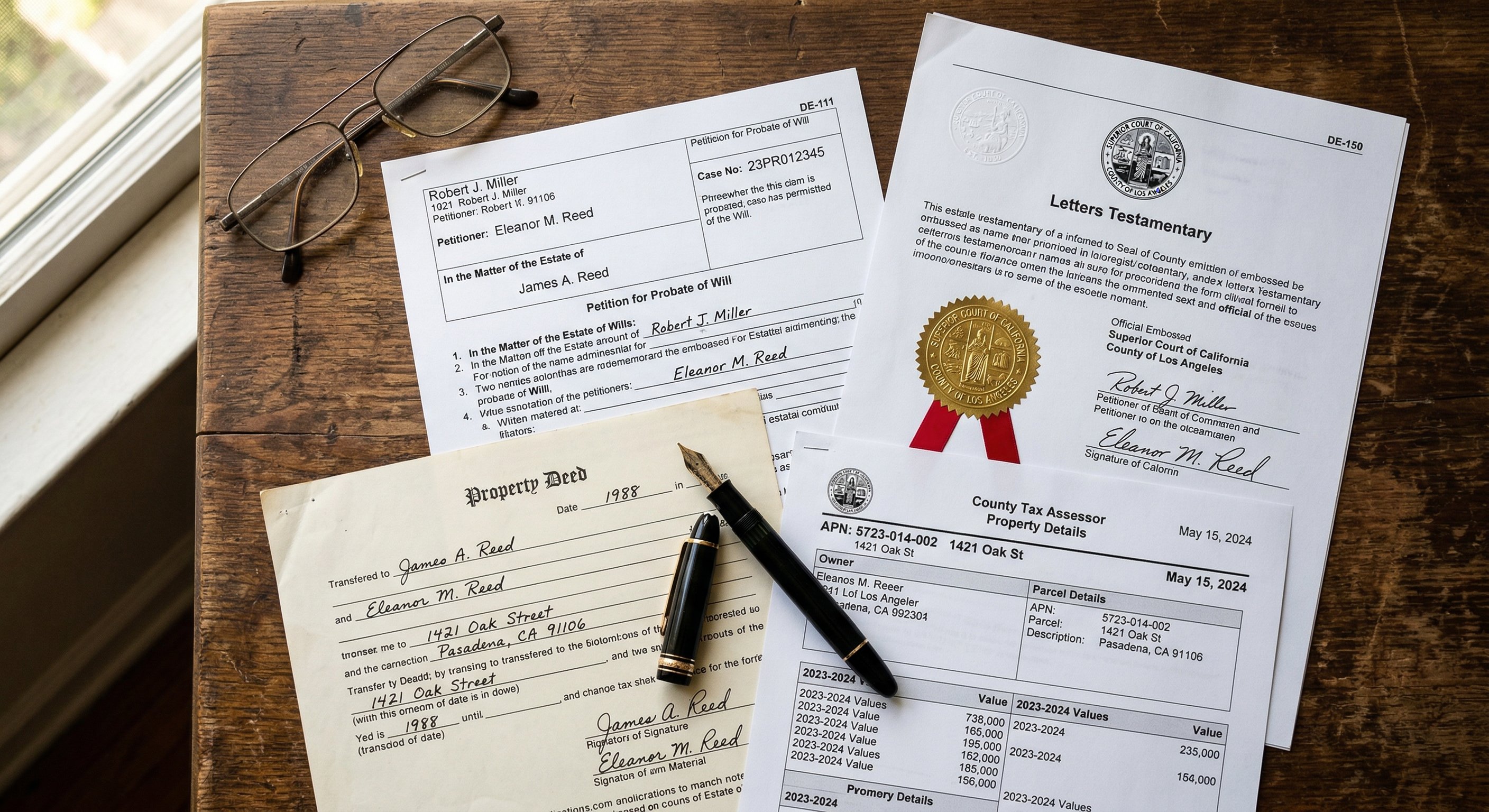
When someone dies owning real property in New York, the estate goes through the Surrogate's Court in the county where the property is located (or where the decedent lived). The executor files a probate petition. The court admits the will (or opens intestacy proceedings if there's no will). Once letters testamentary are issued, the executor can legally transfer or sell real property.
Timeline: Simple NY estates with clean titles and cooperative heirs can close probate in 6-12 months. Complex estates — contested wills, multiple heirs, out-of-state beneficiaries, tax issues — routinely take 2-3+ years. NYC estates with co-op apartments add additional complexity because co-op boards must approve any transfer.
What this means for investors: The window between filing and final sale can stretch for years. Heirs who don't want to manage or maintain an inherited property become increasingly motivated as carrying costs accumulate. That's when the seller's timeline aligns with your offer.
The Letters Testamentary Trigger
Watch for when the Surrogate's Court issues Letters Testamentary (with a will) or Letters of Administration (without one). This is the document that authorizes the executor to act. It's public record. When it's issued, the executor can legally start the sale process — and the clock starts ticking on estate carrying costs. This is the signal most investors miss.
Where to Find Probate Leads in New York
1. Surrogate's Court Filings (The Source)
Every probate filing in New York is public record. Each county's Surrogate's Court maintains a docket of active estates. The filing includes the decedent's name, the executor or administrator's name and address, and — in most cases — the address of the real property in the estate.
NYC boroughs:
- New York County (Manhattan) — Surrogate's Court, 31 Chambers St, Manhattan
- Kings County (Brooklyn) — 2 Johnson St, Brooklyn
- Queens County — 88-11 Sutphin Blvd, Jamaica
- Bronx County — 851 Grand Concourse, Bronx
- Richmond County (Staten Island) — 18 Richmond Terrace, St. George
Nassau and Suffolk (Long Island) handle high volumes of suburban estates with significant real estate. Nassau's court is in Mineola, Suffolk is in Riverhead.
Westchester (White Plains) handles one of the wealthiest suburban counties in the country.
2. New York Courts Electronic Filing System (NYSCEF)
New York has progressively expanded NYSCEF (its e-filing system) to Surrogate's Courts in many counties. This means probate petitions, inventory filings, and letters are increasingly accessible online without a trip to the courthouse. Check which counties in your target area have NYSCEF access — it changes how quickly you can monitor new filings.
3. Estate Attorneys and Trust Officers
New York has one of the largest concentrations of estate planning attorneys and bank trust departments in the world. Attorneys who handle estate administration frequently have clients who need to sell inherited property quickly. Building relationships with attorneys who specialize in estate law — especially those serving Queens, Brooklyn, or suburban counties — can produce a steady stream of off-market leads before they're ever publicly listed.
What to offer: You're providing value by giving the attorney a reliable buyer for clients who need a clean, fast sale. No contingencies, no financing delays, no inspection repair demands. For an executor managing a complex estate, that's genuinely worth paying attention to.
4. County-Direct Probate Data
The most reliable way to monitor New York probate at scale is through county-verified sources — Surrogate's Court dockets cross-referenced with property records and assessor data. This gives you the property address, the executor's contact information, and the property's last assessed value in one place.
That's exactly what DistressIQ pulls together. All 62 NY counties, every probate signal sourced directly from county filings, scored by motivation so you know which leads to call first. Browse free — no credit card needed to see the map.
New York's Top Probate Markets: Where the Volume Is

Not all 62 counties are equal. Here's where investor-grade probate volume concentrates:
NYC Boroughs (Highest Volume, Highest Complexity)
Brooklyn (Kings County) consistently tops the state in raw probate volume — dense population, mix of owned housing and inherited multi-families. Many estates involve rent-stabilized buildings, which require careful due diligence but also create unique value plays.
Queens is the most diverse real estate market in the state — single-family homes ranging from $600K to $2M+, multi-family, commercial mixed-use. Probate volume is high and the seller pool is genuinely motivated because heirs frequently live out of state or abroad.
The Bronx has lower average values than Manhattan or Brooklyn but consistent probate volume and the shortest average investor competition — fewer wholesalers work the Bronx, which means less noise in your outreach.
Manhattan (New York County) probate involves the highest property values in the state but also the most complexity — co-ops, high-rises, estate taxes, contested wills. The margin potential is enormous on the right deal. The work to find it is substantial.
Long Island (Nassau and Suffolk)
Nassau and Suffolk handle thousands of probate filings annually. The average estate value is lower than NYC but the property types are far simpler — mostly single-family homes in established suburban neighborhoods. Fewer complications, faster path to close. High investor ROI on time invested.
Westchester, Rockland, Orange
The suburban counties north of NYC carry significant probate volume driven by an aging population in higher-value homes. Westchester in particular produces estates with properties in Greenwich-adjacent communities — deals that can pencil well for the right buyer.
Upstate NY (Albany, Erie, Monroe, Onondaga)
Albany, Buffalo (Erie County), Rochester (Monroe County), and Syracuse (Onondaga County) are overlooked by most downstate investors. Lower price points, strong rental demand, and probate markets with minimal competition. These are the counties where a consistent outreach strategy can dominate.
Free Weekly Alerts
See What's Distressed in Your Market
Get free weekly alerts — new distressed properties, motivation scores, and hot neighborhoods in your area. Addresses and contact info available inside DistressIQ.
Free forever · No credit card · Unsubscribe anytime
How Long Does New York Probate Take?
New York probate timelines vary widely:
| Scenario | Typical Timeline |
|---|---|
| Simple estate, one heir, clear title | 6-9 months |
| Multiple heirs, clean estate | 9-15 months |
| Estate with will contest or creditor claims | 18 months – 3 years |
| Co-op apartment estate (NYC) | Add 3-6 months for board approval |
| Large estate with NY estate tax | Add 3-12 months for tax clearance |
NY Estate Tax Note: New York is one of only a handful of states that still levies a state estate tax — the threshold is $7.16 million in 2026. Estates above this threshold face additional delays while the estate tax is settled with the NY Department of Taxation. For most investor-grade properties, this isn't a factor — but it matters for the high-value Manhattan and Westchester deals.
The Cliff Effect: New York's estate tax has a famous "cliff" — if an estate is valued at more than 105% of the threshold, the entire estate (not just the amount over the threshold) is taxed. Executors on borderline estates sometimes prioritize a quick sale to minimize the estate's gross value before tax filing. This creates legitimate motivation.
How to Work New York Probate Leads (What Actually Converts)
Lead the Outreach With Empathy, Not an Offer
The executor or administrator on a New York probate estate is usually a family member handling a genuinely difficult situation. They're navigating grief, family dynamics, legal filings, and property maintenance simultaneously — often from out of state. The investors who win in New York probate understand this context.
Your first contact is not a pitch. It's an introduction. You're letting the executor know you work with families navigating inherited properties, you buy in any condition, and if they ever need a straightforward option, you'd be glad to talk.
The ones who are ready to talk will call back. The ones who aren't won't — and you've planted a professional seed for when the timeline pressure increases.
What NOT to do: Don't open with an unsolicited offer. Don't send postcards referencing the deceased by name (it's tactless and has become a red flag for executors). Don't pitch urgency that isn't theirs.
Target the Right Moment in the Timeline
The best time to reach NY probate executors isn't at filing — it's 3-6 months after letters testamentary are issued. That's when carrying costs have accumulated, the legal complexity is clearer, and the executor has a realistic sense of whether the estate can afford a traditional sale process.
DistressIQ tracks the filing date on every probate lead — so you can filter for estates that are 90, 120, or 180 days in, rather than cold-contacting executors the week they filed.
Solve the Out-of-State Heir Problem
A significant percentage of New York probate executors live outside the state. Maintaining, showing, negotiating repairs on, and closing a property in Brooklyn from Chicago or Florida is exhausting. For these executors, a clean as-is offer eliminates weeks or months of coordination overhead.
Lead with this. "I can close in 30 days, no repairs required, no open houses, no inspection contingencies." That's genuinely valuable when you're managing an estate from 1,000 miles away.
Multi-Family and Mixed-Use (NYC-Specific)
If the probate property is a Brooklyn brownstone, a Queens multi-family, or a Bronx mixed-use building — the deal requires different analysis than a single-family. Rent-stabilized tenants, J-51 tax benefits, building violations, and outstanding HPD violations all affect value. Understanding these factors signals to the executor that you're a serious buyer, not a tire-kicker.
Stacking Probate Signals With Other Distress Indicators
A probate filing alone is a strong signal. Probate combined with tax delinquency is one of the highest-conversion signal combinations in real estate investing.
An estate that's both in probate AND accumulating property tax delinquency tells you several things at once: the estate lacks liquid assets, the executor is struggling to cover carrying costs, and the timeline pressure is real. Properties in this situation often qualify for the most straightforward investor conversations.
DistressIQ's motivation score surfaces these stacked-signal properties at the top of your list automatically — so you're not manually cross-referencing probate court dockets against tax delinquency rolls. The scoring handles it, and the hottest leads rank first.

The Practical Workflow: Finding NY Probate Leads in 2026
Here's what an actionable approach looks like:
Get county-verified probate data — either through direct Surrogate's Court monitoring or a platform that aggregates it. Don't rely on national list vendors who resell old data — NY Surrogate's Court filings are available from the source and that's where freshness matters.
Filter by county and timeline — start with your target market (NYC boroughs, Long Island, or a specific upstate metro). Filter for estates 90-180 days post-filing where letters testamentary have been issued.
Cross-reference with tax delinquency — the combined signal dramatically increases your outreach efficiency. An estate that's delinquent on property taxes is an estate under financial pressure.
Reach out by mail first — a professional letter to the executor's address of record, referencing the property address (not the deceased). Keep it brief: who you are, what you do, and a simple offer to talk if they need a straightforward option.
Follow up once by phone — two weeks later, a brief call. Don't pitch on the first call. Just confirm they received your letter and offer to answer questions.
Nurture the 60-90% who aren't ready yet — NY probate timelines are long. Most executors aren't ready to sell in the first 90 days. A simple quarterly follow-up keeps you top of mind when the timeline shifts.
See New York Probate Leads Scored by Urgency
DistressIQ tracks verified probate filings across all 62 New York counties — every Surrogate's Court, every borough, from Manhattan to the North Country. Leads are scored 0-100 by motivation and stacked against tax delinquency, code violations, and other distress signals.
Browse free — no credit card needed to see the map and signals. Only pay when you want contact details on a specific lead.
See probate leads in New York on DistressIQ →
Frequently Asked Questions
How do I find probate filings in New York?
New York probate filings are public records held by each county's Surrogate's Court. In counties enrolled in NYSCEF (New York Courts Electronic Filing System), you can search filings online. For other counties, you can visit the courthouse in person or use a county-direct data platform that aggregates Surrogate's Court records. DistressIQ monitors all 62 NY counties and flags new probate filings daily.
How long does probate take in New York State?
Simple New York estates with one heir and clear title typically complete probate in 6-12 months. Estates with multiple heirs, creditor claims, will contests, or NYC co-op properties often take 18 months to 3+ years. Large estates subject to New York's state estate tax add additional time for tax clearance.
Can you buy property from an estate before probate is complete?
No. The executor must have Letters Testamentary (or Letters of Administration) issued by the Surrogate's Court before they can legally transfer or sell property. Signing a purchase contract before letters are issued is possible, but closing cannot occur until the court authorizes the sale. The contract should include appropriate contingency language.
What is a New York Surrogate's Court?
New York's Surrogate's Court is the specialized probate court that handles wills, estate administration, and guardianship. Every county in New York has its own Surrogate's Court. It's the equivalent of what other states call "probate court." All estate filings — including real property in the estate — are handled through the county's Surrogate's Court.
Are NYC co-op apartments handled differently in probate?
Yes. Co-op apartments are shares in a corporation, not real property — so they're handled as personal property in probate, not real estate. However, transferring a co-op to a new buyer still requires approval from the co-op board, which can add 3-6 months to the timeline. The executor needs both Letters Testamentary from the Surrogate's Court AND board approval before any sale closes.
What's the best way to contact probate executors in New York?
A professional letter to the executor's address of record is the least intrusive and most effective first contact. Reference the property address, not the deceased by name. Keep it brief. Focus on the value you provide: cash purchase, any condition, fast close. Follow up by phone 2 weeks later. Don't pitch on the first call — just confirm receipt and offer to answer questions. The executors who are ready will engage. The ones who aren't will remember professionalism if you follow up later.
DistressIQ sources probate leads directly from Surrogate's Court records across all 62 New York counties. Data is updated daily. Motivation scores stack probate signals with tax delinquency, code violations, and other verified distress indicators.
The data behind this article
DistressIQ Monitors These Signals in Real Time
Pre-Foreclosures
NOD + NTS filings
Tax Delinquency
County treasurer records
Code Violations
Municipal inspection filings
Probate Filings
Superior Court records
Every lead is scored 0–100 for seller motivation based on signal type, duration, severity, and stacking. Nationwide coverage — every US county, updated daily.
Ready to find deals in your market?
See Live Distress Signals in New York
Stop calling dead leads. Every lead in DistressIQ is scored 0–100 for seller motivation, with verified contact info included. Browse the free tier to see what's active in your market right now.
Browse Free Leads — No Credit Card