How to Find Pre-Foreclosure Leads in New York (2026 Investor Guide)
How to Find Pre-Foreclosure Leads in New York (2026 Investor Guide)
TL;DR: New York's judicial foreclosure averages 900 to 1,000 days from filing to auction, among the slowest timelines in the country. That extended window lets investors reach homeowners before they lose the property. Notice of Pendency filings are the trigger. The highest lead volume concentrates in Brooklyn, Queens, the Bronx, and Long Island. ACRIS handles NYC records; county clerks cover the rest. Investors who stack multiple distress signals find the deals worth pursuing.
Most investors hear "New York" and think high prices, complicated regulations, and slow courts. They move on. That reaction is exactly why the pre-foreclosure pipeline in New York stays less competitive than Texas, Georgia, or Florida. The slow courts are the best feature of this market.
Why New York's Foreclosure Timeline Is an Investor Advantage
New York operates under RPAPL Article 13, which governs every judicial foreclosure in the state. There is no non-judicial path. Every case goes through the court system, from the initial filing through a referee's auction.
Before any foreclosure action can be filed, New York law requires lenders to send a 90-day pre-foreclosure notice to the homeowner under RPAPL § 1304, giving the borrower 90 days to cure the default before legal proceedings begin. This window is the earliest signal investors can identify, even before the Notice of Pendency appears in public records.
Once filed, the average timeline from initial Notice of Pendency to completed auction runs 900 to 1,000 days. During periods of court backlog, some cases have stretched past seven years. For comparison, Georgia processes non-judicial foreclosures in roughly 60 days. Texas runs about 45 days from notice to sale.
The extended timeline means a homeowner who receives a Notice of Pendency today still has years before any forced sale. The distress is real and documented, but the urgency has not peaked. The investor who reaches them first, with a legitimate offer and no pressure tactics, wins the deal.
What Starts the Clock: Notice of Pendency and Lis Pendens
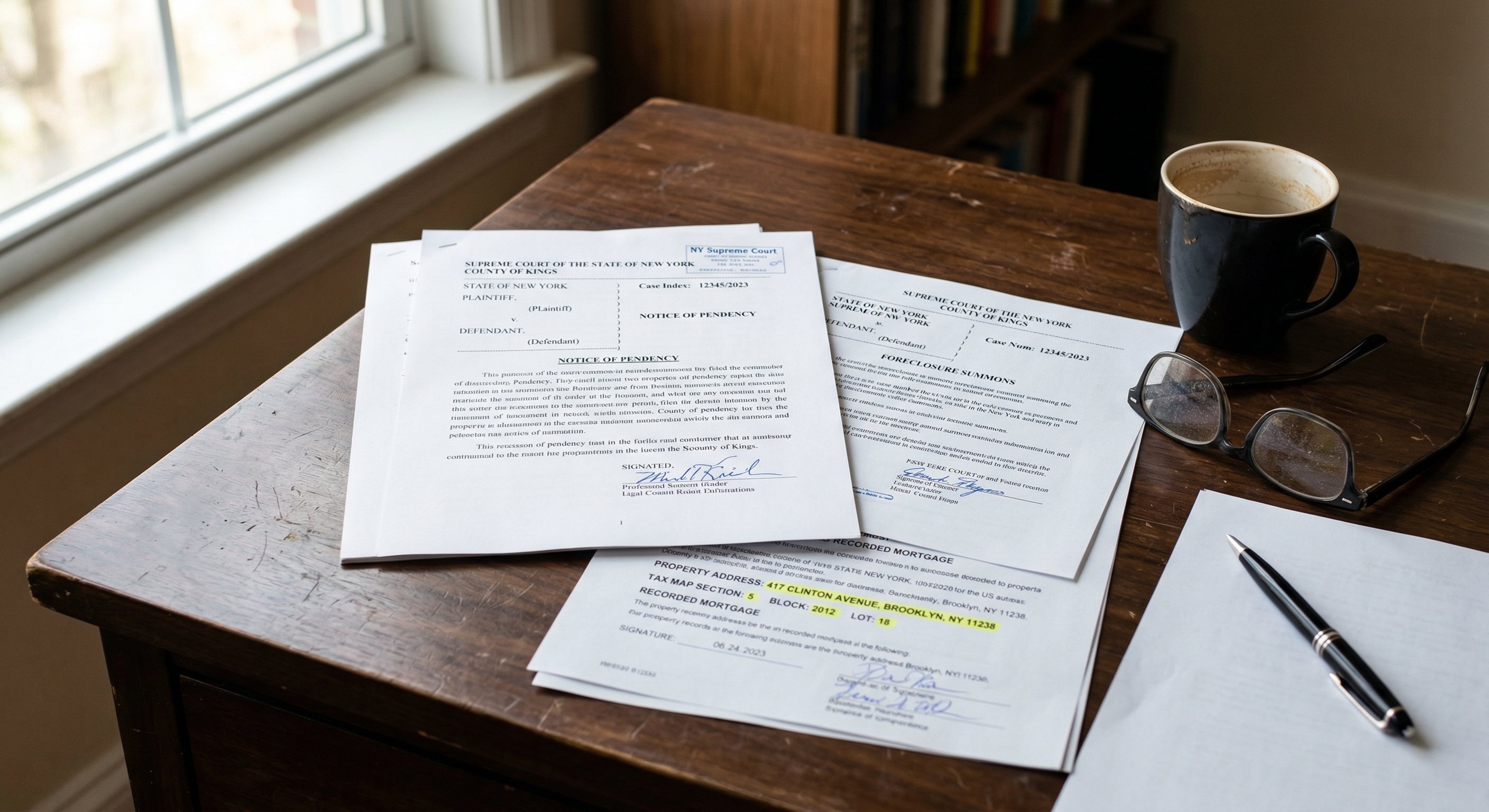
The formal beginning of a New York foreclosure is the filing of a Notice of Pendency (also called a lis pendens) in the county clerk's office. This happens simultaneously with the lender filing a foreclosure summons and complaint in New York Supreme Court.
The Notice of Pendency clouds the property's title, preventing the owner from selling or refinancing through conventional channels. It also creates the public record that investors use to identify pre-foreclosure leads.
After the filing, the process follows this sequence:
- Summons and complaint served on the homeowner, who has 20 to 30 days to respond
- Mandatory settlement conference under CPLR 3408, where the court attempts to arrange a workout between borrower and lender
- Order of Reference appointing a referee to calculate amounts owed
- Judgment of Foreclosure and Sale entered by the court
- Notice of Sale published and the property scheduled for referee's auction
- Referee's auction where the highest bidder takes title
The gap between step one and step six is where investors operate. In most New York cases that gap runs 18 months at minimum and often stretches to three or four years.
Where to Find Notice of Pendency Filings
New York City: ACRIS
The five boroughs use a centralized property records system called ACRIS (Automated City Register Information System), managed by the NYC Department of Finance. ACRIS covers Manhattan (New York County), Brooklyn (Kings County), Queens, and the Bronx. Staten Island (Richmond County) is not included; those records are at the Richmond County Clerk's office.
ACRIS is free, searchable by address or block and lot number, and includes all recorded documents: deeds, mortgages, liens, and Notices of Pendency. Filtering by document type and date range is supported. Direct access is at acris.nyc.gov.
The limitation is scale. ACRIS was built for single-property title research, not bulk lead generation. Running lists of every new Notice of Pendency across a borough requires either manual repetition or a data aggregation platform.
Outside NYC: County Clerk Offices
Beyond the five boroughs, property records are maintained at the county level. Search capability varies:
- Nassau County offers a modern online portal with strong coverage
- Suffolk County provides online access through its county clerk e-recording system
- Westchester County has searchable online records
- Erie County (Buffalo) offers partial online access; some records require in-person requests
- Monroe County (Rochester) maintains a county clerk portal that improves year over year
The same limitation applies: single-property lookups, not bulk generation across a county.
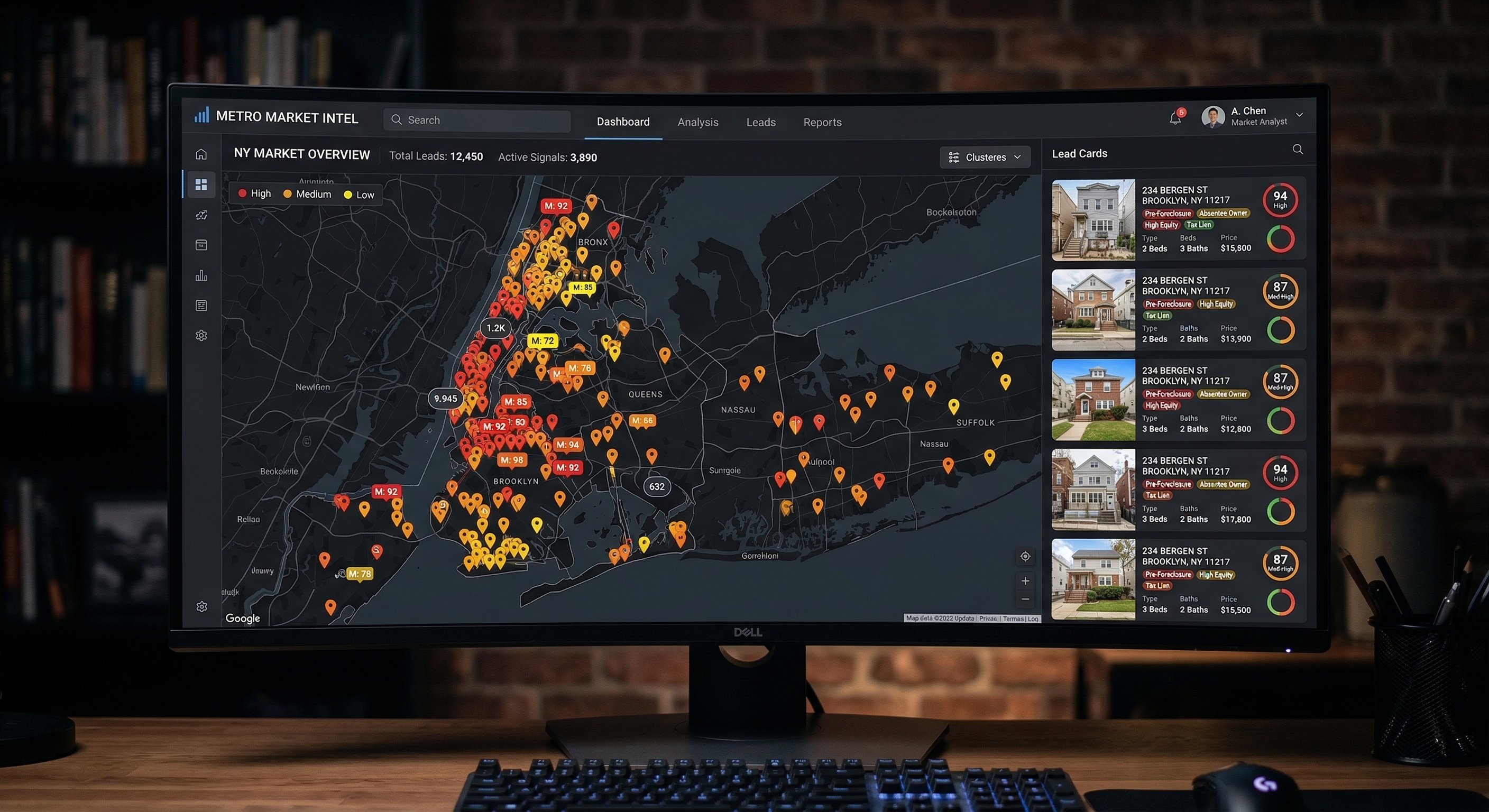
Free Weekly Alerts
See What's Distressed in Your Market
Get free weekly alerts — new distressed properties, motivation scores, and hot neighborhoods in your area. Addresses and contact info available inside DistressIQ.
Free forever · No credit card · Unsubscribe anytime
The Counties Where Pre-Foreclosure Volume Is Highest
New York counties are not interchangeable. The markets differ significantly between downstate and upstate.
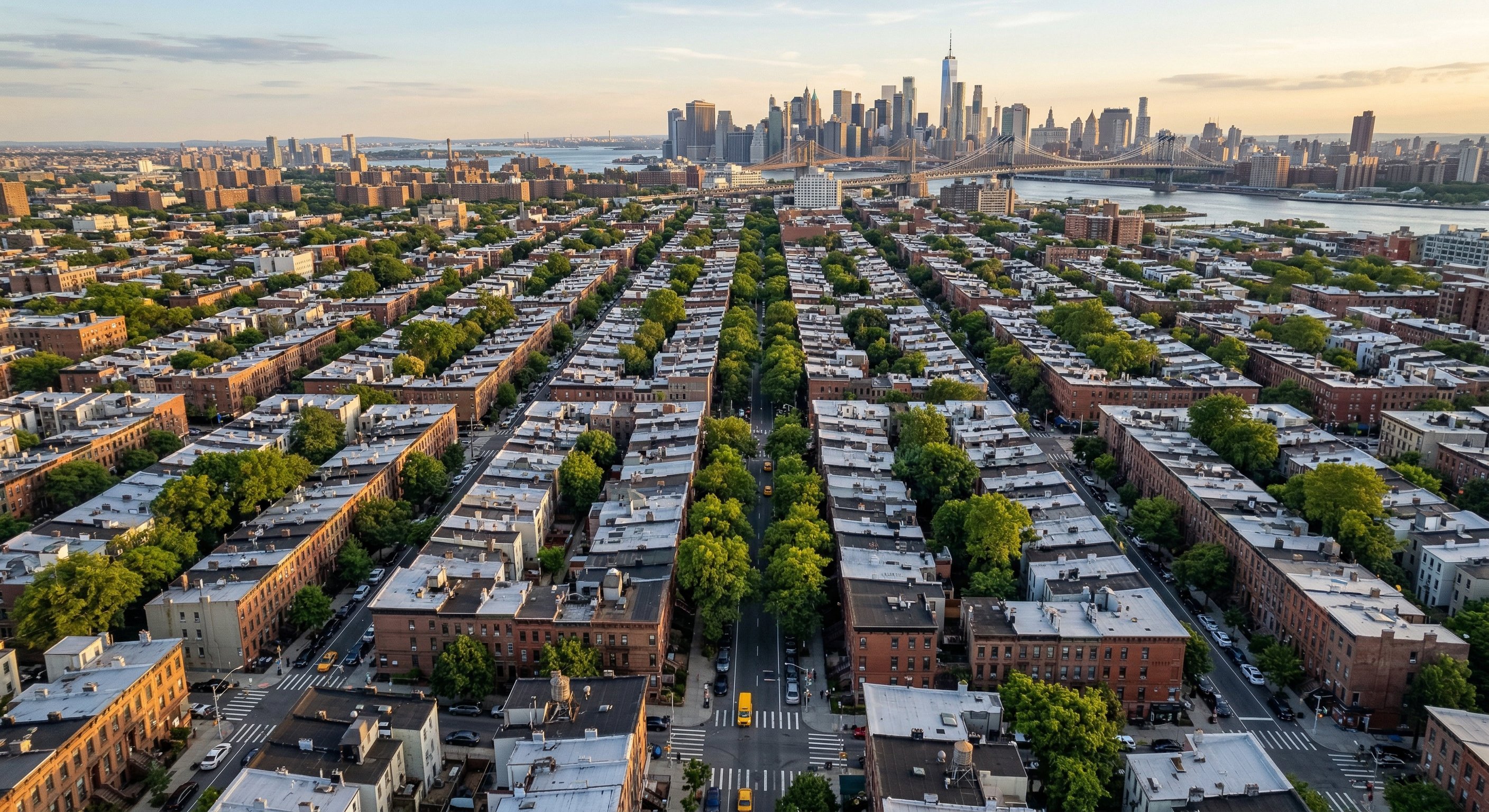
Kings County (Brooklyn). Brooklyn records some of the highest foreclosure filing rates in the state. Older housing stock, elevated loan-to-value ratios, and a mix of owner-occupied and absentee properties create steady distress. A motivated seller in Bedford-Stuyvesant holds an asset worth $800,000 to $1.5 million. Deals work, but the math requires strong comps and a clear exit plan.
Queens County. Consistent pre-foreclosure volume in Jamaica, Hollis, Far Rockaway, and Southeast Queens. Price points run more accessible than Brooklyn. Investor competition remains lighter than Sun Belt markets.
The Bronx. Leads NYC in foreclosure rates per capita. Lower price points and high distressed inventory make it one of the most accessible boroughs for fix-and-flip and buy-and-hold strategies.
Nassau and Suffolk (Long Island). Nassau values range from $500,000 to $1 million for single-family homes. Suffolk offers more inventory at lower price points, particularly in Babylon, Islip, and Brookhaven.
Erie (Buffalo) and Monroe (Rochester). Consistent foreclosure activity at price points that make deal math straightforward. These upstate markets also face a problem downstate does not.
The Zombie Property Epidemic in Upstate New York
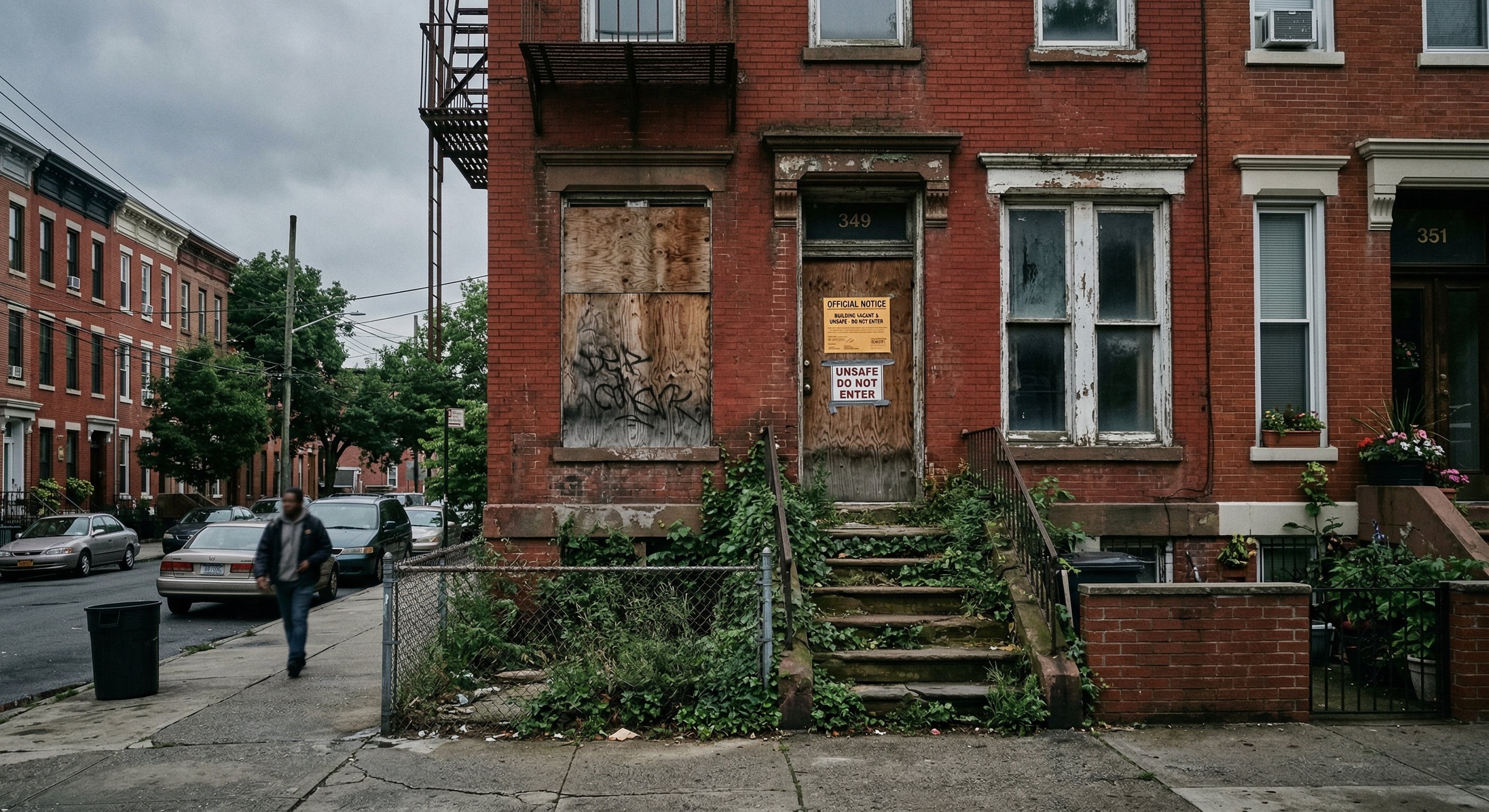
Upstate New York faces a problem that receives less attention than NYC foreclosure rates but destroys neighborhoods: zombie properties. These are homes where foreclosure was started but never completed. The lender filed a Notice of Pendency, the homeowner left assuming they would lose the property, and the lender abandoned the case. The property sits vacant, deteriorating, with no responsible party.
Buffalo, Rochester, Syracuse, and smaller upstate cities hold thousands of zombie properties. A report by the New York State Comptroller's office documented the concentration of vacant and abandoned properties in cities already struggling with population decline and shrinking tax bases.
For investors, zombie properties offer opportunity and complication. The owner who moved away years ago is often willing to sell at a steep discount. The complication is title resolution, which may require negotiating with both the former homeowner and the lender to clear the lis pendens.
How to Build a Pre-Foreclosure Lead Pipeline in New York
The workflow that produces results in this market follows five steps.
1. Source the filings. Notice of Pendency data is the starting signal. Finding filings one at a time through ACRIS or county portals does not scale. Investors building real pipelines use platforms that aggregate filings across counties and deliver fresh leads on a daily or weekly cadence.
2. Layer distress signals. A Notice of Pendency alone confirms the mortgage is in default. The most motivated sellers have multiple signals stacking: mortgage default, property tax delinquency, code violations, and absentee ownership. An owner behind on everything with no presence at the property has few remaining options.
3. Prioritize by recency. Recent filings indicate a homeowner in the early stages with options still open. Older filings may be closer to auction, but the homeowner has been receiving investor mail for years and may be numb to outreach.
4. Skip trace selectively. Trace only leads that clear the multi-signal filter. Single-signal leads convert at low rates. Multi-signal leads with three or four stacked indicators justify the trace cost.
5. Differentiate outreach. Brooklyn and Queens homeowners receive investor mail constantly. Generic postcards blend in. Outreach that references the specific situation, follows up by phone, and arrives again weeks later outperforms bulk mail in markets where dozens of investors mailed the same list.
What to Watch in 2026
New York's foreclosure pipeline has been building pressure since COVID-era forbearance programs ended in 2022. Cases that were paused have been grinding through the courts. Active foreclosure case volume increased through 2024 and 2025, and the 2026 pipeline reflects stalled cases now reaching later stages of judicial process. More filings mean more properties entering the pre-foreclosure window, and more homeowners ready to make a decision. The next 18 to 24 months in New York represent an above-average opportunity cycle.
Frequently Asked Questions
What is a Notice of Pendency in New York?
A Notice of Pendency, sometimes called a lis pendens, is a document filed by a mortgage lender in the county clerk's office when foreclosure proceedings begin. Under RPAPL Article 13, it clouds the property's title and prevents the owner from selling or refinancing through conventional channels. The filing becomes public record, which is how investors identify properties entering pre-foreclosure. In New York, the Notice of Pendency is filed simultaneously with the foreclosure summons and complaint in Supreme Court, and it remains in effect until the case resolves or the lender withdraws it.
How long does foreclosure take in New York?
New York averages 900 to 1,000 days from initial filing to completed auction, making it one of the slowest judicial foreclosure states in the country. During periods of court congestion, some cases have extended past seven years. The mandatory settlement conference requirement under CPLR 3408, the Order of Reference process, and the general backlog in New York Supreme Court all contribute to the extended timeline. For investors, this means the window to reach a homeowner between filing and auction can span several years.
Does New York require a pre-foreclosure notice before filing?
Yes. Under RPAPL § 1304, lenders must send a 90-day pre-foreclosure notice to the borrower before any foreclosure action can be filed. This notice informs the homeowner that the loan is in default and provides 90 days to cure. If the borrower does not cure within that period, the lender may proceed with filing the summons, complaint, and Notice of Pendency. This 90-day notice is the earliest signal that a property may be heading toward foreclosure.
Where can I find pre-foreclosure filings in New York?
For Manhattan, Brooklyn, Queens, and the Bronx, filings are searchable through ACRIS at acris.nyc.gov. Staten Island records are at the Richmond County Clerk's office. All other New York counties maintain property records at the county clerk level, with varying degrees of online access. Nassau, Suffolk, and Westchester have functional online portals. Erie and Monroe counties offer partial digital access. For investors working across multiple counties, an aggregation platform that pulls from all these sources is the practical approach.
What are zombie properties and why do they matter in New York?
Zombie properties are homes where a foreclosure was started but never completed. The lender filed a Notice of Pendency, the homeowner abandoned the property, and the lender abandoned the case. The property sits vacant with no one maintaining it. Upstate cities including Buffalo, Rochester, and Syracuse have been hit hard by this issue. A report from the New York State Comptroller documented the scale across upstate municipalities. For investors, these properties can be acquired at deep discounts from owners who relocated years ago, but the title work requires negotiating with both the former homeowner and the lender to clear the clouded title.
Which New York counties should investors target for pre-foreclosure leads?
Kings (Brooklyn), Queens, the Bronx, Nassau, and Suffolk generate the most consistent pre-foreclosure volume. For investors seeking lower price points, Erie County (Buffalo) and Monroe County (Rochester) offer accessible entry points with straightforward deal math. The NYC boroughs and Long Island operate as fundamentally different markets from upstate regions, with different price levels, buyer pools, and negotiation norms. Treating New York as a single market leads to bad strategy.
Is New York a good market for new real estate investors?
New York's legal complexity and price points create a steeper learning curve than markets like Ohio or Indiana. The judicial process, title issues specific to NYC properties, and the variation between borough and upstate markets all require study. That said, the extended timeline is forgiving. Unlike trustee-sale states where decisions happen in days, New York's pre-foreclosure window gives investors months or years to evaluate a deal, run title, inspect the property, and negotiate. Investors who learn the RPAPL process and understand county-level differences can find opportunities that more casual investors skip.
The Bottom Line
New York's judicial foreclosure system moves slowly. For real estate investors, that is the advantage. The 900 to 1,000 day average from filing to auction creates a long runway to find motivated sellers and negotiate deals before properties reach the referee's sale.
The work is finding the right leads. ACRIS and county clerk portals provide raw records, but manual searches do not scale. The investors building real pipelines in New York use data platforms that aggregate Notice of Pendency filings, cross-reference tax delinquency and code violations, and score leads by motivation level.
New York is a harder market than most. It is also less competitive because of that difficulty. The investors who understand RPAPL Article 13, know which counties produce volume, and can identify multi-signal leads have access to deals that most of the market never sees.
See live pre-foreclosure signals across New York counties on DistressIQ
The data behind this article
DistressIQ Monitors These Signals in Real Time
Pre-Foreclosures
NOD + NTS filings
Tax Delinquency
County treasurer records
Code Violations
Municipal inspection filings
Probate Filings
Superior Court records
Every lead is scored 0–100 for seller motivation based on signal type, duration, severity, and stacking. Nationwide coverage — every US county, updated daily.
Ready to find deals in your market?
See Live Distress Signals in New York
Stop calling dead leads. Every lead in DistressIQ is scored 0–100 for seller motivation, with verified contact info included. Browse the free tier to see what's active in your market right now.
Browse Free Leads — No Credit Card