How to Find Pre-Foreclosure Leads in Michigan (2026 Investor Guide)
How to Find Pre-Foreclosure Leads in Michigan (2026 Investor Guide)
TL;DR: Michigan processes most foreclosures without court involvement under MCL 600.3201, making the timeline faster than nearly every Midwest neighbor. A published notice triggers a four-week countdown to the Sheriff's Sale, but state law then grants homeowners a six-month statutory redemption period that opens a second, overlooked negotiation window. Wayne County leads the state in distress volume. Genesee, Macomb, and Kent counties deliver strong conversion rates with thinner competition. Investors who track county-verified signals daily hold the timing advantage Michigan's compressed schedule demands.
Michigan allows both judicial foreclosure and non-judicial "foreclosure by advertisement" under MCL 600.3201. The non-judicial path dominates because it requires no judge, no lawsuit, and no courtroom schedule. Lenders publish a notice, wait four weeks, and sell the property at auction.
That speed compresses the timeline for reaching homeowners, but it also creates a secondary opportunity after the sale that most investors simply ignore.
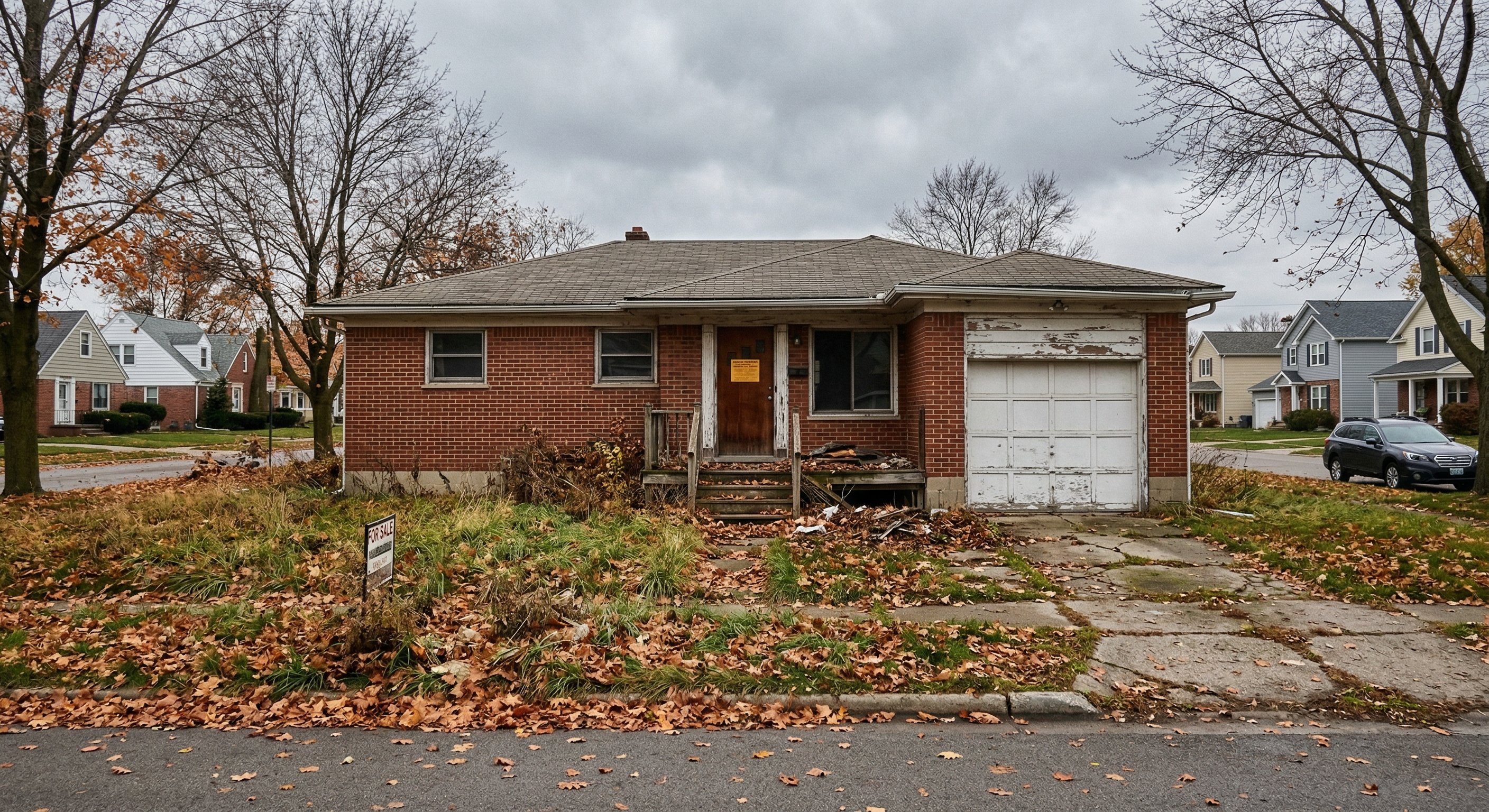
How Foreclosure by Advertisement Works
Michigan's Revised Judicature Act (1961) governs the process. When a mortgage contains a power-of-sale clause and the borrower defaults, the lender may foreclose by advertisement rather than filing a lawsuit.
The lender must publish a notice of foreclosure sale in a county newspaper once per week for four consecutive weeks and post notice physically on the property. The notice names the borrower, describes the property, states the amount owed, and specifies the sale date and location.
The sale happens at public auction. The lender's opening bid usually covers the outstanding balance plus fees and costs. If nobody bids higher, the lender takes title through a Sheriff's Deed.
Here is the part most guides skip: that Sheriff's Deed does not take effect immediately. Michigan grants the homeowner a statutory redemption period to reclaim the property by paying the full sale price plus allowable costs. For most residential properties the period runs six months. Properties larger than three acres, or where the sale price is less than two-thirds of the original debt, get 12 months. Abandoned properties drop to 30 days (MCL 600.3240).
The certificate holder cannot take possession, list the property, or begin renovations until redemption expires. Savvy investors learn to work within this window rather than around it.
Two Windows, Not One
Michigan's process creates two distinct opportunities for real estate investors, and the second window is where the real edge lives.
Window 1: Pre-Sale (the four weeks between first publication and the auction).
This is the traditional pre-foreclosure play. The notice has been published. The homeowner has a sale date staring at them. Investors who reach the owner during this window can negotiate a direct purchase, a short sale, or a deed-in-lieu arrangement that avoids the auction entirely.
The constraint is time. Four weeks of publication leaves a narrow outreach window. If the investor's data is even a week behind the publication date, a quarter of the available time has already evaporated.
Window 2: Post-Sale Redemption (six months after the Sheriff's Sale).
This is the Michigan-specific opportunity that most guides written for a national audience never address.
After the Sheriff's Sale, the homeowner still holds legal title. They cannot refinance or sell on the open market because the Sheriff's Deed clouds the title, but they retain ownership and the right to redeem. The investor who purchased the certificate at auction (or acquired it afterward) now has up to six months to negotiate directly with the homeowner for an early deed transfer.
Homeowners in this position have already lost at auction. Many are open to a clean exit, whether that means moving assistance, a small cash payment, or simply a structured departure rather than forced eviction when redemption expires.
This window rewards patience. The investor already holds the certificate. There is no competitive bidding and no race against other buyers.
Which Michigan Counties Produce the Best Leads
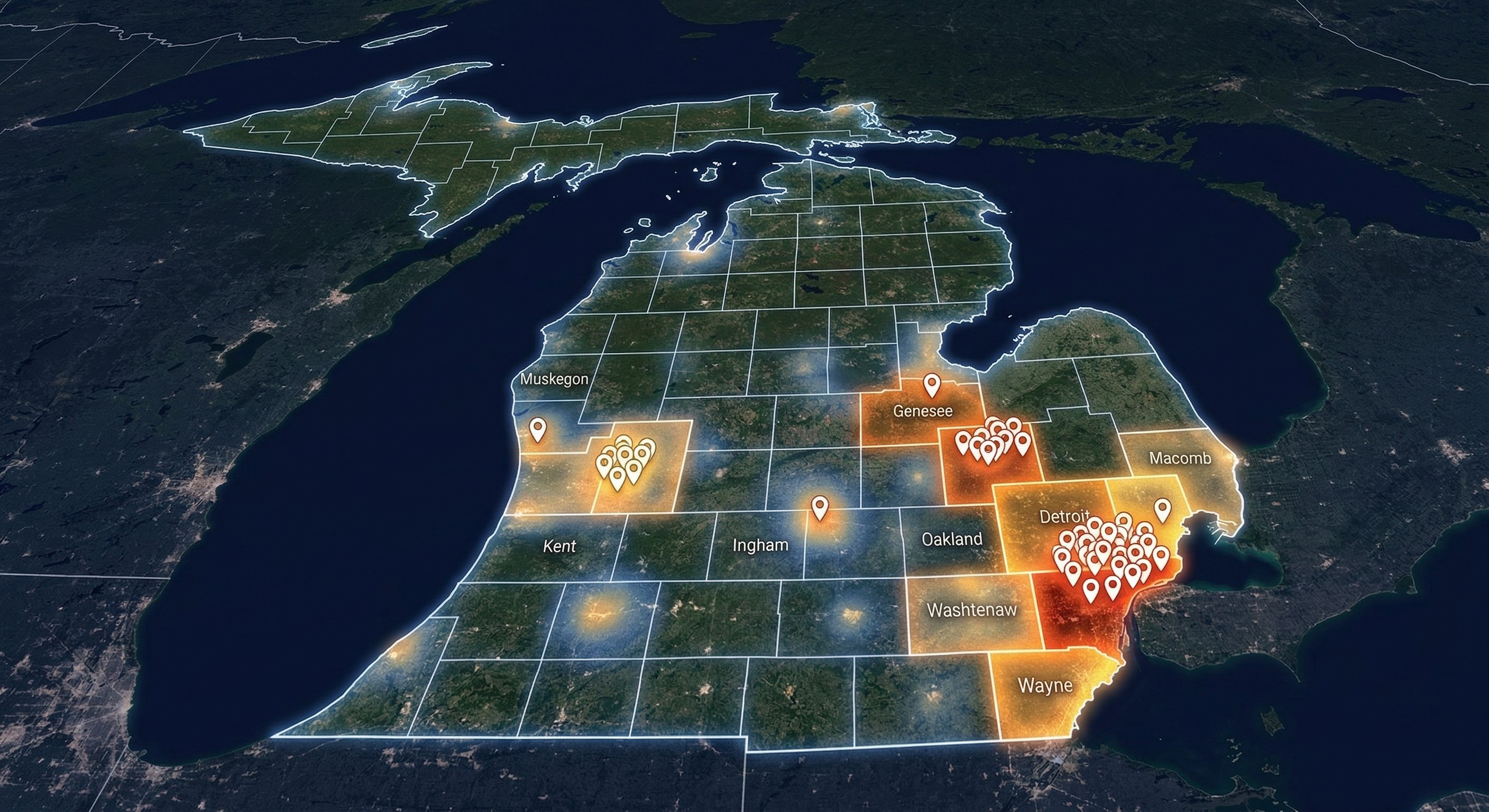
Michigan has 83 counties. Roughly ten of them generate the pre-foreclosure volume that moves the needle for investors building a repeatable pipeline.
Wayne County (Detroit) leads the state in raw distress volume. Detroit's post-bankruptcy recovery has been uneven, with reinvestment concentrated in core neighborhoods while outer-ring areas remain stressed. The volume is high, but so is competition.
Genesee County (Flint) carries persistent distress tied to manufacturing decline and the water crisis aftermath. Rates run well above the state average. Investor saturation is lower than Wayne and conversion rates are strong.
Oakland County (Pontiac, Southfield, Troy) has a lower foreclosure rate but higher property values. When a deal surfaces here, the equity cushion tends to be substantial.
Macomb County (Sterling Heights, Warren) offers solid volume with less investor crowding than Wayne. Many Detroit-focused investors expand into Macomb as a natural second market.
Kent County (Grand Rapids) is Michigan's second-largest metro. Lower distress volume, but higher property values. Grand Rapids rewards selectivity over volume.
Ingham (Lansing), Kalamazoo, and Muskegon round out the secondary tier with enough deal flow to justify monitoring.
Free Weekly Alerts
See What's Distressed in Your Market
Get free weekly alerts — new distressed properties, motivation scores, and hot neighborhoods in your area. Addresses and contact info available inside DistressIQ.
Free forever · No credit card · Unsubscribe anytime
Three Ways to Find Michigan Pre-Foreclosure Leads
1. Newspaper Public Notices (Manual)
State law requires that the foreclosure notice appear in a newspaper of general circulation in the county where the property is located. In Wayne County that might mean the Detroit Free Press. In Genesee it means The Flint Journal. In Kent it means the Grand Rapids Press.
Theoretically, an investor could monitor each paper weekly, extract addresses, cross-reference ownership, then look up contact information. For a single county, tedious but doable. For five counties on different schedules with different formatting, it becomes a data management problem that eats into the four-week window.
2. County Recorder and Court Databases
Some counties maintain online portals. Wayne County's register of deeds is searchable. Kent County offers parcel lookup. The problem is that each county runs a separate system with its own interface and update cadence. Pulling leads from four counties means learning four different platforms.
3. Aggregated County-Direct Data
The practical limit on manual approaches is speed. Michigan's four-week window punishes slow data. A platform that aggregates county-direct signals from all 83 counties and updates daily eliminates the data-chasing overhead.
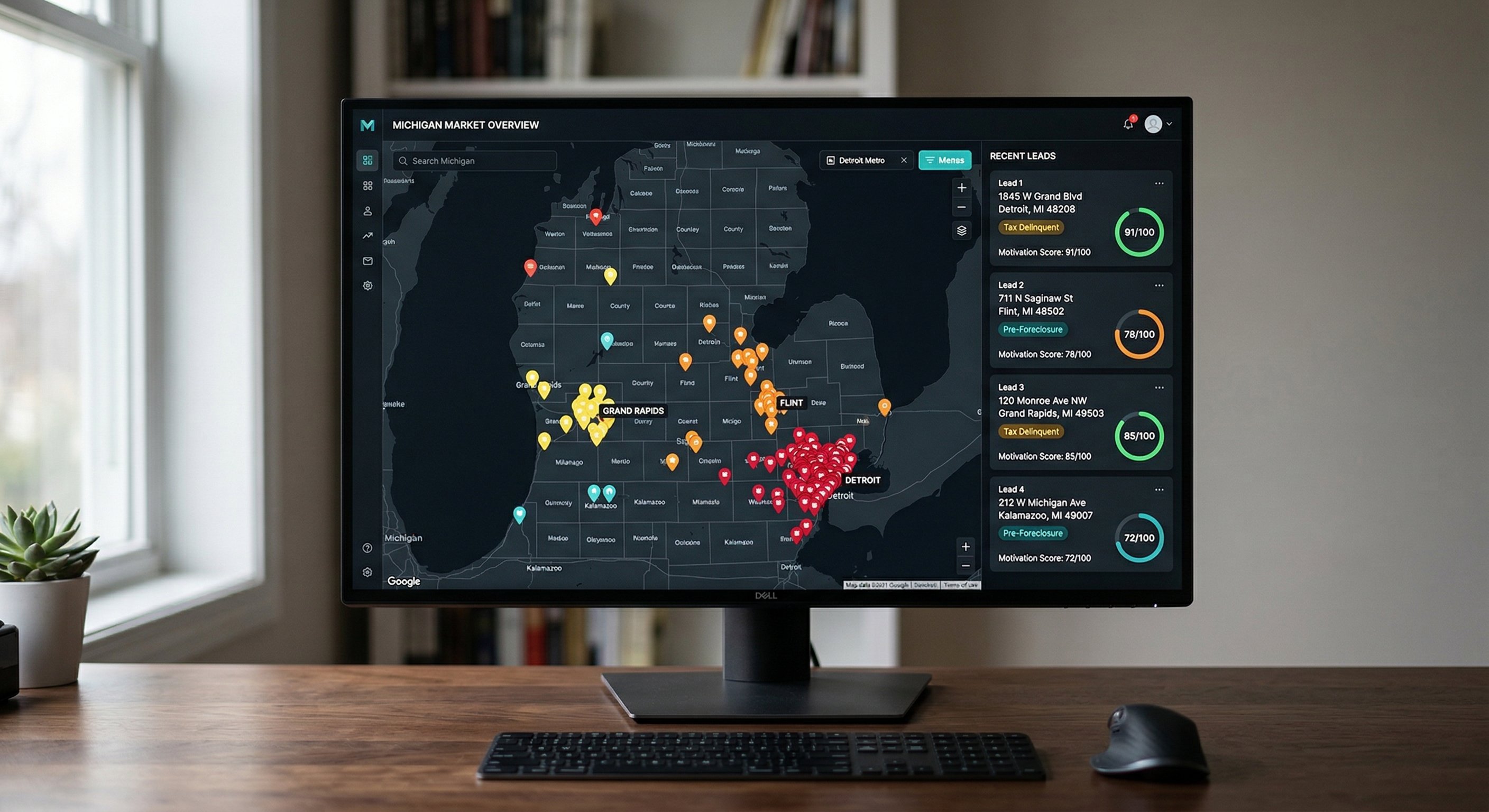
DistressIQ pulls pre-foreclosure signals from county sources across all 83 Michigan counties, refreshed daily. Each lead shows signal type, property characteristics drawn from assessor records, and a motivation score that stacks every available distress indicator on the property. A home carrying both a foreclosure notice and a tax delinquency scores higher than one with a foreclosure notice alone, because multi-signal properties convert at measurably higher rates. Browse the Michigan map for free. Pay only when contact details are unlocked. See live pre-foreclosure leads across Michigan on DistressIQ.
What Separates Good Leads from Noise
Not every pre-foreclosure filing deserves a phone call. Experienced Michigan investors filter on a handful of signals that predict real motivation.
Multi-signal stacking is the strongest indicator. A property with a foreclosure notice plus a tax lien plus an absentee owner signals a homeowner overwhelmed on multiple fronts. These leads convert at higher rates than single-signal properties.
Equity position determines whether a deal can close cleanly. If the assessor-verified value sits well above the debt, the homeowner has something to walk away with and the investor has a workable spread.
Timeline position changes the outreach dynamic. Properties where the notice was published within the past week may find the homeowner still processing the reality. Properties closer to the sale date carry higher urgency but more competition.
Red flags include title disputes, multiple junior lien holders, and declining neighborhood comps.
2026 Michigan Market Context
Foreclosure filings have stabilized near pre-pandemic norms. Michigan's rate sits mid-pack nationally at roughly one filing per 5,300 housing units. Wayne County dominates raw volume, though some smaller counties post higher per-capita rates.
Detroit proper is bifurcated. Neighborhoods near Midtown and the riverfront are appreciating. Outer neighborhoods remain stressed. Pre-foreclosures in the appreciating zones carry equity opportunities that did not exist five years ago.
Interest rates holding above 6.5 percent through 2025 and into 2026 have sustained payment pressure on adjustable-rate borrowers, feeding the pre-foreclosure pipeline statewide.
Grand Rapids has tightened. Lower distress volume, higher values, and more competition mean thinner margins. The investors succeeding in Kent County have the fastest data-to-outreach cycle.

The common thread is execution speed. Michigan's four-week publication window does not reward slow data. The investors who close consistently see the signal when it is filed, not when a reseller batches it into a weekly spreadsheet.
DistressIQ tracks pre-foreclosure signals across all 83 Michigan counties, updated daily from county sources. Browse free. Filter by county, signal type, and motivation score. See live Michigan leads, scored by motivation, no subscription required to browse.
Frequently Asked Questions
How long does pre-foreclosure last in Michigan?
Michigan's foreclosure by advertisement process requires four consecutive weeks of newspaper publication before the Sheriff's Sale, giving investors roughly 30 to 45 days between the first notice and the auction. After the sale, state law adds a six-month statutory redemption period for most residential properties, or 12 months for larger parcels and certain loan-to-value thresholds. The total window from first notice to final resolution can stretch seven months or more, though the active pre-sale period is compressed into four to six weeks.
Where are the most pre-foreclosure leads in Michigan?
Wayne County (Detroit) produces the highest pre-foreclosure volume in the state by a wide margin, driven by Detroit's uneven post-bankruptcy recovery. Genesee County (Flint) follows with elevated rates tied to manufacturing decline and the water crisis. Oakland and Macomb round out the top four in the Detroit metro. For volume with less competition, Genesee and Kalamazoo offer solid deal flow with fewer active buyers.
Does Michigan use judicial or non-judicial foreclosure?
Michigan permits both, but the non-judicial "foreclosure by advertisement" path under MCL 600.3201 is far more common. Any mortgage with a power-of-sale clause can be foreclosed without a lawsuit, provided the lender publishes notice for four consecutive weeks. This makes Michigan's process faster than judicial states like Ohio or New York, where court dockets can extend timelines to several years. The trade-off for investors is a shorter outreach window.
What is the redemption period after a Michigan Sheriff's Sale?
Michigan law grants the homeowner six months to redeem after the Sheriff's Sale by paying the full sale price plus costs. Properties larger than three acres, or where the sale price is less than two-thirds of the original debt, carry a 12-month period. Abandoned properties get 30 days under MCL 600.3240. During this period the certificate holder cannot take possession or list the property, creating a holding-cost burden but also a one-on-one negotiation opportunity.
Is Michigan a good state for pre-foreclosure investing?
Michigan ranks among the better states for pre-foreclosure investing because the dual-track system creates two negotiation windows. The pre-sale period rewards fast data and aggressive outreach, while the six-month redemption period rewards patience. Wayne County alone generates enough volume to support a full-time business, and secondary markets like Genesee, Kent, and Ingham provide diversification. The primary risk is the compressed four-week timeline, which demands current data rather than resold lists.
How do investors find pre-foreclosure leads in specific Michigan counties?
Three approaches exist. Manual monitoring of county newspaper notice sections works for one county but breaks down at scale. Individual county register-of-deeds databases require learning a separate platform per county. Aggregated platforms like DistressIQ pull county-direct signals from all 83 Michigan counties into a single daily-updated interface, eliminating research overhead and returning those hours to outreach and deal negotiation.
The data behind this article
DistressIQ Monitors These Signals in Real Time
Pre-Foreclosures
NOD + NTS filings
Tax Delinquency
County treasurer records
Code Violations
Municipal inspection filings
Probate Filings
Superior Court records
Every lead is scored 0–100 for seller motivation based on signal type, duration, severity, and stacking. Nationwide coverage — every US county, updated daily.
Ready to find deals in your market?
See Live Distress Signals in Michigan
Stop calling dead leads. Every lead in DistressIQ is scored 0–100 for seller motivation, with verified contact info included. Browse the free tier to see what's active in your market right now.
Browse Free Leads — No Credit Card