How to Find Pre-Foreclosure Leads in Michigan (2026 Investor Guide)
How to Find Pre-Foreclosure Leads in Michigan (2026 Investor Guide)
TL;DR: Michigan uses non-judicial "foreclosure by advertisement" — the fastest foreclosure process in the Midwest. The Sheriff's Sale notice is your entry signal, but the real edge is Michigan's 6-month statutory redemption period, which creates a post-sale negotiation window most investors completely overlook. Wayne County leads distress volume, but Grand Rapids, Flint, and Lansing have strong conversion rates with less competition. County-verified distress signals, checked daily, are the most reliable way to find motivated sellers at the right stage of the process.
Michigan has about 100 investors treating pre-foreclosure like it's a simple "call before auction" strategy. The ones closing deals understand something the rest don't: Michigan has two investor windows, not one. Most of the guides out there — written for buyers, not investors — only cover the pre-sale period and completely ignore what happens after the Sheriff's Sale.
This is that guide.
How Michigan's Foreclosure Process Actually Works
Michigan is a non-judicial foreclosure state, which means lenders don't need a court order to foreclose. Instead, they use a process called "foreclosure by advertisement." This is different from judicial states like Ohio or New York where foreclosures can drag on for 2-7 years. In Michigan, the process is faster — but the timeline still creates workable investor windows at each stage.
Here's the sequence:
Stage 1 — Missed payments (Months 1-3) The borrower defaults. The lender sends demand letters. No public record exists yet. The clock starts, but nothing is visible.
Stage 2 — Notice of Foreclosure by Advertisement (4 weeks before sale) This is your first signal. State law requires the lender to:
- Publish notice in a local county newspaper once per week for four consecutive weeks
- Post a physical notice on the property
The notice specifies the exact sale date, property address, and original loan amount. This is public record. When this notice hits, you have roughly 30-45 days to reach the homeowner before the Sheriff's Sale occurs.
Stage 3 — Sheriff's Sale The property is sold at public auction — typically at the county courthouse. The opening bid is usually the outstanding loan balance plus fees. If no one bids above that, the lender takes ownership.
Stage 4 — The Redemption Period (6 months) Here's what most guides completely skip: after the Sheriff's Sale, Michigan law gives the original homeowner a 6-month statutory redemption period to pay off the debt and reclaim the property. During this window, the property legally still belongs to the homeowner — the winning bidder can't take possession yet.
For abandoned properties, this drops to 30 days. For properties with less than one-third of the original loan paid off, the period remains 6 months. For properties with more than two-thirds paid off, it extends to 12 months.
This redemption window is where savvy investors work quietly while the market ignores the property.
Two Windows, Two Strategies
Michigan's process creates two distinct opportunities:
Window 1: Pre-Sale (4-6 Weeks Before Sheriff's Sale)
This is the traditional pre-foreclosure play. You're reaching the homeowner before they lose the property at auction. The pitch is simple: "I can close fast, you avoid the auction, you walk away with equity instead of nothing."
The challenge in Window 1 is time compression. You have 4-6 weeks from when the notice publishes to when the gavel drops. Speed and data quality are everything here — you need the signal early, accurate contact info, and a clean outreach system.
Best counties for Window 1 volume:
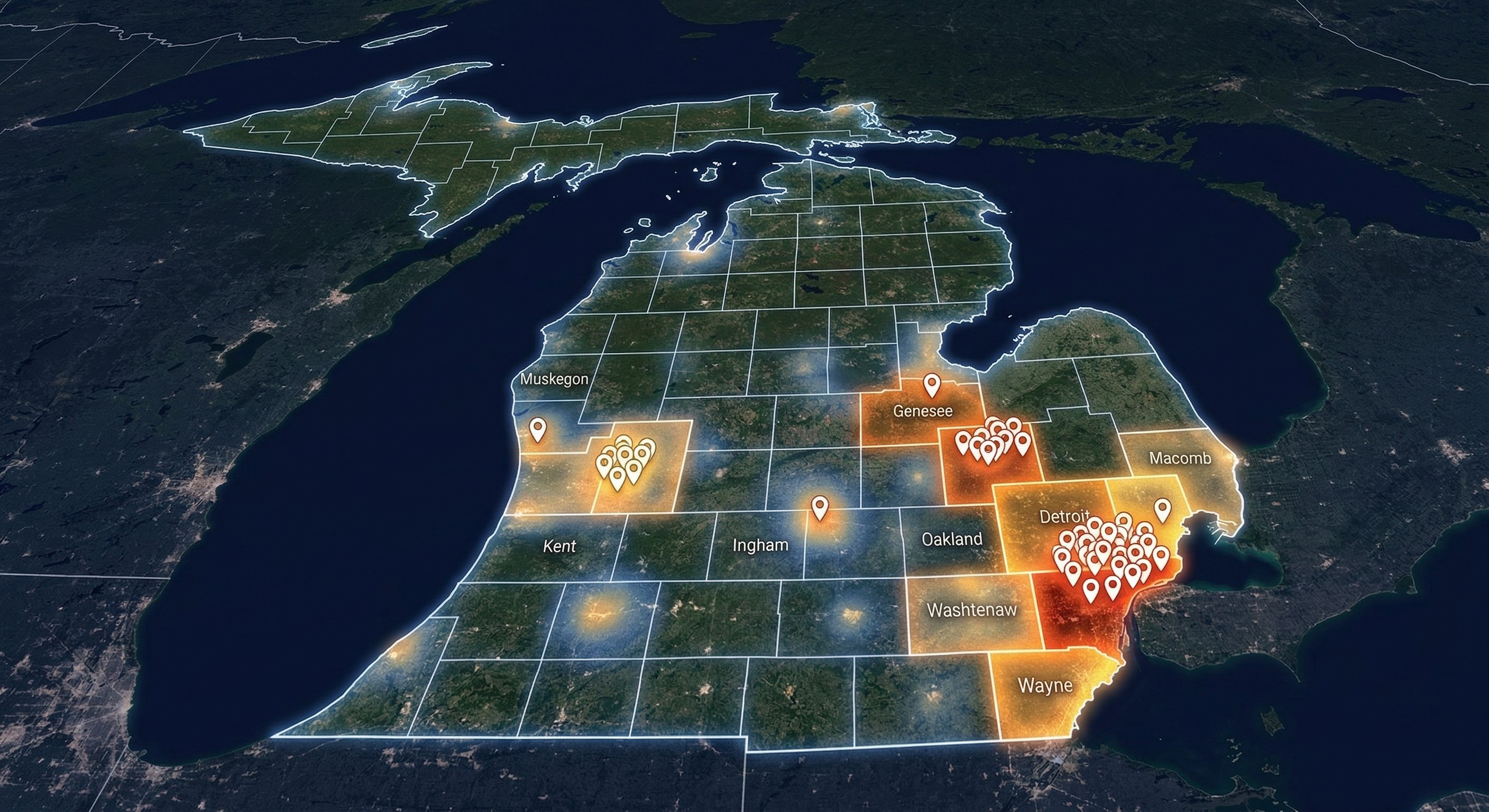
- Wayne County (Detroit) — highest pre-foreclosure volume in the state by a large margin. Detroit's post-bankruptcy real estate market still generates significant distress, particularly in the outer ring suburbs. Expect competition.
- Genesee County (Flint) — consistently elevated distress, strong conversion rates, less investor saturation than Wayne.
- Oakland County — Detroit's wealthier northern suburbs. Higher property values mean better deals when they do convert.
- Macomb County — Detroit's eastern suburbs. High volume, moderate competition.
Window 2: Post-Sale Redemption Period (6 Months)
This is the Michigan-specific edge most investors from other states miss entirely.
After the Sheriff's Sale, the homeowner still technically owns the property. They're in a desperate situation — they already lost the auction, they likely owe more than the property's worth, and they're watching the clock on a 6-month window where they could theoretically redeem but almost certainly can't afford to.
Some investors purchase the Sheriff's Sale certificate (which gives them the right to the property after redemption expires), then approach the homeowner to negotiate early surrender. The homeowner may be willing to deed the property early in exchange for moving costs, forgiveness of remaining obligations, or simply a dignified exit from a painful situation.
This isn't about exploiting someone's worst moment — it's about offering a real option to someone facing an inevitable outcome. Many families in this position want out cleanly. They'd rather cooperate than face a formal eviction after the redemption period ends.
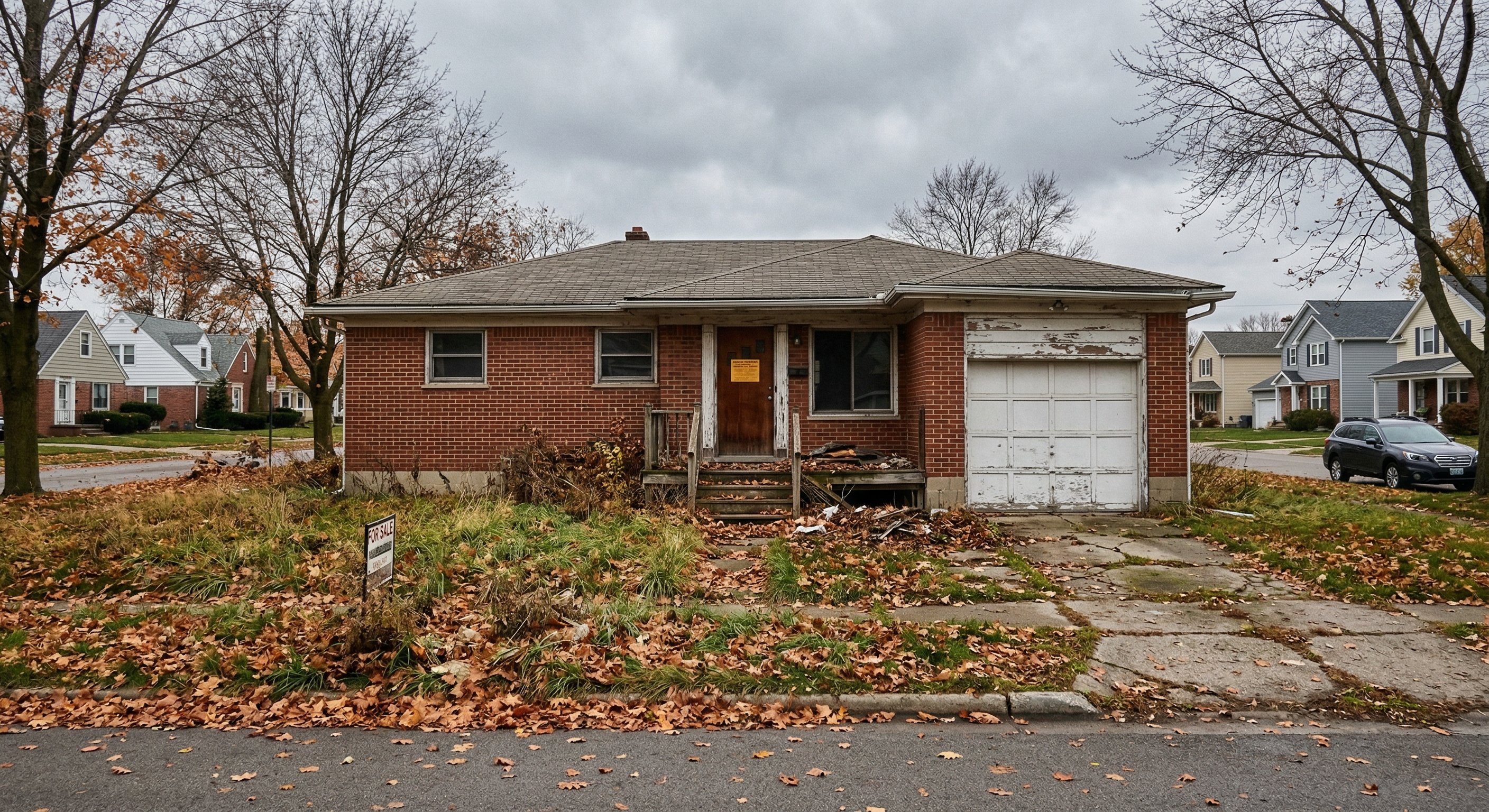
Which Counties to Target in Michigan
Michigan has 83 counties. Not all of them move the needle for real estate investors. Here's how to think about it:
Tier 1 — High volume, established markets
| County | City | Why It Matters |
|---|---|---|
| Wayne | Detroit | Highest distress volume statewide. Detroit MSA has the densest concentration of pre-foreclosures in Michigan. More competition, but more deals. |
| Genesee | Flint | Post-water crisis economic impact still generating distress. Lower competition than Wayne. Strong conversion. |
| Macomb | Sterling Heights | Detroit's eastern suburb ring. Volume + reachable homeowners. |
| Oakland | Pontiac, Southfield | More affluent, lower volume — but when deals appear, they're worth chasing. |
Tier 2 — Secondary markets worth watching
| County | City | Why It Matters |
|---|---|---|
| Kent | Grand Rapids | Michigan's second-largest metro. Growing market, lower distress rate, but meaningful volume. |
| Ingham | Lansing | State capital + MSU brings employment stability, but distress exists in surrounding areas. |
| Kalamazoo | Kalamazoo | Mid-size college town with consistent deal flow. Less investor competition. |
| Muskegon | Muskegon | Lakeshore market seeing appreciation — distress properties here are increasingly valuable. |
Strategy note: Wayne County gets the most investor attention. If your infrastructure can handle it, expand into Genesee and Macomb where the same signals produce less competition.
Free Weekly Alerts
See What's Distressed in Your Market
Get free weekly alerts — new distressed properties, motivation scores, and hot neighborhoods in your area. Addresses and contact info available inside DistressIQ.
Free forever · No credit card · Unsubscribe anytime
How to Find Pre-Foreclosure Leads in Michigan
Option 1: County Newspapers and Public Notice Databases
Michigan law requires publication in "a newspaper in the county where the land is situated." This is technically public, but practically scattered across dozens of regional papers — the Macomb Daily, the Oakland Press, the Detroit Free Press, and so on.
You can piece this together manually. Open 6-8 browser tabs, check publication sites weekly, copy addresses into a spreadsheet, cross-reference ownership records with the county assessor, look up contact info separately. For one or two counties, it's feasible. For any kind of scale, it's a data management nightmare.
The pain is real: different publication schedules, inconsistent formatting, addresses sometimes abbreviated wrong, no standardization between counties. And by the time you've aggregated the data, your 4-6 week window is already half gone.
Option 2: County Recorder and Court Filings
Some counties make their lis pendens and foreclosure notice filings searchable online. Wayne County, for instance, has an online register of deeds. But "searchable" doesn't mean user-friendly — you're often getting raw docket entries with minimal property information, requiring you to then cross-reference with the county assessor's parcel database to get usable contact information.
Add Genesee, Kent, and Oakland into the mix and you're cross-referencing four separate county systems that look nothing alike and update on different schedules.
Option 3: County-Verified Data Platform
The reason serious Michigan investors use data platforms instead of manual county research isn't convenience — it's accuracy and timing. When you need to reach a homeowner in a 4-6 week window, a system that's 10 days behind the publication date costs you real opportunities.
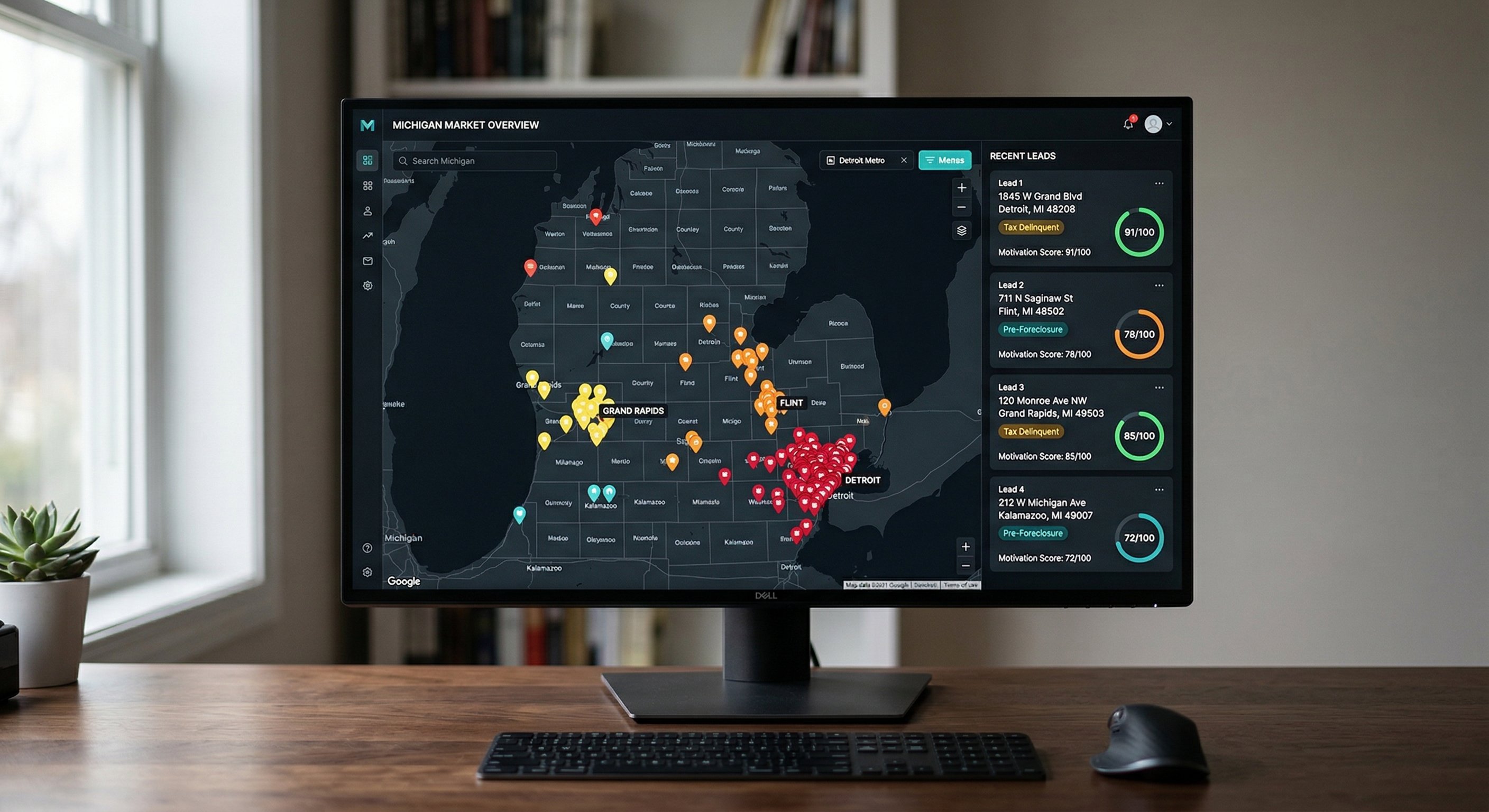
DistressIQ pulls pre-foreclosure signals from county sources across all 83 Michigan counties, updated daily. Every lead shows the signal type, property characteristics (where assessor data is available), and a motivation score that stacks all available distress signals on that property. A home with both a foreclosure notice and tax delinquency scores higher than one with only the foreclosure notice — because the data says multi-signal properties convert better.
You can browse the full Michigan map for free. You only pay when you unlock contact details. See live pre-foreclosure leads in Michigan — browse free on DistressIQ.
What Makes a Michigan Pre-Foreclosure Lead Worth Pursuing
Not every pre-foreclosure in the database deserves your time. Here's how experienced Michigan investors filter:
Signals that predict actual motivation:
- Multiple signal stack — foreclosure notice + tax delinquency on the same property is a strong indication the homeowner is overwhelmed, not just temporarily behind. Single-signal leads convert at lower rates.
- Equity cushion — if the assessor-verified property value shows significant equity above the outstanding loan, the homeowner has something real to walk away with. Zero-equity situations require creative structuring.
- Timeline pressure — if the property has been in pre-foreclosure for 30+ days, the owner has already received outreach from others and is running out of time. Urgency is real.
- Absentee ownership — if the owner's mailing address doesn't match the property address, they're already not living there. Much easier conversation.
Red flags:
- Very recent notice (first week of publication) — you might be the first call, but they haven't fully processed the situation yet. Some investors prefer to wait 2 weeks before outreach.
- Properties with active title disputes or multiple lien holders — complexity slows everything down.
- Low assessor-verified value in neighborhoods with declining comps — the math needs to work.
Outreach That Actually Works in Michigan
The approach that converts in Michigan isn't a scripted sales pitch. Homeowners who are 30-90 days from losing their property to a Sheriff's Sale have heard every "I buy houses" mailer. What they respond to is acknowledgment that this is a hard situation and that you have a legitimate option.
Keep it simple: "I saw your property may be in pre-foreclosure. I buy properties directly and can close quickly — I wanted to reach out before the sale date in case that's an option you'd want to explore. No pressure either way."
That framing — informational, not sales — tends to lower guard rails immediately.
What to offer: Michigan sellers in pre-foreclosure typically care about two things: avoiding the auction and leaving with dignity. A cash offer that covers their immediate debt (or gets close) and allows them 30-45 days to move is often more compelling than a higher number with a longer timeline.

2026 Michigan Market Context
Michigan's foreclosure environment has shifted since the post-COVID moratorium period ended. Key data points for 2026:
- Michigan's foreclosure rate sits around 1 in every 5,300 housing units statewide — middle of the national pack.
- Wayne County consistently posts the highest raw volume, but the rate per housing unit is higher in some smaller counties.
- Detroit proper is experiencing a bifurcated market: core neighborhoods near development zones are appreciating while outer neighborhoods remain stressed. Pre-foreclosures in the appreciating zones have genuine equity plays.
- Grand Rapids has tightened significantly — lower distress overall, but premium pricing on distressed properties when they appear.
- Interest rates holding above 6.5% throughout 2025 have created ongoing stress for adjustable-rate and overleveraged homeowners statewide. This feeds the pre-foreclosure pipeline throughout 2026.
The investors doing well right now aren't chasing volume — they're targeting the right signals in the right neighborhoods with verified contact info and fast follow-up. Michigan rewards execution speed given the 4-6 week pre-sale window.
DistressIQ tracks pre-foreclosure signals across all 83 Michigan counties, updated daily from county sources — so you see the signal when it's filed, not when a data reseller gets around to it. Browse free. Filter by county, signal type, and motivation score. Only pay when you're ready to unlock contact details.
See live Michigan pre-foreclosure leads — scored by motivation, no subscription required to browse.
Frequently Asked Questions
How long does pre-foreclosure last in Michigan?
Michigan's "foreclosure by advertisement" process requires four consecutive weeks of newspaper publication before the Sheriff's Sale can occur. This gives homeowners — and investors — roughly 30-45 days between when the notice first publishes and when the property goes to auction. After the Sheriff's Sale, Michigan adds a 6-month statutory redemption period (30 days for abandoned properties), extending the total window for negotiations considerably beyond what most investors realize.
Where are the most pre-foreclosure leads in Michigan?
Wayne County (Detroit) consistently has the highest pre-foreclosure volume in Michigan. Genesee County (Flint), Macomb County, and Oakland County round out the top four. For investors who want volume with less competition, Genesee and Kalamazoo counties offer solid deal flow with fewer investors in the market.
Do I need a court order to buy a pre-foreclosure in Michigan?
No. Michigan is primarily a non-judicial foreclosure state. The lender doesn't need court approval to proceed with foreclosure by advertisement. From an investor's perspective, this means the process moves faster than judicial states — which compresses your outreach window but also means less legal complexity in the deal itself.
What's the Sheriff's Sale redemption period in Michigan?
Michigan provides a 6-month statutory redemption period after the Sheriff's Sale for most residential properties. For properties where less than one-third of the original loan was repaid, the period is 6 months. Where more than two-thirds was repaid, it extends to 12 months. Abandoned properties have a 30-day redemption window. During this period, the original homeowner can still reclaim the property by paying the outstanding debt — though in practice, very few homeowners can do so, which creates negotiation opportunities for investors who hold the certificate of purchase.
Is Michigan a good state for pre-foreclosure investing?
Yes, particularly in the Detroit metro area and secondary markets like Flint, Lansing, and Kalamazoo. Michigan's non-judicial process is faster than most Midwest states, the dual window (pre-sale + redemption period) gives sophisticated investors more flexibility, and Wayne County alone generates consistent deal flow. The main challenge is the compressed 4-6 week pre-sale window, which requires fast data and fast execution.
How do I find pre-foreclosure leads in specific Michigan counties?
You have three options: check county-level newspaper public notice sections manually (time-consuming and inconsistent), access individual county recorder databases online (varies by county, no standardization), or use a platform that aggregates county-direct data across all 83 Michigan counties in one place. For investors targeting multiple counties, the latter is the only scalable approach — manual multi-county research doesn't survive contact with reality at any meaningful volume.
The data behind this article
DistressIQ Monitors These Signals in Real Time
Pre-Foreclosures
NOD + NTS filings
Tax Delinquency
County treasurer records
Code Violations
Municipal inspection filings
Probate Filings
Superior Court records
Every lead is scored 0–100 for seller motivation based on signal type, duration, severity, and stacking. Nationwide coverage — every US county, updated daily.
Ready to find deals in your market?
See Live Distress Signals in Michigan
Stop calling dead leads. Every lead in DistressIQ is scored 0–100 for seller motivation, with verified contact info included. Browse the free tier to see what's active in your market right now.
Browse Free Leads — No Credit Card