How to Find Pre-Foreclosure Leads in Illinois (2026 Investor Guide)
How to Find Pre-Foreclosure Leads in Illinois (2026 Investor Guide)
TL;DR: Illinois runs the fifth-longest foreclosure timeline in the United States. The judicial process stretches 300 to 490 days on average from complaint filing to sheriff's sale, with Cook County cases regularly exceeding 500 days. That extended window gives investors months to contact owners, negotiate deals, and close before the property reaches auction. Here is how the timeline works, where the data lives, and how to build a system around Illinois pre-foreclosure leads in 2026.
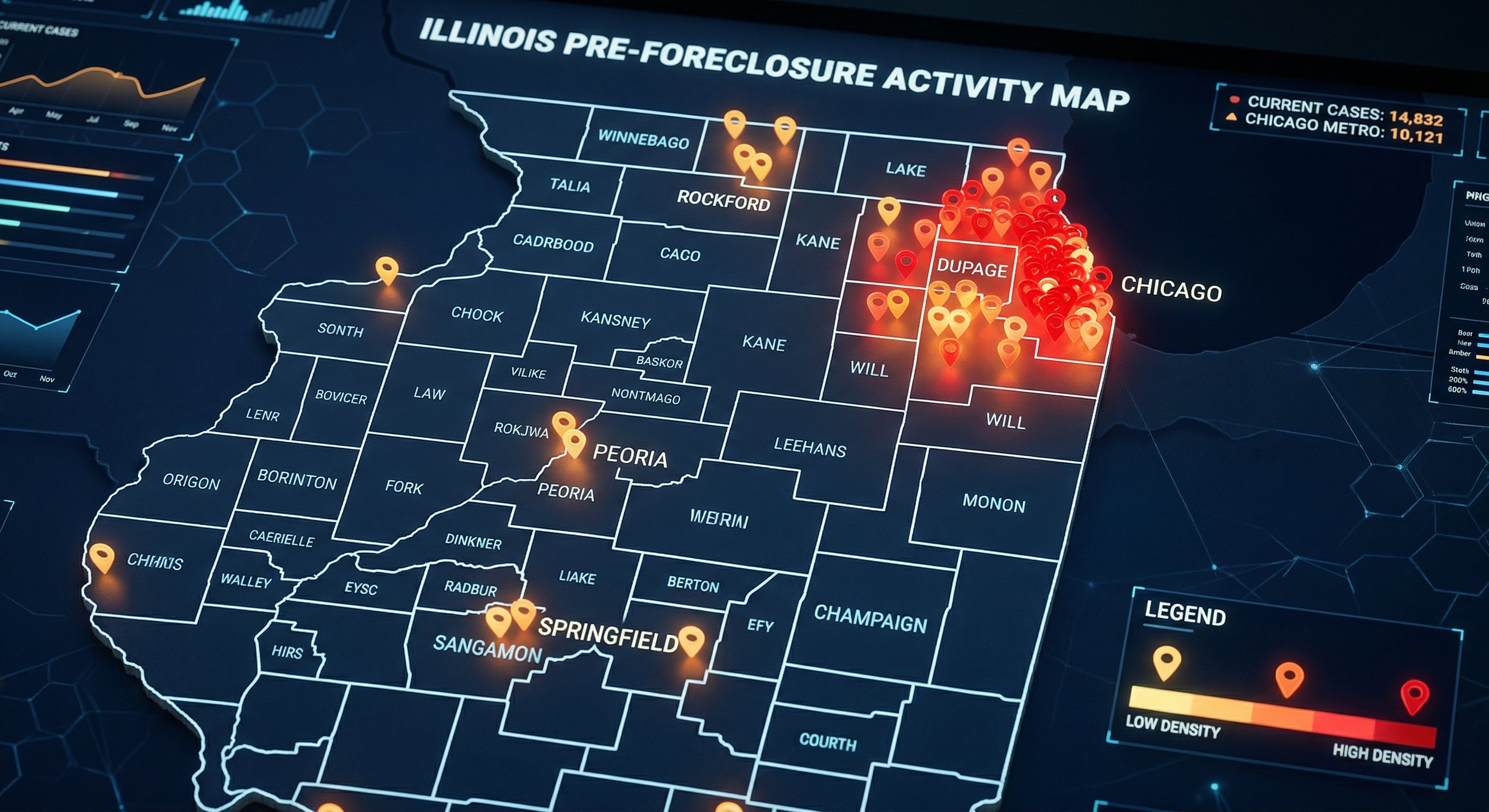
Most investors assume Illinois is just another foreclosure state with another list to pull. It is not. Illinois is one of a handful of judicial foreclosure states where the court system moves slowly enough that pre-foreclosure leads stay active for a year or more. That changes how the pipeline works, how data ages, and when outreach converts.
Arizona processes a non-judicial foreclosure in roughly 90 days. Texas can do it in 60. Illinois? The average case takes 300 to 490 days from complaint filing to confirmed sheriff's sale. In Cook County, timelines regularly stretch past 500 days.
For an investor, that is not a problem. That is the entire advantage.
The Illinois Foreclosure Timeline, Stage by Stage
Illinois foreclosure is governed by the Illinois Mortgage Foreclosure Law (735 ILCS 5/15-1501 et seq.). Every foreclosure must go through circuit court in the county where the property sits. No non-judicial shortcut exists.
| Stage | Typical Timing |
|---|---|
| Borrower defaults on payments | Month 0 |
| Lender files complaint and lis pendens | 2 to 6 months after default |
| Homeowner served with summons | 1 to 4 weeks after filing |
| Homeowner's answer or default entered | 30 days after service |
| Discovery and motion practice | 3 to 9 months |
| Judgment of foreclosure entered | 9 to 18 months from filing |
| Judicial sale noticed and conducted | 30 to 90 days after judgment |
| Court confirms sale | 30 to 90 days after sale |
The pre-foreclosure window runs 12 to 24 months in most Illinois counties. Cook County skews long. Downstate counties with smaller dockets can finish in 10 to 14 months.
Illinois does not grant borrowers a statutory right of redemption after the sheriff's sale. Once the court confirms the sale, title transfers. This matters for investors because it removes a risk layer that exists in states like Minnesota or Michigan, where the former owner can reclaim the property for months after the sale.
The confirmation hearing is a real gate, though. Judges in Cook County have rejected sales where the price appeared unconscionably low, adding another 30 to 90 days.
Why the Long Timeline Creates Opportunity
A longer pre-foreclosure window means more leads are active at any given time. Cases accumulate. In Georgia, a lis pendens filed in January might reach auction by April. In Illinois, that same January filing might not hit sheriff's sale until mid-2026. A list pulled today contains cases from 6, 12, even 18 months ago. Those leads are not stale. The homeowner still holds title. The property has not been auctioned.
Three specific advantages follow:
Early contact gets a long runway. An investor who reaches a homeowner three months into the process has 12 to 18 months to negotiate before the case reaches sale. That is a different conversation than knocking on a door two weeks before auction.
The pipeline compounds. New cases file weekly. Old cases resolve slowly. Cook County alone carries thousands of open cases at any given time.
Competition is thinner than the numbers suggest. Many out-of-state wholesalers assume Illinois is too slow and focus on faster states. The investors who stay tend to be local operators running systematic outreach.
Where the Data Comes From
Illinois is a public records state. The data sources for pre-foreclosure leads are:
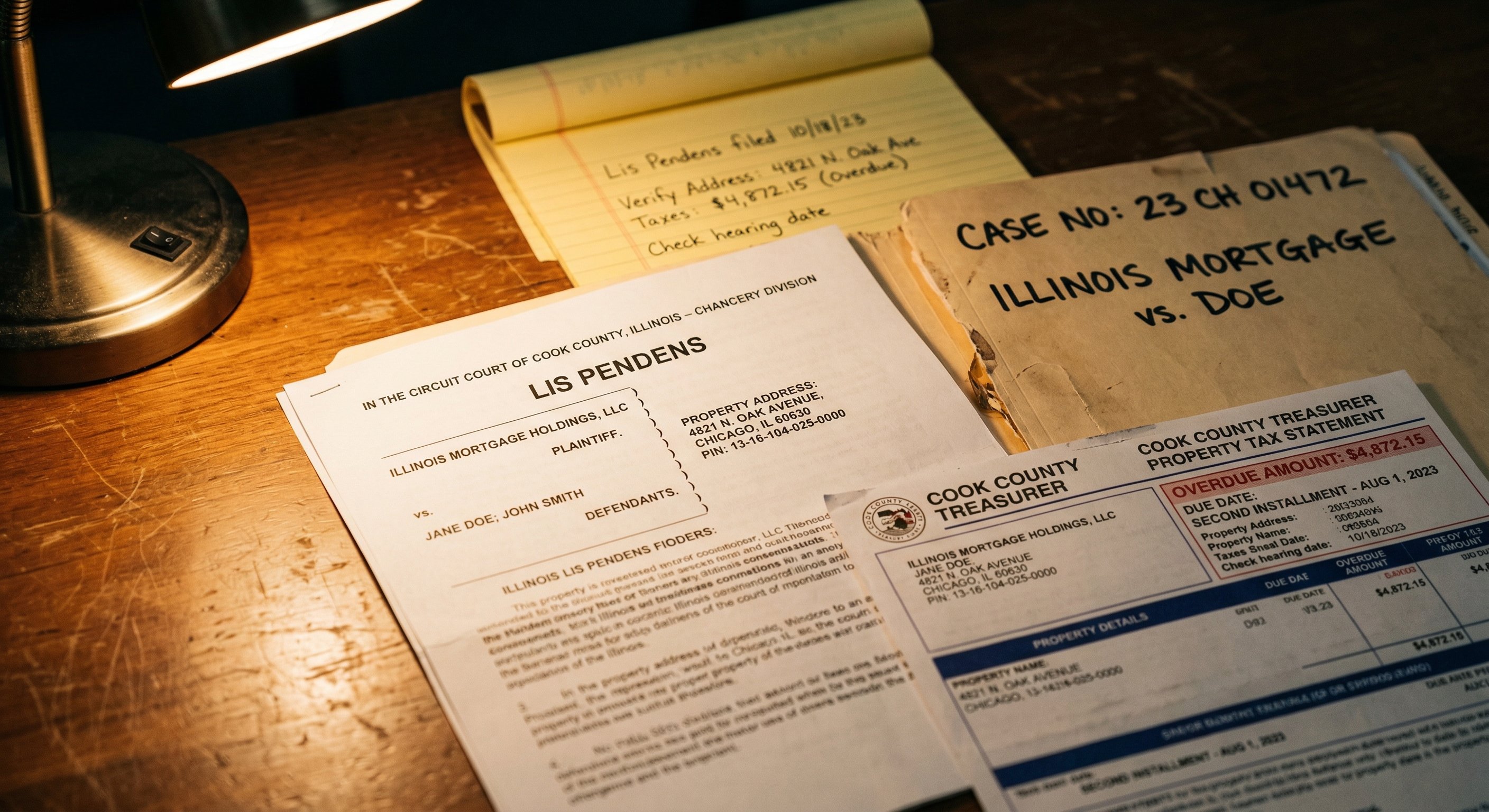
Circuit court filings (lis pendens). The complaint and lis pendens are filed with the circuit court clerk in the county where the property is located. This includes the property address, owner names, lender, amount owed, and case number. Cook County provides electronic case search. Collar counties (DuPage, Lake, Will, Kane, McHenry) each maintain separate portals.
Recorder of Deeds. The lis pendens notice is also recorded with the county Recorder of Deeds, creating a second public record searchable by property address or owner name.
Property tax records. Each county's treasurer maintains tax records on a two-year cycle. Properties can fall behind for multiple years before the annual tax sale. When tax delinquency stacks on top of a pre-foreclosure filing, the motivation signal gets strong.
The data is public. The problem is that it lives in 102 separate county systems, each with its own search interface, its own update schedule, and its own quirks. Stitching it together manually means logging into half a dozen portals and copying addresses one case at a time.
Free Weekly Alerts
See What's Distressed in Your Market
Get free weekly alerts — new distressed properties, motivation scores, and hot neighborhoods in your area. Addresses and contact info available inside DistressIQ.
Free forever · No credit card · Unsubscribe anytime
Cook County vs. the Collar Counties
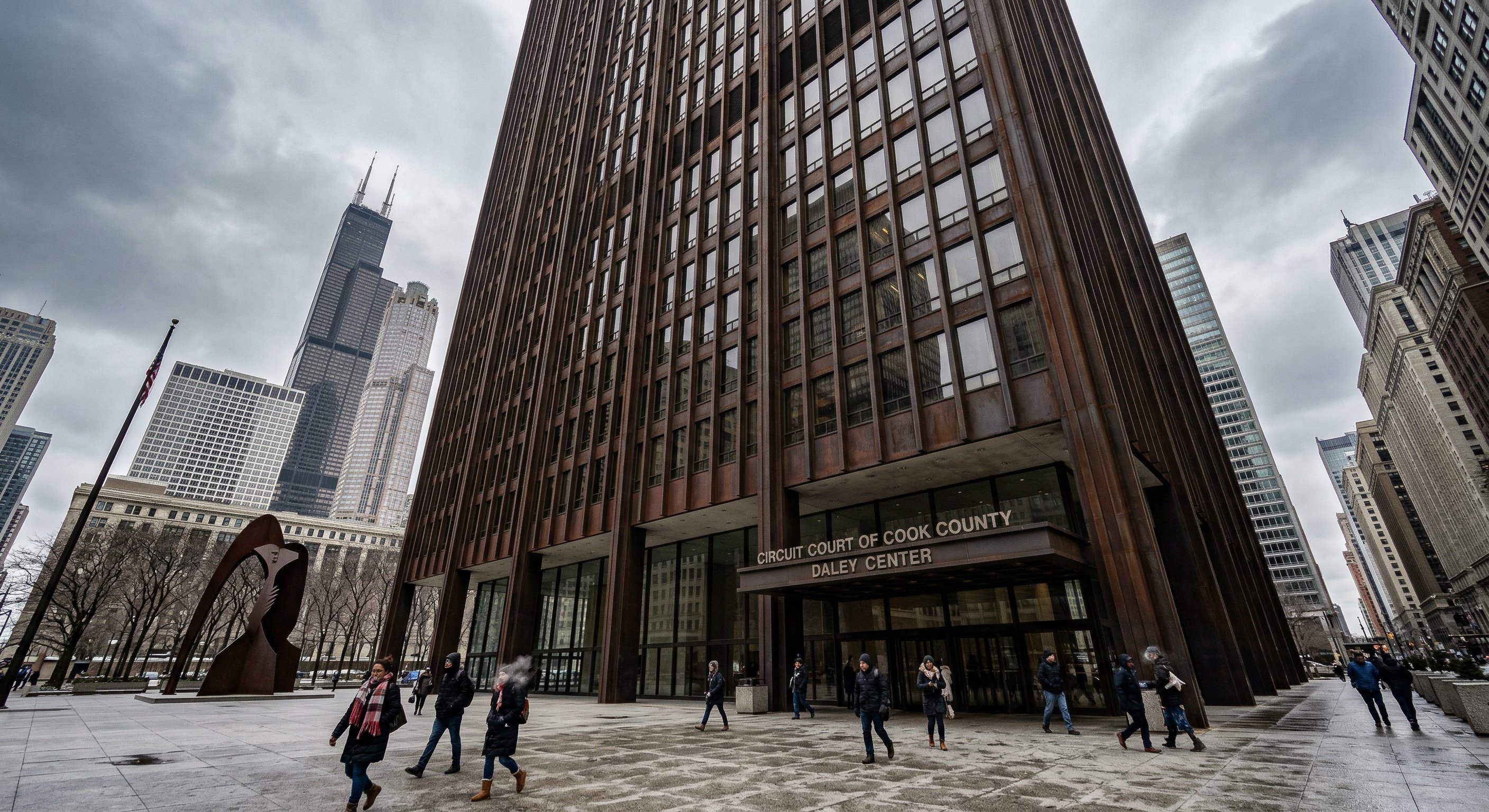
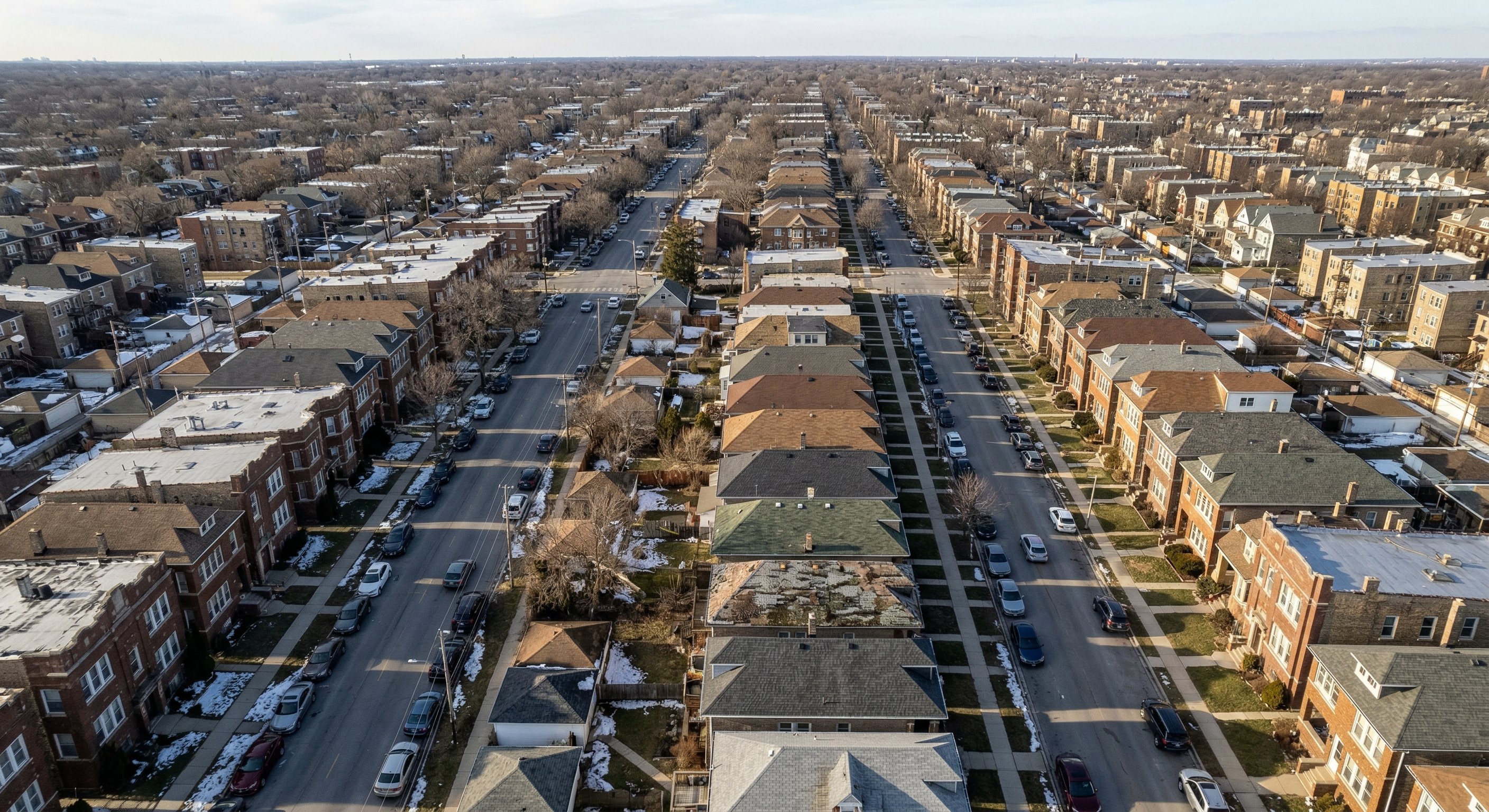
Cook County accounts for roughly 40 percent of Illinois's housing stock and generates the largest raw volume of pre-foreclosure filings in the state. The Chancery Division of the Circuit Court handles the docket. Cases filed in early 2024 may still be in motion in 2026. Chicago neighborhoods with historically high distress rates, including Englewood, Austin, Roseland, and South Shore, produce a steady flow. Inner-ring suburbs like Harvey, Calumet City, and Cicero add volume.
The collar counties present a different profile. Property values are higher, case volume is lower, and timelines can be shorter because dockets are less congested. DuPage County typically processes foreclosures faster than Cook. But fewer investors work those counties, which means less competition per lead.
Property taxes add pressure. Cook County has some of the highest property tax rates in the United States. Effective rates in many Chicago neighborhoods exceed 2.5 percent of assessed value, and some south suburban municipalities push past 3 percent. A homeowner already struggling with mortgage payments who also faces a $6,000 or $8,000 annual tax bill is under compound financial stress.
Downstate Markets Worth Watching
Chicago dominates the conversation, but secondary cities generate real pre-foreclosure volume with far less investor competition.
Rockford (Winnebago County). Consistently posts one of the highest foreclosure rates outside Cook County. Older housing stock, low prices, and strong rental yields for buy-and-hold investors.
Peoria (Peoria County). Manufacturing decline has kept distress levels elevated. Properties in the $50,000 to $120,000 range are common with solid rent-to-price ratios.
Springfield (Sangamon County). A stable employment base, but steady pre-foreclosure inventory in older neighborhoods near downtown.
Champaign-Urbana (Champaign County). The university creates a niche: distressed single-family homes converted to student rentals. Inventory is smaller but the exit strategy is clear.
Decatur and Danville. Higher distress, lower prices, thinner competition. Buy-and-hold markets, not flip markets.
County court systems downstate range from reasonably modern to barely functional. Some still require in-person searches. But the lack of competition compensates.
Building a System Around Illinois Pre-Foreclosures
The investors who close deals in Illinois build a system, not a one-time mailer.
Pull the lis pendens list weekly. New cases file every week. A weekly pull keeps the pipeline fresh.
Cross-reference with tax records. A property that is both in pre-foreclosure and behind on property taxes is a hotter lead than either signal alone. Cook County's property tax portal makes this check straightforward.
Verify the case timeline before outreach. A case filed three months ago is early stage. The homeowner may not have accepted the situation. A case filed 12 to 15 months ago is approaching judgment and the homeowner may be ready to talk. Where a lead sits in the timeline changes the conversation.
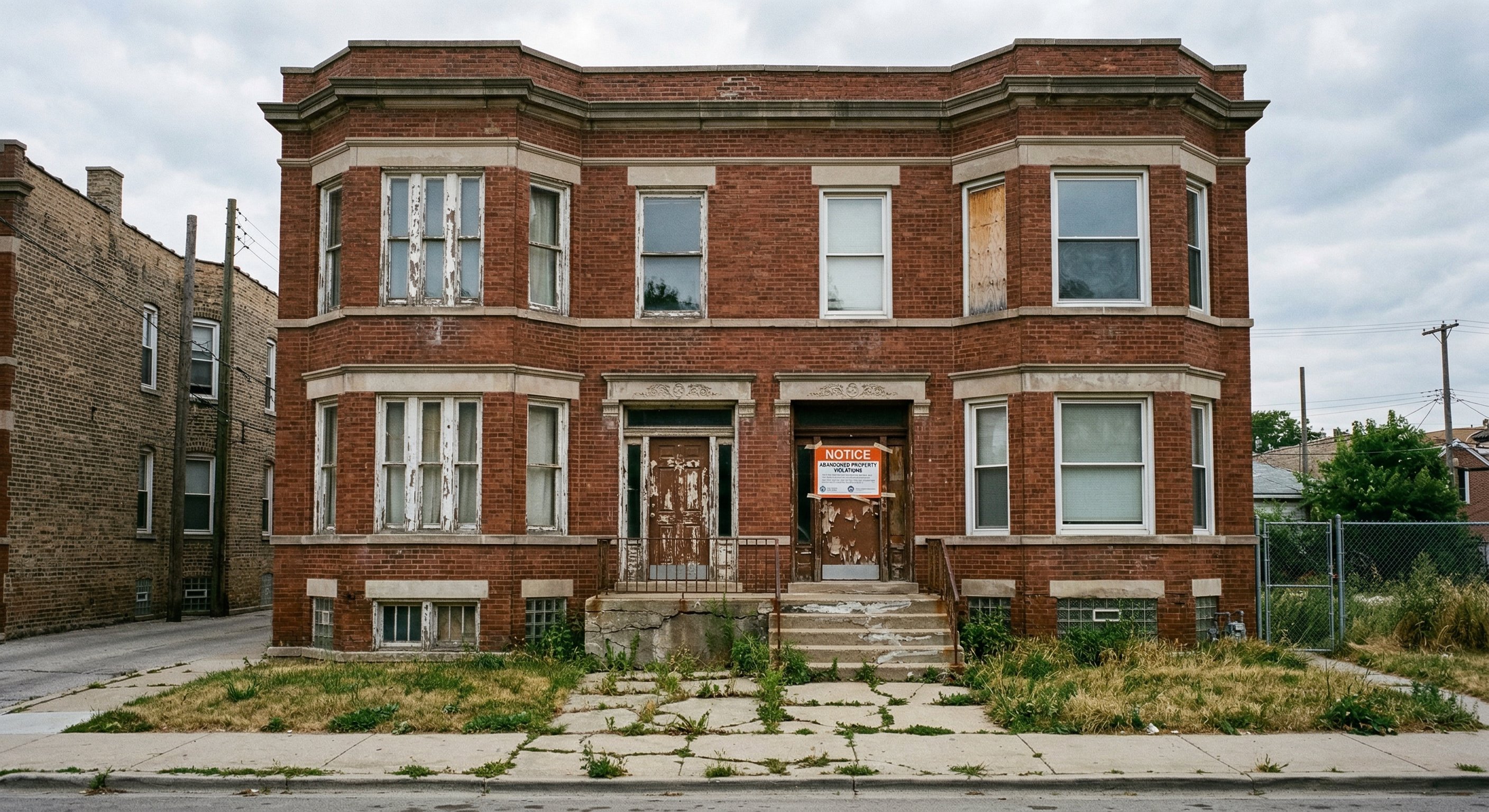
Layer property data. Pull assessed value from the county assessor and compare against the debt in the court filing. Check for code violations and vacancy indicators. Each layer clarifies whether the deal has enough equity to work.
Skip trace the top-tier leads. Court filings give the owner name and property address, not phone numbers or current addresses. Cook County has a high rate of absentee owners: landlords who moved to the suburbs, heirs who never occupied the property. The phone number from a skip trace matters more than the door knock.
Outreach with persistence. One postcard does not work in Illinois. The timeline is too long. The approach that converts is a sequence: a personally addressed letter, a phone call two to three weeks later, another touch at the 60-day mark, and ongoing monitoring of case status. When a case approaches judgment, urgency spikes and previously unresponsive leads become reachable.
What Actually Converts
Direct mail to pre-foreclosure leads typically returns a 0.5 to 2 percent response rate. On 500 mailers per month, expect 2 to 10 responses. Most investors need three or more months of consistent mailing before closing the first deal.
The sweet spot for contact is 6 to 12 months into the case. Earlier, many homeowners still believe they can catch up. Later, some have become numb or moved. The middle window is where the homeowner has accepted the situation and is open to options.
Multi-signal leads outperform single-signal leads by a wide margin. A property with only a lis pendens is a candidate. A property with a lis pendens, tax delinquency, and a code violation is a priority. The stacked signals tell an investor which 20 leads out of 200 deserve most of the attention and budget.
DistressIQ tracks pre-foreclosure filings, tax delinquency, code violations, and other distress signals across every Illinois county, scored by motivation. The map view shows active leads in Cook, the collar counties, and downstate markets in a single interface, ranked by who to contact first. Browsing is free. See Illinois pre-foreclosure leads on DistressIQ.
Frequently Asked Questions
How long does foreclosure take in Illinois?
Illinois is a judicial foreclosure state, meaning every case must go through circuit court. The average timeline runs 300 to 490 days from complaint filing to sheriff's sale, according to data from Attom Data Solutions. Cook County cases frequently exceed 500 days due to docket congestion in the Chancery Division. Downstate counties with smaller caseloads may resolve in 10 to 14 months. The confirmation hearing after the sale can add another 30 to 90 days before title officially transfers.
Does Illinois have a redemption period after foreclosure?
No. Illinois does not grant borrowers a statutory right of redemption after the judicial sale. Once the court confirms the sale, title passes to the purchaser and the former owner has no legal mechanism to reclaim the property. This differs from states like Minnesota and Kansas, where post-sale redemption periods of six to twelve months are standard. The absence of a redemption period in Illinois reduces risk for investors buying at or before auction.
Where can I find pre-foreclosure records in Illinois?
Pre-foreclosure records are public. The primary sources are the circuit court clerk's office in each county, where foreclosure complaints and lis pendens are filed, and the county Recorder of Deeds, where the lis pendens notice is recorded. Cook County provides electronic case search through the Clerk of the Circuit Court. Collar counties such as DuPage, Lake, Will, Kane, and McHenry maintain separate portals with varying search capabilities. Property tax records are available through each county's treasurer or collector.
Why are Cook County property taxes relevant to pre-foreclosure investors?
Cook County has some of the highest effective property tax rates in the United States, with rates exceeding 2.5 percent of assessed value in many Chicago neighborhoods and above 3 percent in some south suburban municipalities, according to the Cook County Treasurer's Office. When a homeowner is already behind on mortgage payments, a large annual tax bill compounds the financial pressure. Properties that appear in both the pre-foreclosure and tax delinquent databases carry a stronger motivation signal than properties with only one distress indicator.
Should an investor focus on Cook County or downstate Illinois?
Cook County offers the highest volume of pre-foreclosure filings in the state and a wide range of property types, including Chicago's multi-unit buildings. Competition is higher but so is deal flow. Downstate markets such as Rockford, Peoria, and Decatur have lower prices, less investor competition, and solid buy-and-hold returns. The tradeoff is fewer deals per market. Experienced investors often work Cook County for flip and wholesale deals while building a rental portfolio in one or two downstate markets.
What is the best time in the foreclosure timeline to contact a homeowner?
The 6 to 12 month window after the lis pendens filing tends to produce the highest conversion rates. During the first few months, many homeowners still expect to resolve the payment issue. Beyond 15 months, some have moved or become disengaged. The middle period is when the homeowner has typically accepted the situation and is open to alternatives such as a cash sale, short sale, or subject-to arrangement. Tracking case status is essential because approaches to judgment often trigger renewed urgency.
See also: Pre-Foreclosure Leads in Texas | Pre-Foreclosure Leads in Florida | Pre-foreclosure Leads in California | What Is Lis Pendens?
The data behind this article
DistressIQ Monitors These Signals in Real Time
Pre-Foreclosures
NOD + NTS filings
Tax Delinquency
County treasurer records
Code Violations
Municipal inspection filings
Probate Filings
Superior Court records
Every lead is scored 0–100 for seller motivation based on signal type, duration, severity, and stacking. Nationwide coverage — every US county, updated daily.
Ready to find deals in your market?
See Live Distress Signals in Illinois
Stop calling dead leads. Every lead in DistressIQ is scored 0–100 for seller motivation, with verified contact info included. Browse the free tier to see what's active in your market right now.
Browse Free Leads — No Credit Card