How to Find Pre-Foreclosure Leads in Georgia (2026 Investor Guide)
How to Find Pre-Foreclosure Leads in Georgia (2026 Investor Guide)
TL;DR: Georgia operates one of the fastest foreclosure timelines in the United States. A homeowner can receive a Notice of Sale and face auction on the courthouse steps in as few as 37 days, because Georgia uses a Security Deed structure that enables non-judicial foreclosure without court involvement. For real estate investors, this compressed window means leads go cold faster than in nearly any other state. This guide explains the legal framework, the signals that matter, county-by-county volume, and the systems needed to reach motivated sellers before the first Tuesday of the month.
Georgia does not use mortgages. It does not use deeds of trust. The state uses a unique instrument called a Security Deed, which transfers legal title to the lender at closing and gives that lender the power to foreclose without filing a lawsuit. This distinction is not a technicality. It is the reason Georgia can move from default to auction in roughly 37 days, and it is the reason most out-of-state investors underestimate how quickly a deal can disappear.
In a judicial foreclosure state like Illinois or New York, the pre-foreclosure window stretches 12 to 24 months. Georgia offers nothing close to that. The lender records a Notice of Sale, publishes it in a newspaper for four consecutive weeks, and sells the property on the first Tuesday of the following month at the county courthouse. No judge. No hearing. No extended redemption period after the sale.
For investors willing to operate at the speed this market demands, the opportunity is significant. Most competing wholesalers in Georgia work stale lists pulled from public records weeks after the filing date. The investor who accesses Notice of Sale filings within days of recording holds a structural advantage.
Georgia's Security Deed and Non-Judicial Foreclosure Framework
The legal foundation for Georgia's rapid foreclosure process is found in Title 44, Chapter 14 of the Official Code of Georgia Annotated (O.C.G.A.). Under O.C.G.A. § 44-14-162, a lender holding a Security Deed may exercise a power of sale without court intervention after the borrower defaults.
The statutory steps are specific:
- Default occurs after the borrower misses payments, typically 90 days of delinquency.
- Notice of Sale is recorded with the Clerk of Superior Court in the property's county, including lender name, borrower name, legal description, and sale details.
- Publication requires the notice in a newspaper of general circulation for four consecutive weeks preceding the sale.
- Written notice must be mailed to the borrower at least 30 days before the sale via certified mail.
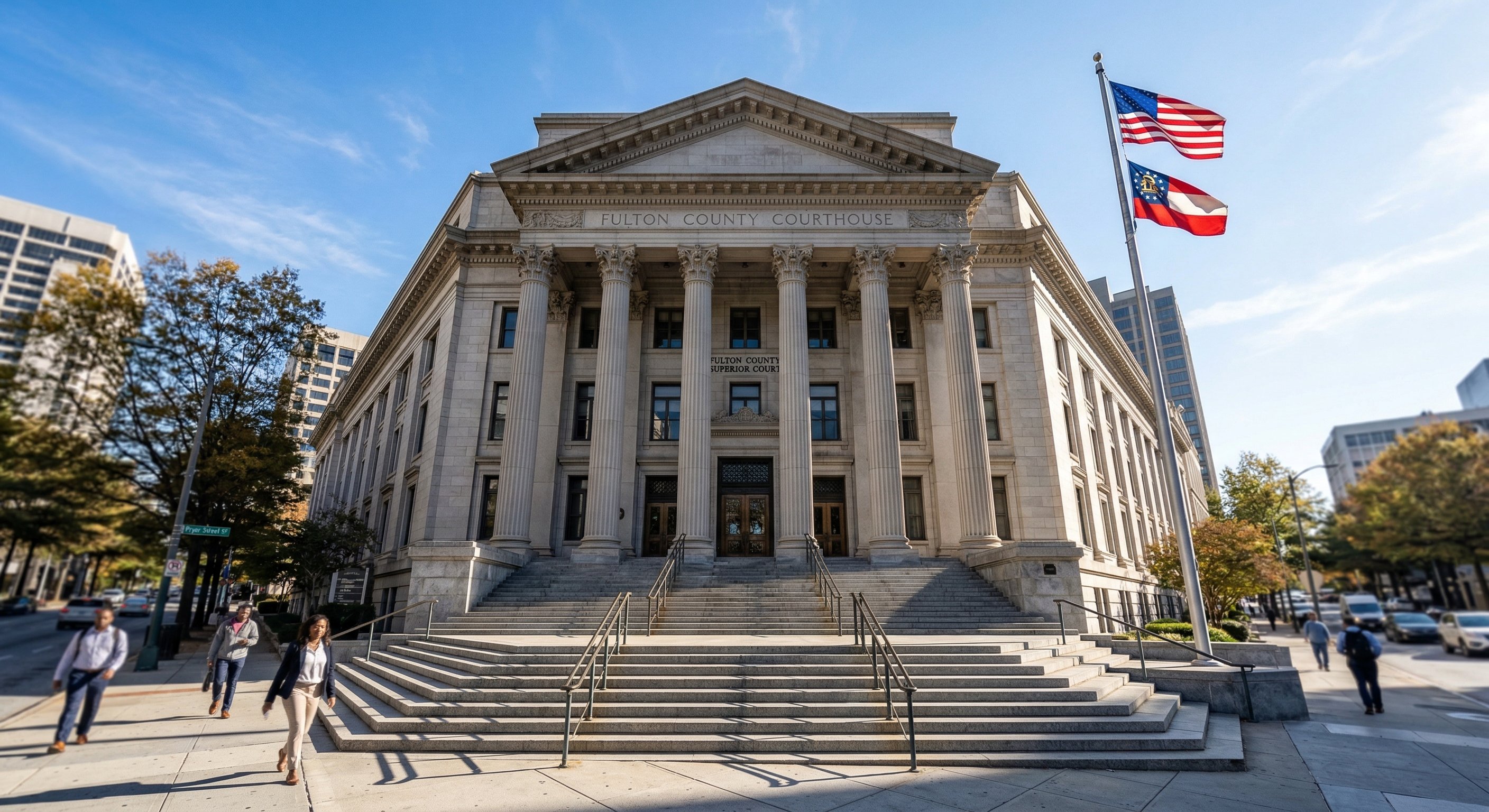
- The sale takes place on the first Tuesday of the month, between 10:00 AM and 4:00 PM, on the county courthouse steps.
The minimum calendar time from Notice of Sale recording to auction is approximately 37 days. Lenders often target a sale date 60 to 90 days out, but nothing in Georgia law requires a longer window.
Post-sale redemption does not exist for non-judicial foreclosures. Once the gavel falls on the first Tuesday, the sale is final.
The Three Signals That Matter in Georgia
Notice of Sale Filing (Primary Signal)
The Notice of Sale is the dominant pre-foreclosure signal in Georgia. Because the state uses a non-judicial process, there is no lis pendens filing for most residential foreclosures. The Notice of Sale is the first public document revealing a property is headed to auction.
Where to find these filings:
- GSCCCA at gsccca.org provides a statewide searchable index across all 159 counties. Free but requires specific search parameters.
- Legal newspapers publish the full notice text. The AJC serves Fulton and DeKalb. Other counties have separately designated publications.
- County databases from individual Superior Court Clerks. Fulton, Gwinnett, and Cobb offer stronger digital access than rural counties.
Lis Pendens (Secondary Signal)
Standard mortgage foreclosures bypass courts, but other actions generate lis pendens filings. HOA foreclosures, mechanic's lien enforcement, and equity line actions proceed through Superior Court. An HOA lis pendens stacked on a mortgage default is a strong motivation indicator.
Tax Delinquency (Stacking Signal)
County Tax Commissioners maintain public delinquency records updated quarterly in most major counties. A property carrying both an active Notice of Sale and tax delinquency is a two-signal lead with elevated motivation that converts at higher rates.

County-by-County Pre-Foreclosure Volume
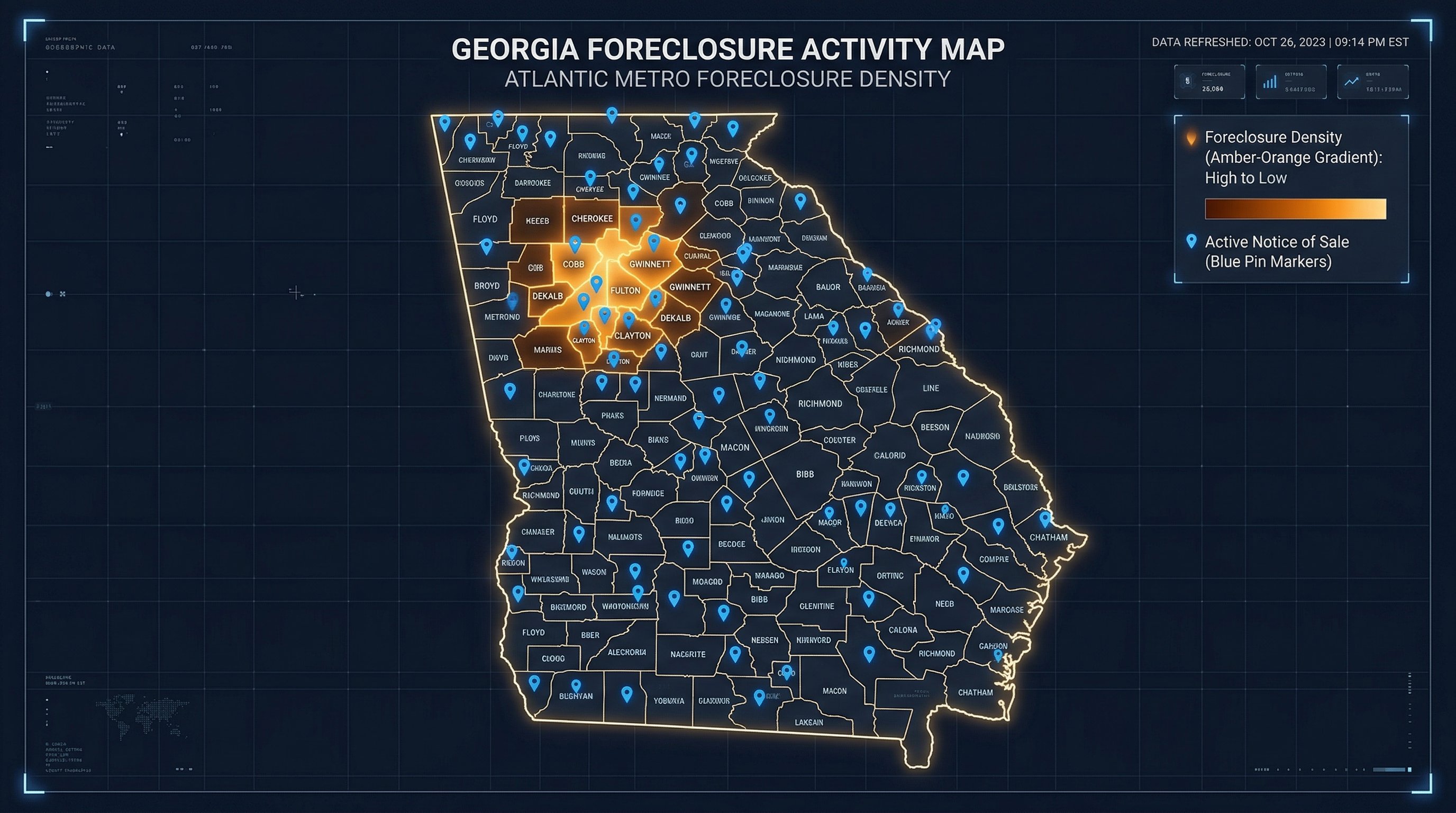
Georgia has 159 counties, second only to Texas. Activity concentrates in the Atlanta metro and several secondary markets.
Atlanta Metro (Tier 1)
Fulton County covers Atlanta's urban core and carries the highest foreclosure volume in the state. Housing ranges from high-value intown neighborhoods to distressed multifamily in south Atlanta. GSCCCA indexes Fulton records reliably.
DeKalb County spans east Atlanta, Decatur, and Stone Mountain. Pre-foreclosure activity runs consistently high, driven by distressed rentals and owner-occupied homes that lost equity during rate adjustments.
Gwinnett County includes Lawrenceville, Duluth, and Suwanee. Rapid appreciation between 2020 and 2023 pushed marginal buyers to the edge. Adjustable-rate mortgages from that period are resetting, and default notices are rising. Gwinnett represents one of the fastest-growing pre-foreclosure markets in the state.
Cobb County covers Marietta, Smyrna, and Kennesaw. Higher median values mean fewer total notices but higher equity upside on individual deals. Properties entering pre-foreclosure in Cobb often carry more remaining equity.
Clayton County encompasses College Park, Jonesboro, and Forest Park. Clayton has historically recorded one of the highest per-capita foreclosure rates in Georgia. Lower median prices and higher notice volume create a market where speed and volume matter.
Secondary Markets
Richmond County (Augusta): Military turnover from Fort Eisenhower creates consistent motivated-seller activity.
Bibb County (Macon): Affordable price points and aging housing stock with a records system less congested than Atlanta's.
Chatham County (Savannah): Rising coastal values attracted investor purchases since 2021. Defaults among those properties are surfacing now.
Muscogee County (Columbus): Fort Moore drives military relocation churn similar to Augusta.
Free Weekly Alerts
See What's Distressed in Your Market
Get free weekly alerts — new distressed properties, motivation scores, and hot neighborhoods in your area. Addresses and contact info available inside DistressIQ.
Free forever · No credit card · Unsubscribe anytime
Building a Lead Pipeline for Georgia's Timeline
The standard pre-foreclosure approach does not work in a 37-day state. Buying a monthly list and mailing postcards produces stale leads. What works instead:
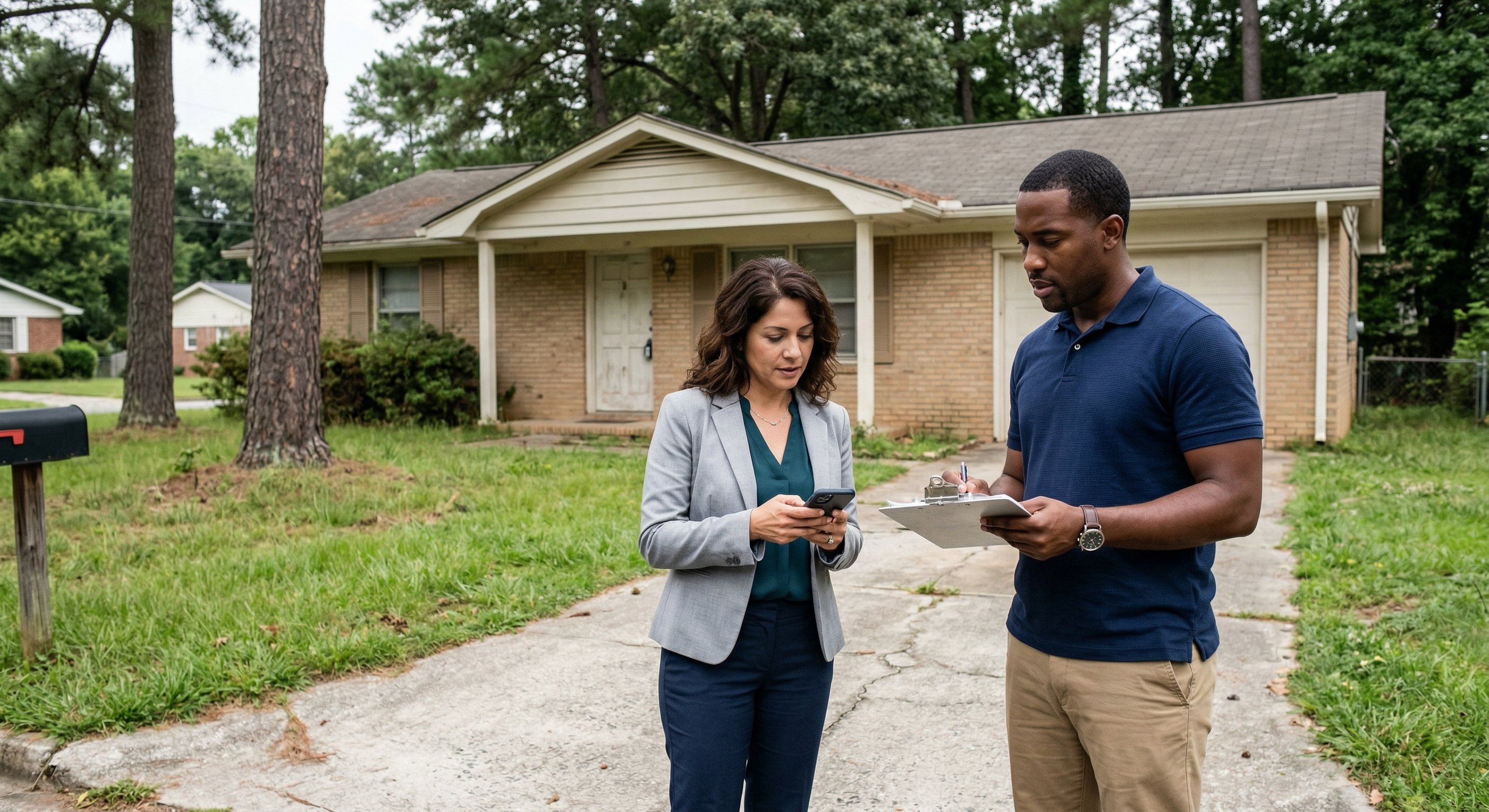
Same-week outreach from filing date. The day a Notice of Sale appears in county records, the clock is running. Phone contact first, then direct mail and door knocks. A single channel is insufficient when the window is measured in weeks.
Sale date targeting. Georgia's first-Tuesday rule makes it possible to calculate the exact auction date the moment the notice is filed. Leads with 60 days until sale allow measured negotiation. Leads with 20 days require an all-cash offer and fast closing.
Signal stacking to prioritize. Properties showing tax delinquency, HOA liens, or out-of-state absentee ownership alongside a Notice of Sale are higher priority. The seller's motivation is compounded.
Cash-close readiness. A seller 30 days from auction cannot wait 45 days for conventional financing. Investors who close in 10 to 14 days hold a genuine edge.
What to avoid: cold mail-only campaigns, ignoring smaller counties where competition is thinner, and relying on lists aggregated across multiple publication cycles.
2026 Market Context
ATTOM Data Solutions reported that U.S. foreclosure starts rose 26 percent year over year as of early 2026, with completed foreclosures up 59 percent. Georgia has historically tracked above the national average in foreclosure activity per capita.
Elevated rates have locked many 2021 and 2022 buyers into properties they cannot refinance. ARM resets are driving new defaults. Post-pandemic affordability corrections continue to stress homeowners who purchased at peak prices with minimal down payments.
Georgia's housing demand remains structurally sound. The state added over 200,000 residents in 2024. Distress is real and concentrated, but it exists within a healthy market, not a declining one. Distressed properties carry underlying value and can be repositioned in a market with genuine buyer demand.
Finding Leads at Scale Across 159 Counties
Manual research through the GSCCCA portal is free and functional for a single county. Investors working multiple markets will spend four to six hours per county per week pulling filings, cross-referencing assessor data, skip-tracing contacts, and ranking leads by urgency.
Legal newspaper subscriptions provide notice text but no property data, ownership records, or contact information. A supplementary source, not a standalone solution.
Statewide data platforms that aggregate county recordings and cross-reference them against assessor databases, tax rolls, and ownership records compress the research cycle from hours to minutes. In a state where the filing-to-auction window can be as short as 37 days, speed of access is the difference between reaching a motivated seller and finding the property already sold.
DistressIQ tracks Notice of Sale filings and lis pendens records across all 159 Georgia counties with daily updates. Each lead is scored by signal density, factoring in tax delinquency, HOA actions, and absentee ownership status. Browse Georgia pre-foreclosure leads at distressiq.ai.
Frequently Asked Questions
How long does the pre-foreclosure window last in Georgia?
Georgia's non-judicial foreclosure process moves faster than almost any other state. The minimum time from Notice of Sale recording to auction is roughly 37 days, because the statute requires only four consecutive weeks of newspaper publication before the first-Tuesday sale. Lenders often set sale dates 60 to 90 days out, but no law obligates them to wait longer. A homeowner can go from receiving notice to losing the property in barely five weeks. Investors who monitor filings weekly or monthly will miss a meaningful percentage of leads entirely.
What is a Security Deed and why does it matter for Georgia foreclosures?
A Security Deed is a real estate instrument unique to Georgia that transfers legal title to the lender at closing while the borrower retains equitable possession. Unlike a mortgage, which requires the lender to go to court, the Security Deed includes a built-in power of sale clause. The lender can record a Notice of Sale, publish it for four weeks, and auction the property without filing a lawsuit or appearing before a judge. This structure is the legal reason Georgia's timeline is so compressed. It also means there is no post-sale redemption period for non-judicial foreclosures.
Where are Notice of Sale filings published in Georgia?
Each Georgia county designates a newspaper of general circulation for legal notices. The Atlanta Journal-Constitution serves Fulton and DeKalb. Gwinnett, Cobb, Clayton, and other metro counties have their own designated papers. Notices must run four consecutive weeks preceding the sale date. The GSCCCA at gsccca.org maintains a statewide digital index where recorded Notices of Sale can be searched by county, party name, and date range.
Which Georgia counties produce the most pre-foreclosure leads?
Volume concentrates in five Atlanta metro counties. Fulton leads in total filings. DeKalb shows consistent high activity. Gwinnett is experiencing rising notice volume as ARM resets from 2021 and 2022 take effect. Clayton records one of the highest per-capita foreclosure rates in the state. Cobb has lower volume but higher deal quality due to elevated median home values. Outside Atlanta, Richmond (Augusta), Bibb (Macon), Chatham (Savannah), and Muscogee (Columbus) generate steady activity with less investor competition.
Can a homeowner redeem a property after a non-judicial foreclosure sale in Georgia?
No. Georgia law does not provide a statutory right of redemption for properties sold through non-judicial foreclosure under a Security Deed. Once the sale is conducted on the first Tuesday at the courthouse steps, title transfer is final. The former owner cannot reclaim the property by paying the debt. This is a significant difference from judicial foreclosure states, where redemption periods of six months or longer are common. For investors, this finality means completed sales remove leads permanently, making pre-sale outreach the only viable contact window.
How do tax delinquency lists supplement pre-foreclosure research?
Georgia county Tax Commissioners maintain public records of delinquent property taxes, typically updated quarterly. Cross-referencing tax delinquency against Notice of Sale filings identifies properties where the owner faces financial pressure from multiple directions. A homeowner who has not paid property taxes in two years and has also received a Notice of Sale is experiencing compounded distress. These stacked-signal leads convert at higher rates because the seller's motivation runs deeper than a single missed mortgage payment.
Is the GSCCCA portal sufficient for building a lead list?
The GSCCCA portal is free and provides searchable access to recorded documents across all 159 counties. However, it returns raw document records requiring manual processing. Each Notice of Sale must be reviewed individually, the property address extracted, ownership verified against assessor records, and contact information obtained through skip-tracing. For an investor working one county at low volume, the portal works. For monitoring multiple counties on a compressed timeline, the manual processing time is a significant bottleneck.
Sources
- Official Code of Georgia Annotated, Title 44, Chapter 14, Article 2 (O.C.G.A. § 44-14-162 et seq.). law.justia.com/codes/georgia/title-44/chapter-14/article-2/
- Georgia Superior Court Clerk's Cooperative Authority. gsccca.org
- ATTOM Data Solutions, U.S. Foreclosure Market Report, January 2026. attomdata.com
The data behind this article
DistressIQ Monitors These Signals in Real Time
Pre-Foreclosures
NOD + NTS filings
Tax Delinquency
County treasurer records
Code Violations
Municipal inspection filings
Probate Filings
Superior Court records
Every lead is scored 0–100 for seller motivation based on signal type, duration, severity, and stacking. Nationwide coverage — every US county, updated daily.
Ready to find deals in your market?
See Live Distress Signals in Georgia
Stop calling dead leads. Every lead in DistressIQ is scored 0–100 for seller motivation, with verified contact info included. Browse the free tier to see what's active in your market right now.
Browse Free Leads — No Credit Card