MLS Data vs. County Assessor Records: Why Your Property Info Is Wrong (And What It's Costing You)
MLS Data vs. County Assessor Records: Why Your Property Info Is Wrong (And What It's Costing You)
TL;DR: MLS property data is agent-reported and routinely inaccurate — wrong square footage, phantom bedrooms, inflated values. County assessor records are the legal source of truth: independently measured, tax-code verified, and updated by the government. When investors make offers based on MLS data, they often overpay. The fix is using assessor-verified property data to calculate comps, ARV, and deal economics. DistressIQ uses assessor-verified data — not MLS listings. Browse distressed properties with accurate property data for free.
One investor on BiggerPockets cross-referenced 3,800 Kansas City MLS listings against county assessor records. His finding: the sqft and bedroom counts were, in his words, "straight-up fiction." Rooms added without permits. Finished basements counted as living space. Sqft pads of 300-800 feet were common.
That's not a data problem. That's a deals problem.
You're running comps against inflated numbers, pulling ARV from bloated square footage, and making offers on properties that aren't what the listing says they are. And you might not find out until you're at the closing table — or worse, after you've already bought.
Where MLS Data Comes From (And Why It's Unreliable)
MLS listings are created by real estate agents. When a property hits the market, the listing agent fills out a data form. That form includes bedrooms, bathrooms, square footage, lot size, year built, and property type.
Here's the problem: nobody verifies it.
The agent enters the numbers they have — which usually come from the previous MLS listing, which was copied from the one before that. If the original data was wrong in 2004, it's been wrong on every listing since. Permitting records? Not checked. County tax assessor measurements? Not cross-referenced. Square footage? Measured by whoever sold it last.
Add to this:
- Unpermitted additions counted as living space (finished garages, enclosed patios, accessory structures)
- Basement finish ambiguity — in some markets, finished basements count as living area; in others, they don't; agents pick whichever one makes the listing look better
- Bedroom creep — a flex room, an office, a nursery — all get listed as "bedroom" if it has a door and fits a bed
- Lot size errors that ripple through comps for years
- Year built misrepresented when additions or full renovations blur the line
A NAR study found that MLS-reported prices differ from HUD-1 closing data 8.75% of the time. That's not rounding error. On a $300,000 property, 8.75% is $26,000 in pricing mismatch. For a fix-and-flip, that's often the entire profit margin.
What County Assessor Records Actually Are
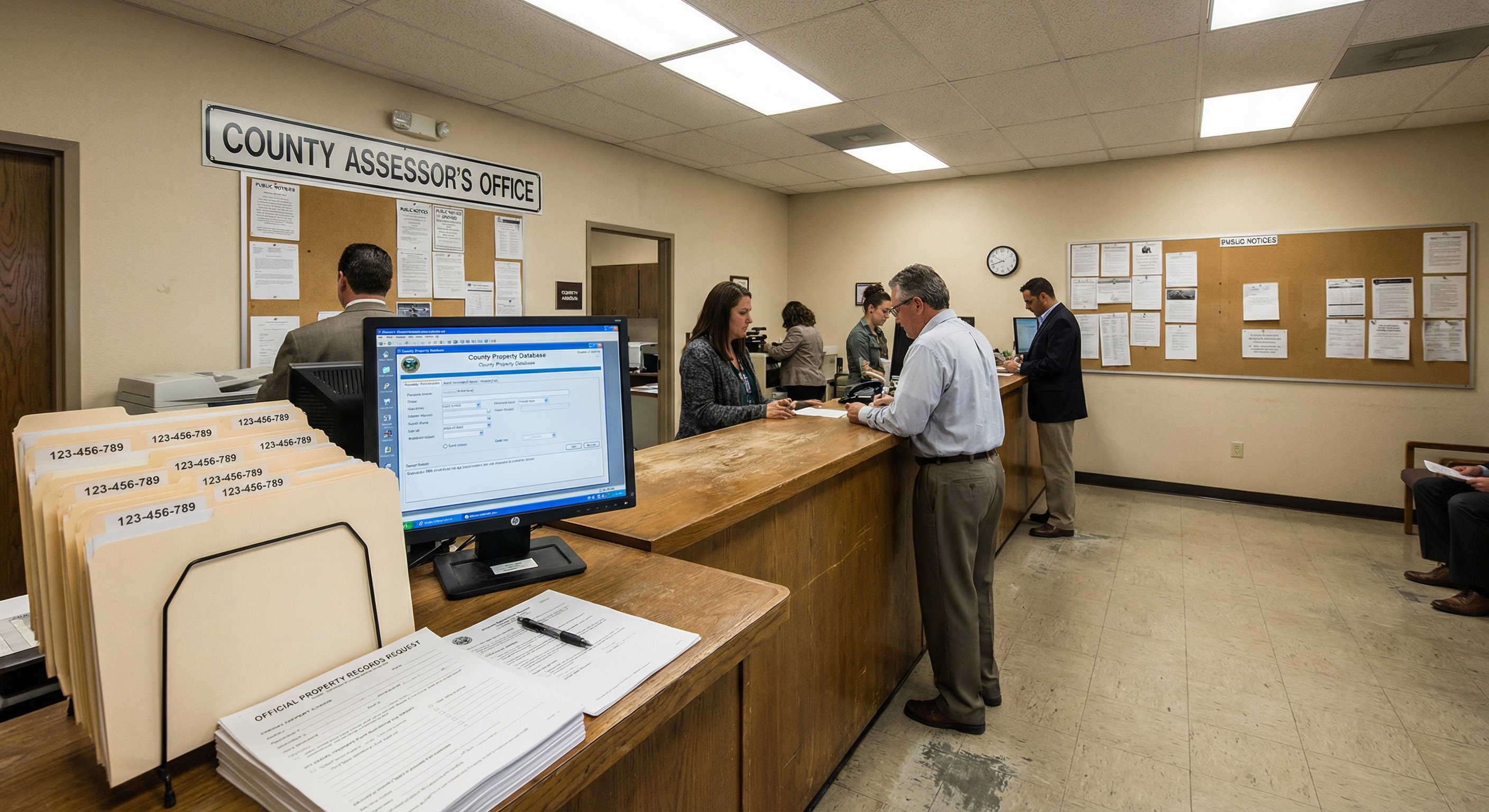
Every county in the United States maintains a tax assessor database. This is the government's official record of:
- Assessed value (the basis for property tax calculations)
- Legal square footage (independently measured, not self-reported)
- Bed/bath count from permitted construction records
- Year built per building permits
- Lot size from recorded plat documents
- Ownership history and transfer dates
- Tax status — current, delinquent, exempt
The assessor's job is to accurately measure and value property for taxation purposes. They have direct incentive to get the numbers right — underassessment means lost tax revenue, overassessment invites appeals and litigation. The county measures what it taxes.
This data is the legal record of truth. Not the MLS listing. Not Zillow. Not the agent's input form.
What Bad Data Actually Costs You
Let's be specific about where MLS inaccuracy damages deal economics.
Comp Analysis
Your ARV starts with your comps. You pull comparable sales within a radius — similar bed/bath count, similar square footage, similar year built. But if the comps in your MLS pull have inflated sqft figures, your price-per-square-foot analysis is contaminated.
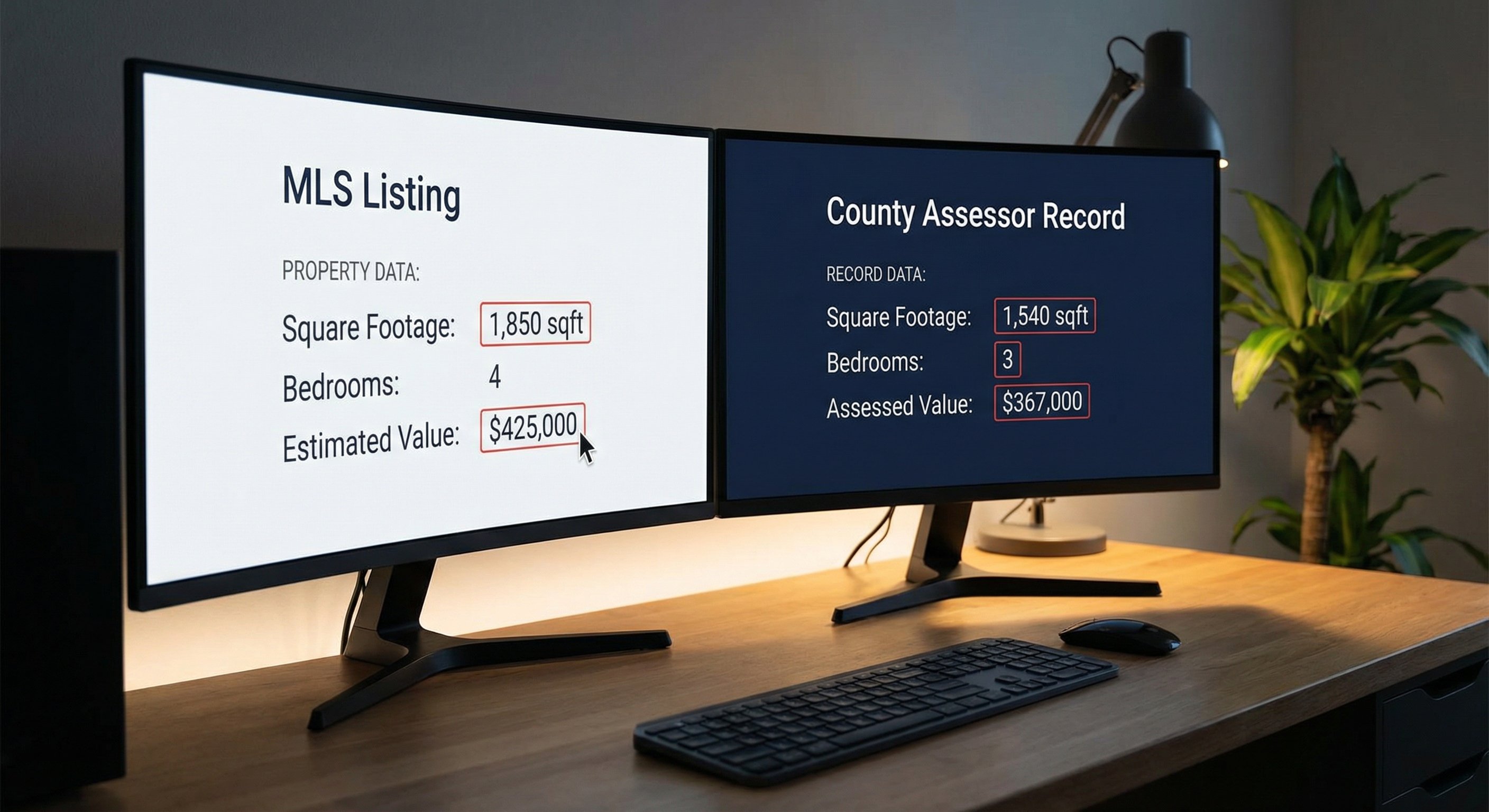
Example: You find three "comps" in the 1,800-1,900 sqft range that sold for $380,000-$420,000. Your subject property MLS listing shows 1,850 sqft. Looks like solid comp support.
But the assessor shows your subject is 1,540 sqft. And two of those comps had the same kind of MLS padding — they were 1,500-1,600 sqft properties listed and sold based on inflated data.
Your price-per-foot analysis just broke. So did your ARV.
Offer Calculations
Wholesalers and flippers both work backwards from ARV. If your ARV is inflated because it's based on bad comp data, your max allowable offer (MAO) is inflated, which means your offer is too high. You're competing against the wrong number.
This is how investors overpay. Not because they ran a bad formula — because they fed the formula bad data.
Renovation Budgeting
You're estimating rehab costs based on 1,850 sqft — flooring, paint, HVAC capacity, roof. But the actual property is 1,540 sqft. That's a material difference in cost estimates, even if the unit costs per sqft are accurate.
Less catastrophic than an inflated ARV, but it eats into margin when you're already operating on thin spreads.
Financing and Appraisal
If you're buying with a loan, the lender orders an appraisal. A good appraiser uses county records, not MLS data. If the appraiser comes in 12% below your purchase price because they're working from assessor sqft instead of MLS sqft — that's a financing gap that kills the deal or forces a price renegotiation at the worst possible time.

Free Weekly Alerts
See What's Distressed in Your Market
Get free weekly alerts — new distressed properties, motivation scores, and hot neighborhoods in your area. Addresses and contact info available inside DistressIQ.
Free forever · No credit card · Unsubscribe anytime
County Assessor Data vs. MLS: A Direct Comparison
| Factor | MLS Data | County Assessor Records |
|---|---|---|
| Source | Agent-input (self-reported) | Government-measured |
| Verification | None required | Independently assessed |
| Square footage | Agent/owner estimate, often inflated | Measured from permitted plans |
| Bedroom count | Agent discretion | Permitted construction records |
| Lot size | Often from prior listing | Recorded plat documents |
| Update frequency | At time of listing | Annually (assessments) + at transfer |
| Incentive for accuracy | Agent wants property to look good | County needs accuracy for tax revenue |
| Legal authority | None | Official government record |
| Cost to access | Included in MLS subscription | Public record (free by law) |
The MLS has its use cases — it tells you what's actively for sale, recent agent prices, and days on market. But for actual property attributes? The county assessor is the legal source of truth. Always.
Why Most Investors Still Use MLS Data
Because it's convenient.
Pulling county assessor records directly requires going county-by-county, navigating incompatible GIS systems, interpreting government data formats, and manually cross-referencing with court filings. There are 3,000+ counties in the United States. Every one has a different portal, different data structure, different update schedule.
The friction is real. So investors default to PropStream, Zillow, or the MLS — and those platforms mostly repackage MLS data or layer on estimated values based on MLS comparables. You're back to the same accuracy problem, just with better UI.
This is why DistressIQ uses assessor-verified property data — not data aggregators or MLS feeds. When property characteristics appear on a DistressIQ lead, they're based on what the county actually recorded — not what an agent typed in.
For distressed property investing specifically, this matters even more. You're often buying properties with limited showing time, at auction, or from motivated sellers who can't always answer detailed questions about the property. Your data has to be right before you get on-site — because sometimes you're making the offer before you leave your car.
Finding motivated sellers in your target market? DistressIQ delivers assessor-verified property data — not MLS guesses. Distressed leads scored 0-100 by motivation, updated daily. Browse your market free →
How to Verify Property Data Before You Offer
Whether you're using DistressIQ or doing this manually, here's the verification protocol:
1. Pull the county assessor record directly. Search by APN (Assessor's Parcel Number) or address. Most county assessor portals are free and public. Look for: legal sqft, bedroom/bath count, lot size, year built.
2. Check the county recorder for permit history. Additions, ADUs, and renovations should have permits on file. If an owner added 400 sqft but there's no permit, that space doesn't count in most financing scenarios.
3. Cross-reference tax payment status. While you're in the county system, check if property taxes are current. Tax delinquency is a major distress signal — and one that's invisible in MLS data.
4. Run comps on assessor sqft, not MLS sqft. When pulling comps, sort by county-recorded square footage rather than MLS-reported. Your price-per-square-foot analysis will be cleaner.
5. Flag outliers for field verification. When assessor data and MLS data differ by more than 10%, walk the property and measure yourself before committing to an offer price.
The Distressed Property Angle: Why This Matters Even More for Off-Market Deals
For on-market properties, at least there's a recent appraisal somewhere in the chain. Lenders have seen the data. Agents have walked it.
Distressed properties — pre-foreclosures, tax delinquent, probate estates, code violation properties — often haven't been touched by the MLS in years. Or the listing was input incorrectly, and nobody updated it for the three years it sat vacant. Or it's going to a courthouse auction where the only data you have is a public record.
In these scenarios, assessor data isn't just more accurate — it's sometimes the only reliable data available.
The county hasn't stopped taxing the property just because nobody's living there. The assessor record is current. The tax payment status is current. The legal description is current.
When you're working distressed leads, especially at scale across multiple counties, the investors who lose money tend to be the ones who trusted the wrong data source. A 1,850 sqft MLS record on a property the county shows at 1,200 sqft isn't just inconvenient — it's a $40,000 mistake waiting to happen.
The Bottom Line
MLS data is an agent-reported record built for marketing, not investment analysis. County assessor records are the government's legal measurement, built for taxation and public record.
When these two data sources conflict, the assessor is right. The MLS is aspirational.
Experienced investors know this. But the tools most of them use — PropStream, DealMachine, Zillow-based analysis — serve up MLS-derived data by default. You have to dig to get to the accurate numbers.
Or you can start with accurate numbers.
DistressIQ leads include assessor-verified property data — sqft, assessed value, year built, and more — based on county tax records, not MLS listings. Because if the data is wrong, the deal is wrong. Browse your county free →
Frequently Asked Questions
Q: Is MLS data always inaccurate?
Not always — some listings are accurate. The problem is that you can't know which ones are wrong without checking. Because MLS entries are self-reported and never independently verified, errors are common enough (particularly in sqft and bed/bath counts) that treating MLS data as reliable without verification is a risk investors in competitive markets can't afford. County assessor records, by contrast, are independently measured.
Q: What's the difference between assessed value and market value?
Assessed value is what the county uses to calculate property taxes — it's typically a percentage of estimated market value, which varies by jurisdiction. It's NOT always an accurate reflection of current market value (some counties reassess infrequently). What assessed value IS reliable for: legal square footage, bedroom/bath counts, lot size, and permitted improvements. Don't use assessed value for ARV — use it for verifying property attributes.
Q: How often are county assessor records updated?
Most counties reassess properties annually for tax purposes, and records update at every ownership transfer. Permit records update when new construction is filed. For distressed properties, assessor records are often more current than MLS data — which may not have been updated since the last sale years ago.
Q: Where can I find county assessor records for free?
Every county in the US is required by law to maintain public property records. Most counties have a free online portal — search "[county name] assessor records" or "[county name] property lookup." Some counties aggregate data at the state level. The limitation is that you need to go county-by-county, and interfaces vary widely. DistressIQ aggregates assessor data across 3,200+ counties so you don't have to navigate each portal separately.
Q: Does this matter for wholesale real estate specifically?
It matters most for wholesale. Wholesalers assign contracts based on ARV calculations, and if your ARV is based on inflated MLS comps, your assignment fee math breaks down — or worse, your end buyer (the flipper) does the verification and renegotiates at closing or kills the deal. Using assessor-verified data from the start means your comps are clean and your buyers don't find surprises.
The data behind this article
DistressIQ Monitors These Signals in Real Time
Pre-Foreclosures
NOD + NTS filings
Tax Delinquency
County treasurer records
Code Violations
Municipal inspection filings
Probate Filings
Superior Court records
Every lead is scored 0–100 for seller motivation based on signal type, duration, severity, and stacking. Nationwide coverage — every US county, updated daily.
Ready to find deals in your market?
See Live Distress Signals in Your County
Stop calling dead leads. Every lead in DistressIQ is scored 0–100 for seller motivation, with verified contact info included. Browse the free tier to see what's active in your market right now.
Browse Free Leads — No Credit Card