How to Find Pre-Foreclosure Leads in North Carolina (2026 Investor Guide)
How to Find Pre-Foreclosure Leads in North Carolina (2026 Investor Guide)
TL;DR: North Carolina runs a hybrid foreclosure system most investors misunderstand. It uses a non-judicial "power of sale" process, but the Clerk of Superior Court still holds a formal hearing before any auction can proceed. That hearing creates a public paper trail 45 to 90 days before the sale. After the auction, a 10-day upset bid window lets competing buyers outbid the winner by as little as 5%. These two windows, stacked with tax delinquency and code violation data, are where the deals live. Mecklenburg, Wake, Guilford, Durham, and Forsyth counties lead in volume.
Why North Carolina's Foreclosure System Is Different
Most states fall into one of two buckets: judicial foreclosure (court lawsuits, judges, long timelines) or non-judicial foreclosure (trustee sales, no court, fast). North Carolina does neither. It uses a court-supervised power of sale process operating as a "special proceeding" before the Clerk of Superior Court. The Clerk verifies that four conditions exist: a valid debt, a default, a right to foreclose under the deed of trust, and proper notice to all parties.
This hybrid structure matters because it generates public records at predictable points. Each filing creates a data signal that can be captured, cross-referenced, and ranked. The timeline is longer than a pure non-judicial state like Georgia, which gives investors more runway to find and contact sellers.
The Full Sequence
Pre-foreclosure notice. For home loans on a primary residence, state law (G.S. 45-102) requires mortgage servicers to mail a written notice to the borrower at least 45 days before filing the Notice of Hearing. This notice itemizes past-due amounts and charges needed to cure the default. This is not a public filing, but it starts the clock.
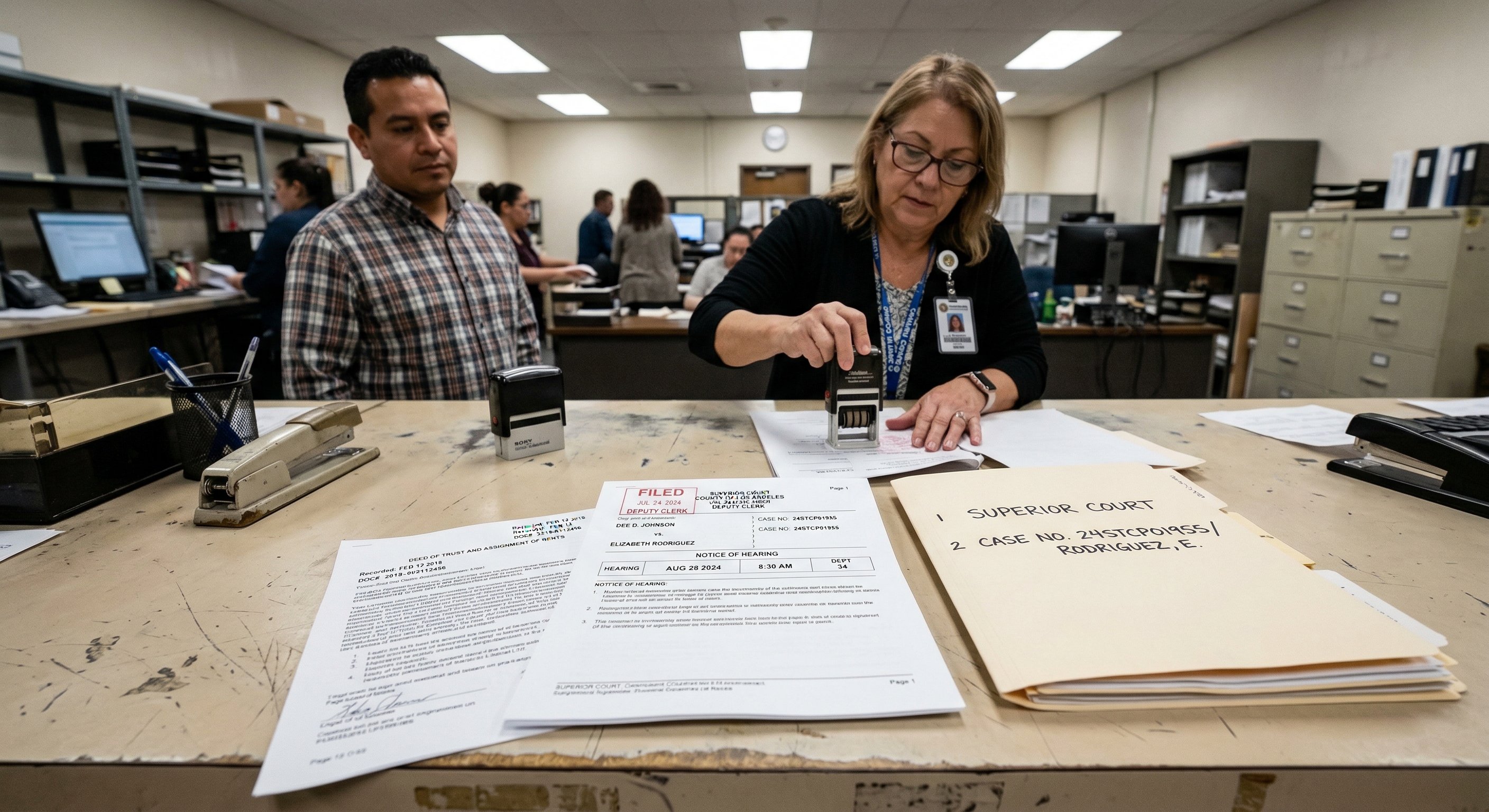
Notice of Hearing. The trustee files a Notice of Hearing with the Clerk of Superior Court (G.S. 45-21.16). This is public record. The notice must be served on every record owner at least 10 days before the hearing date. It identifies the property, debtor, lender, original loan amount, and default type. This is the first data point investors can capture.
Clerk hearing. The Clerk considers evidence and determines whether the four conditions for foreclosure exist. The borrower can appear and contest any finding. If the borrower does not appear, the trustee asks the Clerk to authorize the sale. The Clerk's decision can be appealed within 10 days to a district or superior court judge, which stays the foreclosure pending the appeal.
Foreclosure sale. The sale takes place at the county courthouse or another designated public location. The property goes to the highest bidder. The lender often bids the debt amount, and third-party buyers must exceed it.
10-day upset bid period. After the sale, any person has 10 days to file an "upset bid" with the Clerk (G.S. 45-21.27). The upset bid must exceed the winning price by at least 5%, with a minimum increase of $750. The upset bidder deposits 5% of the bid (minimum $750) by certified check. If a new upset bid is filed, another 10-day window opens. This repeats until no new bids arrive. Only then are rights finalized.
Two Buying Windows
Window 1: Notice of Hearing Through Sale (45 to 90+ Days)
This is the primary pre-foreclosure window. The homeowner has received notice. A court date is set. Sellers range from mildly concerned to desperate, and the ones carrying multiple distress signals are worth calling first.
The best leads in this window carry two or more of these signals: Notice of Hearing filed in the past 15 to 45 days, tax delinquency on the same property, municipal code violations, or probate activity on the title.
Window 2: Post-Sale Upset Bid Period (10 Days, Renewable)
Most investors ignore this window. It requires tracking auction results daily and having capital ready to close fast. But in smaller counties where auction attendance is thin, the winning bid can be surprisingly low. An upset bid of 5% above that price can acquire a property at a discount that was just validated at public auction. The tradeoff: thinner competition, lower prices, faster execution required.
Five Counties with the Most Volume
Mecklenburg (Charlotte). Highest filing count in the state. Strong ARVs and deep buyer pools. The downside is competition. Stack pre-foreclosure filings against tax delinquency to find sellers carrying two problems instead of one.
Wake (Raleigh). Five straight years of aggressive appreciation. Pre-foreclosure properties here support healthy margins even with deferred maintenance. Wake includes Cary, Apex, and Morrisville, where absentee owners accumulate fast. Cross-reference pre-foreclosure with absentee ownership data here.
Durham. Lower raw volume than Charlotte and Raleigh, but a more favorable investor-to-lead ratio. A property that draws 15 calls in Mecklenburg might draw 4 in Durham. The Duke and Research Triangle Park employment base sustains buyer demand.
Guilford (Greensboro). Lower price points than Charlotte and Raleigh. More forgiving ARVs on rehab overruns. Better inventory-to-investor ratio. Consistent volume without saturation.
Forsyth (Winston-Salem). Similar dynamics to Greensboro. Stable demand, thinner competition. One difference: the foreclosure timeline moves slightly faster through the Clerk's office, which compresses the pre-hearing window. Early contact matters more here.
Free Weekly Alerts
See What's Distressed in Your Market
Get free weekly alerts — new distressed properties, motivation scores, and hot neighborhoods in your area. Addresses and contact info available inside DistressIQ.
Free forever · No credit card · Unsubscribe anytime
Finding Leads: Manual vs. Scored Data
Each of North Carolina's 100 counties maintains its own public records. Major metros have online portals. Smaller counties may require in-person requests. Pulling data manually across five counties means navigating five systems and cross-referencing tax and code violation databases separately. It works, but it is a data-entry exercise, not a deal-finding strategy.
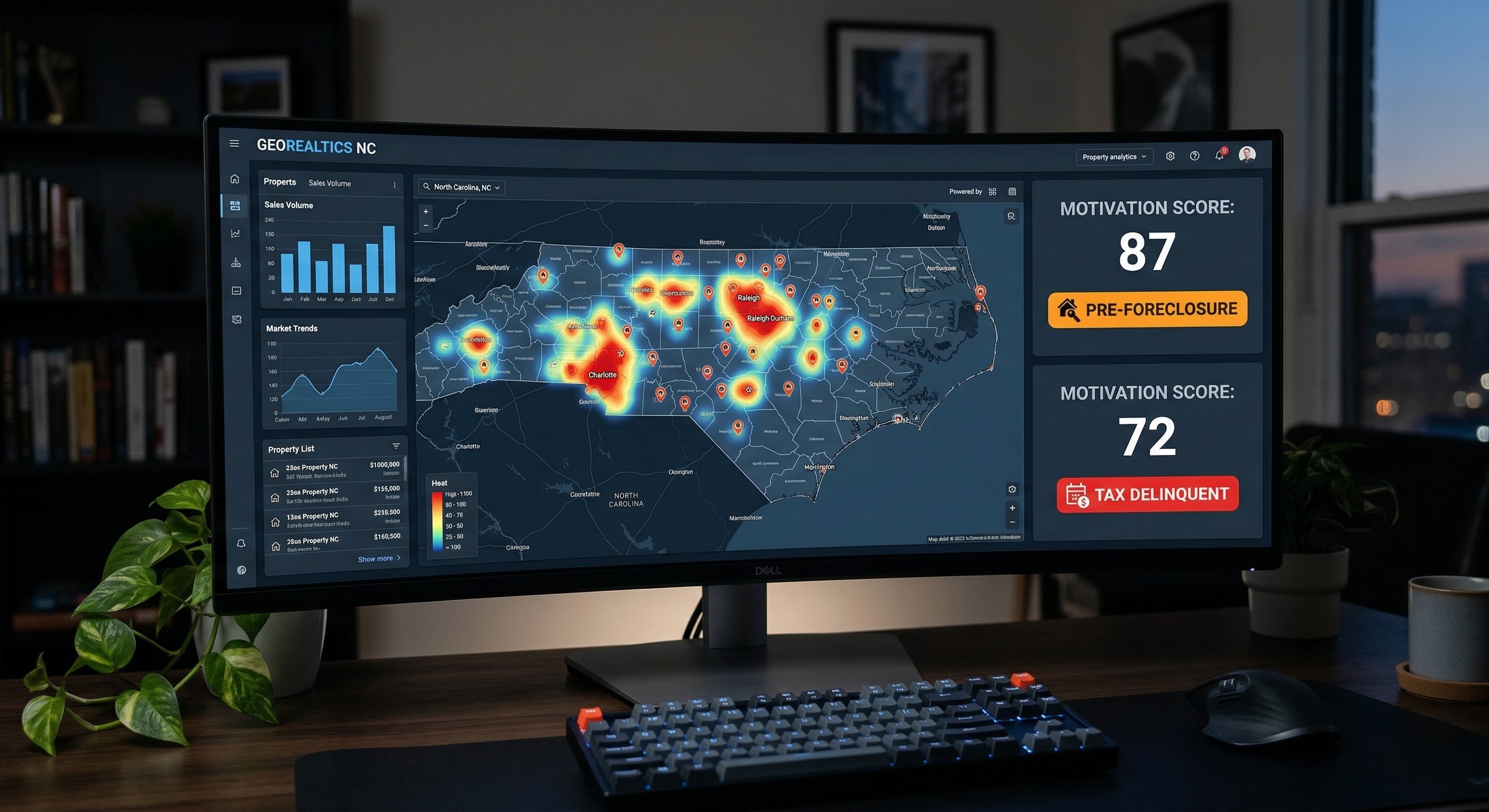
When pre-foreclosure filings from all 100 counties are sourced and cross-referenced against tax delinquency, probate activity, code violations, and ownership records, the output is a ranked queue. Properties with three or four compounding signals sort to the top. Instead of 300 leads with no prioritization, the investor starts with the 40 most likely to convert.
Browse NC pre-foreclosure leads free on DistressIQ
Signal Stacks That Produce the Best Deals
A single pre-foreclosure filing is a starting point. A filing paired with other distress signals is where high-motivation sellers emerge.
Notice of Hearing plus tax delinquency. Behind on the mortgage and behind on property taxes. Two creditors pressing from two directions. These sellers often have limited options and a narrow window.
Notice of Hearing plus long ownership tenure plus probate activity. An owner who has held the property for 15 to 25 years, now facing foreclosure, with estate complications on the title. Complex situations that produce genuine motivated sellers needing a clean close.
Notice of Hearing plus code violations. A property deteriorating to the point of code enforcement, now also in pre-foreclosure. High repair costs mean lower seller price expectations. When the spread works after rehab, this profile produces the best margins.

The Outreach Sequence
Filter by recency and signal density. Focus on Notice of Hearing filings from the past 30 to 60 days. Beyond 90 days, the property is in late-stage foreclosure or the borrower has resolved the default. Prioritize leads with two or more stacked signals.
Skip trace selectively. Run skip traces on the top 15 to 20 percent, sorted by motivation score and property economics.
Phone first. State the property address, the Notice of Hearing filing, and that the caller works with sellers who need a fast close. Let the seller self-select into the conversation.
Follow up by mail within 10 days. Personalized letter. Acknowledge their situation without condescension. Give them a way to respond on their own timeline.
Monitor upset bid results weekly. Pull auction results from target counties. When a property sells below estimated deal value, watch the 10-day upset bid window. This secondary pipeline costs almost nothing and produces deals that pre-foreclosure investors never see.
The 2026 Landscape
Foreclosure filings across North Carolina have been climbing. The post-pandemic forbearance period ended. Interest rates remain elevated. Homeowners who tapped equity through HELOCs and cash-out refinances between 2021 and 2023 are carrying higher payments on properties that may not appraise at those inflated values. ATTOM Data Solutions reported Southeast foreclosure starts up 18 to 26 percent above prior-year levels in late 2025.
North Carolina's hybrid process creates a longer public timeline than non-judicial states. The upset bid period creates a secondary channel most investors ignore. The investors who stay ahead of both windows with scored signals from all 100 counties will close deals their competitors never see.
Frequently Asked Questions
How does North Carolina's foreclosure process differ from other states?
North Carolina falls between purely judicial states like New York and purely non-judicial states like Georgia. The trustee exercises a power of sale, but the Clerk of Superior Court must first hold a hearing and verify four conditions: valid debt, default, right to foreclose, and proper notice to all entitled parties. This creates public records at predictable intervals, giving investors more lead time than pure non-judicial states. The Clerk's decision can be appealed within 10 days to a judge, extending the timeline and creating additional windows for contact.
Where can investors find pre-foreclosure filings in North Carolina?
Each county's Clerk of Superior Court maintains Notice of Hearing filings as public records. Major counties like Mecklenburg and Wake offer online portals. Smaller counties may require in-person visits. The filings include the property description, debtor and lender names, original loan amount, and default type. For statewide coverage across all 100 counties, DistressIQ aggregates filings and cross-references them with tax, probate, and code violation records.
What is the upset bid period and how does it work?
After a foreclosure auction, state law (G.S. 45-21.27) gives any person 10 days to file an upset bid with the Clerk of Superior Court. The bid must exceed the winning price or last upset bid by at least 5 percent (minimum $750). The upset bidder deposits 5 percent of the bid by certified check. If a new bid arrives, another 10-day window opens. This repeats until no new bids arrive. This post-auction acquisition channel exists in few other states.
Which North Carolina counties produce the most pre-foreclosure leads?
Mecklenburg (Charlotte) generates the highest filing count, followed by Wake (Raleigh), Guilford (Greensboro), Cumberland (Fayetteville), Durham, and Forsyth (Winston-Salem). Durham offers a favorable lead-to-investor ratio despite lower raw volume. Mid-size counties like Rowan, Cabarrus, Union, and Onslow produce solid leads with fewer competing investors.
How long does the full foreclosure timeline run in North Carolina?
For home loans on primary residences, the timeline begins with a 45-day pre-foreclosure notice under G.S. 45-102. The lender then files the Notice of Hearing, served at least 10 days before the Clerk's hearing. After authorization, the trustee advertises and conducts the auction, followed by the 10-day upset bid period. The full timeline spans 90 to 150 days in practice. The pre-hearing window of roughly 45 to 90 days from filing to sale is the most productive period for contacting motivated sellers.
Can a borrower stop the foreclosure after the Notice of Hearing is filed?
Yes. The borrower can cure the default by paying the full outstanding amount plus costs at any time before the sale. The borrower can also appear at the Clerk's hearing and contest any of the four findings. If the Clerk authorizes the sale, the borrower can appeal to a judge within 10 days, which stays the foreclosure. These protections extend the timeline and create additional windows for investors to approach sellers before the point of no return.
Do investors need cash to buy through the upset bid process?
Practically, yes. The upset bid process moves fast. Once filed, a new 10-day clock starts. The successful bidder must close quickly, and traditional mortgage financing rarely moves fast enough. Hard money lenders and private capital are the most common funding sources. The deposit requirement of 5 percent of the bid is due at filing, so the investor needs immediate liquidity plus confidence that remaining funds can close within the Clerk's timeline.
Citations:
N.C. Gen. Stat. ch. 45, Art. 2A (Sales Under Power of Sale), particularly G.S. 45-21.16 (Notice and Hearing) and G.S. 45-21.27 (Upset Bids). Available at ncleg.gov.
N.C. Gen. Stat. G.S. 45-102 (Pre-foreclosure Notice for Home Loans), requiring 45-day advance written notice before filing a Notice of Hearing on primary residences.
ATTOM Data Solutions, Q4 2025 U.S. Foreclosure Market Report. Southeast region foreclosure starts up 18-26% year over year. Available at attomdata.com.
The data behind this article
DistressIQ Monitors These Signals in Real Time
Pre-Foreclosures
NOD + NTS filings
Tax Delinquency
County treasurer records
Code Violations
Municipal inspection filings
Probate Filings
Superior Court records
Every lead is scored 0–100 for seller motivation based on signal type, duration, severity, and stacking. Nationwide coverage — every US county, updated daily.
Ready to find deals in your market?
See Live Distress Signals in North Carolina
Stop calling dead leads. Every lead in DistressIQ is scored 0–100 for seller motivation, with verified contact info included. Browse the free tier to see what's active in your market right now.
Browse Free Leads — No Credit Card