How to Find Off-Market Properties in 2026 (The Investor's Guide to Deals Nobody Else Sees)
How to Find Off-Market Properties in 2026 (The Investor's Guide to Deals Nobody Else Sees)
TL;DR: Off-market properties — those not listed on the MLS — are where real investor margins still exist. The best off-market leads aren't found by driving for dollars or mailing every absentee owner in a zip code. They're found by reading public county records for documented distress signals: tax delinquency, lis pendens filings, probate activity, pre-foreclosure notices. Properties with verified distress and zero competing bids are the actual opportunity. DistressIQ surfaces these leads scored by motivation — so you're calling the most urgent sellers first, not the entire haystack.

The phrase "off-market deal" has been so thoroughly over-used that it means almost nothing now. Every wholesaler on Instagram has a "proprietary off-market deal flow." Every guru course promises access to "deals the public never sees."
Here's the truth: most of those deals are on Zillow. Zestimate and all.
Real off-market properties — the ones with genuine motivated sellers who haven't listed because they CAN'T list (probate, foreclosure filing, tax lien arrears, code enforcement action) — are sitting in county records right now. Not on any aggregator. Not in your Facebook group. In the county recorder's office, the tax assessor's database, and the probate court docket.
The investors who find these deals first aren't driving for dollars. They're reading public records.
What "Off-Market" Actually Means (and What It Doesn't)
Off-market means the property isn't listed on a Multiple Listing Service. That's it. The term doesn't imply:
- The seller is motivated
- The deal is priced below market
- You have any competitive advantage
An FSBO (for sale by owner) is technically off-market. So is a $2M property a developer is quietly selling to a buyer in their network. Neither of those are the deals you're looking for.
What you're actually looking for is distressed off-market — properties where the owner has a documented, verifiable reason to sell at a discount, and hasn't listed because the situation is complicated, emotional, or legally constrained.
The difference between "off-market" and "distressed off-market" is the difference between cold-calling every homeowner on a street and calling the specific homeowner who just received a pre-foreclosure notice from their lender.
Where Off-Market Distressed Deals Actually Come From
1. Tax Delinquency Records
When a homeowner stops paying property taxes, the county records it — publicly. Tax delinquent properties are off-market by default: most owners in tax arrears aren't listing their homes because they're in financial distress, often behind on the mortgage too, and sometimes unaware of their legal options.
In most states, the county will eventually sell the tax lien (or the property itself) at auction if delinquency continues. The window between first delinquency and auction is your opportunity.
A property that's been tax delinquent for 18+ months in a state with a long redemption period is a very different lead than one that's 60 days overdue. Timeline matters. Most generic lists don't tell you that.
2. Lis Pendens Filings
A lis pendens is a formal legal notice that a lawsuit affecting the property title has been filed. In real estate, it almost always means the lender has initiated foreclosure proceedings.
What makes lis pendens leads powerful:
- The filing is public record the moment it's recorded at the county courthouse
- Properties in foreclosure are almost always off-market (lenders don't want the liability of showing them)
- The seller has an urgent, documented timeline — the foreclosure process ends with the house being auctioned, not listed
A homeowner who just received a lis pendens filing is in a fundamentally different situation than someone who might theoretically be willing to sell. The urgency is real and documented.
3. Probate Activity
When a property owner dies and the estate enters probate, the property becomes off-market by necessity: no one can legally list or sell the property until the court process resolves who has authority to do so. That process takes 6-18+ months in most states.
But the property's existence in probate is public record from the moment the estate is opened. Heirs who inherit a property they don't want — out-of-state heirs especially — are often highly motivated sellers once they have legal authority to transact.
Probate leads are underworked by most investors because they require monitoring court dockets, not just mailing lists. Most wholesale lead tools don't surface them.
4. Code Enforcement and Violations
Properties with active code violations (failed inspections, health hazards, structural issues flagged by the city) are almost always off-market. Owners can't list them in violation states without disclosure, and many don't bother trying to list when the property needs substantial work.
Code violation data is recorded by municipal and county building departments. It's public. It's time-stamped. And it filters for properties that are, by definition, not in sellable condition through traditional channels.
5. Pre-Foreclosure Notices (NOD/NTS)
Depending on the state, a Notice of Default (NOD) or Notice of Trustee Sale (NTS) is the formal beginning of the foreclosure clock. In California, Texas, Florida, and most high-volume states, these filings are public record.
The pre-foreclosure window — from first filing to auction — is the highest-urgency period for the homeowner. They have a specific deadline, they need a solution, and they'd rather sell to you than lose the property at auction.

The Methods That Don't Work As Well As Advertised
Driving for Dollars
Driving neighborhoods looking for distressed properties works — but it's slow and has no repeatability. You can identify visually distressed properties. You can't identify a homeowner in probate by looking at the house. You can't see a lis pendens filing from the street.
Driving for dollars finds properties. County records find motivated sellers.
Absentee Owner Lists
Every wholesaler mails the same absentee owner lists. Mail response rates on generic absentee lists have cratered as saturation has increased. In most major metro markets, absentee owners hear from multiple investors every month.
The edge isn't "contact absentee owners." It's "contact absentee owners who also have a lis pendens filing and are 14 months delinquent on taxes." That's a motivated seller. The others are just landlords.
Direct Mail to Generic Lists
Direct mail still works when the list is tight. A 500-piece mailing to verified distressed properties with stacked signals outperforms a 5,000-piece mailing to generic absentee owners. Every time.
The math: if your close rate on a tight distressed list is 1 in 40 and your close rate on a generic absentee list is 1 in 400, mailing a 10x smaller list at the same budget is 10x more efficient. You're not in the mail volume business. You're in the lead quality business.
Free Weekly Alerts
See What's Distressed in Your Market
Get free weekly alerts — new distressed properties, motivation scores, and hot neighborhoods in your area. Addresses and contact info available inside DistressIQ.
Free forever · No credit card · Unsubscribe anytime
How to Actually Find Off-Market Properties at Scale
The manual approach looks like this:
- Log into the county tax assessor's portal. Search delinquent properties. Download whatever format they export (PDF, usually). Re-enter data into a spreadsheet.
- Log into the county recorder's office. Search lis pendens filings by date range. Most recorder interfaces are 1990s-era government web portals with no API, no export, no filter for property type.
- Log into the probate court system. Most aren't searchable by property address. You're searching by decedent name, then cross-referencing with property records.
- Repeat this for every county in your market. If you work three counties, multiply by three. If you expand, multiply again.
- Deduplicate across sources. A property might appear in tax delinquent records AND have a lis pendens filing — that's a two-signal lead and you won't know unless you cross-reference manually.
This is the reality of manually sourcing off-market distressed leads. Most investors give up before they get good at it, then wonder why their off-market deal flow is thin.

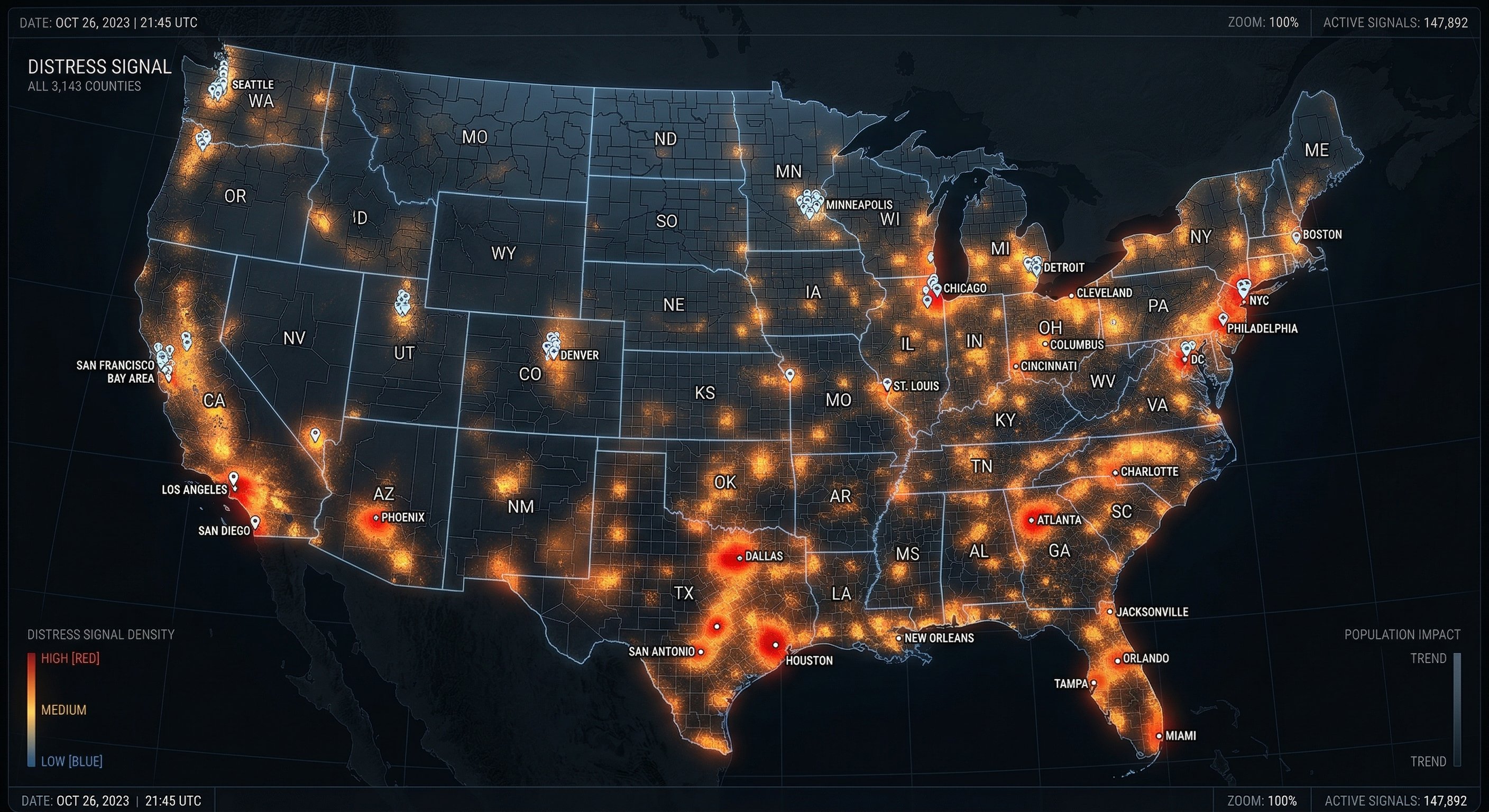
The alternative: use a platform that's already done the county-record work across 3,000+ counties and surfaces leads ranked by urgency.
DistressIQ monitors public county records — tax assessor filings, court documents, recorder data, code enforcement databases — and surfaces only properties with verified distress signals. Not 160M listings. Only distressed. Every lead has at least one documented signal. Many have multiple.
The motivation score (0-100) stacks those signals: a property that's 18 months tax delinquent, has an active lis pendens, and is owned by an out-of-state heir scores higher than one that's 60 days behind on taxes. You don't have to do that math manually. The platform does it.
See what off-market distressed inventory looks like in your market — browse free on DistressIQ.
Signal Stacking: Why Multiple Signals Aren't Just Additive
A single distress signal is a lead. Multiple distress signals on the same property are a compelling reason to call today.
Here's what stacking looks like in practice:
Single signal: Absentee owner, 6 months tax delinquent
- Moderately motivated. Could be a landlord who forgot to update their payment. Worth a mailer.
Stacked signals: Absentee owner + 18 months tax delinquent + active lis pendens + code violation filed last quarter
- This owner is facing tax sale AND foreclosure AND a citation from the city. They have no path to hold this property. They need a solution. Call this one today.
The difference between those two profiles is enormous — but they'd both show up on a generic tax delinquent list as the same kind of lead. Most lead tools don't differentiate. Signal stacking is how you find the sellers who actually need to transact now, not the ones who might possibly entertain an offer.
Which States Have the Best Off-Market Inventory Right Now?
The best off-market markets combine:
- High distress volume — states with above-average foreclosure activity, property tax issues, and aging housing stock
- Investor-friendly laws — states where foreclosure timelines are shorter, assignment contracts are legal, and court processes are navigable
- Discounted seller motivation — markets where the gap between distressed price and ARV is large enough to make the numbers work
Based on current county record activity, the markets with the deepest off-market distressed inventory include:
Texas — Non-judicial foreclosure state (fast timelines), extremely high volume of lis pendens filings, large urban markets (Houston, DFW, San Antonio) with diverse distress signal types. Tax sales are active. No state income tax = investor-friendly holds.
Florida — Judicial foreclosure but high volume. Miami, Tampa, Orlando, and Jacksonville all generate significant distress data. Probate volume is high due to demographics (large retiree population = more estate transitions).
California — High ARV margins make even expensive distressed acquisition math work. Pre-foreclosure leads in LA, Sacramento, San Bernardino, and the Inland Empire have been active. Notice of Default (NOD) filings are public record.
Ohio and Michigan — Lower ARVs but extremely thin investor competition in mid-sized markets. Tax delinquency rates are structurally high in these markets. Lead costs are low.
Georgia — Atlanta suburbs (Fulton, DeKalb, Gwinnett, Cobb) generate significant distress signal volume. Non-judicial foreclosure state with relatively short timelines.
The Off-Market Sourcing Stack in 2026
Here's the workflow structure that experienced investors are using:
Tier 1: Signal identification Monitor county records (or use a platform that does it) for new distress signals in your target markets. This is the intelligence layer — knowing what's happening before it hits any public list.
Tier 2: Lead prioritization Not all distress signals are equally urgent. Stack signals, weight by timeline, and prioritize by motivation. A fresh lis pendens is more urgent than a year-old one. Eighteen months of tax delinquency is more urgent than 90 days. Your calling order should reflect this.
Tier 3: Contact acquisition Once you've identified your top 20 leads for the week, pull owner contact info. This is where skip tracing costs matter — skip tracing a distressed list is worth the cost. Skip tracing 5,000 random absentee owners is not.
Tier 4: Outreach sequence Warm leads (stacked signals, long timelines, out-of-state owners) get calls first. Mail everyone else. Adjust sequence based on response.
Tier 5: Follow-up Most off-market deals don't close on first contact. The seller isn't ready. They're in denial, or in legal process, or waiting to see what happens. A system that tracks contact history and re-surfaces leads when their situation changes closes more deals than one-and-done outreach.

Finding Off-Market Properties Without Burning Your Marketing Budget
The most common mistake: treating off-market lead generation like a volume game when it's actually a signal quality game.
Investors who are mailing 10,000 pieces per month are not automatically doing better than investors mailing 1,000 tightly filtered distressed leads. They're spending 10x more and often getting similar or worse results because the list is broader.
The budget reallocation that works:
- Less: Generic list acquisition (absentee owner, absentee + equity stacks, etc.)
- Less: High-volume direct mail on generic lists
- More: Data quality and signal depth — invest in knowing WHO the most motivated sellers are before spending on outreach
- More: Tight contact acquisition on verified high-signal leads
- Same or more: Follow-up on leads that didn't respond initially (most off-market deals are third or fourth touch)
The math changes dramatically when your close rate improves. Moving from 1 close per 400 contacts to 1 per 80 contacts is a 5x improvement in efficiency. That's achievable with tighter signal filtering — it's not achievable by mailing more.
Frequently Asked Questions
Q: What is an off-market property?
An off-market property is any property that isn't actively listed on a Multiple Listing Service (MLS). This includes distressed properties (foreclosure, probate, tax delinquent), FSBO listings, pocket listings, and properties that haven't been formally listed for sale. For real estate investors, "off-market" typically refers to distressed properties where the owner is motivated to sell quickly, often at a discount.
Q: How do real estate investors find off-market deals?
The most effective methods are: (1) monitoring county public records for distress signals — tax delinquency filings, lis pendens notices, probate court records, and code enforcement violations; (2) using data platforms like DistressIQ that aggregate these county records across thousands of counties and score them by motivation; (3) direct outreach to owners of distressed properties identified through public records. Less effective (and increasingly saturated) methods include driving for dollars and blanket absentee owner mailings.
Q: Are off-market properties always cheaper?
No. Off-market doesn't automatically mean below-market price. Distressed off-market properties — those with documented financial or legal pressure (foreclosure, tax delinquency, probate) — are often available at a discount because the seller has a timeline and limited options. Generic off-market or pocket listing properties may actually be priced at or above market.
Q: What distress signals predict off-market motivated sellers most reliably?
Tax delinquency combined with a lis pendens filing (foreclosure initiation) is the highest-urgency signal stack. Probate properties where the estate includes an out-of-state heir are also reliably motivated. Code violations that prevent listing through traditional channels create soft urgency. Properties with multiple concurrent signals (stacked distress) convert significantly better than single-signal leads.
Q: How do I access county public records for distressed properties?
Every county in the US maintains public records for tax filings, court documents (lis pendens, probate), and recorder data. Most can be accessed directly through county websites, though the interface quality varies significantly. DistressIQ aggregates these records across 3,000+ counties, normalizes them into searchable lead cards, and scores each property by motivation — eliminating the manual county-by-county research process.
DistressIQ surfaces verified off-market distressed leads from 3,000+ US counties — scored by motivation, updated daily from county sources. Browse free, no credit card required.
The data behind this article
DistressIQ Monitors These Signals in Real Time
Pre-Foreclosures
NOD + NTS filings
Tax Delinquency
County treasurer records
Code Violations
Municipal inspection filings
Probate Filings
Superior Court records
Every lead is scored 0–100 for seller motivation based on signal type, duration, severity, and stacking. Nationwide coverage — every US county, updated daily.
Ready to find deals in your market?
See Live Distress Signals in Your County
Stop calling dead leads. Every lead in DistressIQ is scored 0–100 for seller motivation, with verified contact info included. Browse the free tier to see what's active in your market right now.
Browse Free Leads — No Credit Card