How to Find Eviction Leads: The Investor's Guide to Court Records in 2026

How to Find Eviction Leads: The Investor's Guide to Court Records in 2026
TL;DR: Eviction leads come from public court filings at the county level, not from lead list providers. Investors who know how to find eviction filings can identify rental property owners facing financial pressure before those properties hit the open market. The key sources are county circuit or justice court case search portals, state court record databases, and property intelligence platforms that monitor these filings continuously. Court records are public, free to access, and updated with each new filing. The challenge is not access. It is knowing what to look for and how to convert a filing into a usable lead.

Why Eviction Filings Signal Investment Opportunity
An eviction filing does not mean a property is about to change hands. It means a landlord is in a legal dispute with a tenant, and the financial pressure behind that dispute is often a leading indicator of distress.
The U.S. Census Bureau's quarterly housing report consistently shows that rental vacancy rates and eviction filings track closely with local economic conditions. When unemployment rises in a metro area, eviction filings follow within 60 to 90 days. Landlords who lose tenants and cannot quickly refill units face mounting mortgage pressure. Many begin exploring whether to sell. That window between an eviction filing and an eventual listing is where sophisticated investors operate.
The National Low Income Housing Coalition's 2025 Out of Reach report documented that more than 10 million renter households in the United States spend more than half their income on housing costs. That level of cost burden makes even a temporary income disruption a catalyst for eviction. The result is a steady supply of properties where the landlord is under pressure, the tenant may be leaving, and the property condition may be deteriorating. For investors looking for motivated sellers, eviction filings are a time-stamped signal of financial stress.
The Urban Institute's research on eviction patterns across major American cities found that eviction filings concentrate in specific zip codes and building types. Properties with two to four units in working-class neighborhoods generate the highest eviction filing rates. Those same properties frequently appear in investor portfolios. Understanding the filing patterns in a target market gives an investor a structural advantage.

What Eviction Court Records Reveal About a Property
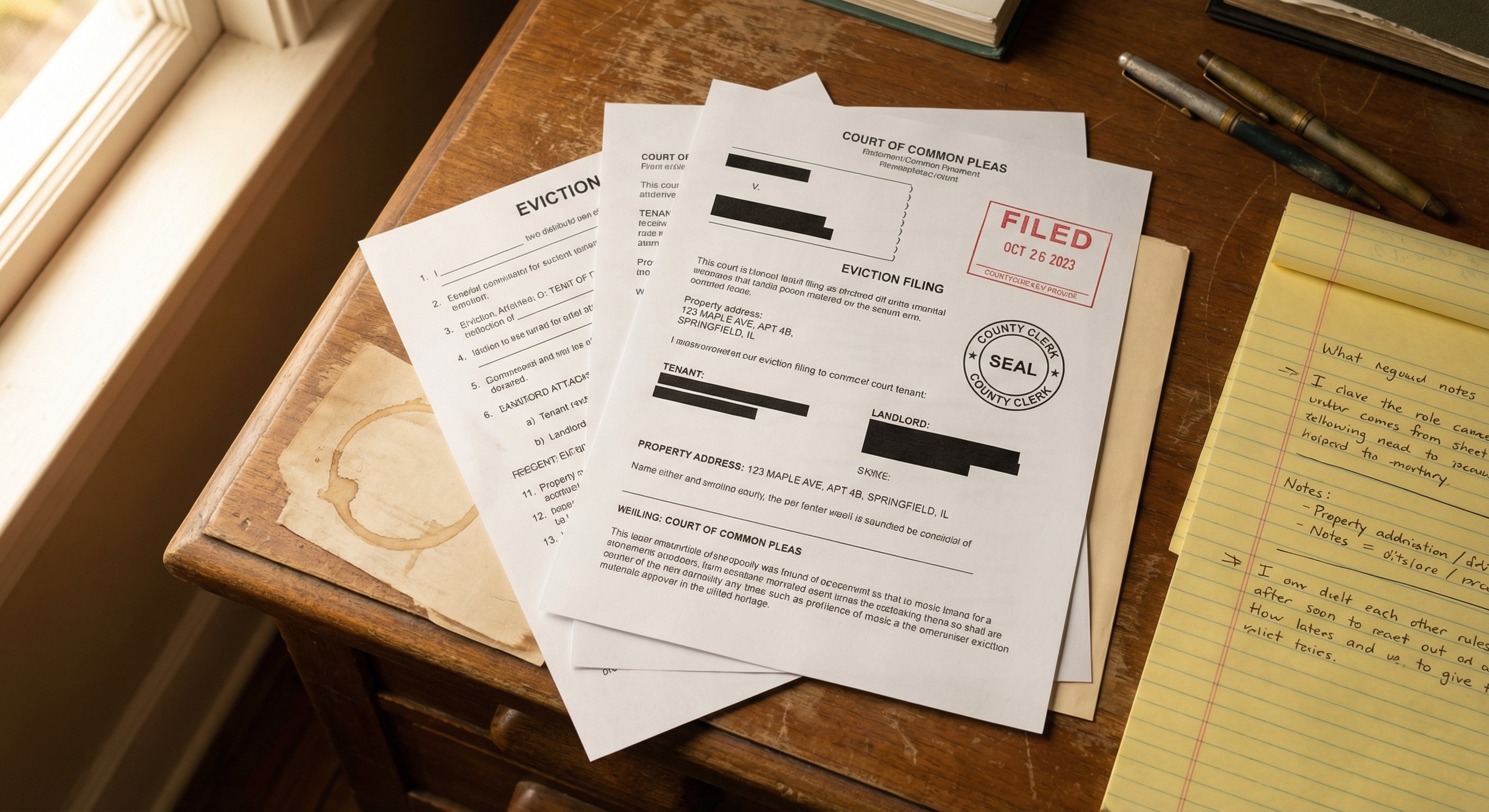
An eviction filing generates a court record that contains more useful information than most investors realize.
The case docket lists the property address, the case number, the filing date, and the names of both the plaintiff (typically the landlord or property management company) and the defendant (the tenant). For an investor, the plaintiff name is the most valuable piece of information in the filing. It identifies who owns the property. That owner becomes a direct outreach target.
Court records also reveal the procedural history of the case. A filing that has progressed through multiple hearing dates, continuances, and warrant requests tells a different story than a case that was resolved in a single hearing. A case that has been active for six months with multiple court dates signals a landlord who is struggling to resolve the situation and may be more receptive to a direct purchase offer.
Some county court systems also include a field hearing summary that describes the condition of the premises, any health or safety violations noted by the court, and whether the tenant has claimed defenses such as uninhabitability or illegal lockout. These details are gold for an investor evaluating whether a property merits a closer look.
The case number and court location allow an investor to pull the full filing documents, including any judgment amounts, restitution orders, and move-out dates ordered by the court. A judgment for back rent that exceeds the property's market value tells a clear story about the owner's financial position.
How to Search County Court Records for Eviction Filings
Every U.S. county maintains an online case search portal. These portals are public record systems built to comply with state open records laws. They are free to use and updated in real time as new cases are filed.
The process starts with identifying the correct court for the target county. In most states, residential eviction cases fall under the county circuit court, justice of the peace court, or a dedicated landlord-tenant court in larger jurisdictions. Searching "eviction case search [County] [State]" typically returns the correct portal within the first three results.
Once inside the portal, investors can search by property address, defendant name, or case number. Searching by property address is the most useful approach for lead generation. It returns every case associated with that address, including any prior eviction history. A property with three eviction filings in five years signals a landlord with chronic tenant problems and a strong likelihood of future distress.
Searching by defendant name is useful for investors who want to build a list of landlords who appear frequently as plaintiffs in eviction cases. Those are portfolio landlords, often operating multiple properties, who are actively using the court system to manage their rentals. A portfolio landlord with five pending eviction cases across four properties is almost certainly under significant financial pressure and is a prime outreach candidate.
State court record databases aggregate county-level data into a single searchable index. Several states offer statewide search tools that allow investors to run a plaintiff name across all participating counties simultaneously. This is a more efficient approach for investors building a regional lead list than searching county portals individually.
Free Weekly Alerts
See What's Distressed in Your Market
Get free weekly alerts — new distressed properties, motivation scores, and hot neighborhoods in your area. Addresses and contact info available inside DistressIQ.
Free forever · No credit card · Unsubscribe anytime
Automating Eviction Lead Monitoring at Scale
Manual court record searches work well for one county or one investor focused on a single market. They do not scale. An investor working three counties needs to check three separate portals. An investor working 10 counties needs a different approach.
The most effective way to monitor eviction filings across multiple jurisdictions is through a property intelligence platform that continuously tracks court records as part of its data pipeline. DistressIQ aggregates eviction filing signals alongside tax delinquency, lis pendens, code violations, and pre-foreclosure data across 3,200-plus counties. The platform updates these signals from county sources and presents them in a single map-based interface sorted by motivation score.
This approach converts a manual research task into a browsing workflow. Instead of logging into five county portals and running individual searches, an investor opens a map, selects the target county, and sees every active eviction signal ranked by urgency. The motivation score incorporates the filing recency, the number of court appearances, and whether a judgment has been entered. Higher scores represent properties where the eviction has progressed further and the landlord's financial pressure is most acute.
The practical difference between manual research and automated monitoring is time. A manual county court search takes 15 to 30 minutes per county when done thoroughly. An investor working 10 counties spends two to five hours per week just on court record research. Automated monitoring delivers the same data coverage in the time it takes to open a browser tab and draw a radius on a map.
How to Convert an Eviction Lead Into a Deal
Finding an eviction filing is the beginning of the process, not the end. Converting a court record into a deal requires the same outreach discipline as any other distressed property lead.
The first step is to identify the property owner from the court record and verify ownership through the county assessor. Court records list the plaintiff name, which is usually but not always the property owner. Some cases involve property management companies as plaintiffs on behalf of owners. Cross-referencing the plaintiff name against the county assessor parcel records confirms the owner of record and their mailing address.
The second step is to evaluate the property condition. Eviction cases frequently involve properties that have suffered deferred maintenance, tenant damage, or both. An investor who can physically drive by the property and note its condition has an advantage over an investor working from a desk. Overgrown yards, boarded windows, and visible structural deterioration all suggest a property that a motivated owner will sell below market value to avoid the cost of repairs.
The third step is outreach timing. An eviction filing creates a public record that remains searchable even after a case resolves. An investor who monitors filings daily and reaches out to owners within the first 30 days of a filing catches the period when the owner is most likely to be actively exploring options. Once a case resolves and the tenant vacates, the urgency often decreases. The owner may decide to repair and re-rent. Reaching out during the active filing period is where the timing advantage is highest.
The fourth step is direct mail and skip tracing. Once the owner's name and address are confirmed, a personalized letter describing a clean, fast purchase transaction is the standard outreach format. A skip trace on the owner returns current phone numbers and confidence scores, enabling direct phone follow-up. The combination of a well-timed letter and a confident phone conversation converts motivated owners at a higher rate than cold outreach on generic lead lists.


What Investors Get Wrong About Eviction Leads
The most common mistake is treating eviction filings as a lead type on par with tax delinquent properties or pre-foreclosures. They are not. Eviction filings are an event, not a signal of ownership distress on their own. A landlord who wins an eviction case and collects back rent has resolved the problem and has no particular reason to sell. An investor who builds a list of every eviction filing in a county is working with a high-noise dataset.
The signal that matters is the combination of an eviction filing and a property condition or ownership profile that suggests financial pressure. A landlord with three pending eviction cases, a property with a code violation history, and a mailing address in another state is a fundamentally different lead than a landlord with one resolved eviction case on a well-maintained property.
Investors who understand this distinction use eviction filings as a trigger, not a destination. The filing tells you who to investigate. The investigation tells you whether to reach out. That sequencing is what separates investors who find genuine deals from investors who spend their time calling landlords who have everything under control.
The second mistake is failing to monitor filings continuously. An eviction case can be filed, proceed through multiple hearings, and reach a judgment within 45 to 90 days in many jurisdictions. An investor who checks court portals weekly will miss the early filing window. Daily monitoring is the only approach that consistently catches new filings while the outreach window is open. Platforms that provide automated daily updates on new eviction signals eliminate this monitoring burden entirely.
Frequently Asked Questions
Q: Are eviction records public information?
Yes. Eviction court records are public in all 50 states. County circuit court and justice court records are accessible through online case search portals maintained by each county. The public nature of these records is what makes eviction lead generation legal for investors. No special access or subscription is required to search court portals directly.
Q: How do I find eviction records in a specific state?
Search the state court system's online database. Most states maintain a statewide case search that covers participating counties. For states without a centralized system, run county-specific searches using the format "eviction case search [County], [State]." Most county portals are indexed by search engines and appear in the first page of results for this query.
Q: What is the difference between an eviction filing and an eviction judgment?
An eviction filing is the initiation of a court case. It means the landlord has filed paperwork with the court requesting removal of a tenant. An eviction judgment is the court's final ruling, typically in favor of the landlord, that authorizes a sheriff's deputy to physically remove the tenant and restore the property to the landlord. A filing without a judgment means the case is still in progress. A judgment means the legal process is complete and the landlord now controls the property.
Q: How long does it take from an eviction filing to a judgment?
The timeline varies significantly by state and by whether the tenant contests the case. In states with streamlined eviction procedures, a judgment can be entered within 14 to 21 days of a filing if the tenant does not appear or contest. In states with more procedural protections for tenants, the process can take 60 to 120 days. Urban Institute research documents that the average eviction case from filing to resolution takes 30 to 90 days in most major metropolitan areas.
Q: Can I buy a property during an active eviction case?
In most cases, yes. A property can be sold while an eviction case is pending, though the transaction requires careful coordination with the title company. The existing tenant's rights transfer to the new owner, meaning the buyer assumes the role of landlord. A real estate attorney should review any purchase contract for a property with an active eviction to ensure the buyer understands their obligations.
Q: How do I get the property owner's contact information from an eviction record?
The eviction filing lists the plaintiff, which is typically the landlord or property management company. Cross-reference the plaintiff name with the county assessor parcel records to get the owner of record and their mailing address. A skip trace service then returns current phone numbers with confidence scores for direct outreach. Platforms like DistressIQ include property owner contact information alongside eviction signals, eliminating the manual cross-reference step.
Q: Are eviction leads better than tax delinquent leads?
Neither is categorically better. Tax delinquent leads signal a property owner who has failed to pay property taxes, typically because of a cash flow problem. Eviction leads signal a landlord who is actively managing a tenant dispute, which may or may not involve financial distress. The best lead source depends on the investor's market, their acquisition strategy, and the local property types available. Most sophisticated investors monitor both signal types simultaneously and prioritize based on property condition and owner motivation.
See how DistressIQ aggregates eviction filing signals alongside tax delinquency, code violations, and pre-foreclosure data across every U.S. county. Browse the map free and filter by the signal types most relevant to your investment strategy.
DistressIQ tracks 31 distress signal types across 3,200-plus counties, updated from county sources daily.
The data behind this article
DistressIQ Monitors These Signals in Real Time
Pre-Foreclosures
NOD + NTS filings
Tax Delinquency
County treasurer records
Code Violations
Municipal inspection filings
Probate Filings
Superior Court records
Every lead is scored 0–100 for seller motivation based on signal type, duration, severity, and stacking. Nationwide coverage — every US county, updated daily.
Ready to find deals in your market?
See Live Distress Signals in Your County
Stop calling dead leads. Every lead in DistressIQ is scored 0–100 for seller motivation, with verified contact info included. Browse the free tier to see what's active in your market right now.
Browse Free Leads — No Credit Card