Tax Lien List Texas: What Local Investors Need to Know in 2026

Tax Lien List Texas: What Local Investors Need to Know in 2026
TL;DR: Texas is a tax deed state — it does not sell tax lien certificates to investors. When property taxes go unpaid, the county eventually auctions the property deed itself at constable or sheriff's sales. Redemption windows are 180 days for non-homestead properties and 2 years for homestead and agricultural land. To find delinquent properties before auction, investors use county appraisal district websites, county tax assessor-collector sites, and platforms like DistressIQ that aggregate stacked distress signals across all 254 Texas counties.
Texas produces one of the largest volumes of tax-delinquent real estate in the country. The state has 254 counties — more than any other state — and each one maintains its own delinquent property roll. For investors who understand how the system actually works, that fragmented pipeline is the opportunity. For investors who assume Texas works like Florida or Arizona, it's an expensive lesson.
The most important thing to know upfront: if you've been searching for Texas tax lien certificates, you're in the wrong state for that strategy. Texas went a different route — and in many ways, it's a better one for direct property acquisition.

Texas Is a Tax Deed State — Here's What That Actually Means
The United States is divided into tax lien states, tax deed states, and a handful of hybrid states. Understanding which category Texas falls into determines your entire strategy.
Tax lien states (Florida, Arizona, Iowa, New Jersey, and others): When property taxes go unpaid, the county sells a certificate representing the tax lien amount to investors. Those investors earn statutory interest — often 16–36% annually depending on the state — while the original owner retains possession and has a redemption period to pay off the lien plus interest. If they don't redeem, the lien holder can eventually foreclose and take the deed. It's an interest-earning play, not an immediate acquisition play.
Texas is a tax deed state — specifically, a "redeemable deed" state. Here's what that means in practice:
When property taxes go delinquent in Texas, the county does not create an investable certificate. Instead, after a legal process that typically spans 1–3 years, the county auctions the deed to the property itself at a public constable's sale or sheriff's sale. The winning bidder walks away with a deed — not a lien.
The former owner then has a defined window to reclaim the property by paying back the purchase price plus a penalty surcharge. Per the Texas Property Tax Code (Chapter 34), that redemption window is:
- 2 years for homestead property (owner-occupied primary residence) and agricultural land
- 180 days for all other property, including non-homestead residential and commercial
For investors, this structure has real advantages. You're not waiting years to foreclose on a lien while collecting interest — you acquire the deed immediately at auction and know your exit from day one.
How Texas Tax Delinquent Properties Enter the Pipeline

The Texas tax delinquency timeline follows a predictable path, though the speed varies county by county.
February 1: The clock starts. Texas property taxes are due January 31. The morning of February 1, any unpaid balance becomes delinquent. Penalties begin accruing immediately — 6% in February, with an additional 1–2% per month added through July.
July 1 (or later): If still unpaid, an additional 12–20% attorney fee is added when the county turns the account over to a delinquent tax collection law firm. This single event dramatically increases the total owed. Under Texas Tax Code Section 33.07, these penalty and attorney fee provisions are mandatory and not negotiable.
Years 1–3 (lawsuit filing): Once the county's tax attorney determines collection is warranted, they file a lawsuit in district court. The timing depends on the county — Harris County (Houston) tends to be more aggressive; rural counties may wait longer.
Post-judgment (constable's sale): Once the court grants a judgment, the property is scheduled for constable's sale. Most counties hold these monthly at the county courthouse. Properties are advertised in the local legal newspaper for at least 21 days before sale.
Auction day: Properties sell to the highest bidder above a minimum bid — typically the total of back taxes, penalties, and legal fees owed. Cash or certified funds only. No financing, no contingencies.
The critical investor insight embedded in this timeline: the best time to reach a distressed Texas owner is 12–18 months before the lawsuit is filed — when the total owed is still manageable, when they still have options, and when competition from other investors is lowest.
How to Find the Texas Tax Lien List (County by County)
Texas doesn't maintain a centralized statewide list of delinquent properties. You'll need to go county by county — or use a platform that aggregates across counties. Here's how to work the major markets directly:
Harris County (Houston metro): The Harris County Tax Assessor-Collector at hctax.net maintains an online property search. Constable sales are posted on the official Harris County Constable's Office site with scheduled auction dates, typically held on the first Tuesday of each month.
Dallas County: Dallas County Sheriff's Sales are posted on the Dallas County official website with monthly sale schedules. The Sheriff's Sale typically occurs on the first Tuesday of each month at the George Allen Courts Building.
Travis County (Austin): The Travis Central Appraisal District and Travis County Tax Office each maintain searchable records. Constable sales are listed through Travis County's official legal notices portal.
Tarrant County (Fort Worth): Tarrant County Tax Assessor-Collector lists delinquent accounts at tarrantcountytx.gov. Constable precinct offices post sale schedules separately.
Bexar County (San Antonio): The Bexar County Tax Assessor-Collector publishes delinquent rolls and constable sale schedules at bexar.org.
Online Auction Platforms: Many Texas counties now use third-party online auction platforms to conduct constable sales. GovEase and RealAuction are the two dominant providers — both aggregate Texas county auctions and allow online registration and bidding from anywhere.
What to look for in each record:
- Account status (delinquent, pending lawsuit, judgment obtained)
- Number of years delinquent and total amount owed
- Assessed market value vs. taxes owed (the equity spread)
- Property classification (homestead vs. non-homestead — affects redemption window)
- Owner name and mailing address for skip tracing and outreach
The limitation of working raw county data: you're seeing one signal in isolation, one property at a time, with no context about what else is happening at that address. A property that's tax delinquent AND vacant AND showing a recent probate filing is in a fundamentally different category than a property that's simply one year behind.
Free Weekly Alerts
See What's Distressed in Your Market
Get free weekly alerts — new distressed properties, motivation scores, and hot neighborhoods in your area. Addresses and contact info available inside DistressIQ.
Free forever · No credit card · Unsubscribe anytime
What Investors Need to Know Before Bidding at Texas Tax Auctions
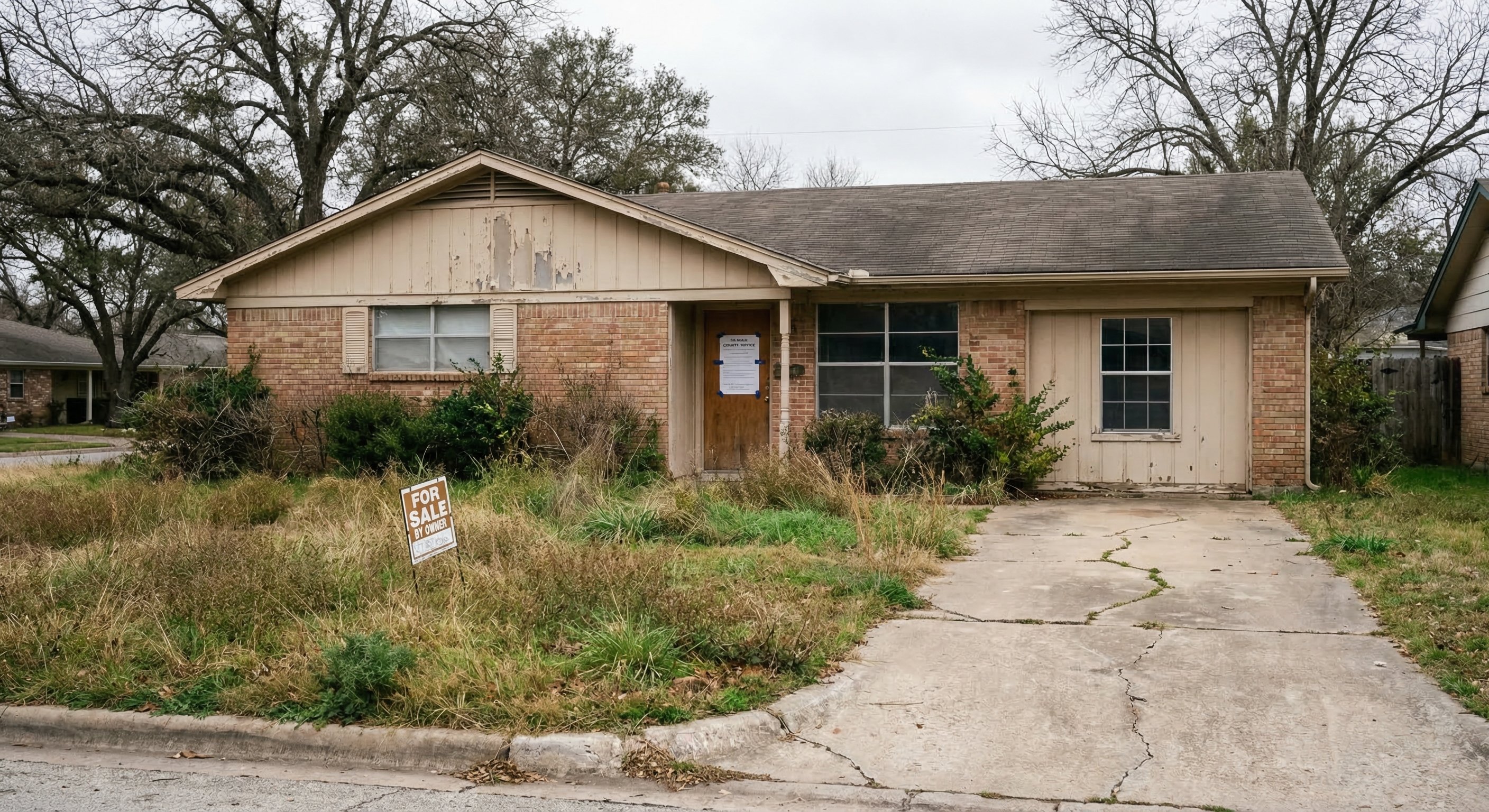
Texas constable sales have specific mechanics that catch unprepared investors — especially out-of-state buyers — off guard.
Do your title work before bidding. A constable's deed can come with surviving encumbrances. While Texas property tax liens are superior to most other liens, federal IRS tax liens and certain federal agency liens may survive the sale depending on how they were handled in the lawsuit. Mechanics liens and HOA liens may also survive in some scenarios. Always pull a title report and consult a Texas real estate attorney before committing capital.
Cash only, no exceptions. Texas constable sales require cash or certified funds on auction day. If you win the bid and can't close, you forfeit any deposit and may be barred from future auctions. Arrange your funding before you show up.
Assess redemption risk carefully. For homestead properties, the 2-year redemption window is real and exercised more often than investors expect — especially when property values are rising and the former owner has family or equity at stake. Non-homestead properties with the 180-day window present dramatically lower redemption risk. Know what you're bidding on.
Minimum bids vary significantly. In distressed markets and rural counties, minimum bids can be well below assessed value — sometimes pennies on the dollar for properties that have accumulated years of delinquency. In hot urban markets like Austin or Dallas suburbs, minimum bids often reflect near-market values because tax owed on a high-value property is proportionally higher.
The real leverage: pre-auction outreach. The constable sale is a competitive event with cash buyers, professional flippers, and hedge fund buyers all competing on thin margins. The investors who systematically outperform do it by getting to owners 6–18 months before auction — when:
- The owner still has options and is more receptive to conversation
- The total owed hasn't yet compounded to an impossible amount
- There's no public auction record triggering a wave of outreach from competitors
- You can negotiate a price that works for both parties without the courthouse drama
Why Tax Delinquency Alone Isn't Enough
Texas generates tens of thousands of new delinquent property records every year. According to the Texas Comptroller of Public Accounts, property tax collections totaled over $80 billion in fiscal year 2023 — with delinquent properties representing a meaningful slice of every county's uncollected balance. [Source: Texas Comptroller, Annual Property Tax Report 2023]
With that volume, a raw "tax lien list Texas" approach creates a needle-in-a-haystack problem. Not all delinquent owners are motivated sellers — many will pay up before auction. The ones who won't have different stories:
- Probate tangles: Owner passed away and the estate is unresolved
- Financial crisis: Job loss, medical debt, divorce — short-term delinquency that may not signal a seller
- Absentee landlord burnout: Out-of-state owner who's done dealing with the property
- Compounding distress: Delinquent taxes + underwater mortgage + vacant property = someone who truly needs out
The National Tax Lien Association (NTLA) estimates that properties showing three or more concurrent distress indicators close at significantly higher rates than single-signal lists — and at better price points for buyers. [Source: NTLA Industry Benchmarks 2024]
That overlap is exactly where experienced investors focus. A Texas property showing up as tax delinquent is a starting point. A Texas property showing up as tax delinquent AND appearing in lis pendens filings AND carrying a vacant indicator AND with an out-of-state owner address is a priority call.

DistressIQ's Approach to Texas Tax Leads
Manually pulling and cross-referencing delinquent records across 254 Texas counties is technically possible. In practice, it requires multiple county logins, inconsistent data formats, manual re-pulls as records update, and still leaves you with a flat list that tells you nothing about signal stacking.
DistressIQ aggregates tax delinquency signals across all Texas counties — county-verified daily — and layers them against 30 other distress signals: vacancy status, mortgage delinquency, lis pendens filings, probate activity, code violations, absentee ownership patterns, and more.
The result is a prioritized Texas lead list, not a raw county dump. Each property gets a distress score based on signal stacking — how many indicators have converged and how severe the situation is. The properties at the top of your list are the ones most likely to convert to a conversation, an off-market offer, and a closed deal.
Coverage: 3,200+ counties nationwide, including all 254 Texas counties. Updated multiple times daily from county sources.
DistressIQ founding member pricing: Starter $89/mo, Pro $174/mo, Elite $349/mo — locked for life with fewer than 50 founding spots remaining. Start your free trial at distressiq.ai
Related Reading
- How to Find Tax Delinquent Properties: The Complete Investor Guide
- Tax Delinquent Properties in Texas: County-by-County Guide
- How to Find Lis Pendens: The Investor's Guide to Pre-Foreclosure Filings
Key Takeaways
- Texas is a tax deed state — no tax lien certificates. You buy the deed itself at constable or sheriff's sale.
- Redemption windows: 2 years for homestead/agricultural land; 180 days for non-homestead and commercial.
- Property taxes are due January 31; delinquency, penalties, and attorney fees compound fast after that.
- All 254 Texas counties maintain separate delinquent rolls — no single statewide list exists.
- GovEase and RealAuction aggregate many Texas county constable sales for online bidding.
- The highest-leverage move is pre-auction outreach — contacting owners 6–18 months before judgment.
- Stacked distress signals (delinquency + vacancy + absentee + lis pendens) dramatically outperform single-signal lists.
Frequently Asked Questions
Q: Does Texas sell tax lien certificates to investors?
No. Texas is a tax deed state, not a tax lien state. Instead of selling a certificate representing the tax debt to investors, Texas counties auction the property deed itself at constable's or sheriff's sales after obtaining a court judgment. Investors buy the property, not the lien.
Q: What is the redemption period for tax deed properties in Texas?
The redemption period depends on property type. Homestead properties (owner-occupied primary residences) and agricultural land carry a 2-year redemption window. All other property types — non-homestead residential, commercial, vacant land — carry a 180-day (6-month) window. During this time, the former owner can reclaim the property by paying the purchase price plus a 25% penalty (first year) or 50% penalty (second year for homesteads). This is governed by Texas Property Tax Code Section 34.21.
Q: Where can I find a Texas tax delinquent property list?
Each of Texas's 254 counties maintains its own delinquent tax roll through the county tax assessor-collector office. For constable sale properties, GovEase and RealAuction aggregate auction listings for many Texas counties. Platforms like DistressIQ compile delinquency data across all Texas counties with additional signal layering.
Q: How long does it typically take for a Texas property to reach constable's sale?
There is no fixed statewide timeline — it depends on when the taxing unit files the lawsuit and how quickly the court moves to judgment. In practice, most properties enter the lawsuit pipeline after 2–4 years of delinquency. Once a court judgment is issued, the constable sale is typically scheduled within 60–90 days, with required 21-day notice published in local legal papers.
Q: Can I finance a Texas tax deed purchase?
Not at the constable sale itself — Texas requires cash or certified funds on auction day. After taking possession and allowing the redemption period to expire (or securing a title insurance policy), investors can typically refinance or leverage the property through conventional lending channels.
Q: Are there liens that survive a Texas tax deed sale?
Yes. While Texas property tax liens are senior to most other liens, certain federal tax liens (IRS) filed under federal law can survive if the federal government wasn't properly notified during the lawsuit process. HOA liens and mechanics liens may survive in some situations. A thorough title search and Texas real estate attorney review are essential before bidding at any tax sale.
Q: Why is pre-auction outreach more effective than bidding at constable sales?
The constable sale is a competitive, cash-only auction open to the public — hedge funds, professional flippers, and experienced local investors all compete, compressing margins. Pre-auction, the owner still has options, competition is essentially zero, and you can structure a deal that works for both parties. The owner avoids public auction embarrassment and clears a debt; you acquire a motivated-seller property before it hits any public list. This is where the real returns in Texas tax deed investing come from.
Texas's scale — 254 counties, millions of parcels, and one of the most active real estate investment markets in the country — means the tax delinquent opportunity here is massive. The investors who win are the ones who work it systematically: multi-county coverage, early outreach, and signal stacking to find the owners who are genuinely ready to move.
See the full Texas distress picture at distressiq.ai — all 254 counties, 31 signal types, updated daily. Start free at distressiq.ai
The data behind this article
DistressIQ Monitors These Signals in Real Time
Pre-Foreclosures
NOD + NTS filings
Tax Delinquency
County treasurer records
Code Violations
Municipal inspection filings
Probate Filings
Superior Court records
Every lead is scored 0–100 for seller motivation based on signal type, duration, severity, and stacking. Nationwide coverage — every US county, updated daily.
Ready to find deals in your market?
See Live Distress Signals in Your County
Stop calling dead leads. Every lead in DistressIQ is scored 0–100 for seller motivation, with verified contact info included. Browse the free tier to see what's active in your market right now.
Browse Free Leads — No Credit Card