Wholesale Real Estate Leads: How to Find Motivated Sellers That Actually Convert
Wholesale Real Estate Leads: How to Find Motivated Sellers That Actually Convert
TL;DR: Most wholesale real estate leads fail because they are built on generic lists every other investor already owns. The wholesalers closing consistent deals target sellers with verified distress signals: tax delinquency, lis pendens filings, probate cases, and code violations sourced directly from public records. Stack two or more signals on a single property and conversion probability rises sharply. This guide covers where assignable-contract leads come from, why MLS deals rarely work, and how to prioritize outreach without burning through a skip trace budget.
Seventy percent of wholesale contracts never close. Not because the wholesaler negotiated poorly, but because the lead was never assignable. The seller had no pressure to accept a below-market offer, or the deal math collapsed the moment an end buyer ran their own numbers.
Wholesale real estate lives or dies on lead quality. The entire model depends on finding a property owner whose situation makes keeping the property more painful than selling below market value, then assigning the contract before closing to a buyer who can close fast.

Why Most Wholesale Lead Lists Fail
The default move for new wholesalers is buying a list: absentee owners, high-equity homeowners, tax-delinquency flags. Data aggregators sell these by the thousands. The problem is not the data. The problem is that 200 other wholesalers in the same market bought the exact same list this month.
When 300 property owners receive mailers from 40 different investors, they stop responding. Response rates on purchased demographic lists hover between 0.5% and 1.5%.
Real motivation is not a demographic category. It is a documented circumstance. A property owner who has not paid taxes in 18 months, has a lis pendens on record, and lives three states away from a vacant house is not a "maybe." That person has a problem a cash offer solves.
The Three Lead Sources That Produce Assignable Contracts
The lead sources that consistently produce wholesale deals share one trait: they identify property owners with documented, time-sensitive pressure to sell.
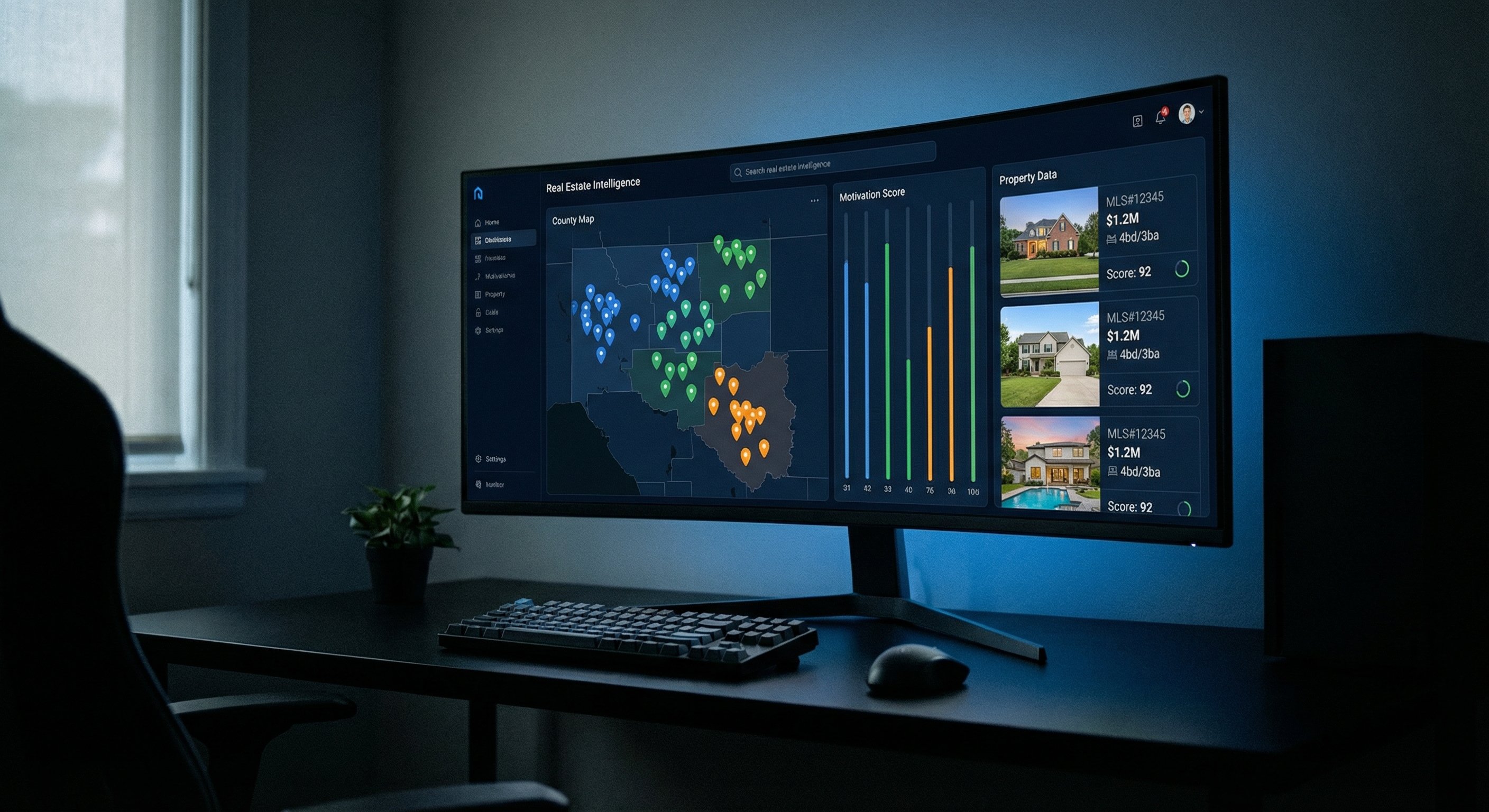
1. Verified distress signals from public records. County recorder offices, tax assessor databases, and court filing systems contain the raw material for every serious wholesale operation. Tax delinquency, lis pendens, probate filings, divorce decrees involving property, code violations, and vacancy indicators are all public record. When two or more signals appear on the same address, the probability that the owner will accept a below-market offer increases dramatically.
The challenge is access. Each county runs its own system. Pulling fresh data across multiple counties requires either manual effort or a platform that aggregates and normalizes the records automatically.
2. Direct mail to high-distress lists. Direct mail still works when the list is precise. A postcard to an owner with a lis pendens filed in the last 60 days and 12-plus months of unpaid taxes outperforms a generic high-equity list by 4 to 6 times. Skip tracing costs $0.10 to $0.50 per record, but verified distress-signal lists convert at 4 to 6 times the rate of cold lists, making per-deal cost dramatically lower.
3. Driving for dollars, stacked with signal data. Driving neighborhoods and noting visible neglect: overgrown lawns, boarded windows, piled mail. This is the oldest wholesale method and it still works. But it has a critical trap. Visible neglect signals distress on the property but reveals nothing about ownership. A boarded-up house might be owned by an out-of-state heir ready to sell at a discount, or it might be a bank-owned property in REO processing where no assignment is possible. Every address must be cross-referenced against tax records, ownership data, and court filings before contact.
The Assignment Fee Math Every Wholesaler Must Know
Wholesale is not arbitrage on market ignorance. It is a service: finding distressed properties, negotiating below-market contracts, and connecting those contracts to end buyers with the capital and willingness to renovate. The wholesaler gets paid through an assignment fee, typically $5,000 to $25,000, written into the purchase contract.
For the deal to work, every party in the chain needs room. The formula: After Repair Value minus repair costs minus the wholesaler's assignment fee minus the end buyer's target profit margin must still produce a deal worth the buyer's time. In practice, this means contracting the property at roughly 60 to 70 percent of ARV minus repairs.
If ARV is $250,000 and repairs are $40,000, the maximum allowable offer sits around $110,000 to $135,000. The assignment fee comes out of the spread between that contracted price and what the end buyer pays. Only truly motivated sellers accept offers at 60 to 70 percent of ARV minus repairs. Semi-motivated sellers will not. This is why lead quality is the entire game.
Free Weekly Alerts
See What's Distressed in Your Market
Get free weekly alerts — new distressed properties, motivation scores, and hot neighborhoods in your area. Addresses and contact info available inside DistressIQ.
Free forever · No credit card · Unsubscribe anytime
Why MLS Deals Almost Never Work for Wholesale
Listed properties already have market exposure. The listing agent has run comps and priced at or near market value. The seller is expecting retail offers. The entire purpose of listing on MLS is to maximize the sale price, which is the opposite of what a wholesale buyer needs.
Motivated sellers who would accept wholesale pricing typically do not list at all. They either cannot afford the repairs required for a retail listing, or they need to move too fast for the standard 60-to-90-day listing cycle. These owners are found through public records and direct outreach, not through the multiple listing service.
The Highest-Converting Lead Types: Probate and Divorce
Two distress signal categories consistently outperform everything else: probate filings and divorce decrees involving property.
Probate generates leads because the seller is almost always an heir, not an owner-occupant. The heir may live in another state, faces ongoing tax obligations for a house they did not choose to own, and operates under a court-imposed deadline to settle the estate. A cash offer that closes in two weeks solves a problem the heir did not ask for.
Divorce filings produce similar dynamics. Both parties need to liquidate shared assets quickly under court-imposed timelines. Time pressure plus emotional pressure equals a seller who will accept below-market pricing to be done with it.
Both lead types share the same advantage: the seller faces a legal deadline, not just financial stress. Deadlines create action.
How to Prioritize Leads Before Spending on Skip Tracing
Skip tracing costs add up. At $0.10 to $0.50 per record, running 2,000 names through a skip trace service costs $200 to $1,000. If half those records are low-probability leads, half the budget is wasted.
The play is filtering before skip tracing:
- Signal count. Only skip trace records with two or more verified distress signals. One signal is a possibility. Two is a probability. Three is a near-certainty.
- Recency. A lis pendens filed 30 days ago has more urgency than one filed 18 months ago. Fresh filings mean the seller's problem is current and unresolved.
- Property type fit. Single-family detached in the target price range. Skip anything outside the buyer network's appetite.
- Equity indicator. Properties with 40 percent or more estimated equity are more likely to transact. The owner can accept a discount and still walk away with cash.
Apply those filters before spending a dollar on contact data. Every skip trace dollar goes toward a lead with genuine conversion probability.

The Geography Factor: Foreclosure Timelines Shape Strategy
State-level foreclosure law determines how much time a distressed seller has, which shapes the wholesale approach.
Non-judicial foreclosure states move fast. Texas, Arizona, Georgia, Nevada, and North Carolina can process a foreclosure in three to six months from notice of default to trustee sale. Sellers in these states have less time to explore options and are more receptive to fast cash offers. Speed is the competitive edge.
Judicial foreclosure states move slowly. Florida, Illinois, New York, New Jersey, and Ohio require court proceedings stretching 12 to 36 months. The window is wider, meaning more time to find sellers, but also more competition because the distress is visible for longer.
Both produce deals. In non-judicial states, reaching the seller within days of a lis pendens filing is critical. In judicial states, relationship-building and consistent follow-up over a longer period matters more.

FAQ
Q: Where can wholesale real estate leads be found for free?
Public records at county recorder offices, tax assessor portals, and court filing systems are accessible at no cost. The tradeoff is time. Each county runs a different system, and manually cross-referencing tax data, lis pendens filings, and ownership records across multiple counties is slow. For investors who want to browse verified distress signals without paying upfront, platforms like DistressIQ allow free map browsing with signal overlays. Contact data and skip tracing are where costs kick in.
Q: How many wholesale leads does it take to close one deal?
It depends entirely on signal quality. Cold absentee owner lists typically require 300 to 500 contacts per closed deal. Verified distressed property leads with two or more stacked signals bring that ratio down to roughly 50 to 150 contacts, depending on market conditions and follow-up consistency. Better data means fewer contacts needed per deal, which means lower cost per acquisition and faster revenue.
Q: What is the best state for wholesale real estate?
Texas and Florida rank at the top due to high transaction volume, population growth driving both new distress and active buyer pools, and foreclosure timelines that create urgency. Georgia, Arizona, and North Carolina are also strong markets. The right state depends on the wholesaler's access to fresh data, their existing buyer network, and whether the target deal size matches local price points.
Q: Is lis pendens the strongest signal for wholesale deals?
Lis pendens is one of the strongest single signals because it documents an active financial and legal crisis with a ticking clock. But it performs best when stacked with supporting signals. A lis pendens alone is a strong lead. A lis pendens plus 18 months of unpaid taxes on a vacant property is a completely different category. Multi-signal stacking is what separates consistent closers from everyone else.
Q: How much does skip tracing cost for wholesale leads?
Quality skip tracing runs $0.10 to $0.50 per record depending on the provider and data depth requested. The key metric is not cost per record, it is cost per conversion. Verified distress-signal lists convert at four to six times the rate of cold demographic lists, which means the effective cost per closed deal is substantially lower even when the per-record price is higher.
Q: Can driving for dollars still work for finding wholesale leads?
Yes, but only when combined with public record verification. Driving neighborhoods identifies properties with visible neglect, which is a genuine distress indicator. The trap is assuming visible neglect equals a motivated seller. The property might be bank-owned, tied up in an estate dispute, or owned by someone with no intention of selling. Cross-referencing every address with tax records, ownership data, and court filings confirms whether the candidate is actually a viable wholesale lead before outreach begins.
Q: Why do MLS-listed properties not work for wholesale?
Properties listed on MLS are priced at market value by a licensed agent whose job is to maximize the sale price for the seller. The entire purpose of listing is full market exposure, which is the opposite of the below-market pricing wholesale requires. Sellers willing to accept 60 to 70 percent of ARV minus repairs are almost never listing on MLS. They are found through public records and direct outreach, not through the multiple listing service.
Ready to stop chasing cold lists and start targeting sellers with verified distress signals? Browse motivated property leads across 3,000-plus counties with signal stacking and motivation scores at distressiq.ai.
Sources
- ATTOM Data Solutions, "U.S. Property & Foreclosure Data Report," 2025.
- National Association of Realtors, "Profile of Real Estate Investors," 2025.
- U.S. Census Bureau, "Residential Vacancy and Homeownership Data," Q4 2025.
The data behind this article
DistressIQ Monitors These Signals in Real Time
Pre-Foreclosures
NOD + NTS filings
Tax Delinquency
County treasurer records
Code Violations
Municipal inspection filings
Probate Filings
Superior Court records
Every lead is scored 0–100 for seller motivation based on signal type, duration, severity, and stacking. Nationwide coverage — every US county, updated daily.
Ready to find deals in your market?
See Live Distress Signals in Your County
Stop calling dead leads. Every lead in DistressIQ is scored 0–100 for seller motivation, with verified contact info included. Browse the free tier to see what's active in your market right now.
Browse Free Leads — No Credit Card