Absentee Owner Leads: How Real Estate Investors Find and Convert Them in 2026
Absentee Owner Leads: How Real Estate Investors Find and Convert Them in 2026
TL;DR: Roughly one in four single-family rental properties is owned by someone who lives at a different address. County tax records make this public and searchable. The investors who profit from absentee owner leads do not mail to every landlord. They stack additional signals like tax delinquency and code violations to isolate genuinely motivated sellers. This article covers how absentee ownership is defined, where the data comes from, which signal combinations convert best, and how to build a direct mail workflow around this list.
In Harris County, Texas, more than 180,000 residential properties have a mailing address that does not match the property address on file with the appraisal district. That mismatch is the foundation of one of the most productive lead sources in real estate investing.
Yet most investors who pull absentee owner lists see terrible results: low response rates, angry callbacks, and a mailing budget that disappears without a contract. The gap comes down to one mistake: treating absentee ownership as a motivation signal when it is really just a demographic filter.

What Absentee Ownership Actually Means
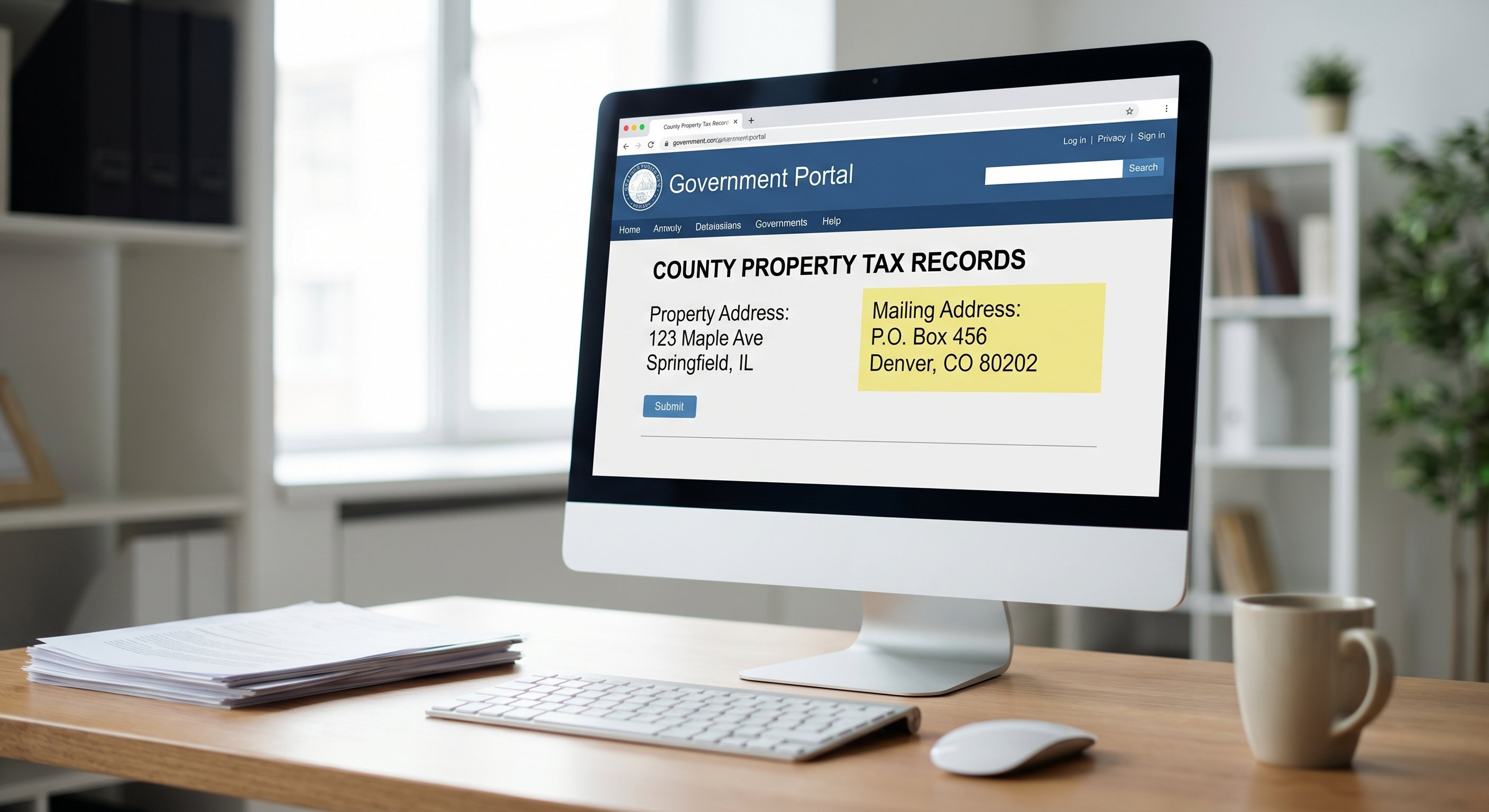
An absentee owner is a property owner whose mailing address on county tax records differs from the property address. That is the entire definition. The county sends the tax bill to one location; the property sits at another.
This category captures a wide range of situations. Some absentee owners are experienced landlords with polished portfolios. Others are accidental landlords who inherited a property across the country and never set foot inside it. Still others are small investors worn down by problem tenants, deferred maintenance, and management headaches.
Absentee status tells you nothing about motivation. It tells you the owner does not live at the property.
Why Absentee Owners Make Good Prospects
Absentee owners are attractive as a lead pool for specific reasons.
They generally have less emotional attachment to the property than an owner-occupant. A house someone has never lived in carries none of the sentiment that makes people resist a sale. The decision is financial, not emotional.
Many carry a landlord's frustration: problem tenants, maintenance requests for a roof they cannot inspect, management fees eating into thin returns. Over time, the cumulative weight makes a clean cash exit look appealing.
A substantial portion never intended to be landlords. They inherited the property and found themselves responsible for taxes, insurance, and upkeep on a house they may not have visited in years. They may not know its current condition or market value.
How to Find Absentee Owners
The data source is county assessor and appraisal district records. Every county maintains tax records with the property address and the owner's mailing address. When these differ, the owner is classified as absentee.
Most investors do not pull this data directly. Platforms such as PropStream and BatchLeads offer absentee ownership as a standard filter. Select a geographic area, apply the filter, and the platform returns every property where the mailing address does not match the property address.
In most mid-size counties, absentee owners represent 20 to 30 percent of residential properties. The raw list is a starting point, not a finished lead sheet.
Free Weekly Alerts
See What's Distressed in Your Market
Get free weekly alerts — new distressed properties, motivation scores, and hot neighborhoods in your area. Addresses and contact info available inside DistressIQ.
Free forever · No credit card · Unsubscribe anytime
Stacking Signals for Conversion
The investors who close deals from absentee lists filter further by adding distress signals.
Absentee plus tax delinquent. The highest-converting combination in most markets. An owner who does not live at the property and is not paying taxes shows clear financial stress or has mentally checked out entirely.
Absentee plus code violation. The municipality has formally notified the owner about a condition needing correction. An absentee owner receiving a code enforcement letter about a property three states away has a problem they cannot solve from a distance.
Absentee plus probate or inheritance. When a property has gone through probate and the new owner lives elsewhere, the probability of a successful contact increases significantly. The heir often has no plan and prefers cash over a long-distance landlord relationship.
Absentee plus lis pendens. A lis pendens filing signals a legal action, often foreclosure, has been initiated. An absentee owner facing a foreclosure timeline has real urgency.
The pattern: absentee status narrows the universe. Distress signals identify the motivated individuals within it.
Out-of-State Absentee Owners Convert Better
Not all absentee owners are equally motivated. Distance is one of the most reliable predictors of conversion.
An out-of-state owner who inherited a property in Houston but has never visited Texas is a fundamentally different conversation than a local investor who chose to rent out a former residence. Distance creates management friction. The out-of-state owner cannot drive by, cannot easily meet contractors, and cannot appear in person for a code enforcement hearing.
Direct mail campaigns consistently show higher response rates from out-of-state absentee owners. When you add a distress signal like tax delinquency, response rates climb into profitable territory.
Skip Tracing Absentee Owners
Skip tracing locates a property owner's phone number or email. For absentee owners, the approach matters.
The property address connects to county records. The mailing address connects to the actual person. Skip tracing from the mailing address consistently produces better contact rates because it is where the owner actually receives mail. It is more current than a property address that may be vacant or tenant-occupied.
For absentee leads pre-qualified with distress signals, skip tracing bridges the gap between a name on a list and a live conversation.

Direct Mail Strategy
Direct mail to absentee owners produces higher response rates than mail to owner-occupants, but only when the message matches the audience.
Absentee owners have less emotional resistance to selling. They need to be convinced the sender is legitimate, local, and serious.
Yellow letters and handwritten postcards consistently outperform professional flyers and printed form letters. A handwritten envelope looks personal, not commercial. It signals that someone took the time to write directly rather than blasting thousands of printed mailers.
The message should be brief. Reference the property address. Mention buying in the area. Provide a local phone number. Avoid aggressive language. The goal is a conversation, not a deal.
Follow-up matters more than the initial mailing. An owner might ignore a letter in January but be motivated by March when a tax bill is due. A sequence of three to five touches over 60 to 90 days significantly outperforms a single postcard.
The Math: Raw List Versus Stacked List
A raw absentee list of 5,000 properties might yield one deal per 2,000 to 3,000 contacts: two or three deals from a campaign costing thousands.
A stacked list filtered for absentee owners with at least one verified distress signal might contain 500 to 800 properties. The deal rate is typically one per 300 to 500 contacts. Same number of deals from a list 84 percent smaller.
Signal stacking is not about more leads. It is about spending only on leads with a realistic probability of converting.

FAQ
Q: What exactly is an absentee owner in real estate?
An absentee owner is a property owner whose mailing address on county tax records differs from the property address. The county sends tax bills to one location while the property sits at another, meaning the owner does not reside there. This category includes landlords, heirs, corporate entities, and investors. Absentee status alone does not indicate motivation to sell, but it identifies owners with less personal attachment than someone who lives there. Most data platforms offer this as a searchable filter based on the mailing address versus property address mismatch.
Q: How do real estate investors find absentee owners?
Investors find absentee owners through county assessor and appraisal district records. The defining data point is a mailing address that does not match the property address. Platforms including PropStream and BatchLeads offer absentee ownership as a standard filter. The raw list typically covers 20 to 30 percent of residential properties in a county, so investors apply additional filters like tax delinquency or code violations to narrow to motivated sellers. Starting with distress signals and then filtering for absentee status produces a smaller but more productive list.
Q: Why do out-of-state absentee owners convert better?
Distance creates management friction. An out-of-state owner cannot drive by the property, meet contractors for bids, or appear for code enforcement hearings. That friction compounds over time, especially when the owner inherited the property and never intended to manage it. Direct mail data shows higher response rates from out-of-state absentee owners compared to in-state ones. The gap widens when distress signals are present, making out-of-state absentee owners with tax delinquency one of the strongest combinations available.
Q: What is the best distress signal to stack with absentee ownership?
Tax delinquency is the highest-converting signal to combine with absentee status. An owner who does not live at the property and is not paying taxes shows financial stress or has mentally disengaged. Code violations rank next, since the owner has been notified of a problem they cannot solve remotely. The strongest lead combines absentee status, tax delinquency, and code violations on the same property: an owner who is financially stressed, under municipal pressure, and geographically removed from the problem.
Q: Should investors skip trace from the property address or the mailing address?
Skip tracing from the mailing address consistently produces better contact rates. The property address connects to county records, but the owner does not live there. The mailing address is where the owner receives mail and reflects their current location. Most skip tracing services work from the owner's name and mailing address, returning phone numbers and emails that reach the actual person rather than a tenant or vacant mailbox.
Q: What type of direct mail works best for absentee owner leads?
Yellow letters and handwritten postcards outperform professional flyers and printed form letters. Handwritten mail looks personal rather than commercial. Absentee owners have less emotional resistance to selling, so the mail piece does not need to convince them that selling is reasonable. It needs to convince them the sender is legitimate. Brief messages referencing the specific property address with a local phone number perform best. A sequence of three to five touches over 60 to 90 days using mixed formats significantly outperforms a single mailing.
Q: How many follow-up touches should an investor send?
Three to five touches over 60 to 90 days produces the best results. Motivation can shift quickly: an owner who ignores a letter in January might be highly motivated by March when a tax bill comes due. The follow-up sequence should mix formats: a handwritten letter first, then a postcard, then a second letter with different wording. Consistent, polite follow-up without aggression generates the most conversations. Each touch reinforces the same core message: the investor is local, serious, and ready to make a fair cash offer.
DistressIQ tracks absentee-owned distressed properties across every U.S. county, combining tax delinquency, lis pendens, probate filings, code violations, and other signals sourced directly from county records. Every property is scored by motivation level so investors can prioritize the highest-probability leads first. Browse the data for free and pay only when contact details are needed at distressiq.ai.
Sources
- U.S. Census Bureau, Residential Vacancies and Homeownership survey data on rental property ownership patterns
- National Association of Realtors, investor activity and absentee ownership research
- County appraisal district public records methodology (Harris County Appraisal District, Los Angeles County Assessor)
The data behind this article
DistressIQ Monitors These Signals in Real Time
Pre-Foreclosures
NOD + NTS filings
Tax Delinquency
County treasurer records
Code Violations
Municipal inspection filings
Probate Filings
Superior Court records
Every lead is scored 0–100 for seller motivation based on signal type, duration, severity, and stacking. Nationwide coverage — every US county, updated daily.
Ready to find deals in your market?
See Live Distress Signals in Your County
Stop calling dead leads. Every lead in DistressIQ is scored 0–100 for seller motivation, with verified contact info included. Browse the free tier to see what's active in your market right now.
Browse Free Leads — No Credit Card