Best Real Estate Lead Generation Software in 2026 (Ranked by What Actually Moves the Needle)
Best Real Estate Lead Generation Software in 2026 (Ranked by What Actually Moves the Needle)
TL;DR: The real estate lead generation software market splits into two categories most investors conflate: data aggregators selling list access, and outreach platforms managing campaigns. Buying both without understanding the distinction leads to wasted spend. The platforms that matter in 2026 solve for data freshness and motivation signal quality, not database size. County-direct daily data with signal scoring outperforms batch-updated lists every time.
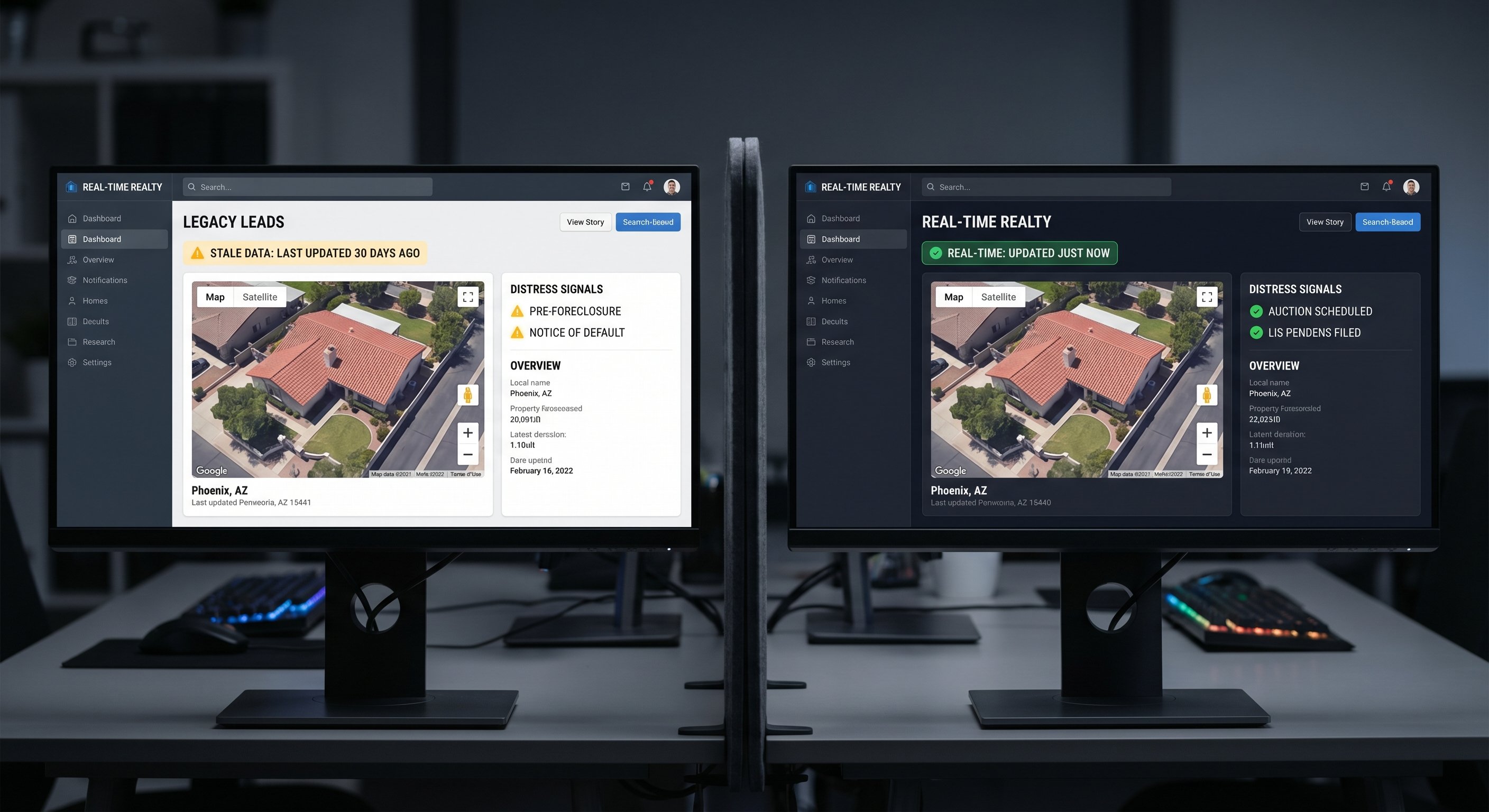
A lead that is fourteen days old in Phoenix has already been called by fifty or more investors. In Dallas and Atlanta, the math is similar. The first-mover advantage in distressed real estate is measured in hours, not weeks, yet most software marketed to investors updates on weekly or monthly cycles. That mismatch between deal speed and data freshness is the central problem in real estate lead generation software in 2026.
Two Product Categories, One Confusing Market
The biggest source of wasted spend in real estate software is a category error. Investors buy from two fundamentally different product categories without realizing they serve different functions.
Data aggregators pull from public records and sell list access. PropStream, BatchLeads, and DealMachine fall here. They provide property records, ownership data, and filtering tools.
Outreach platforms manage campaigns: dialing, texting, direct mail, follow-up. REI BlackBook, FreedomSoft, and Podio occupy this space. They handle communication, not discovery.
Most investors subscribe to both and conflate what each does. The result is a $300 to $500 monthly stack feeding stale leads into an outreach engine that burns skip traces on weak candidates. Better inputs, not more software.
What Separates Useful Software from Expensive Noise
Data freshness. County-sourced data updates daily. Third-party aggregated data may be weeks old. A ninety-day-stale lis pendens is a different lead than a three-day-old one. That gap is the difference between closing a deal and getting voicemail.
Motivation signal versus ownership. Owning property does not make someone motivated. Three years of delinquent taxes, an active lis pendens, a probate proceeding, and a code violation do. Platforms stacking verified signals per property deliver something categorically different from those listing owners and asking investors to guess.
Platform Breakdown
DistressIQ: Best for Verified Distress Signals
DistressIQ is built around one premise: every property surfaced has at least one verified distress signal sourced directly from county records. Tax delinquency, lis pendens, pre-foreclosure, probate, code violations, vacant property notices, and more. Properties with multiple stacked signals receive a 0 to 100 motivation score reflecting verified events, not demographic guesses.
The differentiator is daily data. Where most aggregators batch-update weekly or monthly, DistressIQ pulls directly from county recorders each day. In a market where a fourteen-day-old lead has already been contacted by dozens of investors, that freshness gap is the difference between a conversation and a dead lead.
DistressIQ shows only properties with verified distress signals. No 160 million record database to filter. No generic absentee owner lists. It is a targeting system for investors who need to find sellers who need to sell.
Strengths: Daily county-direct updates, 31+ signal types, motivation scoring based on stacked signals, free map browsing.
Trade-offs: Not for general property research or comp pulling. A distress intelligence tool, not an all-purpose database.
Pricing: Starter $79/month (2,000 views), Pro $149/month (5,000 views). Map browsing free.
PropStream: Best for General Property Research
PropStream is the industry default for broad research: 160 million-plus records, nationwide coverage, comp analysis, MLS integration, equity filtering, and basic skip tracing.
The strength is breadth. Building absentee owner lists filtered by equity and hold duration is what PropStream was designed for. The weakness is also breadth. PropStream cannot tell investors which two hundred properties to call first. Distress coverage is basic (pre-foreclosure, tax default) from aggregated sources with a seven to fourteen day lag on new filings. No scoring, no stacking.
Strengths: Massive database, comp tools, MLS integration. Weaknesses: Seven to fourteen day lag, no motivation scoring. Pricing: Starts at $99/month.
BatchLeads: Best for Bulk Skip Tracing and List Stacking
BatchLeads combines list building, skip tracing, and campaign management in one workflow. At $0.19 per record, bulk skip tracing is among the most competitive pricing available. List stacking lets investors layer filters before tracing. A driving for dollars app adds a field component.
The freshness issue mirrors PropStream: aggregated data on inconsistent schedules means the same lag that makes leads stale elsewhere applies here.
Strengths: Best skip trace pricing at $0.19/record, list stacking, driving for dollars app. Weaknesses: Similar freshness issues, no motivation scoring. Pricing: Starts at $119/month.

DealMachine: Best for Driving for Dollars
DealMachine is purpose-built for field work: drive neighborhoods, spot distressed properties, log them with photos and GPS, build custom lists without leaving the app.
The mobile experience is the best in the category. No other platform comes close for capturing leads while driving a target area. The limitation is public records depth: DealMachine is not a broad property database, and the enrichment layer is thinner than PropStream or BatchLeads.
Strengths: Best mobile app, fast capture with GPS, integrated mail. Weaknesses: Limited public records depth. Pricing: Starts at $49/month.
Free Weekly Alerts
See What's Distressed in Your Market
Get free weekly alerts — new distressed properties, motivation scores, and hot neighborhoods in your area. Addresses and contact info available inside DistressIQ.
Free forever · No credit card · Unsubscribe anytime
Which Tool for Which Problem
The right choice depends on what limits deal flow, not which platform has the longest feature list.
Cannot figure out which leads to call first? Motivation scoring and verified distress signals solve that. A list of two hundred high-motivation properties converts at a different rate than five thousand generic absentee owners.
Need comps, ownership history, equity data? PropStream serves that well.
Skip trace costs eating margins? BatchLeads brings per-record costs down.
Building lists from field observation? DealMachine handles that discovery layer.
Most investors underinvest in data quality and overinvest in outreach volume. They mail five thousand postcards to a list that forty other investors also mailed, get eight callbacks, close one deal, and conclude direct mail is dead. The problem was not the channel. It was the list.

What Software Cannot Replace
No platform replaces the local relationships producing the best off-market leads. Probate attorneys who know which families are preparing to sell inherited properties. Divorce attorneys handling forced sales. Code enforcement officers who see properties heading toward vacancy before any filing hits a database.
These relationships generate leads that never appear in any platform. They exist in local knowledge and trust that technology cannot replicate. The investors closing the most deals run both: software for scale, local relationships for deals that never hit the open market.
What to Avoid
Generic "motivated seller" lists without verification. A platform selling a pre-built list without explaining how motivation was verified is selling a demographic filter, not a signal. "Owns property ten-plus years with high equity" is not motivation. It is a guess.
County data that is actually aggregated. Many platforms market "county records data" but purchase it from aggregators who pull on inconsistent schedules. Ask whether the data comes from county systems or resellers.
Batch skip tracing on unfiltered lists. Paying per trace on a list where seventy percent of leads have no motivation signal is burning money. Trace the top tier only.
Building the Right Stack
- Start with verified distress signals sourced directly from county records.
- Prioritize by signal stacking: multiple verified events mean higher conversion rates.
- Skip trace selectively on the top tier only.
- Add driving for dollars for hyperlocal discovery that records miss.
- Use a general database for due diligence: comps, ownership history, market context.
The goal is not every platform. It is knowing who to call on Monday morning.

FAQ
Q: What is the best real estate lead generation software for beginners?
Beginners should start with free or low-cost tools. Propwire offers free access to a property database for understanding ownership patterns and filtering. Once ready to make offers, a platform with verified distress signals provides a meaningful edge. DealMachine at $49 per month is also a strong beginner option for those working a hyperlocal area. The key is matching the tool to the strategy rather than buying the most expensive option first.
Q: How important is data freshness in real estate lead generation software?
Data freshness is arguably the most important factor separating converting leads from wasted outreach. In Phoenix, Dallas, and Atlanta, a fourteen-day-old lis pendens has already been contacted by dozens of investors. The first to reach a motivated seller closes at a dramatically higher rate than the fiftieth. Platforms updating daily from county recorders deliver a structural advantage over those batching weekly or monthly. Freshness is the core value proposition.
Q: What is the difference between data aggregators and outreach platforms?
Data aggregators like PropStream, BatchLeads, and DealMachine pull public records and sell list access with filtering tools. Outreach platforms like REI BlackBook, FreedomSoft, and Podio manage communication: dialing, texting, email, direct mail, and CRM. Most investors need one of each, but buying both without understanding the distinction leads to overlapping features and underinvesting in data quality.
Q: Is skip tracing included in most real estate lead generation platforms?
Some platforms bundle skip tracing, others charge per record. BatchLeads includes credits and offers bulk tracing at $0.19 per record, among the lowest available. PropStream includes a basic tracer but charges for volume. The critical point: skip tracing is only valuable on a filtered, high-motivation list. Bulk tracing an unfiltered database wastes money on weak candidates. Trace the top tier of verified signals first, then expand only if ROI justifies it.
Q: Can real estate lead generation software replace driving for dollars?
No, and the best investors use both together. County-based distress platforms capture leads attached to legal filings: tax delinquency, court cases, violations, probate. Driving for dollars captures properties that look distressed but lack filed signals. Visible neglect, overgrown yards, and boarded windows exist in the physical world before any database. Combining data targeting and field observation covers both what is on record and what is visible on the ground.
Q: What distress signals should investors look for in lead generation software?
The most actionable signals include tax delinquency, lis pendens (often indicating pre-foreclosure), probate filings, code violations, vacant property notices, and bankruptcy cases. The key metric is whether a platform stacks them per property. A property with delinquent taxes, an active lis pendens, and a code violation is fundamentally different from one with a single minor flag. Platforms scoring motivation based on stacked signals deliver better targeting than those presenting signals in isolation.
For investors ready to see verified distress signals in their target market, browse the map free at distressiq.ai. No credit card required to explore the data. Contact info unlocks only when a lead is worth pursuing.
Sources
- National Association of Realtors, "Real Estate in a Digital Age" (2025 report on technology adoption among investors)
- DistressIQ internal data, county recorder ingestion pipeline coverage across 3,000+ US counties
- PropStream public pricing and feature documentation, accessed April 2026
The data behind this article
DistressIQ Monitors These Signals in Real Time
Pre-Foreclosures
NOD + NTS filings
Tax Delinquency
County treasurer records
Code Violations
Municipal inspection filings
Probate Filings
Superior Court records
Every lead is scored 0–100 for seller motivation based on signal type, duration, severity, and stacking. Nationwide coverage — every US county, updated daily.
Ready to find deals in your market?
See Live Distress Signals in Your County
Stop calling dead leads. Every lead in DistressIQ is scored 0–100 for seller motivation, with verified contact info included. Browse the free tier to see what's active in your market right now.
Browse Free Leads — No Credit Card