Real Estate Data Aggregators vs. County Records: Why the Source System Matters More Than You Think
Real Estate Data Aggregators vs. County Records: Why the Source System Matters More Than You Think
TL;DR: Real estate data aggregators like PropStream, CoreLogic, and ATTOM resell information passed through multiple distribution layers before reaching you, introducing compounding errors and latency at each step. County assessor and recorder data is the original source of truth — the same records governments use to calculate taxes and record title. For investors, the difference between a comp at $285,000 and $241,000 is not a rounding error. It is whether you make money on a deal or lose your earnest money deposit. Understanding where your data comes from is not a technicality. It is the foundation of every accurate offer you make.
The Comp That Nearly Killed a Deal
A Phoenix investor pulled a property card on a 1968 ranch home listed at $89,000. The aggregator platform showed 2,340 square feet, 4 bedrooms, 2 bathrooms, and an ARV of $287,000 based on three recently sold comparables. The math worked. He put in an offer at $85,000, won the bid, ordered a formal appraisal, and watched the appraiser come back at $198,000.
The problem was not the comps. The problem was that the three comparables the platform pulled were all records where the square footage field had been pulled from the original listing, not the county assessor's record. The county had the home at 1,620 square feet, 3 bedrooms, 1.5 bathrooms. The investor had built his entire offer on a data error that added 720 square feet to a 57-year-old house nobody had ever actually measured.
He lost the deal and his $2,500 earnest money deposit. That is what bad property data costs in practice.
This is not an isolated case. Independent analyses of MLS listings have found material discrepancies in bedroom count, bathroom count, or square footage in 10% to 30% of residential listings compared to professionally measured appraisals and county assessor records. Studies cited by listing data analysts show MLS square footage can be off by 5% to 10% in a significant portion of listings, with errors compounding over time as agents copy prior listing figures without re-verification (PlanSnapper, "MLS Square Footage Errors," 2026). In older neighborhoods, the error rate climbs higher. In rural counties where assessor's offices update records infrequently, the delta between what the aggregator shows and what the county actually has on file can be catastrophic.
The question is not whether aggregator data has errors. Every investor who has run a deal through PropStream, DealMachine, BatchLeads, or any of their competitors has felt that sting. The question is why those errors exist — and whether the platform you're using is solving the problem or perpetuating it.
What Is a Real Estate Data Aggregator
A real estate data aggregator is a company that collects property information from multiple sources, standardizes it, and resells it to consumers or businesses. The major players include CoreLogic, ATTOM Data (now Green Street), PropStream, DataTree, and REISpace, among others. These companies do not create the original record. They do not send appraisers to measure properties or clerks to update assessor's files. They acquire data in bulk from other sources.
The typical data supply chain looks like this:
Step 1 — Original source: County assessor records, county recorder filings, state court records, lender foreclosure filings, MLS associations, and utility companies each generate their own data about a property.
Step 2 — First-party redistribution: MLS associations distribute listing data to subscribers and syndication partners. County governments publish records through third-party bulk download services, in some cases deliberately limiting access to reduce server load.
Step 3 — Aggregation: The aggregator purchases bulk access, ingests the data into its own system, and applies standardization logic to harmonize fields across counties with different data formats.
Step 4 — Consumer delivery: The aggregator sells access to investors, agents, and developers through a web platform or API.
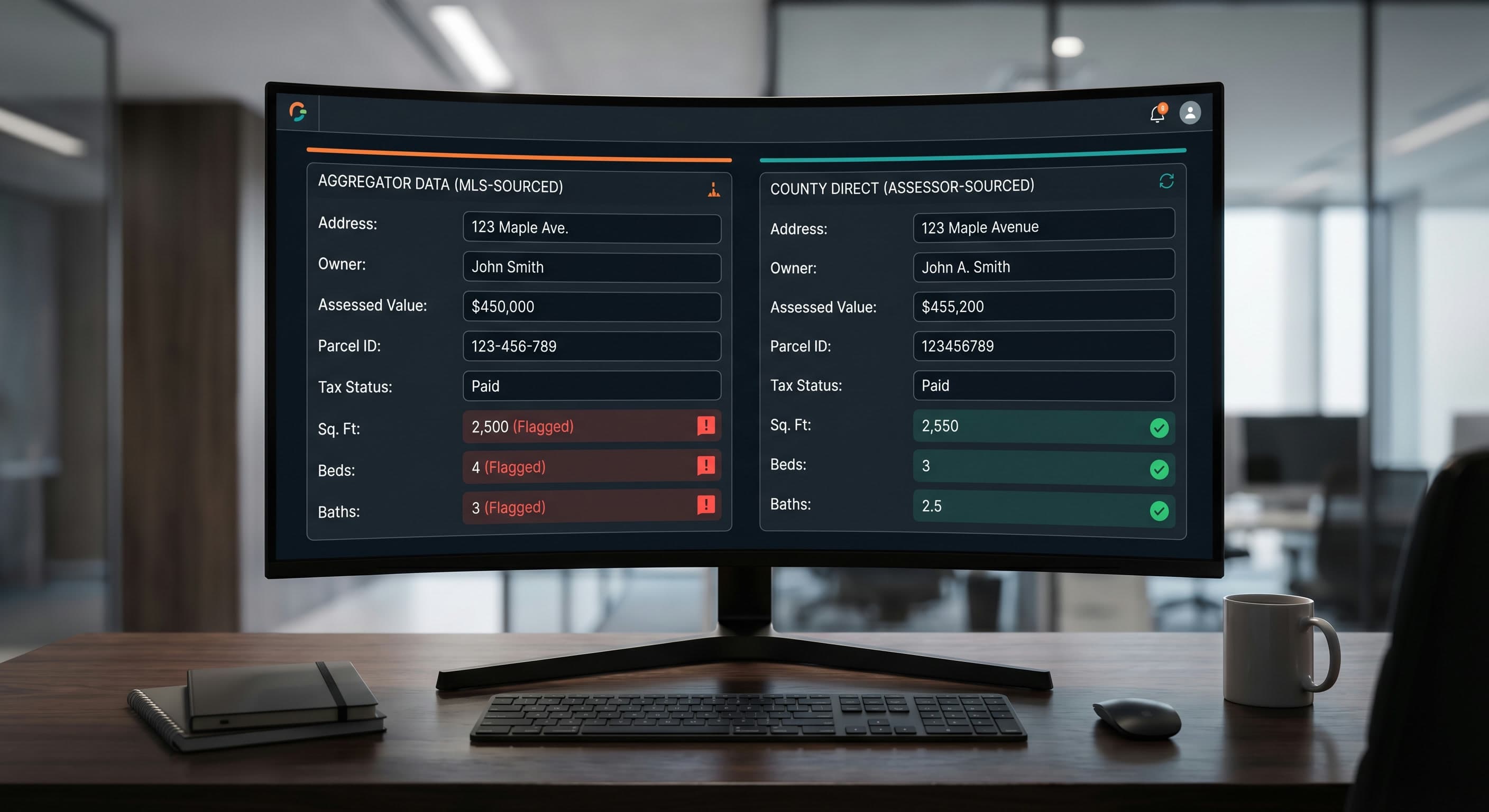
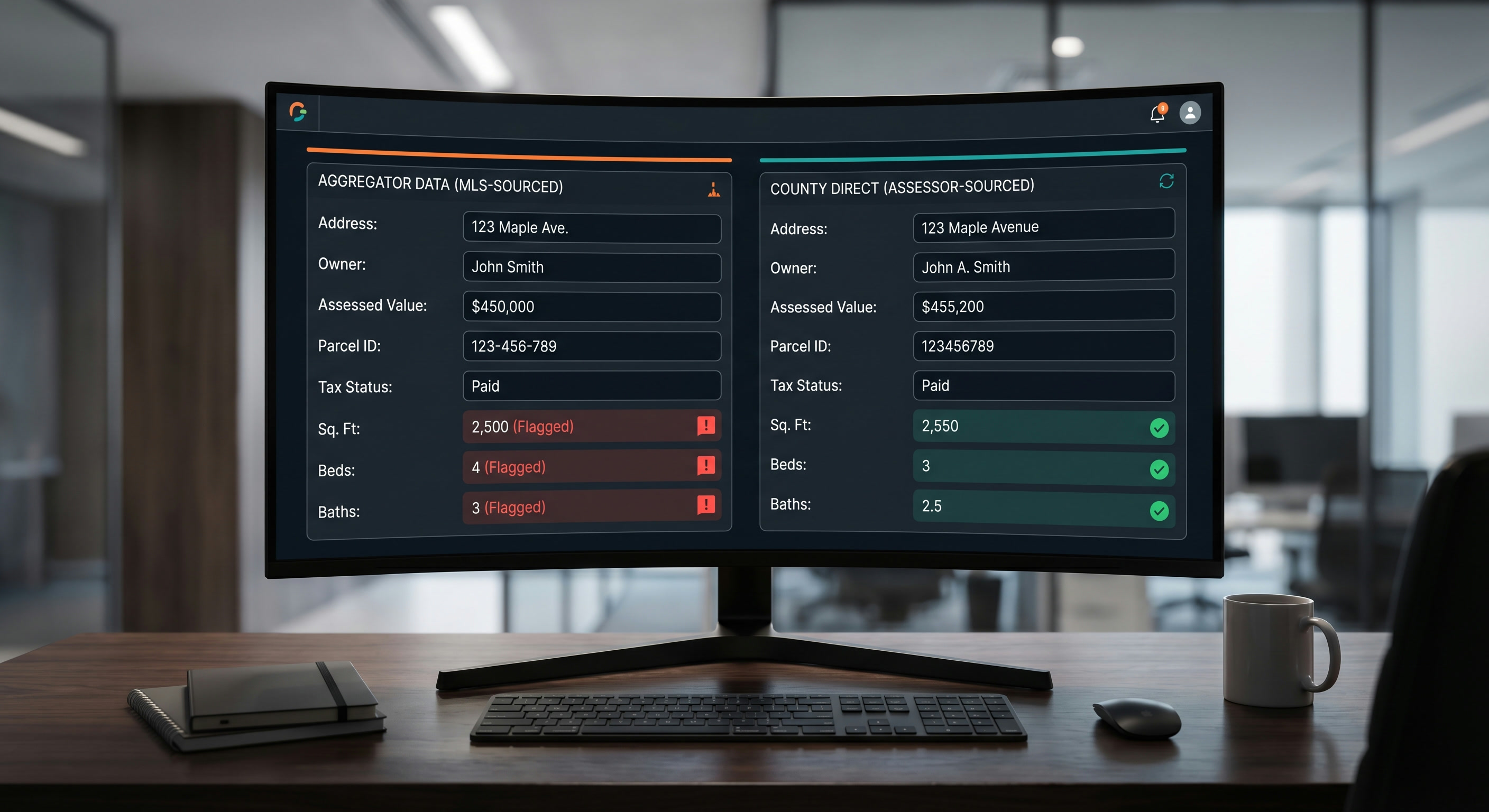
At each step, the data passes through a translation layer. Fields get renamed. Dates get recalculated. Square footage values from an MLS listing — which is entered by a lister agent, not a government official — get stored alongside square footage values from an assessor record, and in many platforms they are not labeled differently. Investors reading a property record often cannot tell which type of source generated each data field.
The compounding effect: data that was inaccurate at the source stays inaccurate in the aggregator. Data that was accurate at the source can become inaccurate through a formatting translation error. And data that was accurate and correctly formatted can become stale because the aggregator only refreshes its bulk download on a weekly or monthly schedule.
What County Direct Records Actually Contain
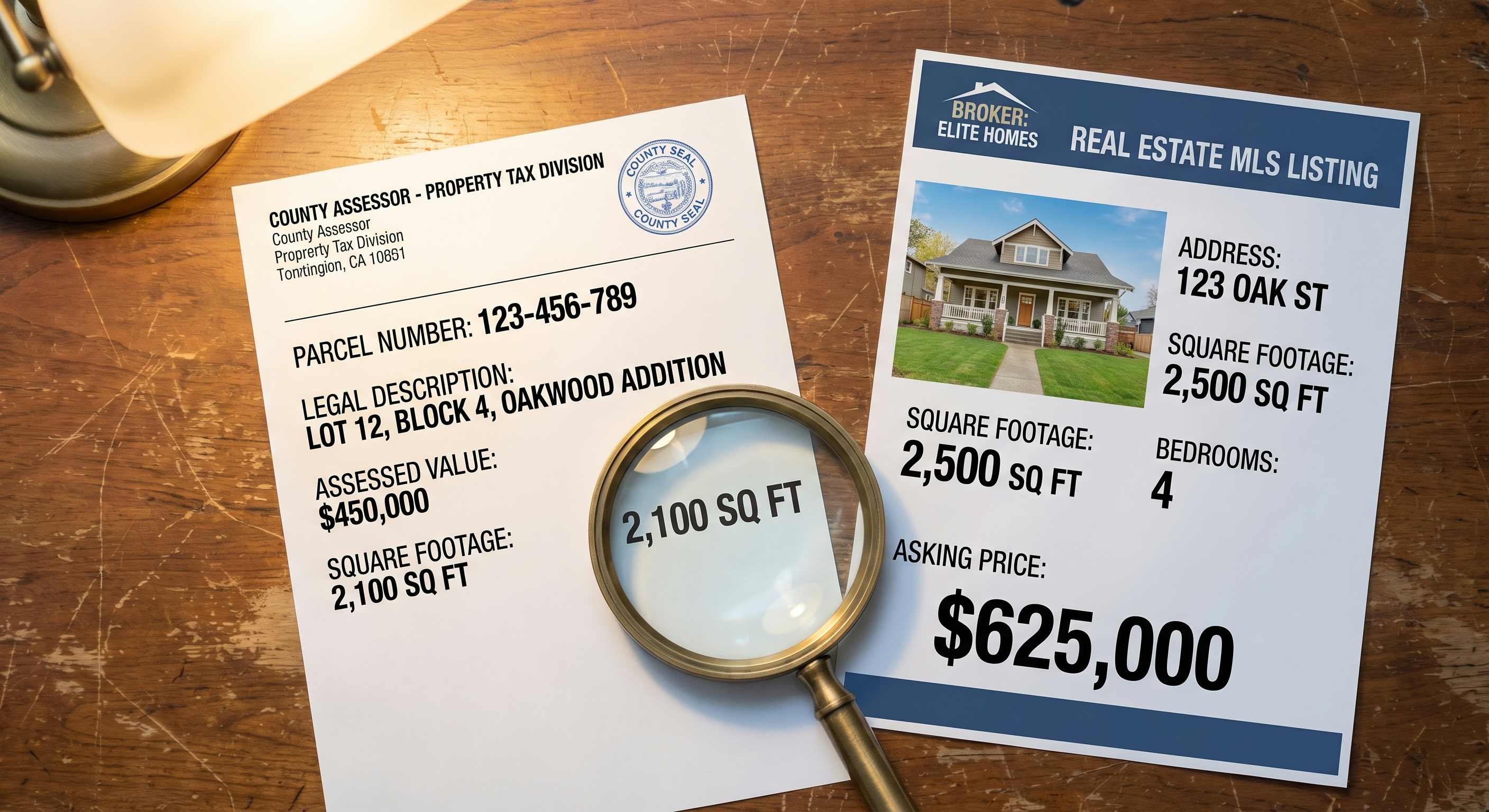
County assessor and recorder records are the original source documents for most property data. When a county assessor records a property's square footage, they are not guessing from a listing. They are entering data derived from building permits, surveys, or prior official records. When a county recorder files a deed transfer, that filing creates the legal record of who owns the property.
The data that lives in county systems includes:
- Assessed value and tax history — The assessor's annual record of what the county believes the property is worth for tax purposes. This is not the market value, but it is a government-official record of a specific transaction or assessment event.
- Square footage and lot size — Often derived from building permits and surveys, not from real estate listings. In older properties predating digital records, assessors have paper files that sometimes contradict the digital database.
- Ownership history and recording date — The county recorder maintains the chain of title. When a deed is recorded, the filing date is the legal record of the transfer, not the effective date listed on the purchase agreement.
- Tax delinquency status — County tax records are the authoritative source on whether property taxes are current. MLS listings do not contain tax status.
- Code violations and building permits — In many counties, active code enforcement cases and open building permits are searchable through the county system, not through any aggregator.
- Mortgage and lien recordings — The recorder's office records deeds of trust, mortgage assignments, and lien filings. This is where lis pendens filings, junior liens, and HOA liens show up.
The critical distinction: county records are the documents that have legal weight. A square footage figure in an MLS listing is a marketing claim. The same figure in a county assessor's file is a record the government uses to calculate your property taxes.

Free Weekly Alerts
See What's Distressed in Your Market
Get free weekly alerts — new distressed properties, motivation scores, and hot neighborhoods in your area. Addresses and contact info available inside DistressIQ.
Free forever · No credit card · Unsubscribe anytime
The Three Ways Aggregators Get Data Wrong
Understanding how data degrades through the aggregator supply chain helps you evaluate any platform critically. There are three primary failure modes.
Stale Data From Infrequent Refreshes
Most aggregators do not maintain live connections to county systems. They download bulk data on a scheduled basis — monthly for some counties, weekly for others, and in the worst cases, only when a county publishes an updated bulk file. If a county updates its data on March 1 and the aggregator's next refresh is March 28, the platform is operating on data that is 27 days out of date for that county. During peak market periods, a month of data updates can include hundreds of new filings, new transfers, new tax delinquencies, and new lis pendens records.
Source-Type Labeling Failures
Many aggregator platforms store square footage, bedroom count, and bathroom count fields without clearly labeling whether they came from the county assessor's official record or from the MLS listing. A listing agent entering "3,100 sqft" for a property they want to market aggressively is not lying — they may have measured the property themselves or taken the figure from a prior listing. But if that figure contradicts the county assessor's record, it belongs in a different field, labeled differently, and interpreted differently when calculating ARV.
When investors cannot distinguish the source type for each field, they effectively treat marketing data as official government records. That is a dangerous conflation.
Format Translation Errors
Counties use hundreds of different data systems — some running software from the 1990s, others on modern cloud platforms. When an aggregator ingests bulk data from thousands of counties simultaneously, translation errors are structural, not accidental. Fields get truncated. Date formats get swapped (02/03/2026 versus 03/02/2026). Numeric values get stored as text and then exported in scientific notation. An aggregator platform may display "0.24 acres" correctly while internally storing it as "10,450" square feet and converting incorrectly during export.
The Field-Level Differences That Actually Matter

For distressed property investors, certain data fields carry more weight than others when evaluating a deal. Here is where aggregator errors most commonly translate into real financial losses.
Square footage — The most consequential field in ARV calculations. Errors of 200 to 600 square feet on a mid-market home can shift a comp by $15,000 to $45,000, depending on the price per square foot in the market. County assessor square footage is not infallible — unpermitted additions can create unrecorded space — but it is a government-official record with an audit trail. MLS square footage is self-reported by the listing agent.
Bedroom and bathroom counts — County records sometimes lag behind actual room counts when homeowners complete unperitted renovations. In markets with lots of DIY renovation activity, this is a meaningful source of error. The direction of the error matters: county records tend to undercount improved space, meaning your ARV is conservative. Aggregator platforms sourced from MLS listings tend to overcount, as agents have an incentive to maximize the marketing profile of a listing.
Lot size — Parcel dimensions matter for lot value, particularly in landlocked urban infill lots where a 50-foot versus 60-foot frontage can change the development potential. Lot size is a county GIS field. Aggregators usually pull it from county bulk downloads, but the translation process is where decimal points get lost.
Owner occupancy status — County assessor records indicate whether the owner claims the property as a homestead exemption. This is one of the strongest proxies for occupancy available without a site visit. Aggregators source this field inconsistently, and some platforms do not expose it at all.
Tax delinquency — County treasurer records are the authoritative source. A property can be current on MLS and delinquent at the county. For distressed property investors, this is the most important signal in the dataset.
How to Evaluate the Data Behind Any Platform
Before trusting any property data platform for deal analysis, run these three checks.
Check 1 — Compare the listed square footage to the county assessor's online record. Most county assessor websites allow free searching by address. Pull the official record for three properties you know well — your own home if possible, or a property with a known recent sale. Compare the assessor's square footage, bedroom count, and bathroom count to what the platform shows. If the platform matches the county assessor on all three, the platform has live county data. If it shows MLS-sourced figures, you know which data type it is relying on.
Check 2 — Look for data freshness indicators. PropStream, BatchLeads, and most major platforms do not prominently display the data-as-of date for individual county records. If you cannot find when the data for a specific county was last updated, assume it is at least 30 days old. Some platforms publish a county coverage page or data dictionary that shows refresh schedules.
Check 3 — Cross-reference a known distressed property. Find a property in your market that you know is tax delinquent, has a code violation, or is in pre-foreclosure. Search for it on the platform. If it appears with current owner information, delinquency status, and signal flags, the platform has fresh county-direct access. If it appears without the distress signal you know is active, the platform's data is stale for that county.
The Honest Comparison
| Factor | Data Aggregator | County-Direct Platform |
|---|---|---|
| Data source | Resold from MLS, third-party bulk feeds | Original county assessor, recorder, and court records |
| Typical refresh frequency | Weekly to monthly | Daily to weekly |
| Square footage source | MLS listing or assessor record, often unlabeled | County assessor official record |
| Tax delinquency data | Often delayed 30-60 days | Same-day or next-day from county treasurer |
| Ownership history accuracy | Recorder data, 2-4 week delay typical | Recorder data, same-day or 1-week delay |
| Code violation data | Rarely included | Available in most counties |
| Lis pendens / court filings | Delayed via court record feeds | Often pulled directly from court electronic filing systems |
| Price | Subscription-based, $50-$300/month | Varies; DistressIQ starts at $129/month |
| Data coverage by county | High, but inconsistent freshness | Nationwide, freshest available |
The table is not meant to suggest that aggregators are useless. PropStream and CoreLogic offer broad national coverage that is valuable for market analysis and broad searches. But for the specific task of finding and evaluating distressed property deals — where tax delinquency, lis pendens status, code violations, and accurate property characteristics are the difference between a profitable deal and a losing one — the freshness and source accuracy of county-direct data matters more than aggregator breadth.
The Practical Implication for Your Next Deal
Here is the exercise worth doing this week. Pick five properties on any platform you currently use. For each one, pull the county assessor's record directly — most county assessor websites allow free searches. Compare:
- Square footage (assessor vs. platform)
- Bedroom and bathroom counts
- Most recent ownership transfer date and price
- Tax status
Note the deltas. If the platform matches the county on all five, the platform has live county access. If there are discrepancies, you now know the direction and rough magnitude of the error in your market. You can apply a correction factor to every ARV calculation you run through that platform.
For investors working with DistressIQ, the platform sources property characteristics directly from county assessor records wherever available, and distress signals (tax delinquency, lis pendens, pre-foreclosure, code violations) are pulled from the same county systems daily. The goal is to close the gap between what the county knows about a property and what the investor knows, as quickly as possible after the record is created.
Find motivated sellers faster — see properties with verified distress signals from county records, updated daily, scored by motivation. Browse distressed property leads free on DistressIQ →
The investors who consistently close deals at prices the market supports are not the ones with better negotiating skills or deeper pockets. They are the ones with better data. And better data starts with understanding where it comes from.
Frequently Asked Questions
Q: Does the MLS ever have more accurate data than the county assessor?
Yes, in specific situations. The county assessor's record may not reflect recent renovations, additions, or conversions that were completed without a building permit. In markets with significant unpermitted construction — particularly in older urban neighborhoods — the MLS figure (which may reflect a recent professional measurement) can be more current than the assessor's record. The best practice is to check both and use the higher figure when calculating ARV, with an appropriate haircut for unpermitted space.
Q: How often do county assessor records actually get updated?
It varies significantly by county. Some counties update records within days of a building permit final inspection or a recorded deed. Others, particularly smaller rural counties, may update their digital records only once or twice per year. If a county still uses paper files for certain record types, there may be a significant lag between a real-world change and its appearance in the digital system.
Q: Is it legal to access county assessor records directly?
Yes. County assessor and recorder records are public records in all 50 states. Most counties provide free online access to basic property information through their assessor website. For example, Sacramento County offers a free Assessor Parcel Viewer for public use. Detailed document access (deed copies, lien filings, full legal descriptions) may require a small per-document fee or a subscription to the county's records portal.
Q: How does DistressIQ get its property data?
DistressIQ sources property characteristics from county assessor records and pulls distress signals (tax delinquency, lis pendens filings, pre-foreclosure activity, code violations) from county recorder and court electronic filing systems. Data is refreshed from county sources on a daily basis where counties provide digital access, with coverage across all US counties.
Q: Can I rely on an aggregator platform for county data if the county data is stale?
This is where judgment matters. If the county only updates quarterly and the aggregator refreshes monthly, the aggregator is actually more current than the county's own digital file. But in counties with weekly or daily digital updates, the aggregator's monthly refresh is strictly worse. The key variable is not whether you use an aggregator or go direct — it is how recently each data source was actually updated.
The data behind this article
DistressIQ Monitors These Signals in Real Time
Pre-Foreclosures
NOD + NTS filings
Tax Delinquency
County treasurer records
Code Violations
Municipal inspection filings
Probate Filings
Superior Court records
Every lead is scored 0–100 for seller motivation based on signal type, duration, severity, and stacking. Nationwide coverage — every US county, updated daily.
Ready to find deals in your market?
See Live Distress Signals in Your County
Stop calling dead leads. Every lead in DistressIQ is scored 0–100 for seller motivation, with verified contact info included. Browse the free tier to see what's active in your market right now.
Browse Free Leads — No Credit Card