Pre-Foreclosure Leads Massachusetts: How Investors Find Properties Before the Auction

Pre-Foreclosure Leads Massachusetts: How Investors Find Properties Before the Auction
TL;DR: Massachusetts pre-foreclosure begins when a lender files a Chapter 244 foreclosure petition, triggering a 30-day right-to-cure period and mandatory mediation for owner-occupied properties. The state uses a judicial foreclosure process, meaning every case passes through Land Court or a county Superior Court. Strongest activity concentrates in Suffolk, Worcester, Middlesex, and Hampden Counties. DistressIQ tracks pre-foreclosure petition filings across all Massachusetts counties daily, scoring each property by motivation so investors know exactly which leads to work first.

Massachusetts is not a state where investors can move fast and loose. The legal framework governing pre-foreclosure is specific, the timelines are predictable, and the properties that move through this process tend to have genuine distress behind them. That is exactly what makes Massachusetts pre-foreclosure leads valuable for investors who understand the system.
What Pre-Foreclosure Means in Massachusetts
Pre-foreclosure in Massachusetts starts when a mortgage lender files a foreclosure petition in the appropriate county court. Unlike states where lenders can post a notice and proceed to auction, Massachusetts requires judicial oversight. Every pre-foreclosure case generates a public court record that investors can track.
Most homeowners have already missed multiple mortgage payments and received a notice of default before the petition is filed. The pre-foreclosure window begins when the foreclosure petition is recorded at the county registry of deeds.
What makes Massachusetts uniquely structured is the intersection of Chapter 244 of the Massachusetts General Laws, the Land Court system, and the state's mandatory mediation program for owner-occupied properties. These layers add time and complexity, but they create a searchable public record trail that sophisticated investors use to find leads before a property reaches auction.
The Massachusetts Pre-Foreclosure Timeline Under Chapter 244
Massachusetts General Laws Chapter 244 governs foreclosure in the state. The critical stages are as follows:
Notice of Intention to Foreclose (NOI). The lender records an NOI at the registry of deeds and mails a copy to the borrower before the foreclosure petition can be filed. This must include the mortgage details, default amount, and borrower's right to cure. This is the first public record most investors will see.
30-Day Right to Cure. After the NOI is recorded, the borrower has a statutory 30-day right to cure the default. A property in this period means the borrower is actively aware of the foreclosure and may be more receptive to a direct purchase offer.
Foreclosure Petition Filed. If the default is not cured, the lender files a foreclosure petition in the appropriate court. In Suffolk County and other urban areas, this is often filed in the Land Court; more rural counties use Superior Court.
Mediation Request. For owner-occupied properties, courts may order mediation, adding 60 to 90 days to the timeline. Investors who monitor court dockets can identify properties in this phase.
Auction Date Set. Once pre-auction requirements are satisfied, including service of process and publication of the auction notice, an auction date is scheduled. Massachusetts foreclosure auctions are typically held at the county courthouse or at the property itself.
The total timeline from first missed payment to auction typically runs 120 to 180 days, though it can stretch longer in cases involving mediation, bankruptcy filings, or lender delays. That extended timeline is the investor's advantage.
Massachusetts Counties with the Strongest Pre-Foreclosure Activity
Suffolk County (Boston). The most densely populated county in New England generates the highest absolute number of pre-foreclosure filings. Boston's housing market has significant investor activity, and the mix of condominium developments, triple-decker rental housing, and single-family homes creates diverse lead types. Condo association lien foreclosures are particularly common in Boston's dense urban core.
Worcester County. Central Massachusetts has experienced substantial foreclosure activity as a bedroom community for Boston. Worcester, Fitchburg, and Leominster show elevated pre-foreclosure rates relative to population.
Middlesex County. The largest county by population includes Cambridge, Lowell, and Framingham. Pre-foreclosure activity reflects the Boston metro's market diversity, with urban and suburban distressed property patterns coexisting.
Hampden County (Springfield). Western Massachusetts has historically seen high per-capita foreclosure rates, driven by manufacturing sector dislocations and older housing stock requiring significant maintenance capital.
Bristol County (Fall River, New Bedford). Southeastern Massachusetts has elevated foreclosure activity tied to the region's economic recovery. New Bedford and Fall River properties frequently move through pre-foreclosure with substantial equity positions given relatively lower purchase prices compared to eastern Massachusetts.
Plymouth, Norfolk, and Essex Counties round out the activity map. Essex County's cities of Lynn and Lawrence generate consistent pre-foreclosure lead flow.
Free Weekly Alerts
See What's Distressed in Your Market
Get free weekly alerts — new distressed properties, motivation scores, and hot neighborhoods in your area. Addresses and contact info available inside DistressIQ.
Free forever · No credit card · Unsubscribe anytime
How Investors Find Pre-Foreclosure Leads in Massachusetts
The challenge for investors is not finding the data; it is aggregating it fast enough to act before other investors do.
Massachusetts registries of deeds maintain searchable online databases, and the Land Court has its own electronic filing and docket system. The Suffolk County Registry handles Land Court matters for the Boston metro area. County registries in Worcester, Middlesex, Hampden, and Bristol each maintain their own electronic systems. An investor working five counties needs five separate searches and manual deduplication.
Pre-foreclosure cases also appear in court dockets before the auction notice is published. Monitoring Suffolk County Land Court, Worcester Superior Court, and Middlesex Superior Court dockets requires manual check-ins or a legal monitoring service. No single source aggregates Massachusetts pre-foreclosure filings across all counties into a searchable list.
What DistressIQ Does. DistressIQ pulls pre-foreclosure petition data from county court records and registry filings across Massachusetts, updated daily. Every property in the pipeline is scored using a multi-signal motivation engine that weighs time elapsed since filing, equity position based on assessed value versus estimated loan balance, whether a mediation request has been filed, and proximity to auction date. Investors see a ranked list of leads rather than a raw list of filings.

What DistressIQ Shows for Every Massachusetts Lead
When an investor views a pre-foreclosure lead, the lead card includes the property address and physical description from county assessor records: assessed value, year built, lot size, and property class. Investors use assessed value as a baseline for estimating equity positions.
Filing details include the filing date, the court where the petition was filed, and current case status. Properties in the 30-day right-to-cure period are flagged separately from those progressing through the court system.
A motivation score from 0 to 100 reflects the weight of multiple distress signals. A property that is pre-foreclosure, tax delinquent, and flagged for code violations scores higher than one with a single pre-foreclosure filing. DistressIQ also factors in the local auction clearance rate for the specific county.
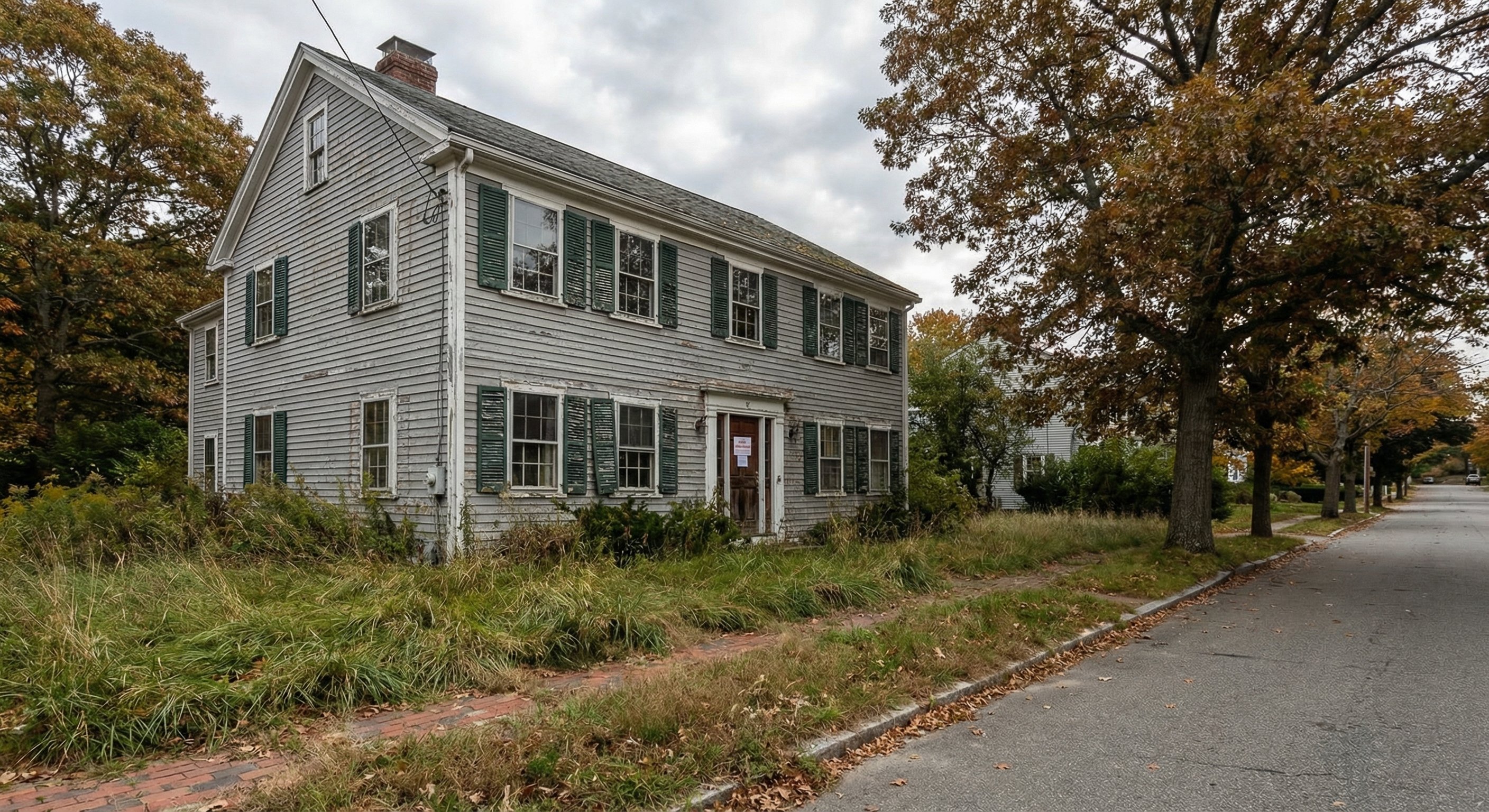
Street View and aerial imagery are available for every lead. Massachusetts properties frequently show deferred maintenance visible from the street: overgrown yards, broken storm windows, and roof deterioration are visible before the investor ever drives the neighborhood.
Owner contact information is available on demand through the skip-tracing feature. For Massachusetts pre-foreclosure leads, the most valuable contact is often the borrower's mailing address if it differs from the property address, which is common for investment properties.
Browse live pre-foreclosure leads across every Massachusetts county, scored and ranked by motivation at DistressIQ.
Navigating the Right-to-Cure and Redemption Period
Massachusetts does not have a formal redemption period after a foreclosure auction. Once the auction is confirmed, the former owner's rights are extinguished. Pre-auction intervention is the primary exit path for borrowers and the primary opportunity for investors.
The 30-day right-to-cure is the most actionable window. During this period, the borrower is under active legal notice and exploring every option to avoid losing the property. Direct contact with a clean all-cash offer covering the outstanding loan balance plus modest moving expenses can produce deals that do not appear in any public auction record because the property is withdrawn before auction.
The mediation process deserves attention. Massachusetts courts can order mediation in cases involving owner-occupied properties, creating a court-supervised meeting between the lender and borrower. Properties in active mediation are identifiable through the court docket and represent a category of leads where the homeowner is actively trying to find a resolution, which may include accepting a short sale or a deed-in-lieu of foreclosure.
For investors, a short sale approved by the lender on a Massachusetts pre-foreclosure property can be an excellent deal. The lender has already determined that foreclosure is not in its best interest, the property is marketed at a discount to clear the debt, and the transaction closes faster than a typical REO listing.

Massachusetts vs. Neighboring States
Connecticut uses a six-month right-to-cure period before a lender can move to judgment, substantially longer than Massachusetts. Rhode Island's judicial process is comparable in length but has different documentation requirements. New Hampshire uses a non-judicial foreclosure process for most mortgages, which means no court petition is filed and pre-foreclosure activity is harder to track through public court records. Massachusetts occupies a middle position: judicial oversight, a 30-day right-to-cure, and mandatory mediation considerations. The balance of process complexity and public record accessibility makes it one of the better New England states for data-driven pre-foreclosure investing.
Frequently Asked Questions
Q: How long does pre-foreclosure last in Massachusetts?
The pre-foreclosure period from initial payment default to auction typically runs 120 to 180 days, not including bankruptcy filings or court-ordered mediation delays. The 30-day right-to-cure window after the NOI is recorded is the most actionable period for investors. Mediation, if ordered, can extend this to 200 or more days.
Q: Can an investor buy a property during pre-foreclosure in Massachusetts?
Yes. A purchase agreement signed during pre-foreclosure, before the auction date is confirmed, can terminate the foreclosure process if the lender agrees to the payoff and the sale closes. This requires the homeowner to be willing to sell and the lender to accept the negotiated payoff amount. The deal is cleanest during the 30-day right-to-cure window.
Q: What is the redemption period in Massachusetts?
Massachusetts does not have a post-auction redemption period. Once the foreclosure auction is confirmed, the former owner's rights are extinguished. Pre-auction acquisition is the only path to redeeming a distressed property.
Q: What documents should an investor review for a Massachusetts pre-foreclosure lead?
The mortgage and note, the Notice of Intention to Foreclose recorded at the county registry, the foreclosure petition filed with the court, any answer or responsive pleading filed by the borrower, court orders including mediation requests, and the auction notice if published. Title issues are more common in Massachusetts than in non-judicial states because of the Land Court's role in tracking title chains.
Q: How does Massachusetts mediation affect investor timelines?
When a court orders mediation for an owner-occupied property, it adds 60 to 90 days to the timeline. The homeowner and lender are working toward a resolution that may include a short sale approval. Properties in active mediation are identifiable through court docket monitoring and represent leads where homeowner engagement is confirmed.
Q: What counties in Massachusetts have the most pre-foreclosure activity?
Suffolk County (Boston), Worcester County, Middlesex County, and Hampden County (Springfield) consistently show the highest filing volumes. Pre-foreclosure rates per capita tend to be highest in Hampden and Bristol Counties, which have lower average property values but elevated economic stress indicators compared to the Boston metro.
Q: How is DistressIQ different from searching Massachusetts court records manually?
DistressIQ aggregates pre-foreclosure filings across all Massachusetts counties and registries into a single interface, updated daily from county sources. The motivation score ranks leads by conversion likelihood rather than by filing date alone. Manual registry searches require separate platforms for each county, lack scoring or multi-signal analysis, and cannot alert investors to new filings in near-real-time.

Massachusetts pre-foreclosure leads reward investors who understand the Chapter 244 process and move quickly during the right-to-cure window. The judicial process keeps casual buyers out, which means less competition for investors who do the work. DistressIQ tracks pre-foreclosure activity across every Massachusetts county, scores each lead by motivation, and delivers the data in a ranked format for investors to prioritize their outreach immediately.
The data behind this article
DistressIQ Monitors These Signals in Real Time
Pre-Foreclosures
NOD + NTS filings
Tax Delinquency
County treasurer records
Code Violations
Municipal inspection filings
Probate Filings
Superior Court records
Every lead is scored 0–100 for seller motivation based on signal type, duration, severity, and stacking. Nationwide coverage — every US county, updated daily.
Ready to find deals in your market?
See Live Distress Signals in Your County
Stop calling dead leads. Every lead in DistressIQ is scored 0–100 for seller motivation, with verified contact info included. Browse the free tier to see what's active in your market right now.
Browse Free Leads — No Credit Card