How to Find Foreclosure Leads in New York (2026 Investor Guide)
How to Find Foreclosure Leads in New York (2026 Investor Guide)
TL;DR: New York foreclosures are governed by the Real Property Actions and Proceedings Law (RPAPL) Article 13 and must pass through the state Supreme Court system before any sale can occur. The process routinely takes 900 to 1,500 days, and in Kings and Queens counties, timelines approaching four years are documented. That slowness creates an enormous pre-foreclosure window where investors who identify leads at the lis pendens stage have years to negotiate with motivated sellers. The best foreclosure leads in New York come from stacking county-verified signals, including lis pendens filings, tax delinquency, vacancy indicators, and code violations.
New York State processes more than 40,000 new foreclosure filings in a typical year, and New York City accounts for roughly 60 percent of that volume. Yet the state's judicial foreclosure framework, codified in RPAPL Article 13, moves so slowly that many properties remain in pre-foreclosure limbo for two to four years. For real estate investors, this is the single biggest structural advantage in the New York market.
The investors who close deals find properties months or years before auction, when the homeowner still controls the title and is eager to negotiate a clean exit.
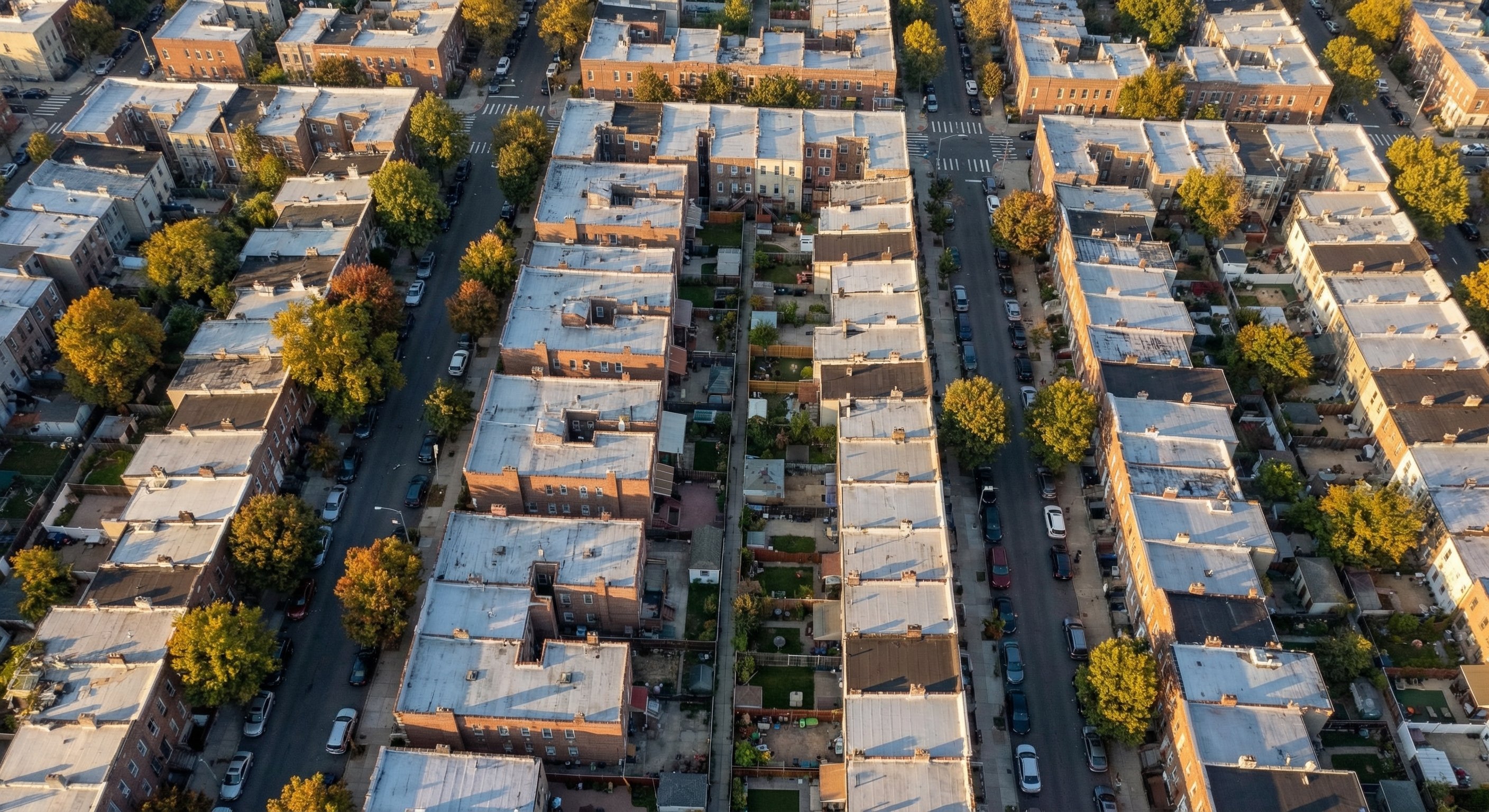
How New York's Foreclosure Process Works
New York is a strict judicial foreclosure state. Every residential foreclosure must be approved through the court system before a lender can sell the property.
Under RPAPL § 1304, the lender must send a 90-day pre-foreclosure notice to the borrower before filing any court action. This notice is the earliest public signal that a property is heading toward distress, giving investors a three-month head start before the lis pendens appears.
After the 90-day period, the lender files a summons and complaint in the New York Supreme Court and simultaneously records a lis pendens at the county clerk's office, clouding the title and putting any buyer on notice that a legal claim exists. Most counties then require a mandatory settlement conference under CPLR 3408, which adds months to the timeline and often fails to produce a resolution. If no settlement is reached, the case proceeds through discovery until a court-appointed referee computes the amount owed and the court issues a judgment of foreclosure and sale.
Statewide, the process averages 900 to 1,100 days. In New York City, timelines frequently exceed 1,500 days. In Kings and Bronx counties, four years is not unusual.
Where to Find New York Foreclosure Leads
Lis Pendens Filings
The lis pendens is the foundational signal for New York foreclosure investors: public, county-recorded, and the starting gun for that extended pre-foreclosure window. But accessing this data requires working with multiple disconnected systems.
In New York City, the primary source is ACRIS (Automated City Register Information System), covering Manhattan, Brooklyn, Queens, and the Bronx. Staten Island operates a separate portal. Every upstate county maintains its own system. There is no single statewide database, and raw filings do not include property details, owner contact information, or lead quality indicators.
Stacked Signals: The Real Lead Quality Test
A lis pendens alone is a signal, not a lead. The most actionable foreclosure leads in New York combine multiple distress indicators.
Lis pendens plus tax delinquency means the homeowner is behind on the mortgage and property taxes, indicating genuine financial distress.
Lis pendens plus vacancy means the owner has left the property and the building is deteriorating.
Lis pendens plus code violations means municipal enforcement is adding cost pressure, giving the owner another reason to seek a fast exit.
Lis pendens plus absentee ownership means the owner lives out of state or out of the country, often the most motivated scenario: unable to manage the property and wanting it resolved quickly.
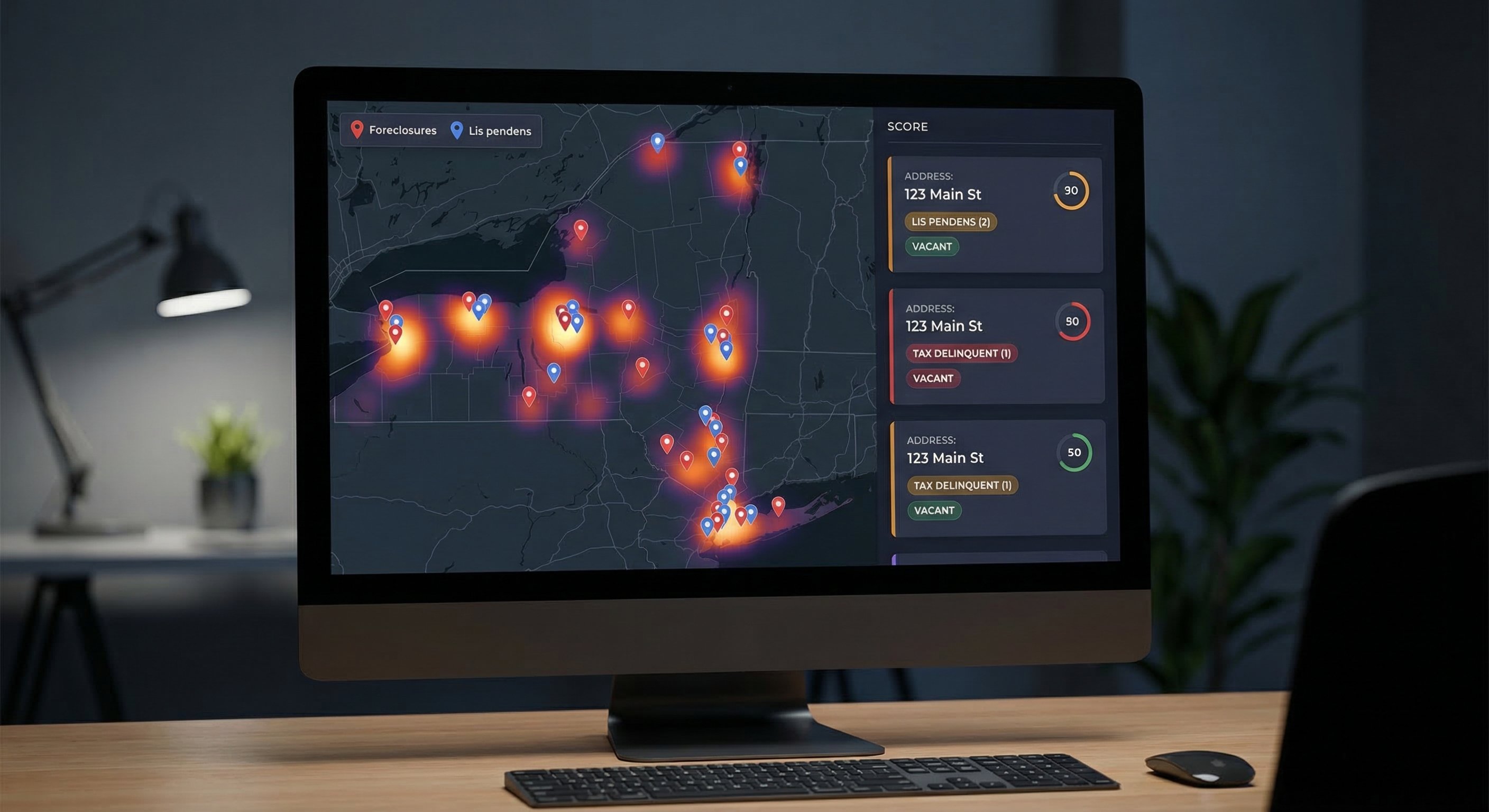
DistressIQ stacks 31 distress signal types across more than 11 million active signals nationwide. Every New York lis pendens is cross-referenced against tax records, vacancy indicators, code enforcement, and ownership records to produce a prioritized lead.
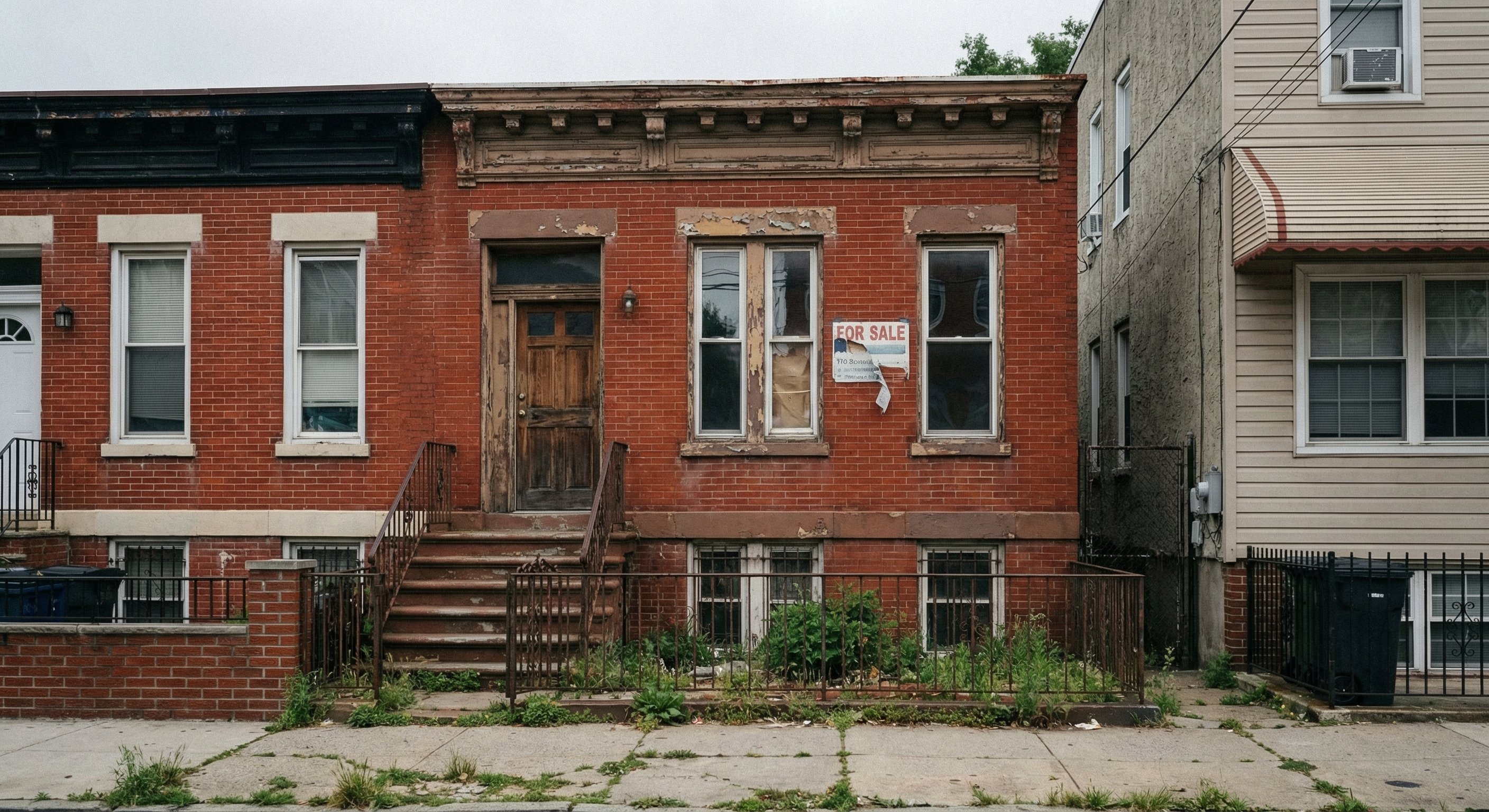
New York Foreclosure Markets by County
New York is not one market. Each region has distinct investor dynamics and competition levels.
New York City: The Volume Center
The five boroughs account for approximately 60 percent of all state filings.
Kings County (Brooklyn) produces enormous volume with substantial equity even in distress, but institutional competition is intense.
Queens County offers strong volume with less saturation. Diverse housing stock and high absentee ownership rates create leads harder for competitors to identify.
Bronx County leads the city in pre-foreclosure activity. Lower median values and frequent overlap between mortgage distress and tax delinquency create dense signal clusters.
Richmond County (Staten Island) has smaller inventory but significantly less competition.
Long Island: Nassau and Suffolk
Nassau County has persistent activity driven by high property taxes, with properties tending to carry more equity than Bronx distressed homes. Suffolk County generates high filing volume in communities farther from the city, with larger lot sizes attracting a suburban investor profile.
Upstate New York: Lower Competition, Steady Volume
Erie County (Buffalo) is one of the strongest foreclosure markets in the Northeast: low prices, plentiful motivated sellers, minimal institutional competition. The courts process cases faster than the five boroughs, so the pre-foreclosure window is shorter but deal flow is consistent.
Monroe County (Rochester) has elevated rates driven by economic shifts. Low property values and persistent distress create a steady pipeline for cash flow investors.
Onondaga (Syracuse) and Oneida (Utica) counties offer elevated rates and low entry prices for rental-income-focused investors.
Free Weekly Alerts
See What's Distressed in Your Market
Get free weekly alerts — new distressed properties, motivation scores, and hot neighborhoods in your area. Addresses and contact info available inside DistressIQ.
Free forever · No credit card · Unsubscribe anytime
How to Work New York Foreclosure Leads
Filter by filing age. A lis pendens filed last month means the homeowner may still believe they can resolve things with the lender. A lis pendens filed 12 to 24 months ago with no resolution indicates a much warmer lead. The sweet spot for outreach is 6 to 24 months after filing.
Cross-reference tax records. Any property both in active foreclosure and behind on property taxes is in genuine financial distress. New York City uses its own assessment framework and upstate counties use another, but the signal is the same: unpaid taxes plus pending foreclosure equals a seller who needs out.
Check for vacancy and absentee ownership. Properties where the owner has relocated are the highest-conversion leads. The owner has moved on emotionally and practically, is accumulating costs without benefit, and responds to clear offers promising a fast close.
Evaluate equity. A Brooklyn home with a $400,000 mortgage and $700,000 value is a different negotiation than one where the mortgage exceeds the value. Short sales require lender approval but can produce deep discounts. Know which situation applies before contact.
Make contact early. Many homeowners do not know they can sell before auction, avoid a public foreclosure, and walk away with something. The investor who explains these options clearly wins the relationship and the deal.
New York Foreclosure Auctions
For leads that reach auction, New York conducts referee's sales at the county courthouse. NYC auctions happen at the Supreme Court building for each borough; upstate auctions take place at county courthouses. Bidding requires cash or certified funds, typically 10 percent down with the balance due in 30 days. There is no inspection period. New York does not provide a statutory post-sale redemption period for residential properties.
By auction time, the buyer competes with institutional funds and experienced bidders who work these sales weekly. Pre-foreclosure remains the superior opportunity for most individual investors.
FAQ
Q: How long does foreclosure take in New York?
The average timeline runs 900 to 1,100 days from lis pendens to completed sale statewide. In New York City, timelines frequently exceed 1,500 days, and Kings and Bronx counties have documented cases approaching four years. This is governed by RPAPL Article 13 and results from mandatory settlement conferences, discovery practice, and the volume of cases overwhelming the court system. For investors, this creates the longest pre-foreclosure working window of any state.
Q: What is a lis pendens and why does it matter for New York investors?
A lis pendens is a notice of pending litigation filed with the county clerk when a foreclosure action begins. In New York, it is recorded simultaneously with the summons and complaint in Supreme Court. The filing clouds the title, preventing the owner from selling or refinancing without addressing the foreclosure. It is the first publicly searchable distress signal for any given property. In NYC, lis pendens can be searched through ACRIS for the four main boroughs, while upstate counties each maintain separate recording systems.
Q: What is the 90-day pre-foreclosure notice under RPAPL § 1304?
New York requires lenders to send a 90-day notice to borrowers before filing a foreclosure action, informing the homeowner of the lender's intent to foreclose and providing information about housing counseling and loss mitigation options. This is the earliest point in the foreclosure pipeline where a property can be identified as heading toward distress. Investors who track these notices gain a head start of three months or more before the lis pendens appears in public records, making it a critical early window.
Q: Which New York counties have the most foreclosure activity?
The highest-volume counties are Kings (Brooklyn), Queens, Bronx, Nassau, Suffolk, and Erie (Buffalo). The five boroughs account for approximately 60 percent of all state filings. Upstate, Erie County and Monroe County (Rochester) generate the most activity with far less investor competition. Investors seeking lower competition and steady deal flow should consider upstate counties, where property values are lower but motivated sellers are equally plentiful.
Q: Can you buy a foreclosure before the auction in New York?
Yes. During the pre-foreclosure period, which in New York can last years, the homeowner retains full ownership and can sell at any time. Pre-foreclosure purchases allow for inspections, title searches, and negotiated pricing, while buying at auction requires cash, provides no inspection period, and pits the buyer against institutional funds. The extended New York timeline makes pre-foreclosure acquisition especially viable compared to states where foreclosure moves quickly.
Q: Is New York a tax lien or tax deed state?
New York operates a hybrid system that varies by municipality. New York City runs an annual tax lien sale program where bundled liens are sold to third-party servicers, but does not auction individual properties. Most upstate counties function as tax deed jurisdictions, where the county can take title through an In Rem proceeding after the redemption period expires, typically two to three years. The process varies significantly by county.
Q: Do investors need a real estate license to buy foreclosures in New York?
No. Investors buying properties for their own account do not need a license. Licensure is required only for those acting as brokers or agents on behalf of others for compensation. Investors who buy, sell, or wholesale deals they own or hold equitable interest in through assignable contracts generally fall within the unlicensed investor exemption. New York has specific regulations around wholesale transactions, so consulting a local real estate attorney is advisable.
DistressIQ provides county-verified distress signal data across 3,200+ counties, with 31 signal types stacked on every property. Filter by signal age, count, county, and property type, then evaluate with Street View and aerial imagery. Early access pricing starts at $89 per month with founding member rates locked for life. Explore New York foreclosure leads at distressiq.ai.
Sources
- New York State Unified Court System, "Residential Mortgage Foreclosure": https://www.nycourts.gov/courts/foreclosure.shtml
- New York Real Property Actions and Proceedings Law, Article 13
- ATTOM Data Solutions, "U.S. Foreclosure Market Report": https://www.attomdata.com
The data behind this article
DistressIQ Monitors These Signals in Real Time
Pre-Foreclosures
NOD + NTS filings
Tax Delinquency
County treasurer records
Code Violations
Municipal inspection filings
Probate Filings
Superior Court records
Every lead is scored 0–100 for seller motivation based on signal type, duration, severity, and stacking. Nationwide coverage — every US county, updated daily.
Ready to find deals in your market?
See Live Distress Signals in Your County
Stop calling dead leads. Every lead in DistressIQ is scored 0–100 for seller motivation, with verified contact info included. Browse the free tier to see what's active in your market right now.
Browse Free Leads — No Credit Card