The Hidden Cost of Bad Property Data for Real Estate Investors

TL;DR: Bad property data costs the average real estate investor $15,000 to $30,000 per year in overpays, blown deals, wasted outreach, and lost opportunities. MLS-reported square footage differs from county records in 8.75% of transactions. AVMs carry a 6-10% error margin. On a $300,000 property, that is $18,000 to $30,000 riding on data that may be wrong. The fix is county-direct data: the same records lenders, appraisers, and title companies rely on. DistressIQ pulls from county assessor databases, not MLS listings.
The Hidden Cost of Bad Property Data for Real Estate Investors
Most real estate investors never calculate what bad data costs them. They track their deals, their rehab expenses, their marketing spend. But almost no one puts a dollar figure on the times they overpaid because the square footage was wrong, walked away from a good deal because an appraisal came in low, or burned hours chasing leads with incorrect phone numbers.
That silence is expensive. Bad data does not announce itself. It just quietly takes money out of your pocket on every deal you run.
This article puts specific numbers on those costs. Not estimates or industry averages borrowed from unrelated sectors — dollar amounts that directly apply to real estate investors who are buying, flipping, or wholesaling residential properties in 2026.
What "Bad Property Data" Actually Means for Investors
Bad property data is not just annoying. It is financially toxic. In this context, it means:
- Square footage that does not match reality — MLS listings that count a garage as living space, or count an unpermitted addition, or simply have a typo in the bedroom count.
- After-Repair Value built on inflated comps — AVMs and MLS comps that pull from records with the same errors, compounding the mistake.
- Contact information that is months or years out of date — Skip tracing results that return disconnected numbers because the database has not been updated.
- Tax and lien status that does not reflect current county records — Lists that claim a property is clear when it is actually in tax default.
- Ownership records that show the wrong person — Deeds that have not been updated after a death, divorce, or transfer.
Each of these costs you money. Some of them cost you deals. Some of them cost you tens of thousands.
Cost 1: Inflated ARV Destroys Your Offer Math
The After-Repair Value is the foundation of every fix-and-flip and wholesaling deal. You calculate your maximum allowable offer (MAO) by working backward from ARV, subtracting your renovation costs, your holding costs, and your desired profit margin.
If ARV is wrong, every number downstream is wrong.
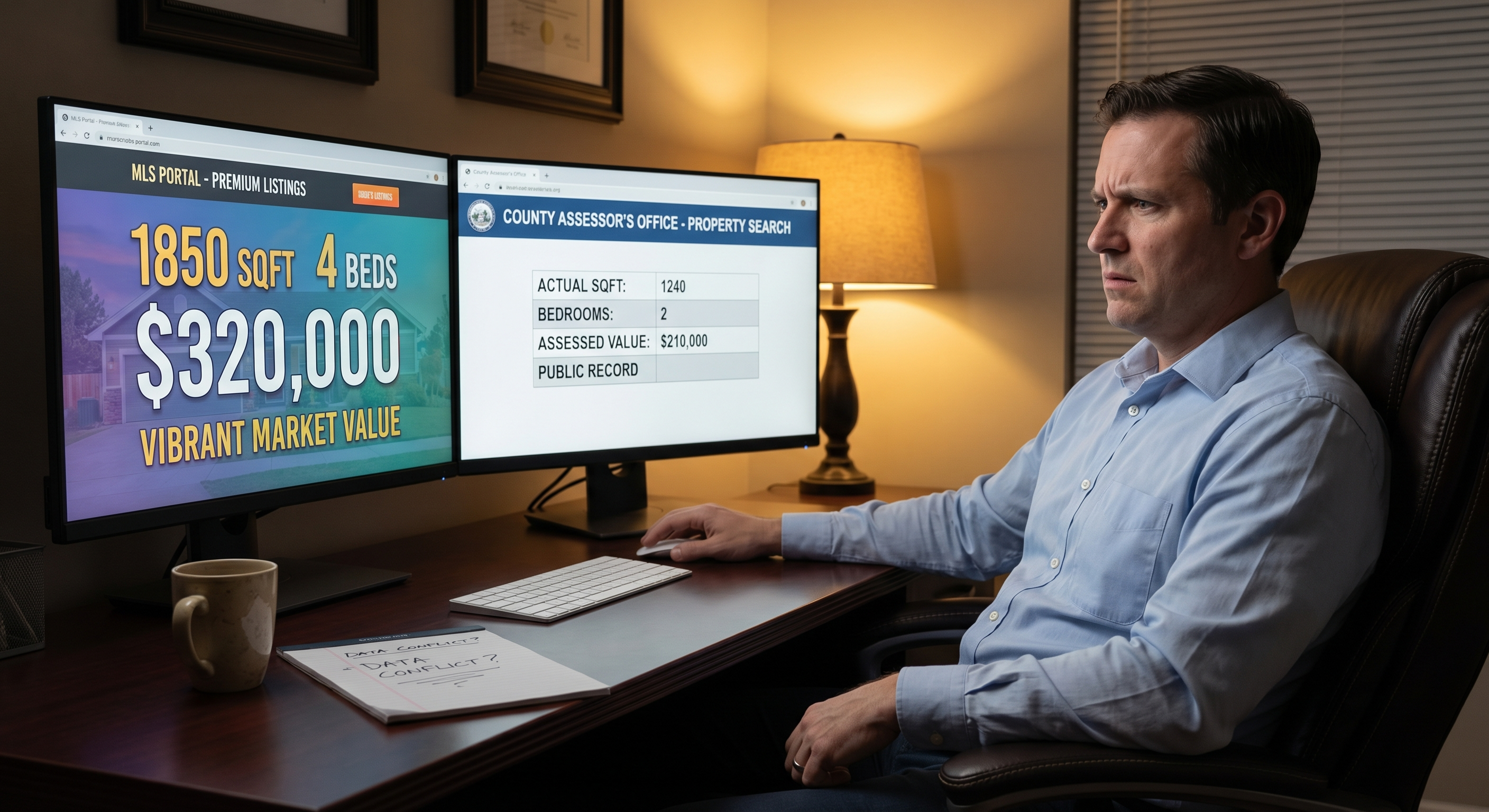
The National Association of Realtors studied how often MLS-reported sale prices differ from what actually closed on the HUD-1 settlement statement. The answer: 8.75% of the time. That is not rounding error. On a $300,000 property, 8.75% is a $26,250 gap between what the MLS said the property was worth and what it actually traded for.
Now run that through your offer formula:
- Inflated ARV: $320,000
- Renovation estimate (based on 1,850 sqft MLS record): $45,000
- Desired profit: $25,000
- Your MAO: $250,000
Then you get to closing. Lender orders appraisal. Appraiser uses county records, not MLS. County shows the property is actually 1,240 sqft — not 1,850. Appraisal comes in at $270,000. Your purchase price was $250,000. There is no gap — you got lucky.
But what if the property was listed at $260,000? Your MAO was $250,000. You offer $250,000 and the seller counters at $255,000. You think you are getting a deal at $255,000. Appraisal comes in at $270,000. You are paying $255,000 for a property appraised at $270,000. Looks fine on paper.
Except two of your comps had the same inflated square footage. The real ARV, based on county-square-foot comps, is $258,000. You just overpaid by $12,000 on a property that will barely break even after rehab.
Collateral Analytics studied AVM accuracy across multiple platforms. Their finding: 6-10% average error margin. On a $400,000 property, that is a $24,000 to $40,000 swing. For a fix-and-flip operating on $20,000 to $30,000 profit margins, a single AVM error can eliminate the entire profit on a deal.
The fix: always pull ARV from county-recorded square footage, not MLS square footage. Run your comps against assessor records. When the MLS and the county disagree, trust the county.
Cost 2: Appraisal Gaps Kill Deals at the Worst Moment
You found the deal. You ran your numbers. You got under contract. Your lender orders the appraisal.
The appraiser looks at county records, not your MLS comps. If your purchase price was based on inflated MLS data, the appraisal comes in below your purchase price. Now you have an appraisal gap.
According to a 2025 analysis by United States Real Estate Investor, 32% of negative appraisals kill deals. Many of those are not valuation disputes — they are data disputes. The appraiser used county records. Your offer was based on MLS data. Those are two different properties.
In a best-case scenario, the seller renegotiates. In a worst case, you lose the earnest money deposit, your inspection costs, and your option fee — and you start over.
Appraisal gaps are particularly brutal for investors because you often cannot bring as much cash to the table as a conventional buyer. You are relying on the numbers working on paper. When the appraisal breaks the math, you have no fallback.
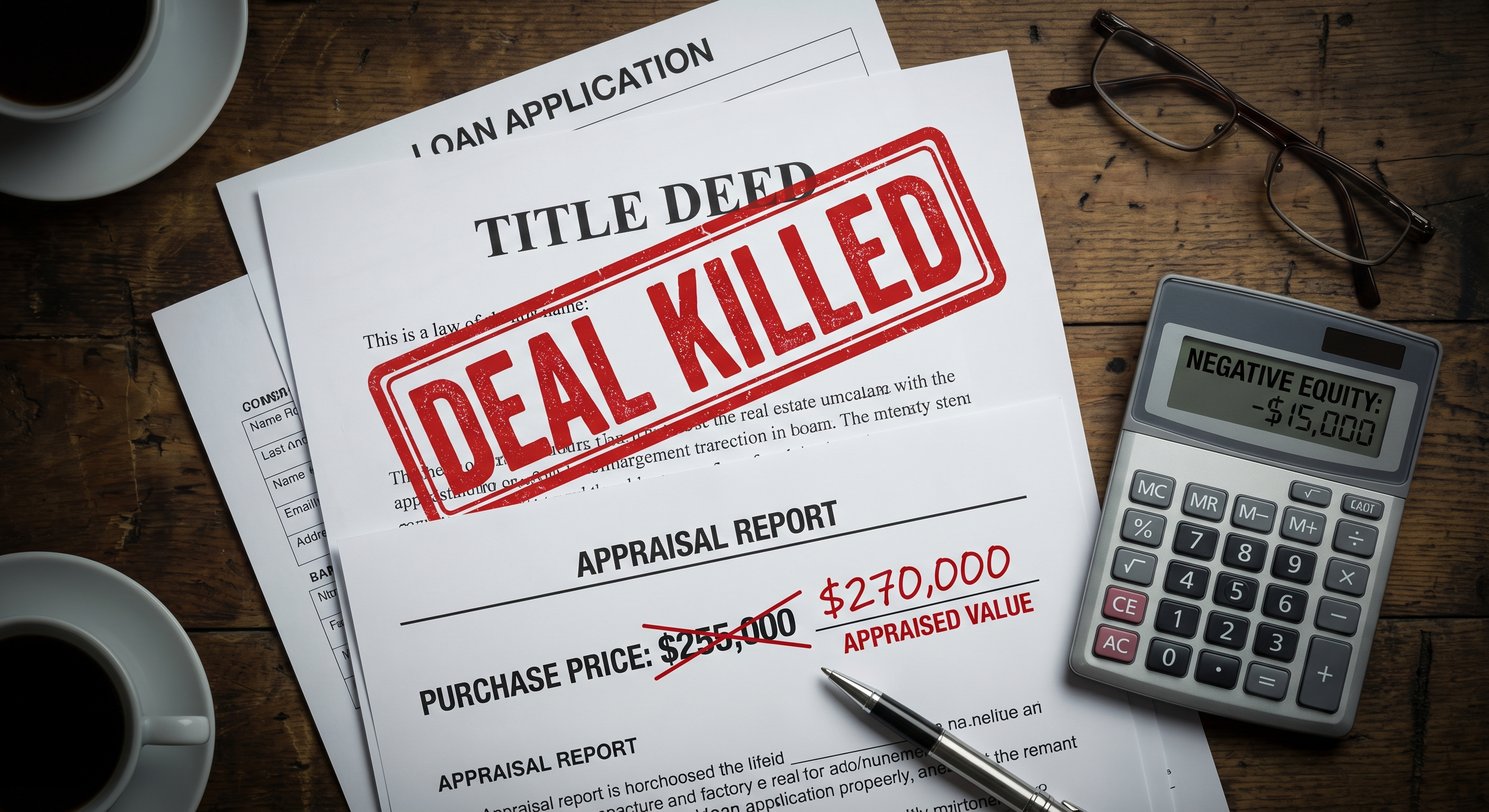
The real cost is not just the dead deal. It is the time. Three to six weeks of your pipeline tied up in a property that was never going to close. Three to six weeks you could have been working a property with clean data.
Free Weekly Alerts
See What's Distressed in Your Market
Get free weekly alerts — new distressed properties, motivation scores, and hot neighborhoods in your area. Addresses and contact info available inside DistressIQ.
Free forever · No credit card · Unsubscribe anytime
Cost 3: Renovation Budgets Built on Wrong Square Footage
Renovation costs are calculated per square foot. Flooring, paint, HVAC, roof, electrical — all of it scales with the size of the structure.
If you are budgeting based on 1,850 square feet and the actual structure is 1,240 square feet, your renovation estimate is off by roughly 50%. Flooring alone on 610 extra square feet, at $6 per square foot, is $3,660. Paint at $2.50 per square foot is another $1,525. Those are just two line items.
On a full renovation, square footage errors of 20-30% — which are common in MLS data — can throw your rehab budget off by $10,000 to $25,000 depending on property size and scope.
For a wholesaler, a blown renovation budget means your assignment fee math breaks. For a flipper, it means the deal stops working mid-rehab, which is the worst possible time to discover you are over budget.
Experienced flippers know this. They measure the property themselves, walk the structure with a tape measure, and verify county records before they finalize their rehab estimate. The ones who skip this step are the ones who get burned.

Cost 4: Bad Skip Tracing Burns Hours and Dials
Skip tracing is only as good as the underlying data. If you are using a lead list built from MLS-derived ownership data, you are starting with stale information. The property may have changed hands. The owner may have died. The phone number may have been disconnected.
A study by Revaluate found that 50% of records in the average real estate professional's database have missing or incorrect contact information within 18 months of collection. For distressed property leads — which often sit on lists for weeks or months before being worked — that number is probably higher.
Every bad phone number you dial is time you are not spending on a live lead. Every voicemail you leave for a disconnected number is a dead end. Every mailer sent to an outdated address is money spent on ghosts.
For an investor running 200 to 500 leads per month, a 30-40% skip tracing failure rate means 60 to 200 dead ends. If you are spending 3 minutes per lead on phone calls, that is 3 to 10 hours of wasted effort every month — just from bad data, not bad outreach.

The fix: use county-direct ownership records as your source data, not MLS-derived lists. County assessor records are updated at the time of each transaction, deed recording, and transfer. They reflect the current legal owner. Skip tracing from a current owner record hits at a dramatically higher rate than skip tracing from a stale MLS listing.
Cost 5: Tax Delinquency Lists That Are Not Delinquent
Some data providers sell "tax delinquent property lists" that include properties with outstanding tax bills — but the list has not been updated in 30, 60, or 90 days. During that window, some of those owners have paid their taxes. Some have entered payment plans. Some have disputed the assessment.
If you are calling these owners claiming their property is tax delinquent, and they have already resolved the issue, you have just insulted them. You have wasted your marketing dollar on a lead that has no motivation problem. And you have shown them that your data is unreliable — which means they will not trust you when you call them about a legitimate lead later.
In states with aggressive tax lien sales — Texas, Alabama, Georgia — this matters even more. The redemption period in Texas is two years. A property that appeared on a tax delinquent list six months ago may have already been redeemed, sold at auction, or the owner may have worked out a deal with the taxing authority that does not show up in a data aggregator for another 90 days.
DistressIQ updates tax payment status directly from county assessor records on a daily basis. When a tax payment is recorded at the county, it shows up in DistressIQ the next day. No 30-day lag. No 60-day lag.
Cost 6: The Compounding Effect Across Your Entire Pipeline
Here is what most investors miss: bad data does not just cost you on one deal. It poisons every downstream calculation in your pipeline.
Your lead scoring is built on assumptions about property condition, equity, and motivation. If the square footage is wrong, your equity estimate is wrong. If the ownership record is stale, your contact information is wrong. If the tax status is outdated, you are calling motivated sellers who are no longer motivated.
When you compound those errors across a pipeline of 500 leads, the math gets ugly fast.
The typical investor pipeline looks like this:
- 500 leads sourced
- 200 phone calls placed
- 50 properties toured
- 10 offers made
- 3 deals closed
If bad data inflates your equity estimates, you are spending time on properties that do not have the equity you thought. If bad contact data cuts your effective reach rate from 40% to 25%, you are making 100 calls instead of 200 to reach the same number of people. If bad tax status data includes 20% resolved leads, you are wasting 100 calls on dead ends.
The compounding effect is that your pipeline shrinks, your cost per deal goes up, and your profit margins compress — even if you are executing well on every deal you do get to closing.
The Fix: County-Direct Data, Not MLS Aggregated Data
The solution to bad property data is not better algorithms. It is better source data.
County assessor records are the legal record of truth for a property. They are what lenders use to underwrite loans. They are what appraisers use to establish value. They are what title companies use to issue title insurance. They are updated at the time of each transaction, each tax payment, each deed recording.
MLS data is a marketing record. It is built to sell properties. Square footage is entered by listing agents who have an incentive to maximize the property's appeal. Bedroom and bathroom counts include rooms that may not be permitted. Lot sizes are sometimes entered from memory.
These two record systems disagree with each other more than 8% of the time. When they disagree, county records are right and MLS records are wrong.
DistressIQ was built on this principle. Every signal — pre-foreclosure, tax delinquency, probate, vacancy, code violations — is pulled directly from county assessor and county clerk records, not MLS aggregators. Ownership records are verified against the county's current deed. Tax payment status is updated daily from the county's own payment ledger.
When you are making a $250,000 offer on a property, you need to know the county thinks it is worth $225,000. Not discover that six weeks later when the appraisal comes in.
How to Verify Property Data Before You Make an Offer
Even if you are not using DistressIQ, you can protect yourself from bad property data on every deal:
Step 1: Pull the county record yourself. Every county assessor in the United States has a public portal where you can look up a property by address or parcel number. It takes five minutes. It is free. Pull the square footage, lot size, owner of record, and tax payment status directly from the county.
Step 2: Compare square footage. If the county shows 1,240 sqft and the MLS shows 1,850 sqft, assume the county is right and work backward from the county figure.
Step 3: Run comps on county sqft. When pulling comparable sales, filter by county-recorded square footage, not MLS square footage. Most MLS systems will let you sort or filter by sqft. If yours does not, pull the county sqft for each comp and calculate price-per-square-foot using county numbers.
Step 4: Verify ownership before skip tracing. Confirm the county deed matches the name on your lead list before you spend money on skip tracing. If the deed has been transferred and your list still shows the old owner, you are paying to skip trace someone who does not own the property.
Step 5: Check tax status directly. Do not rely on a third-party data provider's tax status if you are within 60 days of a tax sale date. Call the county tax collector's office directly. It takes one phone call and it tells you exactly where the property stands.
Frequently Asked Questions
How often is MLS square footage wrong? MLS-reported square footage differs from county assessor records in approximately 8.75% of transactions, according to NAR research. Common errors include counting unpermitted additions as living space, counting finished garages as bedrooms, and data entry typos on bedroom and bathroom counts. Errors are more common in older homes, distressed properties, and homes with recent renovations.
What is the cost of an inaccurate ARV for house flippers? The cost depends on the error margin and property value. AVMs carry a 6-10% error margin nationally, which on a $300,000 property means a $18,000 to $30,000 swing in ARV. If your ARV is inflated by 8.75% and you work backward using a standard 70% MAO formula, you will overpay by roughly $18,000 on a $300,000 property. For a flip with $25,000 in renovation costs and $20,000 in holding costs, that overpayment eliminates your profit.
Can bad property data affect skip tracing results? Yes. Skip tracing accuracy depends on the quality of the underlying ownership record. If your lead list is derived from MLS data that has not been updated since the last transaction, you may be skip tracing against an owner who sold the property 12 months ago. County-direct ownership records are updated at the time of each deed recording, making them the most current source for skip tracing.
What percentage of real estate deals fall through due to appraisal issues? Approximately 32% of deals that fall through do so because of appraisal problems, according to industry analysis. Many of these are downstream effects of comp analysis errors — where the purchase price was based on MLS data that inflated square footage or property condition, and the appraiser's county-based valuation did not support that price.
How can I verify property square footage before making an offer? Pull the county assessor record directly from the county's public portal. Compare the county-recorded square footage against the MLS listing. When the two disagree, use the county figure as your baseline. If you have access to the property, verify the county record by physically measuring the structure. On MLS comps, apply the same discipline: use county-recorded sqft rather than MLS-reported sqft for price-per-square-foot calculations.
Does bad tax status data affect distressed property investing? It can be costly. If a tax delinquent property list has not been updated in 30 to 60 days, you may be working leads that have already paid their taxes, entered a payment plan, or been redeemed at auction. This is especially risky in states with short redemption periods or aggressive tax sale schedules. Daily updates from the county source are the only reliable way to maintain accurate tax status on a lead list.
What is the most reliable property data source for real estate investors? County assessor records are the most reliable source for property characteristics, ownership, and tax payment status. MLS data is most useful for understanding what is currently listed for sale, recent list prices, and days on market. For distressed property investing, county-direct data is essential because distressed properties are often not listed on the MLS at all, and their data quality is lower than mainstream listings.
The Bottom Line
Bad property data is not a tech problem. It is a deal-killing problem. The average investor loses $15,000 to $30,000 per year to data errors they never account for — inflated ARV calculations, appraisal gaps, blown renovation budgets, wasted outreach hours, and dead-end tax delinquent leads.
The fix is straightforward: use county-direct data as your primary source. Verify everything before you make an offer. Pull comps against county square footage, not MLS square footage. Check tax status directly from the county, not a third-party aggregator with a 30-day lag.
The data is only as good as its source. Start at the source.
Browse verified distressed property leads with county-direct data updated daily at DistressIQ.
The data behind this article
DistressIQ Monitors These Signals in Real Time
Pre-Foreclosures
NOD + NTS filings
Tax Delinquency
County treasurer records
Code Violations
Municipal inspection filings
Probate Filings
Superior Court records
Every lead is scored 0–100 for seller motivation based on signal type, duration, severity, and stacking. Nationwide coverage — every US county, updated daily.
Ready to find deals in your market?
See Live Distress Signals in Your County
Stop calling dead leads. Every lead in DistressIQ is scored 0–100 for seller motivation, with verified contact info included. Browse the free tier to see what's active in your market right now.
Browse Free Leads — No Credit Card