Vacant Property Leads Tennessee: The Grand Division Investor's Guide

Vacant Property Leads Tennessee: The Grand Division Investor's Guide
TL;DR: Tennessee's 3,200+ abandoned or vacant properties across its 95 counties represent genuine opportunity for investors who understand the state's unique geography. The Volunteer State divides into three distinct markets: West Tennessee around Memphis, Middle Tennessee anchored by Nashville, and East Tennessee with Knoxville and Chattanooga. Each region generates vacant property leads through different mechanisms, from Memphis strip mall vacancies to Nashville's absorbed suburban market to Appalachian rural abandonment. State law requires properties vacant 180+ days to register with local codes departments, creating a public record trail that informed investors use to identify opportunities before they reach the open market.

Every investor who has worked vacant property leads in Tennessee arrives at the same conclusion: the Volunteer State is not one market. It is three.
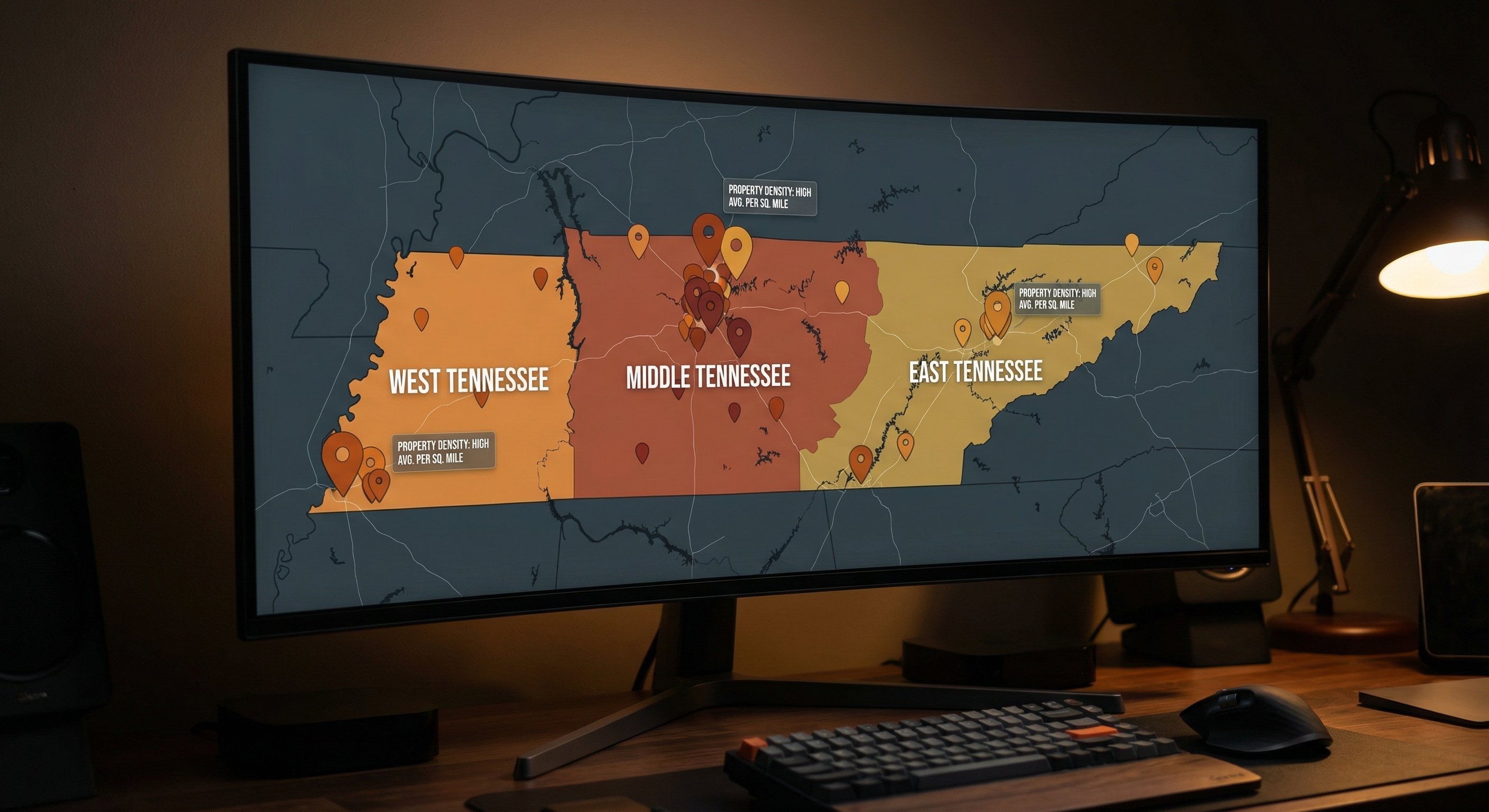
West Tennessee runs from the Mississippi River eastward to the Tennessee River, a flat alluvial plain where Memphis dominates and small towns hollow out as populations drift toward the city. Middle Tennessee stretches from the river to the Eastern Continental Divide, where Nashville's explosive growth has compressed suburban vacancies into an increasingly competitive landscape. East Tennessee wraps around the Appalachian Mountains, a region of stunning beauty and persistent rural poverty where vacant properties reflect economic flight rather than speculative oversupply.
Understanding these divisions is not academic. It determines which vacant property leads are worth chasing, which counties generate the most motivated sellers, and where investor competition is so fierce that wholesale margins collapse. Memphis investors chase different signals than Knoxville investors. The strategies that work in Franklin County will fail in Hancock County.
This guide covers how to find vacant property leads across all 95 Tennessee counties, with particular focus on the markets where volume and opportunity align.
The Tennessee Vacant Property Landscape: Three Regions, Three Markets
Tennessee contains roughly 2.8 million housing units according to U.S. Census Bureau data, with a vacancy rate that varies dramatically by region. The statewide vacancy rate masks the reality that each grand division operates under different economic pressures, demographic trends, and local government responses to abandoned property.
West Tennessee centers on Memphis, a city that has wrestled with vacancy and abandonment for decades. Shelby County alone reported over 10,000 vacant and abandoned residential properties in recent surveys, making it one of the highest-density vacant property markets in the southeastern United States. The causes are structural: population loss from the 2010 census through the pandemic accelerated disinvestment in North Memphis, Whitehaven, and Orange Mound neighborhoods. Economic shifts closed retail corridors along Winchester Road and Bartlett Boulevard, leaving strip mall vacancies that attract both squatters and opportunistic investors.
Outside Memphis, West Tennessee small towns face different but equally challenging vacancy patterns. Rural counties like Haywood, Tipton, and Lauderdale contain properties abandoned as employment opportunities concentrated in Memphis or moved overseas. These are not high-volume markets, but the acquisition prices reflect the economic reality of persistent population decline. A farmhouse in Crockett County might list at $15,000 with significant rehabilitation needs.
Middle Tennessee tells a different story. Nashville's population growth has been among the fastest in the nation since 2010, creating a market where vacant property leads are scarce and competitive. The suburban counties surrounding Nashville, including Williamson, Rutherford, and Sumner, have vacancy rates well below the national average. Any vacant single-family home that appears in Brentwood or Hendersonville attracts multiple offers within days of listing.
The Middle Tennessee vacant property opportunity exists primarily in three zones: urban Nashville neighborhoods undergoing transition where gentrification displaces lower-income residents, secondary cities like Clarksville, Columbia, and Murfreesboro where growth is compressing outward from Nashville, and the rural counties north and south of the metro where economic fundamentals lag the regional boom.
East Tennessee presents the most geographically dispersed vacant property market. Knoxville's vacancy landscape reflects both its role as a university town and its position in a region where manufacturing job losses from the 1990s and 2000s never fully recovered. The rural counties of East Tennessee, from Campbell County in the north to Polk County in the south, contain properties abandoned as younger residents migrated toward Knoxville, Chattanooga, or out of state entirely.
Chattanooga presents a unique East Tennessee vacancy pattern. The city's revitalization since the 1980s environmental cleanup has created a market where even distressed properties in historically problematic neighborhoods like East Lake or Piney Flats have regained value. Investors in the Chattanooga market compete not with each other but with the city's own redevelopment agency, which acquires vacant properties for affordable housing initiatives.

Tennessee Code Enforcement: The Vacancy Registration Trigger
Every Tennessee municipality with a population over 25,000 operates under state authority to register vacant properties. The Tennessee Abandoned Properties Act, codified in Tennessee Code Annotated Section 13-7-801, authorizes local governments to require registration of properties that remain vacant for 180 days or more following notice of violation.
This registration requirement is the single most important tool for finding vacant property leads in Tennessee. When a property owner fails to register, the city or county can assess civil penalties that accumulate monthly. When penalties become unmanageable, motivated sellers emerge. When penalties become severe enough, lenders holding mortgages on abandoned properties often initiate foreclosure rather than absorb the cost of registration and maintenance.
Investors who monitor Tennessee code enforcement records gain access to a list of property owners who have already demonstrated neglect. A landlord who allowed a property to sit vacant for 200 days in a Memphis neighborhood has signaled something important about their financial situation, their willingness to manage properties, or both. That signal is an invitation.
Davidson County (Nashville) maintains one of the most aggressive vacant property registries in the state. The Metropolitan Government's Property Standards Division conducts monthly inspections of registered vacant properties and publishes a public list updated quarterly. The list includes the property address, owner name, registration status, and most recent inspection findings. Investors who cross-reference this list with county assessor data can identify properties where the owner is likely motivated to sell.
Shelby County (Memphis) operates its vacant property registry through the Division of Neighborhoods and Conservation, which works in coordination with the Memphis Land Bank Corporation. The Land Bank acquires vacant properties from the registry when owners fail to maintain them or pay accumulated code enforcement penalties. Investors can purchase properties directly from the Land Bank at prices that reflect the cost of the code enforcement process, often well below market value for comparable properties in stable neighborhoods.
Knox County (Knoxville) and Hamilton County (Chattanooga) maintain similar systems, though with smaller registration volumes reflecting their smaller populations. Hamilton County's code enforcement works closely with the City of Chattanooga's Community Development Division, which has an active program to acquire vacant properties for redevelopment in neighborhoods targeted for revitalization.
The pattern across all Tennessee jurisdictions is consistent: vacancy creates registration obligations, registration obligations create costs, costs create motivated sellers. Investors who understand this cycle find vacant property leads that never appear on traditional MLS listings.
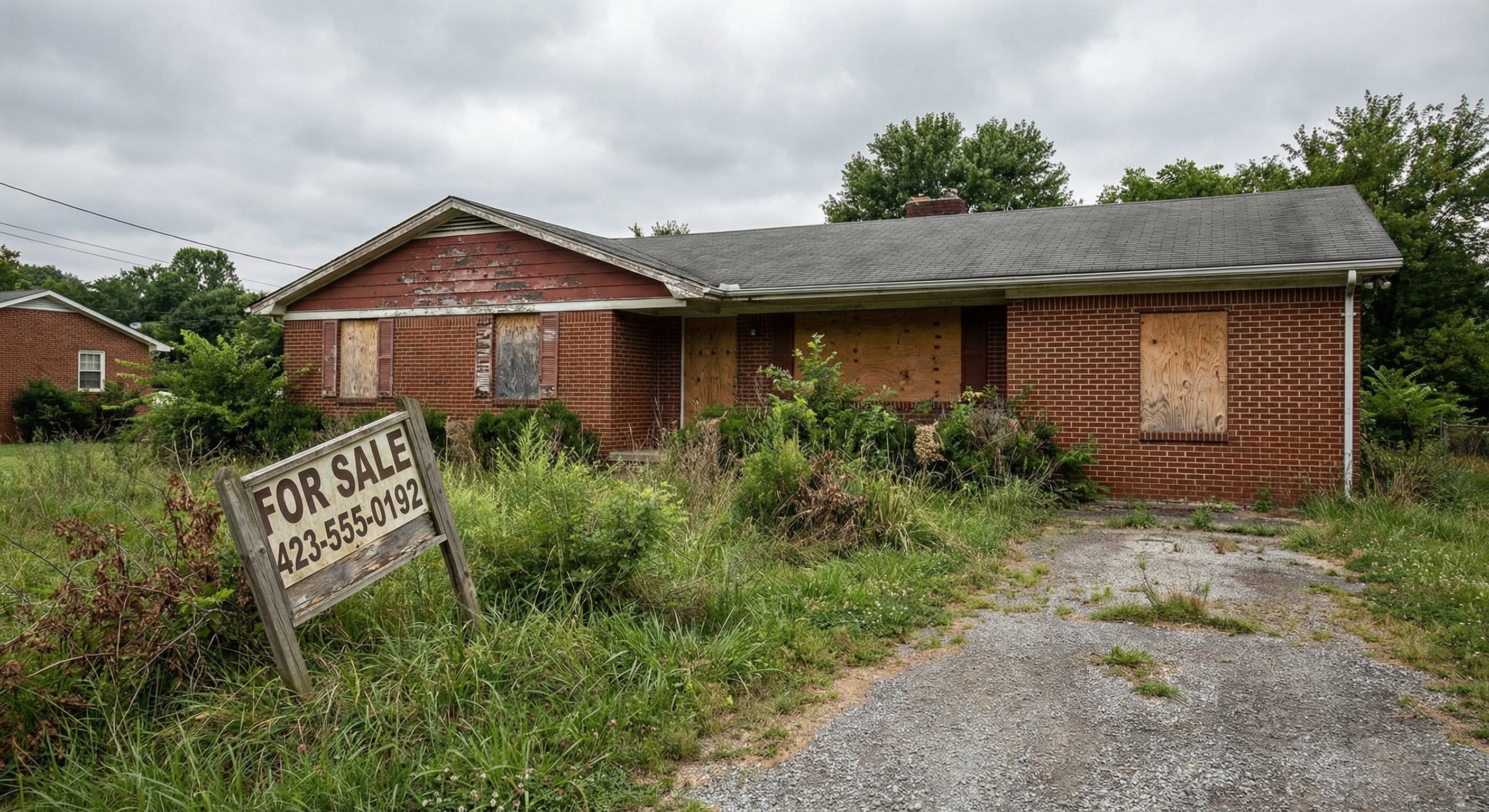
Memphis: Tennessee's Vacant Property Capital
No discussion of Tennessee vacant property leads can avoid Memphis. The city consistently ranks among the highest-vacancy major metropolitan areas in the United States, with a combination of factors that creates both the most opportunity and the highest risk for investors.
The Memphis vacant property market breaks into three distinct sub-markets, each requiring a different investor approach.
Inner-city residential vacancies concentrate in neighborhoods like North Memphis, Whitehaven, Orange Mound, and Binghamton. These properties are often single-family homes or small multi-family buildings where decades of disinvestment have created a cycle of abandonment. Acquisition prices in these neighborhoods frequently fall below $20,000, sometimes below $5,000 for structures requiring significant rehabilitation. The investor who can rehabilitate these properties profitably needs either deep local market knowledge or a network of contractors who understand the specific challenges of Memphis inner-city rehabs, including foundation issues common in clay soils, asbestos in pre-1980 construction, and title complications from decades of informal family transfers.
Strip mall and retail center vacancies represent a Memphis-specific opportunity that rarely appears in statewide analyses. Memphis has absorbed significant retail square footage as national chains closed underperforming locations, leaving behind properties that require demolition or major renovation to redeploy. The Winchester Road corridor between Memphis and Bartlett contains multiple vacant strip centers that local investors acquire for conversion to medical offices, churches, or self-storage facilities. These transactions rarely appear in any lead generation system because they involve commercial rather than residential properties.
Suburban absorption failures in Memphis's outer neighborhoods represent the third sub-market. As Memphis expanded eastward through the 1990s and 2000s, developers built subdivisions that assumed continued population growth. When growth stalled, partially built subdivisions left homeowners in communities without the commercial services that made the location attractive. Cordova, Germantown, and Collierville have relatively few vacant properties, but surrounding areas like Eads, Arlington, and Brunswick contain individual homes and small developments where abandonment has occurred.
Investors targeting Memphis vacant property leads should understand the Memphis Land Bank Corporation's role. The Land Bank acquires properties through tax sale non-redemption, code enforcement liens, and voluntary donation from lenders. Properties are offered for sale through a competitive bid process that prioritizes end-use over highest price, meaning investors who commit to rehabilitation or occupancy can win properties against higher bids from speculators.
Free Weekly Alerts
See What's Distressed in Your Market
Get free weekly alerts — new distressed properties, motivation scores, and hot neighborhoods in your area. Addresses and contact info available inside DistressIQ.
Free forever · No credit card · Unsubscribe anytime
Nashville: Low Vacancy, High Competition
Tennessee's capital city presents investors with the opposite problem from Memphis. Nashville's vacancy rate has remained below four percent for most of the past decade, driven by in-migration that has consistently outpaced new construction. Any vacant property lead in the Nashville metro attracts serious attention from multiple investors.
The Middle Tennessee investor who wants vacant property leads in Davidson County needs a different strategy than the Memphis-focused investor. Competition for vacant single-family homes in Nashville neighborhoods like East Nashville, Germantown, and Sylvan Park is intense enough that wholesale margins often disappear. The investor who pays $250,000 for a vacant lot in East Nashville expecting to wholesale it for $275,000 will find the market has already priced that opportunity.
Two strategies work for Nashville-area vacant property leads.
First, focus on properties with complication that deter casual buyers. Estate sales where heirs cannot agree on whether to sell, divorce situations where one spouse refuses to cooperate, and properties with environmental contamination requiring specialized remediation all create delays and complications that thin the competitive field. These vacant property leads require more legal and transaction work than standard acquisitions, but the margins reflect the effort.
Second, look to secondary markets within the broader Nashville metropolitan area. Wilson County (Lebanon), Rutherford County (Murfreesboro), and Sumner County (Gallatin) all contain vacant properties at price points below Nashville proper but with access to the same regional economy. These markets lag Nashville proper by 18 to 36 months in terms of price appreciation and competitive intensity. The investor who builds a pipeline in Murfreesboro today is positioning for the market that Nashville represented three years ago.
Williamson County presents a special case within the Nashville region. The county's median household income exceeds $100,000, and vacant properties are rare. When one does appear, it typically reflects an estate situation or a property held by an out-of-state owner who lost track of it. These are not high-volume leads, but they represent clean transactions with well-maintained structures.

East Tennessee: The Rural Opportunity
Investors who expand their Tennessee vacant property search to East Tennessee find a market defined by geography and economics rather than population density. The Appalachian Mountains created a landscape of small valleys and isolated communities where economic opportunity has always been uneven.
Rural East Tennessee vacant properties differ fundamentally from Memphis or Nashville vacancies. Memphis vacancies reflect economic contraction and disinvestment in urban neighborhoods. Nashville vacancies are rare and competitive. East Tennessee vacancies often reflect properties in communities that were viable 40 years ago but have not adapted to the post-manufacturing economy.
Campbell County, where the coal economy collapsed in the 1990s, contains properties in communities like La Follette and Caryville where the population has declined by 30 percent or more since 1990. These properties can be acquired for a few thousand dollars, sometimes less, but the investor must understand that rehabilitation into market-rate housing may not be possible. The appropriate exit strategy might be land banking, hunting lease arrangements, or demolition with lot cleanup.
Hawkins County, Hancock County, and the northern portions of Knox County contain similar patterns. The investor who buys a $5,000 vacant house in Hancock County faces a market where the pool of potential buyers is extremely small. That does not make the acquisition wrong, but it does require honest analysis of exit options before purchase.
The urban East Tennessee markets of Knoxville and Chattanooga offer more conventional opportunities. Knoxville's vacancy rate has tightened along with the rest of the Tennessee economy, but the city's Land Bank program and code enforcement registry still produce leads that sophisticated investors can work. Chattanooga's redevelopment agency actively seeks investor partners for its vacant property program, providing both acquisition opportunities and funding partnerships for qualified developers.
Tennessee Tax Sales: Another Path to Vacant Property Leads
Tennessee's annual tax sale cycle produces another stream of vacant property leads. Properties with delinquent property taxes become subject to sale at the county trustee's annual auction, which occurs in most Tennessee counties during the spring and summer months.
The Tennessee tax sale process operates differently from many states. Counties conduct their own sales under state guidelines, creating 95 separate processes across the state. The redemption period varies by county, ranging from one year to two years depending on the jurisdiction. Properties that do not redeem become subject to a court confirmation process that can take additional months.
Investors who acquire vacant properties at Tennessee tax sales need to understand the redemption risk. A property purchased at a Hamilton County tax sale might redeem within 60 days if the owner surfaces with back taxes and penalties, or might remain in limbo for two years while the redemption period runs. The investor's capital is tied up during this period, and the actual return depends entirely on whether redemption occurs.
Shelby County's tax sale is among the largest in the state, with hundreds of properties offered annually. The county has moved to an online auction format that increases participation and typically drives prices above the minimum bid. Investors who want to acquire vacant properties in Memphis through the tax sale process should budget for competition from regional and national investors who have discovered the Memphis market.
Davidson County's smaller tax sale volume reflects the Nashville metro's low vacancy and high property values. Properties that do appear in the Davidson County tax sale are typically vacant lots in transitional neighborhoods or commercial properties in areas undergoing redevelopment.
DistressIQ tracks vacant property leads across all Tennessee counties, including properties flagged by code enforcement, registered as vacant with local governments, and identified through absentee owner records. Browse Tennessee properties scored and ranked by motivation at DistressIQ.
Frequently Asked Questions
Q: What is the best way to find vacant property leads in Tennessee?
The most effective approach combines code enforcement record monitoring with county assessor data analysis. Tennessee municipalities with populations over 25,000 are required to maintain vacant property registries under the Tennessee Abandoned Properties Act. Cross-referencing registry properties with county assessor records identifies properties where the owner has failed to maintain registration or pay accumulated penalties. This combination produces a list of properties where the owner is likely motivated to sell, often below market value. Additional sources include Tennessee Land Bank Corporation properties in Shelby, Davidson, and Knox counties, plus the annual county tax sales conducted by each of Tennessee's 95 county trustees.
Q: How does Tennessee's vacant property registration law work?
Tennessee Code Annotated Section 13-7-801 authorizes Tennessee municipalities to require registration of properties that remain vacant for 180 days or more. Properties must be registered with the local code enforcement department, and owners must pay registration fees that vary by jurisdiction. Annual registration fees in Tennessee cities typically range from $100 to $500 per property, with additional inspection fees. Properties that remain unregistered after the 180-day threshold accumulate civil penalties that can reach $1,000 or more per month in some jurisdictions. The registration requirement creates a paper trail that investors can monitor to identify vacant property leads before they reach the open market.
Q: Is Memphis a good market for vacant property investing?
Memphis presents Tennessee's highest-volume vacant property market with acquisition prices that reflect the city's persistent economic challenges. Properties in North Memphis, Whitehaven, and Orange Mound neighborhoods can be acquired for under $20,000, sometimes under $5,000, but require significant rehabilitation investment. The Memphis Land Bank offers properties for sale through a competitive bid process that favors end-use buyers. Investors should budget for rehabilitation costs that may exceed the acquisition price by a factor of three to five, and should understand the specific title complications that affect Memphis inner-city properties including decades of informal family transfers and mechanics liens from unpaid contractors.
Q: What are Tennessee's three grand divisions and why do they matter for real estate investors?
Tennessee's grand divisions are West Tennessee, Middle Tennessee, and East Tennessee, each with distinct geography, economy, and real estate market characteristics. West Tennessee is a flat alluvial plain centered on Memphis, with the highest vacancy rates and lowest property values in the state. Middle Tennessee is a limestone plateau centered on Nashville, with the lowest vacancy rates and highest property values driven by the metropolitan area's sustained population growth. East Tennessee is a mountainous region with Knoxville and Chattanooga as economic centers, containing both urban revitalization opportunities and rural areas with persistent vacancy from economic contraction. Investors should develop separate strategies for each division rather than assuming Tennessee is a uniform market.
Q: How do Tennessee tax sales work for vacant properties?
Tennessee counties conduct annual tax sales where properties with delinquent property taxes are offered for public auction. The minimum bid is typically the amount of delinquent taxes plus fees and costs. Successful bidders pay the full bid amount and receive a lien that earns interest at the rate specified in the county's resolution, usually between eight and eighteen percent per year. Owners have a redemption period ranging from one to two years depending on the county to repay the bid amount plus accumulated interest and reclaim their property. Properties that do not redeem become the tax sale purchaser's property through a court confirmation process. Investors should understand that redemption is common in appreciating markets, meaning capital can be tied up for extended periods without completing acquisition.
Q: Can out-of-state investors work Tennessee vacant property leads effectively?
Out-of-state investors can operate effectively in Tennessee's vacant property markets, but they need strong local partnerships. Memphis inner-city rehabs require contractor relationships who understand local conditions, from clay soil foundation issues to asbestos remediation in pre-1980 construction. Nashville's competitive market rewards investors with local network connections who hear about off-market opportunities before they are widely marketed. East Tennessee's rural markets require honest assessment of exit options because the pool of potential buyers for rehabilitated properties may be extremely limited. Virtual wholesaling arrangements, where the out-of-state investor finds leads and connects them with local buyers, can be profitable without requiring the investor to manage properties directly.
Tennessee's vacant property landscape rewards investors who understand that the Volunteer State contains multiple distinct markets under one state name. Memphis, Nashville, and the East Tennessee mountains each create different opportunities, require different strategies, and present different risks. The investors who build the local knowledge to navigate each division find a state with enough property volume and price diversity to build a sustainable wholesale or fix-and-flip business.
DistressIQ tracks vacant property leads across all 95 Tennessee counties, updated daily from county code enforcement records and assessor data. Browse properties with vacancy signals, absentee owner flags, and code violation indicators at DistressIQ.
The data behind this article
DistressIQ Monitors These Signals in Real Time
Pre-Foreclosures
NOD + NTS filings
Tax Delinquency
County treasurer records
Code Violations
Municipal inspection filings
Probate Filings
Superior Court records
Every lead is scored 0–100 for seller motivation based on signal type, duration, severity, and stacking. Nationwide coverage — every US county, updated daily.
Ready to find deals in your market?
See Live Distress Signals in Your County
Stop calling dead leads. Every lead in DistressIQ is scored 0–100 for seller motivation, with verified contact info included. Browse the free tier to see what's active in your market right now.
Browse Free Leads — No Credit Card