Vacant Property Leads in Arizona: How to Find and Work Them in 2026
Vacant Property Leads in Arizona: How to Find and Work Them in 2026
TL;DR: Vacant property leads in Arizona are among the most accessible for real estate investors — Arizona's dry climate preserves structures longer, Maricopa and Pima counties publish detailed assessor data, and the state's massive snowbird absentee-owner population creates year-round lead flow. Stacking vacancy signals with tax delinquency or code violations dramatically improves lead quality. The best deals rarely surface from a single data source — the ones your competition misses come from cross-referencing multiple county signals simultaneously.
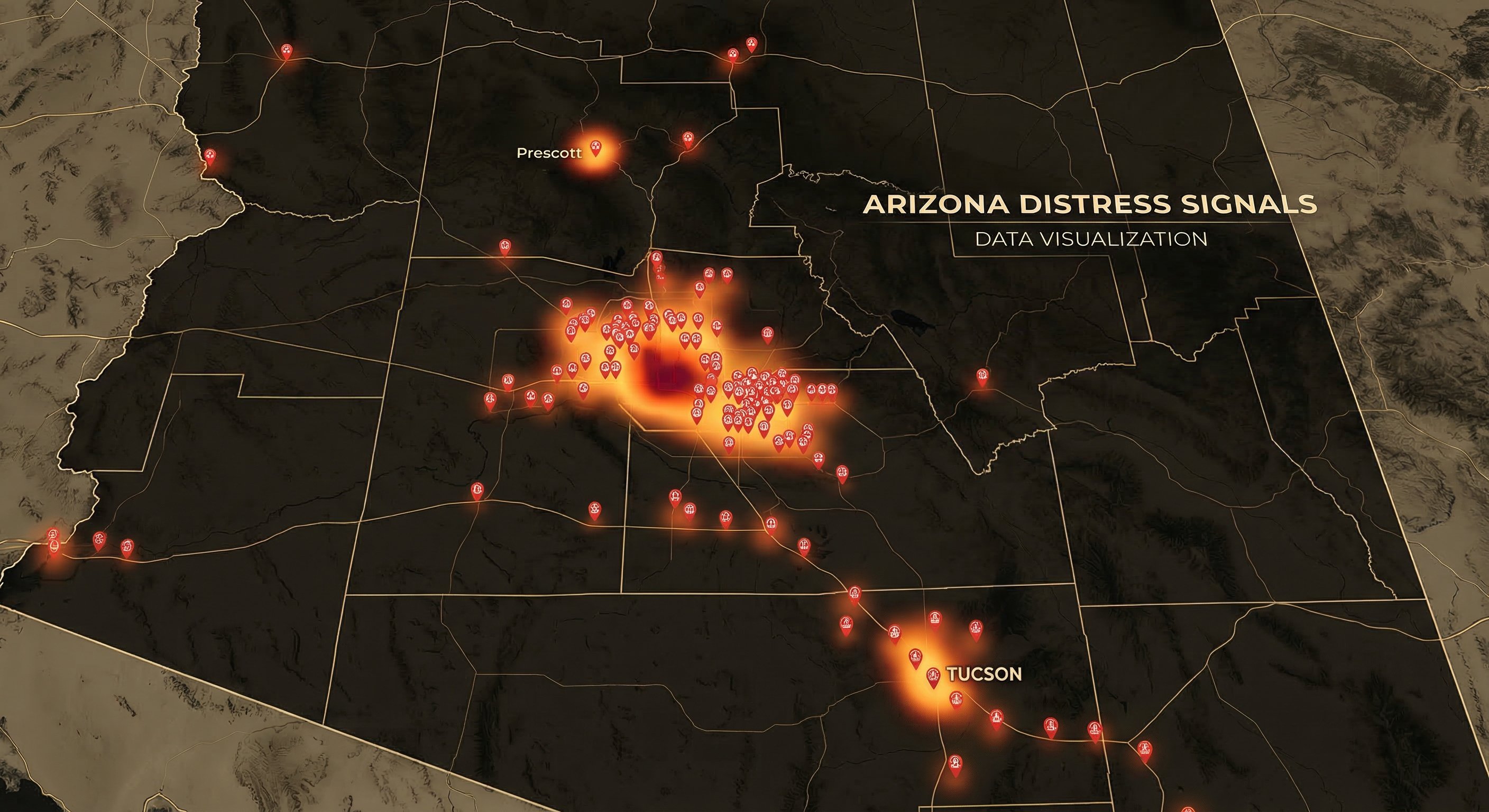
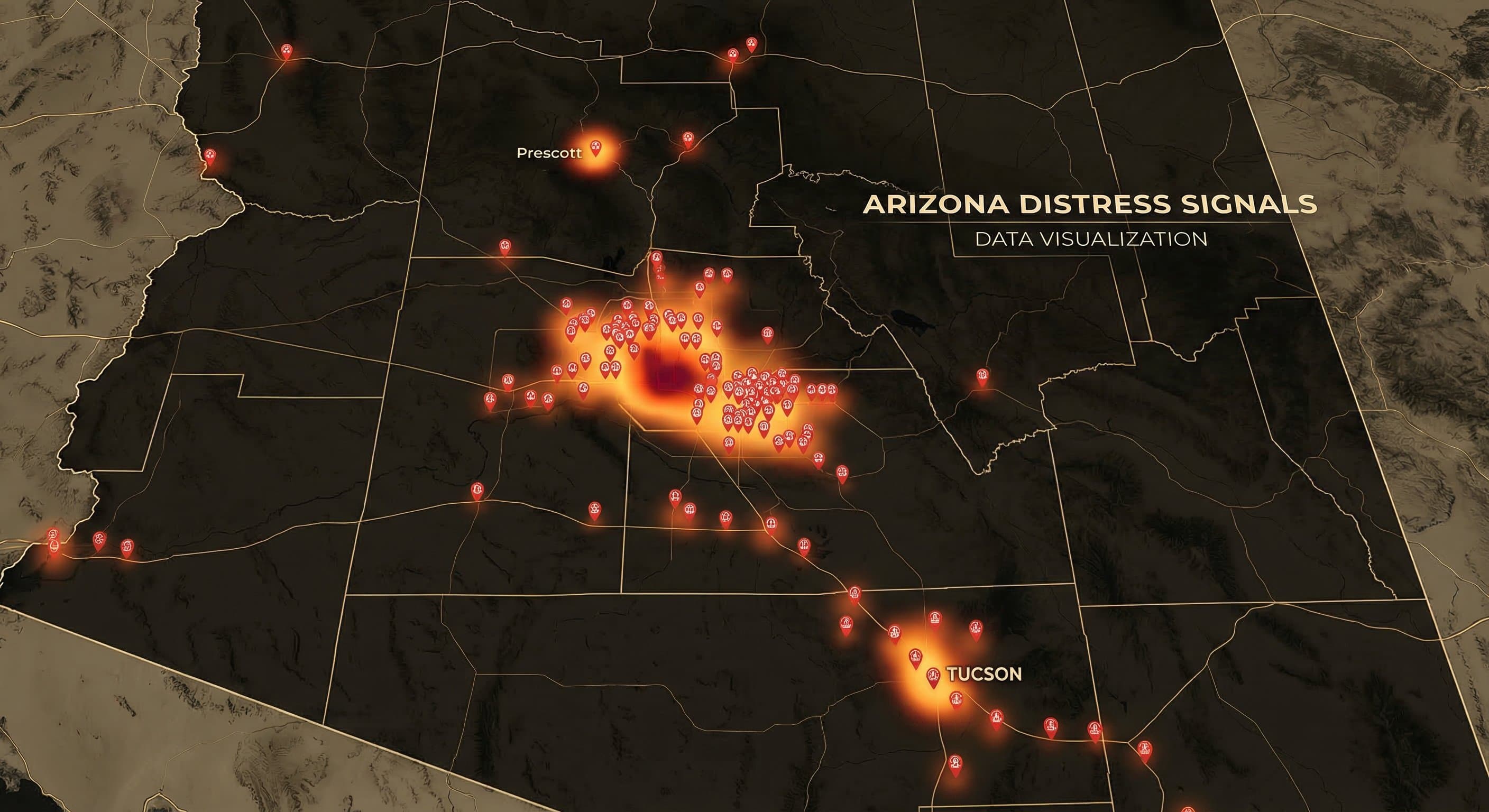
Arizona adds roughly 100,000 new residents every year — but for every gleaming new build going up in Queen Creek or Buckeye, there's a weathered ranch home sitting empty in a Phoenix suburb. An absentee owner somewhere out of state stopped paying property taxes 18 months ago. A snowbird whose health no longer allows the annual drive south hasn't touched the property since 2022. That gap between Arizona's growth narrative and its shadow inventory is exactly where real estate investors make money.
Vacant properties here aren't hard to spot — the desert doesn't hide neglect the way dense weeds do in Georgia or Ohio. But finding the right vacant properties — the ones where the owner is genuinely motivated, the title is clean, and the deal math pencils — requires more than driving around with your eyes open.
Why Arizona Has an Unusual Density of Vacant Property Leads
Arizona's vacancy situation is structurally different from most states, for four reasons that compound on each other.
Snowbird absentee ownership is the biggest driver. Hundreds of thousands of part-year residents own Arizona properties they use December through March, then leave dark for eight to nine months. A meaningful percentage of these owners age out of travel, face health issues, or simply stop maintaining properties they never planned to sell. The result: a permanent pipeline of out-of-state owners with deteriorating Arizona assets and no clear exit plan.
The 2008 shadow inventory never fully cleared. Greater Phoenix was ground zero for the housing crash. Some properties that went through foreclosure between 2007 and 2012 changed hands multiple times, accumulated deferred maintenance, and ended up with owners who can't or won't maintain them. These don't appear in any pre-packaged list — they're scattered across Maricopa, Pinal, and Mohave counties, waiting for investors who know where to look.
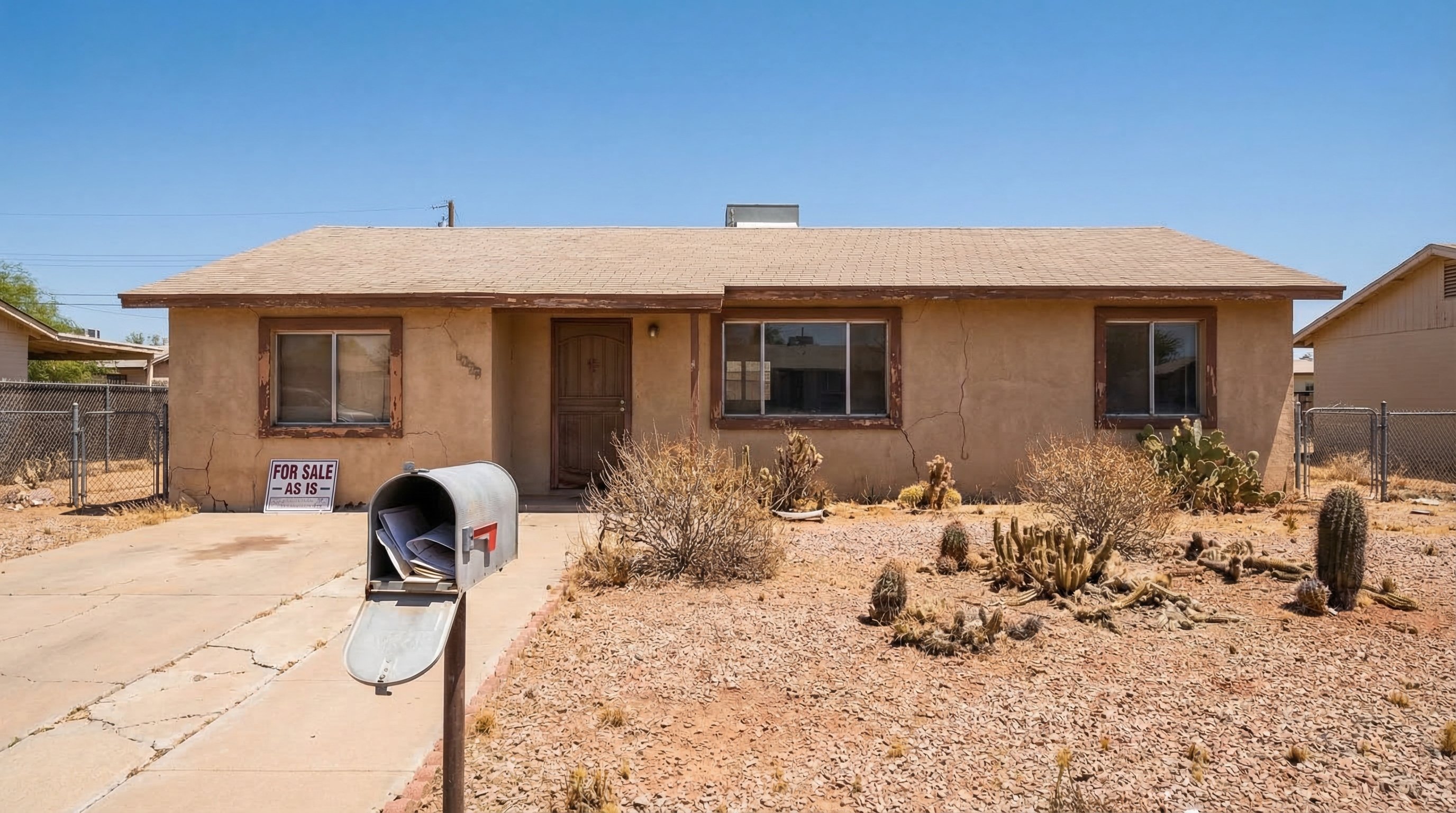
Arizona's extreme heat accelerates vacancy deterioration. When a property sits empty in 115°F summer heat without operational AC, damage compounds fast — cracked stucco, burst pipes, rodent intrusion, pool system failures. What begins as a seasonal vacancy becomes a structural problem, which becomes a motivated seller within 12 to 18 months.
Estate properties from Arizona's aging demographic. Arizona has one of the largest 65-and-over populations in the country. Real property held by estates frequently sits in probate limbo while families debate what to do — and vacant properties in probate are among the cleanest deal structures an investor can find.
The Four Best Sources for Arizona Vacant Property Leads
1. County Assessor Data (The Foundation)
Every Arizona county maintains assessor records that list the owner's mailing address separately from the property address. When those addresses diverge, you have a likely absentee or vacant situation.
Maricopa County — covering Phoenix, Scottsdale, Tempe, Mesa, Glendale, and the surrounding metro — has one of the most advanced assessor portals in the country. Investors can filter by owner mailing address outside Arizona (non-resident ownership), assessed value versus improvement value ratio (low improvement suggests a structure in poor condition or vacant land), and last sale date, which frequently clusters long-untransacted properties in specific submarkets.
Pima County (Tucson) and Yavapai County (Prescott) offer similar data with less sophisticated search interfaces, but the raw records are equally public and equally actionable.
The catch: raw assessor data gives you a property list, not a qualified lead list. An absentee owner in California isn't necessarily motivated to sell their Arizona property. You need to stack additional signals to separate "could sell" from "will sell."
2. Tax Delinquency Records
Arizona is a tax lien state. When property taxes go unpaid, the county sells tax lien certificates to third-party investors rather than taking immediate ownership. The property owner then has three years to pay the outstanding taxes plus interest before the certificate holder can apply for a tax deed and force a sale.
That three-year clock creates the most actionable window in Arizona distress investing. Properties with delinquent taxes and a physically vacant structure are among the highest-conversion leads in the state. The combination signals: the owner is disengaged from the asset (vacant), under financial pressure (can't or won't pay taxes), and facing a time-sensitive situation (the three-year redemption clock).
Maricopa County holds its annual tax lien certificate sale in February. Pima County's is in March. These are public records — investors can cross-reference delinquent parcels against vacancy indicators well before each sale date.
According to the Arizona Department of Revenue's Property Tax Division, statewide property tax delinquencies represent thousands of parcels where the owner has effectively abandoned their financial relationship with the asset — and the timeline is forcing a decision.
3. Code Violation and Nuisance Property Lists
Arizona municipalities maintain active code enforcement databases. Properties flagged for unsecured structures, high weeds or debris accumulation, utility disconnections, or rodent harborage are almost always physically vacant — and the owners are either financially distressed or simply done with the property.
Phoenix publishes code enforcement data through its Neighborhood Services department. Tempe, Mesa, Chandler, and Scottsdale all maintain similar databases. Pulling these in bulk requires public records requests in most cities, but the leads they surface are pre-validated: if a municipality is actively pursuing a property owner for code violations, there's almost certainly a motivated seller somewhere in the equation.
4. Stacked Distress Signals (The Multiplier)

This is where serious Arizona investors separate themselves from the competition.
A single data point — vacant, or absentee, or tax delinquent — tells you one thing. When you stack signals:
- Vacant + tax delinquent + absentee owner = highly motivated, time-pressured seller
- Vacant + probate filing + extended single ownership = estate situation needing quick resolution
- Vacant + code violations + HOA delinquency = owner facing simultaneous stressors from multiple directions
Each additional signal narrows the universe from "might be a deal" to "almost certainly a deal." The challenge is that manually cross-referencing Maricopa County assessor data, county tax delinquency records, and municipal code violation databases takes hours per search — before you've identified a single lead worth pursuing.
Arizona's Best Markets for Vacant Property Leads
Not every Arizona submarket offers the same deal flow or investor dynamics.
Greater Phoenix (Maricopa County) is the highest-volume market by a significant margin. The inner ring — Glendale, Peoria, El Mirage, and Surprise on the west side; Tempe, Mesa, and Gilbert on the east — offers the best ratio of deal volume to competition. Outer exurbs like Queen Creek, Buckeye, and Goodyear have more new construction and fewer distressed legacy properties.
Tucson (Pima County) is consistently underrated by Phoenix-focused investors. A large university population drives high transient and absentee ownership. A significant retired demographic and lower price point make deal math accessible for newer investors. Neighborhoods south and west of downtown have some of Arizona's most interesting vacant property concentrations.
Prescott and Prescott Valley (Yavapai County) are second-home and retirement markets with elevated snowbird absentee ownership. The 45-minute elevation change from Phoenix makes Prescott attractive to part-year residents — and creates a steady pipeline of properties whose owners have aged out of the annual drive or passed away.
Casa Grande and Pinal County have one of the highest distress concentrations in the state — legacy 2008-era inventory that never cleared. Fast-growing exurban fundamentals mean improving exit values for investors who can source the right properties now.
Free Weekly Alerts
See What's Distressed in Your Market
Get free weekly alerts — new distressed properties, motivation scores, and hot neighborhoods in your area. Addresses and contact info available inside DistressIQ.
Free forever · No credit card · Unsubscribe anytime
How to Work Arizona Vacant Property Leads
Finding and Contacting Owners
Arizona's strong public records infrastructure makes owner tracing more straightforward than in most states. County assessor records, recorder filings, and probate court documents are all public and relatively current. Start with assessor records for the owner's mailing address before paying for a skip tracing service.
For absentee owners, first-class direct mail still converts in Arizona — particularly letters that don't look like bulk mail. A personally addressed envelope to a California or Washington address reaches a snowbird owner who gets almost no physical mail and may be genuinely surprised that someone is interested in their Phoenix asset.
Pricing Vacant Arizona Properties Correctly
Arizona's extreme climate creates repair line items that investors in other states don't face:
- HVAC systems — a critical and expensive system in Arizona; vacant homes with failed AC have accelerated interior damage
- Pool equipment (if applicable) — vacant pools are legal and liability nightmares; plaster, pumps, and safety compliance all need assessment
- Foundation inspection — Arizona's expansive clay soil combined with extreme heat causes foundation movement that's more common than buyers expect
- Pest inspection — scorpions, termites, and pack rats are all significantly more prevalent in vacant structures
What motivated sellers need is certainty and speed, not maximum price. An offer with a 10-day close consistently beats a higher offer with 30 days and contingencies.
Title Considerations for Vacant Properties
Arizona uses a Deed of Trust and Trustee Sale process (non-judicial foreclosure), which means title chains can have gaps that don't appear in assessor records. Always run a full title search on vacant properties — especially those that changed hands multiple times between 2008 and 2014.
The Arizona Title Insurance Statutes (A.R.S. § 6-841 et seq.) provide robust protection for insured buyers, but only if the title search catches existing issues first. Vacant properties with long ownership gaps deserve extra scrutiny before any offer.

Key Takeaways
- Arizona's snowbird absentee ownership creates year-round lead flow that doesn't exist in most states
- Tax lien status with a 3-year redemption period creates time-pressure dynamics that motivate sellers before the situation becomes a forced sale
- Maricopa County's assessor portal is among the most investor-accessible county data systems in the country
- Signal stacking — vacancy plus tax delinquency plus code violations — produces the highest-quality leads
- Tucson and Pima County are underrated deal markets for investors focused exclusively on Phoenix
- Always budget for AZ-specific repairs — HVAC, pool, foundation, pest — when pricing vacant property offers
Other platforms give you a spreadsheet. DistressIQ shows you the property — Street View and aerial on every lead, so you know what you're walking into before you waste a drive.
DistressIQ stacks 31 signal types — vacancy, tax delinquency, code violations, probate, and more — across 3,200+ counties nationwide, updated daily from county-verified records. Filter Arizona leads by signal stack severity and see exactly which properties are most likely to convert.
Founding member pricing: 30% off locked for life — fewer than 50 spots remain. Starter $89, Pro $174, Elite $349/mo. Start free at distressiq.ai →
Frequently Asked Questions
Q: What is the redemption period for tax delinquent properties in Arizona?
Three years. When property taxes go unpaid in Arizona, the county sells a tax lien certificate to investors at an annual public auction. The property owner has three years from the certificate sale date to pay the outstanding taxes plus accrued interest. After three years, the certificate holder may apply for a tax deed, which can ultimately force a sale. This three-year window is the prime period for investors to approach owners directly.
Q: How do I find vacant properties in Maricopa County?
Maricopa County's Assessor portal (mcassessor.maricopa.gov) lets you search by owner mailing address differing from property address — a strong vacancy indicator for absentee situations. Cross-reference those results with Maricopa County's tax delinquency records for stacked-signal leads. For bulk filtered lists without manual cross-referencing, platforms like DistressIQ pre-stack these signals across all Maricopa parcels and rank them by distress severity.
Q: Are vacant properties in Arizona worth buying?
Deal quality depends heavily on condition. Arizona's dry climate means exterior surfaces hold up better than in humid climates, but interior systems — especially HVAC — suffer without maintenance in extreme heat. Budget for AC inspection, pool equipment assessment if applicable, foundation evaluation, and pest inspection before finalizing any offer. Vacant properties with genuinely motivated sellers can offer strong upside when acquisition is priced to reflect actual repair scope.
Q: What is the difference between absentee owner and vacant property in Arizona?
Absentee ownership means the owner's mailing address differs from the property address — the classic snowbird situation, or an out-of-state investor. Vacant property means the structure is physically unoccupied. These overlap frequently but aren't identical: a snowbird's home is technically "absentee-owned" nine months a year but seasonally occupied. A truly vacant structure has no occupant at any point. Stacking both conditions with tax delinquency identifies the highest-motivation sellers.
Q: Do Arizona municipalities publish code violation property lists?
Yes. Phoenix, Tempe, Mesa, Scottsdale, Chandler, Glendale, and most major Arizona municipalities maintain code enforcement databases. Properties flagged for unsecured structures, debris accumulation, disconnected utilities, or similar violations are almost always physically vacant and frequently have owners who are financially distressed or disengaged. Contact each city's Neighborhood Services or Code Enforcement department for information on data access or public records requests.
Q: Which Arizona counties have the most vacant property investment opportunities?
Maricopa County (Phoenix metro) has the highest overall volume. Pima County (Tucson) offers strong deal flow with less institutional investor competition. Pinal County (Casa Grande area) has a high distress concentration from 2008-era inventory that still hasn't cleared. Yavapai County (Prescott) and Mohave County (Lake Havasu City) both have elevated absentee vacancy rates driven by the second-home and retirement demographic.
Q: How does DistressIQ find vacant properties in Arizona differently from a spreadsheet service?
DistressIQ cross-references 31 distress signal types — county assessor absentee flags, tax delinquency filings, probate court records, code enforcement indicators, and more — simultaneously across Arizona counties, updated daily from county-verified sources. Instead of manually pulling from multiple county portals, you get a ranked distress score that weights each property by how many signals are active and how severe each signal is. Every Arizona lead includes Street View and aerial imagery built directly into the interface.
Sources: Maricopa County Assessor | Arizona Department of Revenue — Property Tax | Arizona Legislature — A.R.S. Title 42 (Property Tax)
The data behind this article
DistressIQ Monitors These Signals in Real Time
Pre-Foreclosures
NOD + NTS filings
Tax Delinquency
County treasurer records
Code Violations
Municipal inspection filings
Probate Filings
Superior Court records
Every lead is scored 0–100 for seller motivation based on signal type, duration, severity, and stacking. Nationwide coverage — every US county, updated daily.
Ready to find deals in your market?
See Live Distress Signals in Your County
Stop calling dead leads. Every lead in DistressIQ is scored 0–100 for seller motivation, with verified contact info included. Browse the free tier to see what's active in your market right now.
Browse Free Leads — No Credit Card