The Best BatchLeads Alternatives in 2026 (For Investors Who Want Better Data)
The Best BatchLeads Alternatives in 2026 (For Investors Who Want Better Data)
PropStream and BatchLeads now operate under the same parent company. That means an investor searching for a BatchLeads alternative is not choosing between two independent platforms at all. They are looking for something outside the PropStream ecosystem entirely. This guide covers the five options worth considering and what makes each one different from the list-pulling model both BatchLeads and PropStream share.
Something surprising happened in real estate investing software. Two of the most popular list-pulling platforms became siblings. PropStream acquired BatchLeads, consolidating two of the biggest names in property data under one roof. For investors who use either tool, that changes the math on what an "alternative" actually means.
When someone types "BatchLeads alternative" into a search bar, the assumption is that they want to compare independent platforms with different strengths. PropStream comes up in that search, and for good reason. It has 160 million property records, 165-plus search filters, built-in skip tracing on higher tiers, and property research features that most competitors cannot match. But if PropStream and BatchLeads are owned by the same company, recommending one as an alternative to the other is like recommending a different trim level on the same car.
The investors who benefit from this guide are the ones who want something fundamentally different from the list-pulling model itself. Not a different brand of the same approach. A different way to find motivated sellers.

Why the List-Pulling Model Has a Ceiling
BatchLeads does what it promises. Over 150 million property records, hundreds of filters, built-in skip tracing, and a workflow that has generated deals for thousands of wholesalers. Build a list, trace the contacts, run a mail or call campaign. It works.
The ceiling shows up in conversion rates. When every investor in a market pulls the same absentee-owner, high-equity list from the same data aggregator, the motivated sellers on those lists get buried in outreach. Response rates drop. Deal conversion drops. The list that worked in 2021 barely moves the needle in 2026.
The deeper issue is inference versus verification. Filtering for "absentee owner plus 40% equity plus vacant" produces a subset with higher statistical probability of motivation. It does not reveal which of those two hundred properties has an owner who is actively distressed right now, versus one who has been a stable absentee landlord for a decade. That distinction is the difference between a warm lead and a wasted skip trace dollar.
Three forces are pushing investors beyond list-based tools.
Cost accumulation. BatchLeads pricing ranges from roughly $77 to $150 per month depending on tier. The Reia AI add-on costs $19 per month. The AI-powered preview dialer adds another $89 per month. Those extras push the real monthly cost well above the base subscription before a single mail piece goes out.
List saturation. The same databases feed most platforms in this space. When multiple investors work the same filters in the same zip codes, the result is an arms race in mail volume rather than an improvement in targeting.
No built-in motivation scoring. BatchLeads recently added BatchRank AI with limited access on lower tiers. A step in the right direction. But the core product is still built around filter-based list construction, not signal-based lead identification.
Five Platforms Worth Considering
1. DistressIQ: Best for Verified Distress Signals
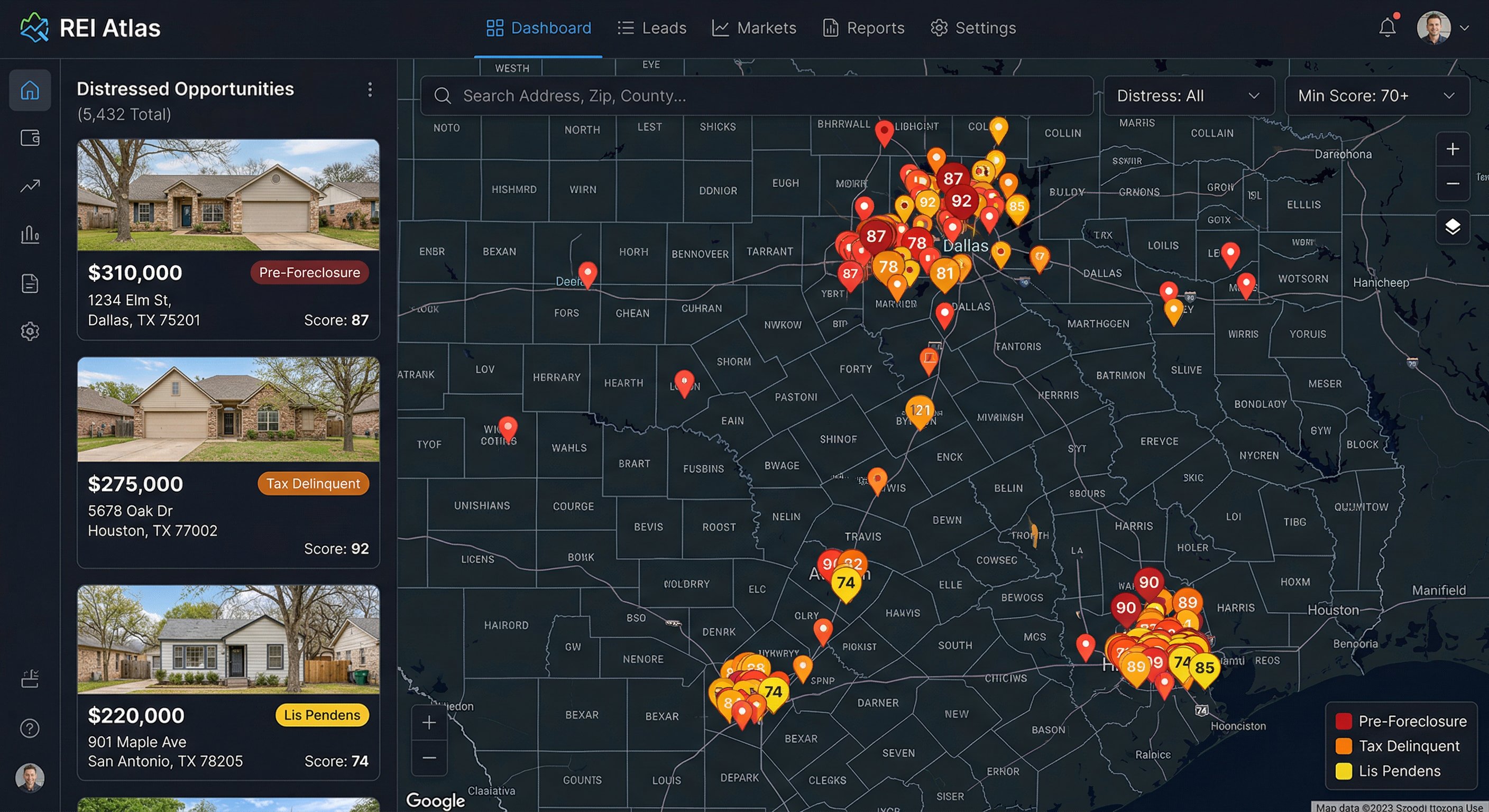
DistressIQ takes the opposite approach. Instead of starting with 150 million records and filtering down, it starts with county public records and shows only properties with at least one verified distress signal. Pre-foreclosure, tax delinquency, lis pendens, probate filing, code violation, mechanic's lien, HOA lien. The data comes directly from county assessors, courts, and recorder offices, not from a third-party aggregator.
Each property receives a motivation score from 0 to 100 based on how many signals are present and how recently they appeared. A property with active pre-foreclosure plus unpaid tax delinquency plus a code violation scores higher than one matching a single equity filter. That score is a call priority list, already built.
Pricing starts at $79 per month for the Starter plan with 2,000 lead detail views. Pro is $149 per month for 5,000 views. Browsing the map and viewing signal data is free. Contact info is purchased only when an investor decides a specific lead is worth calling.
The tradeoff: DistressIQ is not built for investors who mail ten thousand records per month in a spray-and-pray model. It is built for targeted outreach to verified distress, which means smaller lists and higher conversion.
2. PropStream: Best for Property Research Depth
PropStream's product page highlights over 160 million public records, MLS data integration, 165-plus search filters, a rehab calculator, ADU calculator, automated valuation modeling, and AI-powered property condition analysis. It is one of the most feature-rich property research tools available to individual investors.
The nuance: since PropStream and BatchLeads share a parent company, PropStream is not truly an alternative in the way most investors mean when they search for one. It is a sibling product with different strengths. PropStream has better comps, better ownership history, and more research depth. BatchLeads has faster list-building workflows. But the underlying data source and business model are similar enough that switching between them does not solve the core problem of list saturation and unverified motivation.
Pricing starts at $99 per month for Essentials, with Pro and Elite tiers that add skip tracing, team seats, and Lead Automator features.
3. DealMachine: Best for Driving for Dollars
A mobile-first platform built around driving-for-dollars workflows. Point a phone at a house, pull owner data, start an outreach sequence. The driving-based discovery model creates leads that no database can replicate: the house with the overgrown lawn, the faded "for rent" sign, the visible neglect that signals an owner who may be ready to sell.
Best for investors who do significant neighborhood canvassing and want to track and follow up on properties they have physically visited. Limitation: the list-building side is weaker than BatchLeads or PropStream, and the model does not scale the way data-based sourcing does.
4. ListSource and ATTOM Data: Best for High-Volume Mail
Enterprise-grade data platforms used by direct mail companies, hedge funds, and institutional buyers. Deep datasets, clean formatting, reliable delivery at scale. Best for investors running mail operations of ten thousand or more per month who need deliverable lists at volume. Not optimized for the individual investor who wants to identify and call motivated sellers quickly.
5. Propwire: Best Budget Entry Point
A newer platform with free tiers and lower entry prices. Pulls from public record databases with basic filter options. Has attracted investors priced out of premium platforms. Data quality and update frequency are lower than paid options. Works as a starting point while learning the workflow, but serious investors typically outgrow it quickly.
BatchLeads vs. DistressIQ: The Core Tradeoff
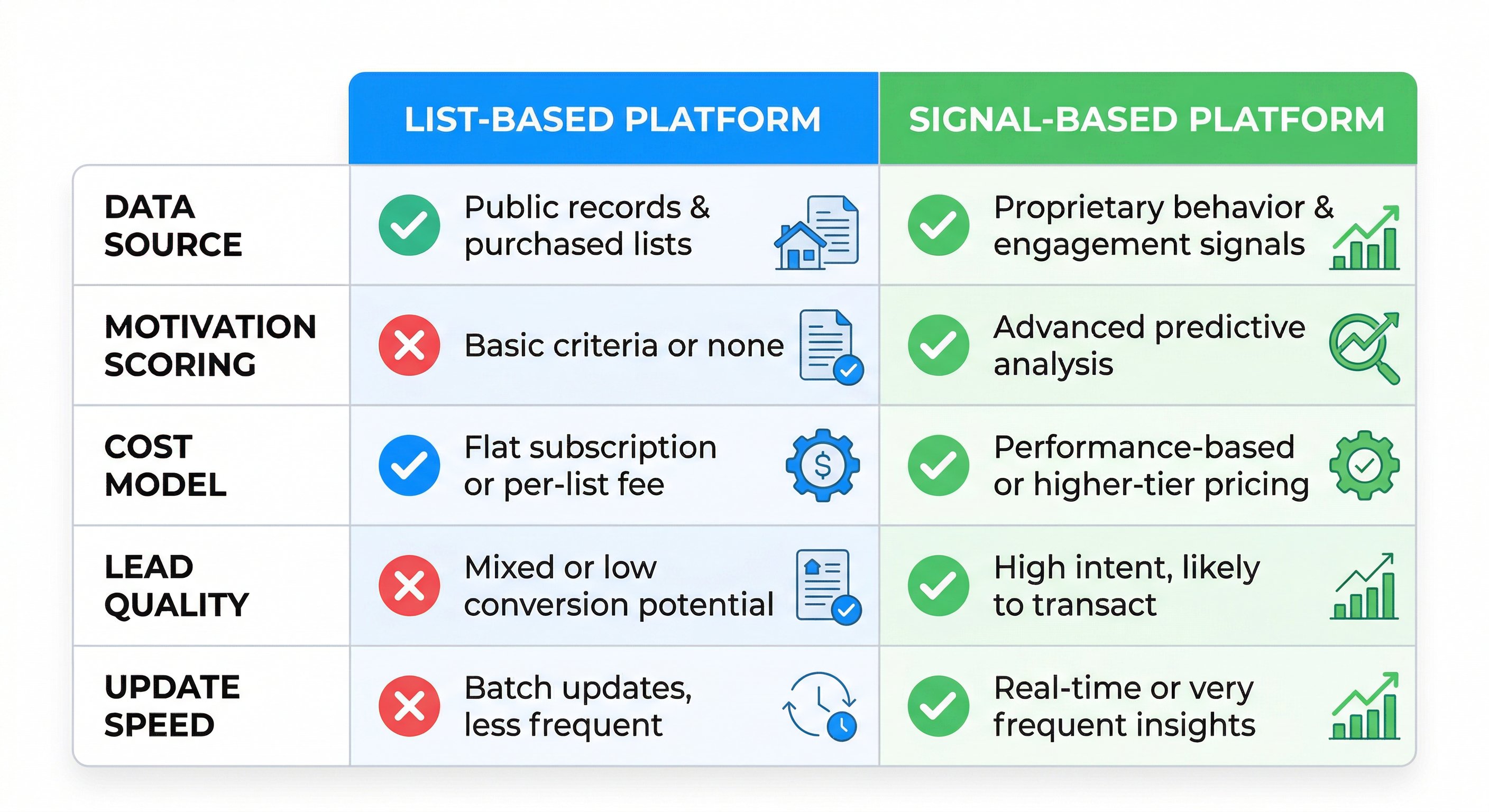
| Feature | BatchLeads | DistressIQ |
|---|---|---|
| Database size | 150M+ properties | Distressed only, all with verified signals |
| Data source | Aggregated third-party | County-direct (assessors, courts, recorders) |
| Motivation scoring | BatchRank AI (limited on lower tiers) | 0-100 multi-signal score, built in |
| Skip tracing | Included in lead quotas | On-demand, pay per contact |
| Browse before paying | No | Yes, unlimited free map view |
| Update frequency | Varies by source | Daily |
| Starting price | ~$77-$150/mo plus add-ons | $79/mo (Starter) |
BatchLeads optimizes for how many leads an investor can pull. DistressIQ optimizes for which leads to call first. Neither is universally right. But for investors who have looked at a 500-record export and thought "where to even start," DistressIQ answers that question.
Free Weekly Alerts
See What's Distressed in Your Market
Get free weekly alerts — new distressed properties, motivation scores, and hot neighborhoods in your area. Addresses and contact info available inside DistressIQ.
Free forever · No credit card · Unsubscribe anytime
The Real Cost Per Deal
Most investors do not run this math until they have lost enough money to get curious.
Take a 500-record list from any list-based platform. Skip tracing: $0.10 to $0.15 per record, so $50 to $75. Mail at roughly $0.50 per piece: another $250 to $350. Response rate on a standard absentee-owner high-equity list: 2 to 3 percent. Ten to fifteen responses from 500 contacts. Of those, maybe 3 to 5 justify follow-up. One deal closes if outreach is good and timing is right.
Now run it differently. Start with 150 properties where every lead has a verified distress signal and a motivation score above 70. Skip trace the top 50, already sorted by signal strength. Response rates on scored distress lists run materially higher because calls reach people in active distressed situations, not people who statistically resemble someone who might be.
Same deal outcome. Fewer contacts burned. Lower skip trace cost. Less outreach time. The platform subscription price is the least important number in this equation.
Who Should Switch
Switch if skip trace costs are burning through budgets on contacts that never respond. Switch if response rates on standard lists have dropped below 2 percent. Switch if the same filters produce the same lists as every other wholesaler in the market. Switch if the inability to tell which properties are actually motivated right now is the bottleneck.
Stay with BatchLeads if the business model genuinely requires high-volume mail at 10,000-plus pieces per month. Stay if the workflow depends on specific integrations, CRM connections, or team features already in place. Stay if maximum filter flexibility across the full property universe matters more than targeting a narrower set of verified distress signals.
Some investors use both. BatchLeads for volume campaigns, DistressIQ for the priority call list. Different tools for different stages of the funnel.

What to Evaluate in Any Alternative
Data provenance. Aggregated data from third-party providers is cheaper to maintain but slower to update and further from the source. County-direct data means new filings and status changes appear faster. A tax delinquency filed last week is a very different signal from one filed fourteen months ago.
Scoring versus filtering. Filtering reduces a universe. Scoring ranks what remains. If two properties match the same filters, how does an investor know which to call first? Scoring answers that. Filtering does not.
When you pay. On most platforms, skip trace costs hit before there is any way to know whether a lead is warm or cold. On DistressIQ, distress signals are visible during free browsing. Contact info is purchased only after an investor has decided a lead is worth calling.
Update speed. Public records change daily. Pre-foreclosure filings, tax delinquency updates, new lis pendens entries, code violation citations. If a platform refreshes weekly or monthly, signals may have already resolved or worsened by the time they appear on a list.
Full-stack cost. Platform subscription, skip tracing, mail, dialer time, staff hours. Calculate the entire cost per deal, not just the monthly fee.
For investors ready to see what signal-based lead identification looks like in practice, DistressIQ offers free browsing across all covered counties. No credit card required. Pull up a market, check the signals, evaluate the quality before spending anything.
Browse free on DistressIQ at distressiq.ai
Frequently Asked Questions
Is BatchLeads the same company as PropStream?
BatchLeads and PropStream now share the same parent company, which changes how investors should think about comparing them. They are sibling products with different interface strengths. BatchLeads has faster list-building workflows, while PropStream offers deeper property research features like comps, ownership history, and a rehab calculator. Both are built on the same fundamental model of filtering large property databases. An investor looking for a genuine alternative needs to look outside this ecosystem entirely, toward platforms built on a different data methodology.
What is the best alternative to BatchLeads for finding motivated sellers?
The best alternative depends on what is missing from the current workflow. For investors who want pre-verified distress signals instead of filter-based lists, DistressIQ is the strongest option because every property has at least one verified signal sourced from county records and a motivation score that ranks call priority. For investors focused on driving for dollars, DealMachine fits better. For investors running massive mail volume, ListSource or ATTOM Data provide scale. The key question is whether the investor wants more of the same approach or a fundamentally different one.
How much does BatchLeads cost in 2026?
BatchLeads pricing in 2026 starts at approximately $77 to $150 per month for the core subscription, depending on the tier selected. Additional costs include Reia AI at $19 per month, the AI-powered preview dialer at $89 per month, and overage charges of $0.04 per record for imports exceeding the monthly quota. Lead quotas range from 10,000 to 75,000 per month across tiers. Investors should factor in the full cost of the platform plus skip tracing, mail, and outreach when evaluating return on investment.
Can you browse leads on DistressIQ without paying?
Yes. DistressIQ offers unlimited free browsing across all covered counties. Investors can see every distressed property on the map, view the type and date of each distress signal, and check the motivation score without entering a credit card. Payment is required only when an investor wants to view the owner's contact information for a specific property. This pay-per-contact model means lead quality in a target market can be evaluated before committing any budget.
What distress signals does DistressIQ track that BatchLeads does not?
DistressIQ tracks 12 or more signal types sourced directly from county public records: pre-foreclosure filings, tax delinquency, lis pendens, probate filings, code violations, mechanic's liens, HOA liens, and others depending on county data availability. Every signal is verified against the source record, not inferred from a statistical filter. BatchLeads can filter for properties that may be in foreclosure or may be tax delinquent based on aggregated data fields, but it does not attach verified court filings or assessor records to each property as discrete, date-stamped signals. The result is a list of statistically likely candidates rather than a set of properties with confirmed, active distress events attached to specific filing dates.
Should an investor use both BatchLeads and DistressIQ?
Some investors do exactly that. BatchLeads works well for high-volume mail campaigns where raw record counts matter and the outreach strategy depends on casting a wide net. DistressIQ works better for targeted calling where call priority and verified motivation determine who gets contacted first. Using both lets an investor run a volume campaign through BatchLeads while maintaining a separate, pre-ranked call list through DistressIQ. For investors with the budget for two subscriptions, the combination covers both ends of the outreach funnel.
Sources: BatchLeads pricing and feature data from batchleads.io/pricing; PropStream pricing and feature data from propstream.com/pricing; PropStream product navigation observed listing BatchDialer as integrated product line, April 2026.
The data behind this article
DistressIQ Monitors These Signals in Real Time
Pre-Foreclosures
NOD + NTS filings
Tax Delinquency
County treasurer records
Code Violations
Municipal inspection filings
Probate Filings
Superior Court records
Every lead is scored 0–100 for seller motivation based on signal type, duration, severity, and stacking. Nationwide coverage — every US county, updated daily.
Ready to find deals in your market?
See Live Distress Signals in Your County
Stop calling dead leads. Every lead in DistressIQ is scored 0–100 for seller motivation, with verified contact info included. Browse the free tier to see what's active in your market right now.
Browse Free Leads — No Credit Card