Tax Delinquent Properties for Sale: How Investors Find and Buy Them in 2026
Tax Delinquent Properties for Sale: How Investors Find and Buy Them in 2026
TL;DR: Properties with two or more years of unpaid taxes represent one of the most dependable distress signals in real estate. The county will eventually auction the lien or deed, creating two investor opportunities: bidding at the tax sale itself, or approaching the delinquent owner beforehand to negotiate an off-market purchase. Understanding the mechanics of tax lien states versus tax deed states is what separates consistent deal closers from the rest.
Every county in America maintains a list of properties where the owner stopped paying taxes. Not a short list. In Cook County, Illinois, the annual tax sale catalog runs to tens of thousands of entries. Yet most real estate investors never look at it.
Tax delinquency is one of the few distress signals backed by a hard legal deadline. The county does not negotiate. It does not extend payment plans indefinitely. After enough time passes, the government auctions the debt or the deed. That ticking clock is what makes tax delinquent properties for sale such a productive lead source.
Two Separate Opportunities, Not One
Most articles treat tax delinquency as a single strategy. It is not. There are two entirely different plays, and they attract different types of investors.
The first: buying at the county tax sale. When an owner falls far enough behind, the county holds a public auction. Depending on the state, it sells a lien certificate or the actual deed.
The second: approaching the owner before the sale. This is the off-market play. The investor contacts the delinquent owner directly and offers to buy at a discount. The owner avoids auction and walks away with equity; the investor acquires below market value.
Both work. The first attracts passive capital. The second attracts active wholesalers and flippers.
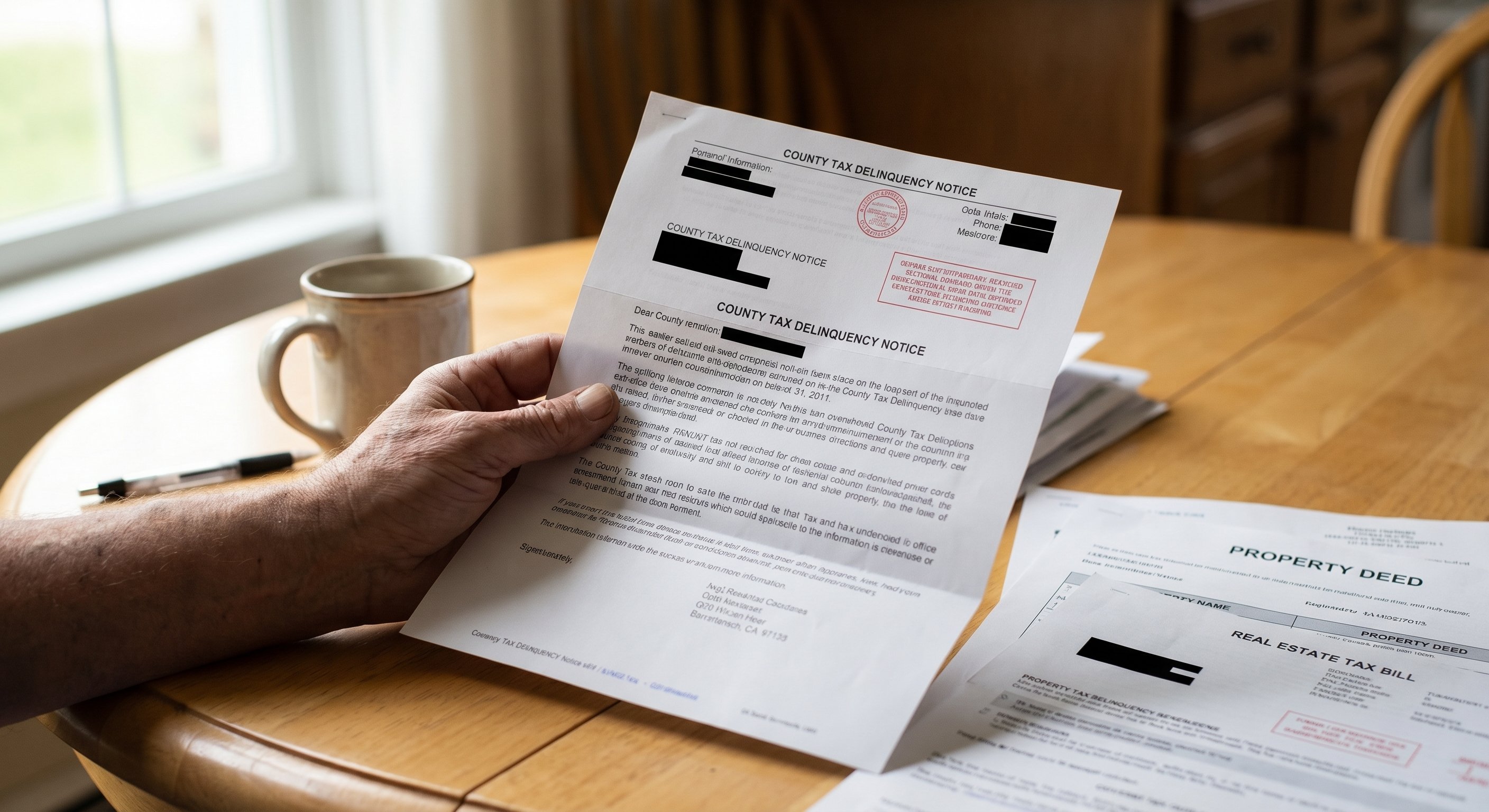
Tax Lien States vs. Tax Deed States
The legal structure of the tax sale depends entirely on the state.
Tax lien states (approximately 30 states, including Florida, Illinois, New Jersey, Colorado, and Arizona): The county sells a lien certificate at auction. The investor pays the owner's back taxes to the county and earns interest on that amount, often between 16% and 24% annually. The owner has a redemption period, typically one to three years, to repay the investor with interest. If the owner does not pay, the investor can initiate foreclosure to take ownership.
This appeals to investors seeking predictable returns secured by real estate. Risk exists: the property could be worthless or encumbered by senior liens. But for prepared investors, tax liens can produce double-digit returns with property as collateral.
Tax deed states (approximately 20 states, including Texas, California, Georgia, and Michigan): The county auctions the actual deed. The winning bidder becomes the new owner at a fraction of market value, subject to any remaining title issues. Properties are often sight-unseen, and quiet title actions are a routine post-sale step.
Hybrid states allow both mechanisms depending on the county or delinquency type. Investors operating across state lines must verify rules for each jurisdiction.

Where Delinquent Lists Come From
Every tax delinquent property list originates from county government. The county treasurer, tax collector, or auditor publishes properties with unpaid taxes. Most counties release their delinquent tax roll 30 to 90 days before the scheduled auction. Some maintain year-round databases on the county website. A few still publish only in local newspapers, as required by state statute.
The format is wildly inconsistent. One county exports a clean CSV with parcel numbers, owner names, and delinquent amounts. The next posts a scanned PDF of a printed ledger. A third requires a formal records request taking two weeks to process. The data is all public record, but assembling it into something usable is manual and slow.
Free Weekly Alerts
See What's Distressed in Your Market
Get free weekly alerts — new distressed properties, motivation scores, and hot neighborhoods in your area. Addresses and contact info available inside DistressIQ.
Free forever · No credit card · Unsubscribe anytime
The Off-Market Advantage
The most profitable deals rarely happen at auction. They happen months earlier, over a phone call with the owner.
An owner six to twelve months from a tax sale still has options. When an investor reaches out during this window, the conversation feels like help rather than a last resort. The owner has time to negotiate and walk away with equity.
The sweet spot is 18 to 36 months of delinquency. Multiple county notices have arrived. Penalties have compounded. The total owed feels insurmountable. But the auction is still months away, leaving time to close without pressure.
Why Owners Stop Paying Taxes
Understanding why owners fall behind makes outreach more effective. Four causes dominate.
Inherited property. Someone dies, and heirs receive a house they never asked for. The estate may be tangled in probate. The heirs may live out of state and have zero interest in managing a distant property. They may not even realize taxes are due until the delinquency notice arrives. These owners often want the problem gone, not managed.
Elderly owners on fixed income. Property taxes rise over time. Social Security does not keep pace. A homeowner who could afford the taxes ten years ago may now face bills that consume an unsustainable share of monthly income.
Absentee landlords. An investor bought a rental years ago, stopped maintaining it, lost the tenant, and gradually lost track of the tax bills. The property sits vacant, generates no income, and accumulates debt. These owners often recognize the liability and are open to selling.
Financial distress from job loss or medical debt. Medical bills, divorce, business failure, extended unemployment. The tax delinquency is a symptom of broader financial collapse, meaning the owner may be highly motivated to liquidate.

Signal Stacking: When Delinquency Meets Other Distress Indicators
Tax delinquency alone is a strong signal. Combined with other indicators, it becomes almost predictive.
The most powerful combination: tax delinquency paired with an absentee owner. If the owner does not live there and has not been paying taxes, two things are true simultaneously: no emotional attachment to the house, and financial disconnection from it. Outreach to these owners converts at rates two to three times higher than outreach to resident owners with the same delinquency profile.
Other high-value combinations include delinquency plus code violations (the owner cannot afford taxes or maintenance), delinquency plus pre-foreclosure (both county and lender are pursuing), and delinquency plus a lis pendens filing (active litigation involving the property).
Each additional signal narrows the field and raises the probability of a positive response. The challenge is that these signals live in different county systems with different formats and update schedules. Cross-referencing them manually across even five counties is a multi-day project.

The Practical Playbook
Identify the source. Determine which county office publishes the delinquent roll and in what format.
Pull and clean the data. Standardize parcel numbers, owner names, and addresses. This alone can take hours per county if data arrives as a scanned PDF.
Cross-reference with other signals. Check each property against code violations, pre-foreclosure filings, and absentee owner databases. The overlap is where the best leads live.
Prioritize by motivation. Rank by delinquency duration, total owed, stacked signals, and absentee status.
Skip trace and outreach. Phone calls outperform direct mail for these leads because the urgency is immediate.
Lead with the situation, not the pitch. Reach out to owners dealing with tax situations and ask whether selling might be worth exploring. Honest and direct.
Know the numbers. Understand what the owner owes, the property's market value, and the auction timeline before making an offer.
FAQ
Q: How do tax lien auctions actually work?
Tax lien auctions are conducted by the county, usually once per year. The county publishes a list of delinquent properties, and investors bid on the right to pay the outstanding taxes. In some states, investors bid down the interest rate they will accept. In others, they bid a premium above the tax amount. The winning bidder receives a lien certificate and begins earning interest immediately. If the owner redeems the lien by paying back with interest within the redemption period, the investor exits with a return. If not, the investor can pursue foreclosure. Due diligence before bidding is critical because the lien is only as good as the property securing it.
Q: Can an investor really buy a property for just the back taxes?
In tax deed states, the winning bid at auction can be as low as the delinquent tax amount plus fees and court costs. However, competitive auctions often drive prices well above the minimum, especially for desirable locations. The new owner may also need a quiet title action, adding legal costs and months to the timeline. The "pennies on the dollar" narrative is real but not universal. Properties at genuine bargain prices tend to be the ones nobody else wants due to condition, location, or title complications.
Q: What happens to the owner's mortgage when a tax deed is sold?
Property tax liens almost always have priority over mortgages. The tax sale can wipe out the lender's interest. In practice, mortgage lenders monitor delinquency closely and often pay the back taxes themselves to protect their collateral, then add the amount to the borrower's balance. If the lender does not intervene and the property sells at a tax deed auction, the mortgage is typically extinguished. The former owner may still owe the debt personally, but the lien on the property is gone. This is one reason tax deed properties can be attractive acquisitions.
Q: How long does the redemption period last?
Redemption periods vary by state, ranging from a few months to three years. Florida allows up to two years for certain lien certificates. Illinois grants approximately two to three years depending on the sale type. Texas, a tax deed state, generally offers a six-month redemption period. During this window, the owner can repay the full amount owed, including interest and penalties, and reclaim clear title. Investors buying tax liens must factor the redemption period into return calculations because capital is tied up until the owner redeems or the period expires.
Q: Is it ethical to contact owners behind on taxes?
Yes, when done with honesty and respect. The owner faces a legal process that will result in property loss if unresolved. An investor offering a fair purchase price provides an alternative to auction, where the owner would receive nothing. The key is offering a genuine solution rather than exploiting desperation. Transparent communication about property value, amount owed, and auction timeline is the standard for ethical outreach. Many owners are grateful for the information and the option, even if they ultimately choose not to sell.
Q: Do all counties publish tax delinquent lists online?
No. Most mid-size and large counties maintain online tax records, but many smaller and rural counties require in-person visits, written requests, or subscriptions to third-party data providers. Some publish only in local newspapers. This patchwork of access methods is why aggregating data at scale is difficult, and why investors who pull from multiple counties gain a meaningful advantage.
For investors looking to identify and prioritize tax delinquent properties across multiple counties without manually assembling lists from dozens of government websites, DistressIQ aggregates tax delinquency data alongside other distress signals and scores every property by motivation level. Browse leads for free, unlock contact info only for the properties worth pursuing.
Sources
- National Tax Lien Association, "State-by-State Tax Sale Guide," 2025 edition
- National Association of Counties, "Property Tax Administration Survey," 2025
- Cook County Treasurer's Office, Annual Tax Sale Records, 2025
The data behind this article
DistressIQ Monitors These Signals in Real Time
Pre-Foreclosures
NOD + NTS filings
Tax Delinquency
County treasurer records
Code Violations
Municipal inspection filings
Probate Filings
Superior Court records
Every lead is scored 0–100 for seller motivation based on signal type, duration, severity, and stacking. Nationwide coverage — every US county, updated daily.
Ready to find deals in your market?
See Live Distress Signals in Your County
Stop calling dead leads. Every lead in DistressIQ is scored 0–100 for seller motivation, with verified contact info included. Browse the free tier to see what's active in your market right now.
Browse Free Leads — No Credit Card