The Real Estate Data Provider Investors Should Actually Be Using in 2026
The Real Estate Data Provider Investors Should Actually Be Using in 2026
TL;DR: Most real estate data providers are reselling the same third-party data that's already been mailed by 50 other investors. The difference that actually moves the needle is the source of the data—county records vs. data aggregators—and how fresh it is. County-direct data providers like DistressIQ pull verified distress signals (pre-foreclosure, tax delinquent, probate, code violations) straight from county sources and score them by motivation level, so you know which 200 leads out of thousands are actually worth calling. Everything else is mostly noise.
The hardest question in real estate investing isn't "where do I find deals?" It's "why are my leads going nowhere?"
You pull a list of 3,000 tax delinquent properties. You mail 500. You get 4 callbacks—two of them wrong numbers. You wonder if the strategy works at all.
The strategy works. Your data doesn't.
This is the problem most investors discover about 90 days too late: the real estate data provider you're using determines 80% of your results, but almost nobody evaluates providers beyond price and record count.
Here's how to actually think about this.
What "Real Estate Data Provider" Actually Means
The label gets applied to a wide range of products doing very different things. Before you can evaluate any provider, you need to understand what kind of data they're selling.
There are essentially three categories:
1. Data Aggregators (the big platforms)
PropStream, BatchLeads, ATTOM Data, CoreLogic—these companies aggregate property records from hundreds of county sources, clean them, and sell access to the full database. You get 150-160 million property records, filtering tools, and skip tracing bundled in.
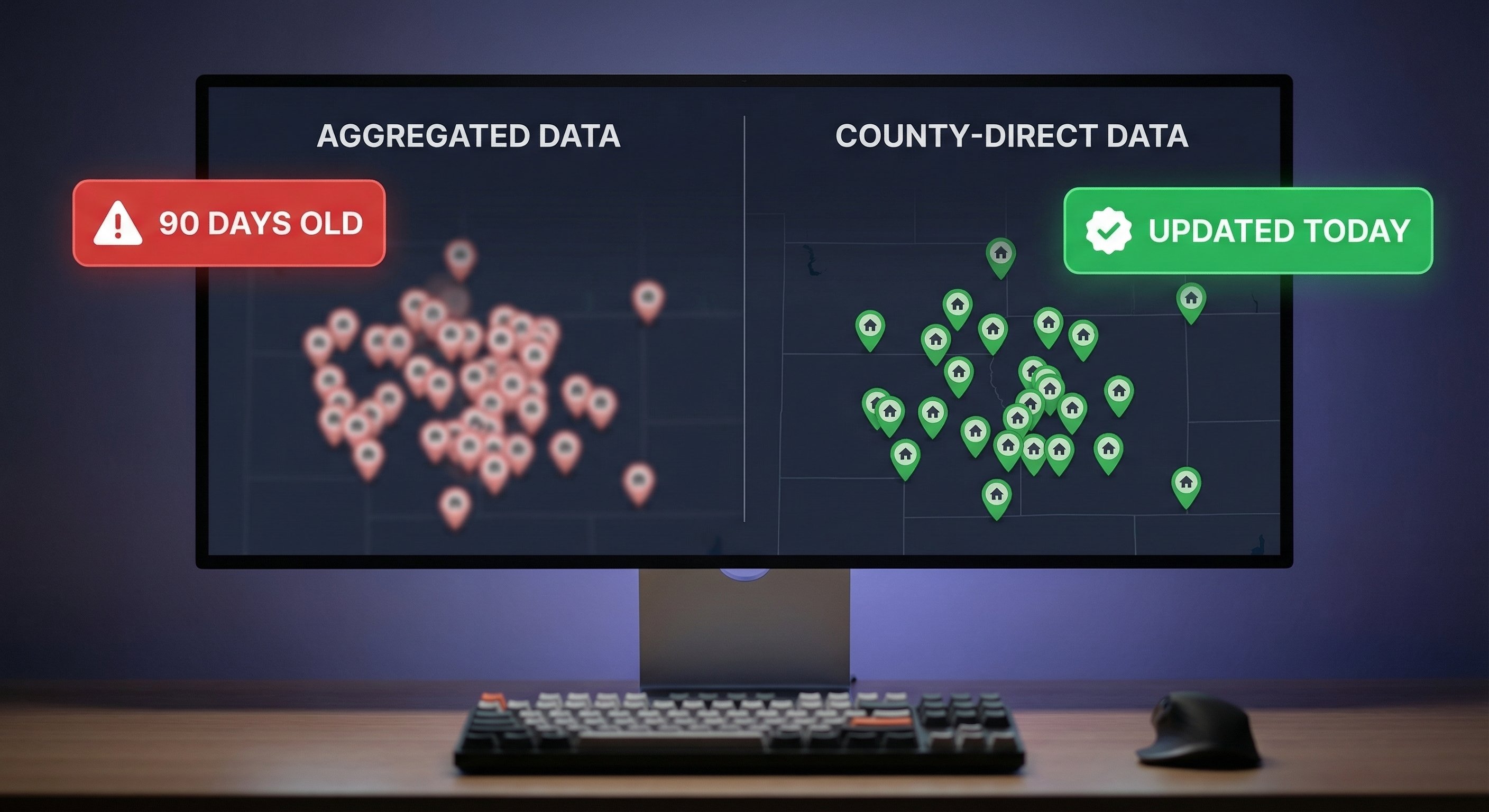
The problem: By the time data has been aggregated, cleaned, normalized, and packaged into a subscription platform, it's often 3-6 months old. And because every wholesaler in your market has the same subscription, you're mailing the same list as everyone else.
Community observation from real estate investor forums: "Anything on PropStream is going to be 6-12 months behind and hammered by every wholesaler under the sun."
2. List Brokers
Companies that sell targeted mailing lists—absentee owners, pre-foreclosures, high equity properties. You buy the list, skip trace it, and mail it. The data quality varies wildly.
The problem: List brokers buy their data from the same aggregators, then resell at markup. You're three steps removed from the source, with all the data degradation that implies.
3. County-Direct Providers
This is the category most investors don't know exists. Instead of aggregating from a central data warehouse, county-direct providers pull from individual county sources—assessor databases, court filings, recorder documents, tax rolls—and update daily.
The advantage: The data is as fresh as the source. When a lis pendens is filed Tuesday morning, you can be calling Wednesday. When a property enters the tax delinquent rolls, you know before any aggregator has picked it up.
Why the Source of Data Matters More Than the Volume
A platform with 160 million records sounds impressive. But if you're an investor looking for motivated sellers, you don't need 160 million records—you need 2,000 verified distressed properties in your target market, scored by how motivated the owner actually is.
Volume without signal quality is noise.
What you actually need from a real estate data provider:
- Signal verification — Is this property actually in distress, or is "tax delinquent" based on 12-month-old data that may have already been resolved?
- Signal freshness — When was this record last updated from the actual county source?
- Signal depth — Is this one data point (tax delinquent) or a stacked picture (tax delinquent + code violation + absentee owner + 18 months without sale)?
- Assessor-verified property data — When you're calculating ARV, are you working from MLS data (which can be fabricated by whoever listed it) or county assessor records (which are the legal basis for property taxes)?
That last point deserves its own moment.
Why MLS Data Is Often Wrong—and County Assessor Data Isn't
Real estate investors lose money on bad ARV calculations constantly. The most common cause: MLS square footage doesn't match the actual property.
MLS data is entered by whoever lists the property. Agents have been known to round up, include unfinished spaces, or simply transcribe the wrong number. There's no external verification mechanism.
County assessor data is different. The assessor determines property characteristics for the purpose of calculating property taxes—and property owners pay penalties if those numbers are wrong. Assessor square footage is the legally verified figure. So when DistressIQ says a property is 1,840 square feet, that's coming from the same record your county government uses to set the tax bill, not from what an agent typed into the MLS 8 years ago.
MLS says 2,400 sqft. County assessor says 1,890. Which number do you trust when calculating your maximum allowable offer?
The Motivated Seller Problem No One Talks About
Most investors treat "motivated seller" as a static property attribute—as if motivation is something a property either has or doesn't have.
It's not. Motivation is dynamic. It changes week to week.
A homeowner who's two months behind on property taxes and has a code violation notice might not be ready to sell. Add a lis pendens filing six weeks later, and now you have a real motivated seller—someone staring down the courthouse steps with no runway left.
The difference between these two situations isn't just one more signal. It's a completely different conversion probability.
This is where stacking distress signals matters, and it's where most real estate data providers fail entirely. They tell you what signals a property has, but they don't tell you how much it matters. A pre-foreclosure filing in a state with a 6-month timeline is very different from the same filing in a state with a 90-day timeline.
Sorting by signal count isn't enough. You need scoring.

Free Weekly Alerts
See What's Distressed in Your Market
Get free weekly alerts — new distressed properties, motivation scores, and hot neighborhoods in your area. Addresses and contact info available inside DistressIQ.
Free forever · No credit card · Unsubscribe anytime
How to Evaluate Any Real Estate Data Provider
Before you sign up for any platform, run through this checklist:
1. Where does the data actually come from?
Ask directly: "Is your data pulled from individual county sources, or are you licensing from a data aggregator?"
If the answer is "aggregated from multiple sources" or they mention ATTOM, CoreLogic, or Black Knight—they're a reseller. The data will be older and identical to what your competitors have.
2. How often is it updated?
"Daily" should mean daily from the actual county source. Weekly or monthly updates are almost useless for pre-foreclosure and lis pendens data, where timing is everything.
3. Can you see the distress signals—not just ownership info?
Property ownership data is a commodity. What separates valuable real estate data providers from generic property databases is verified distress signal data: lis pendens filings, tax delinquency status, code violation notices, probate proceedings, pre-foreclosure filings.
If a platform shows you 160 million properties and asks you to guess who's motivated, it's not doing the work.
4. Is there a scoring or prioritization system?
Raw lists require you to prioritize manually. Good platforms score leads by motivation level—stacking signal types, recency, and severity into a single rank so the hottest leads surface automatically.
5. What does the property data pull from?
For investment decisions, you need assessor-verified property characteristics—square footage, year built, assessed value, lot size, property type—from county tax assessor records, not MLS listings.
The Case Against Paying for Volume You Don't Need
PropStream's pitch is essentially: "160 million properties, every filter you could want." That's genuinely useful if you're running a brokerage or doing broad market analysis.
But most real estate investors aren't doing market analysis. They're building a call list for this week.
For that use case, paying for access to 160 million properties is like paying for a phone book when you just need the 200 numbers you're actually going to dial.
The investors who get the best returns from data aren't the ones with the most records. They're the ones with the most accurate records and the best system for prioritizing which ones to contact first.
That shift—from volume to signal quality—is the mindset change that separates the wholesalers who close 3 deals a month from the ones who close 30.

What DistressIQ Does Differently
DistressIQ is built specifically for real estate investors who want verified motivated seller data—not a general property database.
How it works:
- Every property on DistressIQ has at least one verified distress signal sourced from county records: tax delinquency, pre-foreclosure filing, lis pendens, probate proceeding, code violation, or 20+ other signal types
- Property characteristics (square footage, year built, assessed value, lot size) are verified against county tax assessor records where available—not MLS
- Distress signals are updated daily from county sources
- Every lead is scored 0-100 based on signal stacking—how many signals, how recent, how severe
- The map and list views are free to browse—you only pay when you want contact details, export, or skip trace
That last point is important. Most real estate data providers charge you a flat subscription fee whether you use it or not. DistressIQ's free browsing tier lets you evaluate the quality of leads in your market before you commit a dollar.
PropStream charges you to see whether the data is any good. DistressIQ shows you first.
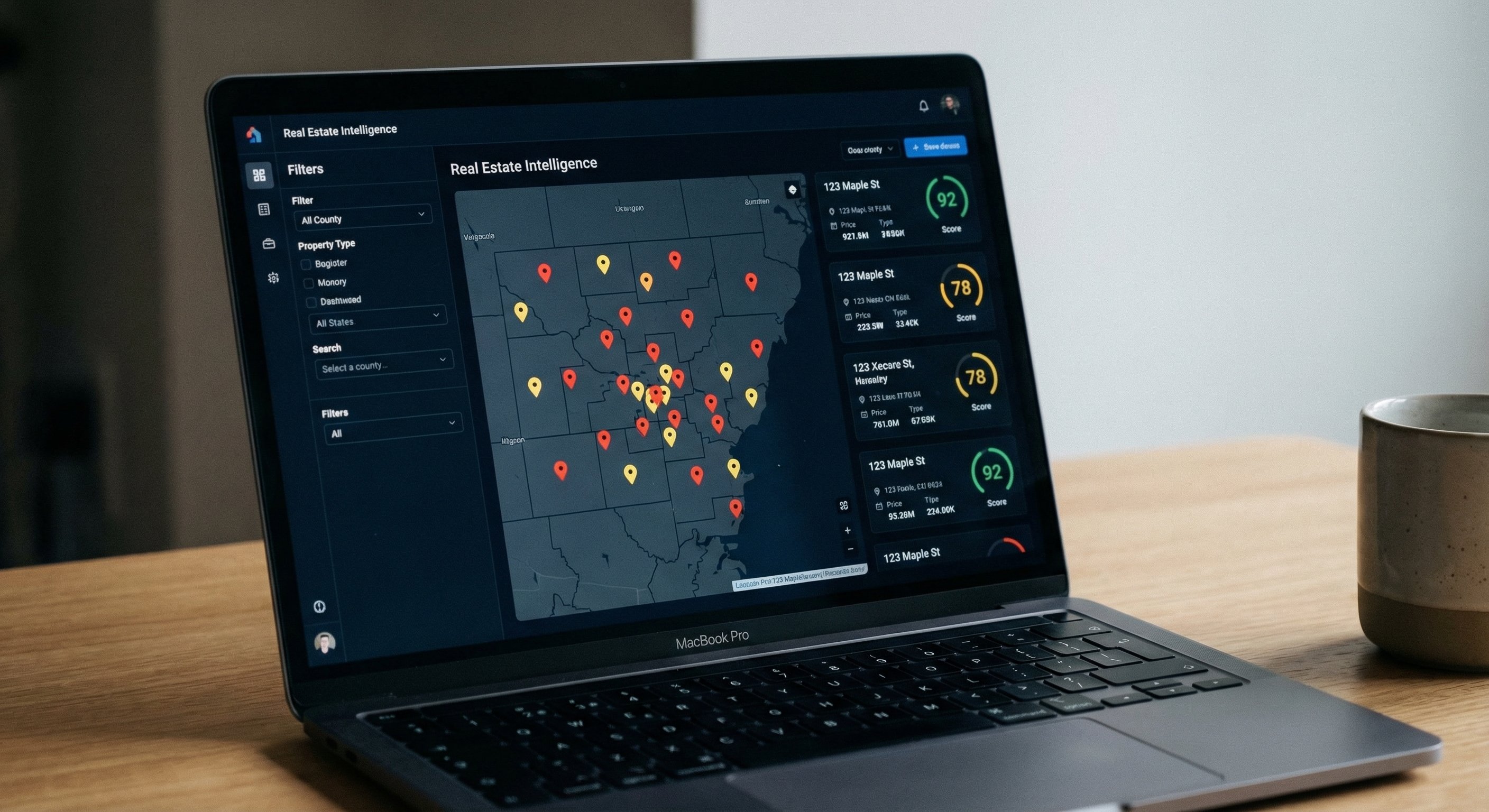
The motivation score is the practical differentiator. When you open DistressIQ in a county, you're not looking at a flat list of distressed properties—you're looking at a ranked list, hottest leads at the top. The 92-score property with four stacked signals and a recent lis pendens filing gets your call before the 41-score tax delinquent from 2024 that may have already been resolved.
You don't need to build that logic manually. It's baked in.
Pricing:
- Starter: $129/month (2,000 lead detail views, 1 seat)
- Pro: $249/month (5,000 views, 3 team seats, daily alerts)
- Elite: $499/month (10,000 views, 10 seats, real-time alerts, API access)
- Annual pricing cuts 20% off all plans
- Founding member pricing still available: 30% off locked for life (limited spots remaining)
Browse verified distressed properties in your market — free on DistressIQ
How This Plays Out in Practice
Say you're a wholesaler in a market like Columbus, Ohio. You're targeting pre-foreclosures.
With a data aggregator: You get a list of 2,400 pre-foreclosure properties in Franklin County. That list is 6 months old, built from a data aggregation run last fall. Three other wholesalers in Columbus have the same list. You start mailing. Your conversion rate reflects the competition and the data lag.
With county-direct data: You see 340 active pre-foreclosure properties with verified, current filing dates. The list is sorted by motivation score—stacked signals first. The top 50 leads include properties with both a lis pendens and a code violation notice filed within the last 30 days. You call those 50 first. Your conversion rate reflects the accuracy and freshness of the data.
Same market. Very different results.
That gap isn't theoretical. It's the practical outcome of sourcing from county records directly versus buying from a data warehouse that aggregated them months ago.
The Bottom Line on Real Estate Data Providers
Your data strategy is your deal strategy. They're the same thing.
If you're using a data aggregator with 6-month-old records and no signal scoring, you're competing on hustle—making the same calls as every other investor in your market, in the same order, on the same timeline.
If you're using county-direct data with verified distress signals and motivation scoring, you're competing on intelligence—calling the properties that matter most, at the moment they matter most, before most of your competition has the data.
The second position wins more deals. It's not close.
If you want to see what county-direct motivated seller data looks like in your target market, DistressIQ's full map view is free. No credit card required to browse. See the distress signals, the motivation scores, and the property details before you commit.
See distressed properties in your market, scored by motivation — browse free on DistressIQ
Frequently Asked Questions
What is a real estate data provider?
A real estate data provider is a company that gives investors access to property data, ownership records, and distress signal data. They range from large aggregators (PropStream, BatchLeads, ATTOM) that license data from multiple sources, to county-direct providers like DistressIQ that pull data fresh from individual county records. The key differences are data freshness, signal verification, and how leads are prioritized.
How is county-direct data different from data aggregators?
County-direct data is sourced from the actual county recording and assessor systems—court filings, tax rolls, deed records—and updated daily. Data aggregators license bulk data from companies like ATTOM or CoreLogic that have already collected and consolidated county data, often with a 3-6 month lag. The practical difference: county-direct data tells you about a lis pendens filed this week; an aggregator's database may not reflect it until next quarter.
Why does data freshness matter so much for real estate investing?
For motivated seller situations—pre-foreclosure, tax delinquency, lis pendens—timing is everything. A homeowner in pre-foreclosure who has 90 days until auction requires a completely different approach (and urgency) than one who just filed last week. Stale data means you're calling people whose situation may have already changed, or missing the window when they're most likely to accept an offer.
What does DistressIQ include in its property data?
DistressIQ shows verified distress signals (pre-foreclosure filings, tax delinquency, lis pendens, probate, code violations, and 20+ other signal types) sourced directly from county records, updated daily. Where available, property characteristics (square footage, year built, assessed value, lot size, property type) are verified against county tax assessor records. Every lead includes a motivation score (0-100) based on stacked signals, plus built-in Street View and aerial imagery to preview the property before making contact.
What does DistressIQ cost?
Browsing the full map and list of distressed properties is free—no credit card required. Paid plans start at $129/month for the Starter tier (2,000 lead detail views). Pro is $249/month (5,000 views, team seats, daily alerts). Elite is $499/month (10,000 views, API access, real-time alerts). Annual billing saves 20%. A limited founding member pricing is available at 30% off for life.
The data behind this article
DistressIQ Monitors These Signals in Real Time
Pre-Foreclosures
NOD + NTS filings
Tax Delinquency
County treasurer records
Code Violations
Municipal inspection filings
Probate Filings
Superior Court records
Every lead is scored 0–100 for seller motivation based on signal type, duration, severity, and stacking. Nationwide coverage — every US county, updated daily.
Ready to find deals in your market?
See Live Distress Signals in Your County
Stop calling dead leads. Every lead in DistressIQ is scored 0–100 for seller motivation, with verified contact info included. Browse the free tier to see what's active in your market right now.
Browse Free Leads — No Credit Card