Pre-Foreclosure Leads Cook County: What Smart Investors Need to Know in 2026

TL;DR: Cook County, Illinois is one of the highest-volume pre-foreclosure markets in the country, with thousands of properties in pre-foreclosure at any given time. Illinois uses judicial foreclosure, which means the process moves through the court system and generates a public docket record that investors can track. The pre-foreclosure window in Cook County typically runs 90 to 180 days before a sale date is set, giving motivated investors a meaningful opportunity to contact owners directly. DistressIQ aggregates Cook County pre-foreclosure signals alongside tax delinquency, code violations, and other distress indicators in a single interface updated daily.

The Cook County Pre-Foreclosure Market at a Glance
Cook County, Illinois contains Chicago and 130 surrounding municipalities. It is the second-most populous county in the United States, and its real estate market reflects that scale: at any given time, thousands of properties sit in some stage of pre-foreclosure. For investors who know how to access and interpret the court docket, that volume translates directly into opportunity.
The pre-foreclosure window is the period between when a lender files a foreclosure lawsuit and when the property goes to auction. During this window, the homeowner still holds legal title. They can sell the property, negotiate a loan modification, or work out a short sale. For investors, this is the optimal entry point: the owner is motivated, the property has not yet been sold at a depressed auction price, and there is typically still equity in the deal.
Cook County foreclosure data from recent years shows consistent volume across all property types, from single-family homes in South Side neighborhoods to multi-unit buildings in Rogers Park and vintage co-ops on the North Shore. The county recorded thousands of foreclosure filings annually even in lower-activity years, and with mortgage delinquency rates rising across the Chicago metro area in 2025 and 2026, the pre-foreclosure pipeline has grown accordingly.

Why Cook County Investors Track Pre-Foreclosure Leads Differently
Most real estate investors find out about distressed properties at the auction stage. That is the loudest, most visible part of the process, and it is where most of the competition concentrates. Institutional buyers send scouts to every Cook County sheriff sale. They have capital ready, relationships with auction attorneys, and the volume to make auction investing profitable even at thin margins.
Pre-foreclosure is different. The filings are public records, but they are court records, not auction listings. You have to know where to look, and you have to move faster than the investors who are waiting for the sheriff sale. The window is finite and it does not stay open long.
Cook County presents specific conditions that make pre-foreclosure investing more accessible than in many other major metros. The judicial process generates a public docket that is trackable. The volume means there is enough inventory to build a systematic approach rather than chasing one-off deals. And the diversity of property types across the county means investors can find pre-foreclosure leads that match their acquisition strategy, whether that is a $90,000 South Side bungalow or a $600,000 greystone in Lincoln Park.

How Illinois Foreclosure Law Creates the Pre-Foreclosure Window
Illinois is a judicial foreclosure state. That distinction matters significantly for how pre-foreclosure leads surface and how much time investors have to work with.
In a judicial foreclosure, the lender must file a lawsuit in circuit court to foreclose. The process follows a defined legal sequence. The lender files a complaint. The homeowner is served and has 30 days to respond. If no answer is filed, the lender moves for a default judgment. If the case is contested or involves loss mitigation applications, the timeline extends. After judgment is entered, the court sets a sale date.
This court-driven process means that every step generates a public record. Investors who access the Cook County Circuit Court clerk's online docket can track cases from the initial filing forward. The docket shows when the complaint was filed, whether an answer has been submitted, whether mediation is underway, and when a judgment is entered setting the sale date.
The practical consequence for investors is a multi-month window of visibility before the auction. In Cook County, that window typically runs 90 to 180 days from the initial filing to the scheduled sale date. Contested cases, bankruptcy filings by the homeowner, and loss mitigation negotiations can extend this to a year or longer. That is not unusual in Cook County, where court dockets in high-volume districts can be significantly backlogged.
This contrasts with non-judicial foreclosure states like Texas or Georgia, where lenders can accelerate the process without court involvement and set auction dates with minimal advance notice. Illinois gives investors more time and more information, but only if they are watching the docket.

Free Weekly Alerts
See What's Distressed in Your Market
Get free weekly alerts — new distressed properties, motivation scores, and hot neighborhoods in your area. Addresses and contact info available inside DistressIQ.
Free forever · No credit card · Unsubscribe anytime
What Pre-Foreclosure Leads Reveal About Owner Motivation
A pre-foreclosure filing does not automatically mean the owner is reachable or motivated to negotiate. It means the lender has begun formal legal action. The owner is under financial pressure and facing a court process they probably did not expect. Some owners are paralyzed by the situation. Others are actively looking for a way out.
The investors who close the most pre-foreclosure deals have developed filters to separate reachable owners from lost causes. Here is what to look at when evaluating a Cook County pre-foreclosure lead.
Equity position. The most important factor is the relationship between what the owner owes and what the property is worth. An owner with substantial equity has a genuine incentive to sell before auction and negotiate a payoff. An owner who is underwater or near underwater has fewer options and may be less responsive to outreach.
Occupancy status. Owner-occupied properties tend to have more motivated sellers. The homeowner is living in the property and has a personal stake in finding a solution before losing the home. Investor-owned properties are less likely to produce a responsive owner, though the tenant situation may create its own opportunity.
Distress signals beyond the foreclosure. Pre-foreclosure combined with tax delinquency signals deeper financial distress. Code violations indicate a property that may need significant rehab beyond the investor's acquisition cost. Absentee ownership, where the mailing address differs from the property address, often means the owner is easier to reach and more accustomed to receiving outreach from investors.
Servicer activity. If the servicer has started loss mitigation discussions, the owner may be working toward a loan modification. That does not necessarily close the door. Some modifications fail. Some owners engage the process and then stop responding. A failed loss mitigation attempt often accelerates the owner's willingness to consider a direct sale.
Cross-referencing multiple distress signals against the pre-foreclosure filing is the fastest way to build a targeted Cook County pre-foreclosure list that separates actionable leads from noise.
How to Find Pre-Foreclosure Leads in Cook County
There are three layers of access for Cook County pre-foreclosure data, each with a different trade-off between cost, speed, and scalability.
Cook County Circuit Court Clerk Online Docket. The clerk's office provides public access to court filings at cookcountyclerkofcourt.org. Investors can search by case type, party name, and date range. The docket shows the full case history. This is free but time-consuming. Manually tracking cases across Chicago's 7 suburban townships and Chicago Township does not scale beyond a handful of properties.
Cook County Sheriff's Office Auction List. Once a judgment is entered and a sale date is set, the Cook County Sheriff's Office publishes the auction list. This is the clearest signal that a pre-foreclosure case is moving toward the sale stage. The list is public and updated regularly. Investors who track the sheriff's list in combination with the court docket can triangulate where a property is in the process and estimate how much time remains before auction.
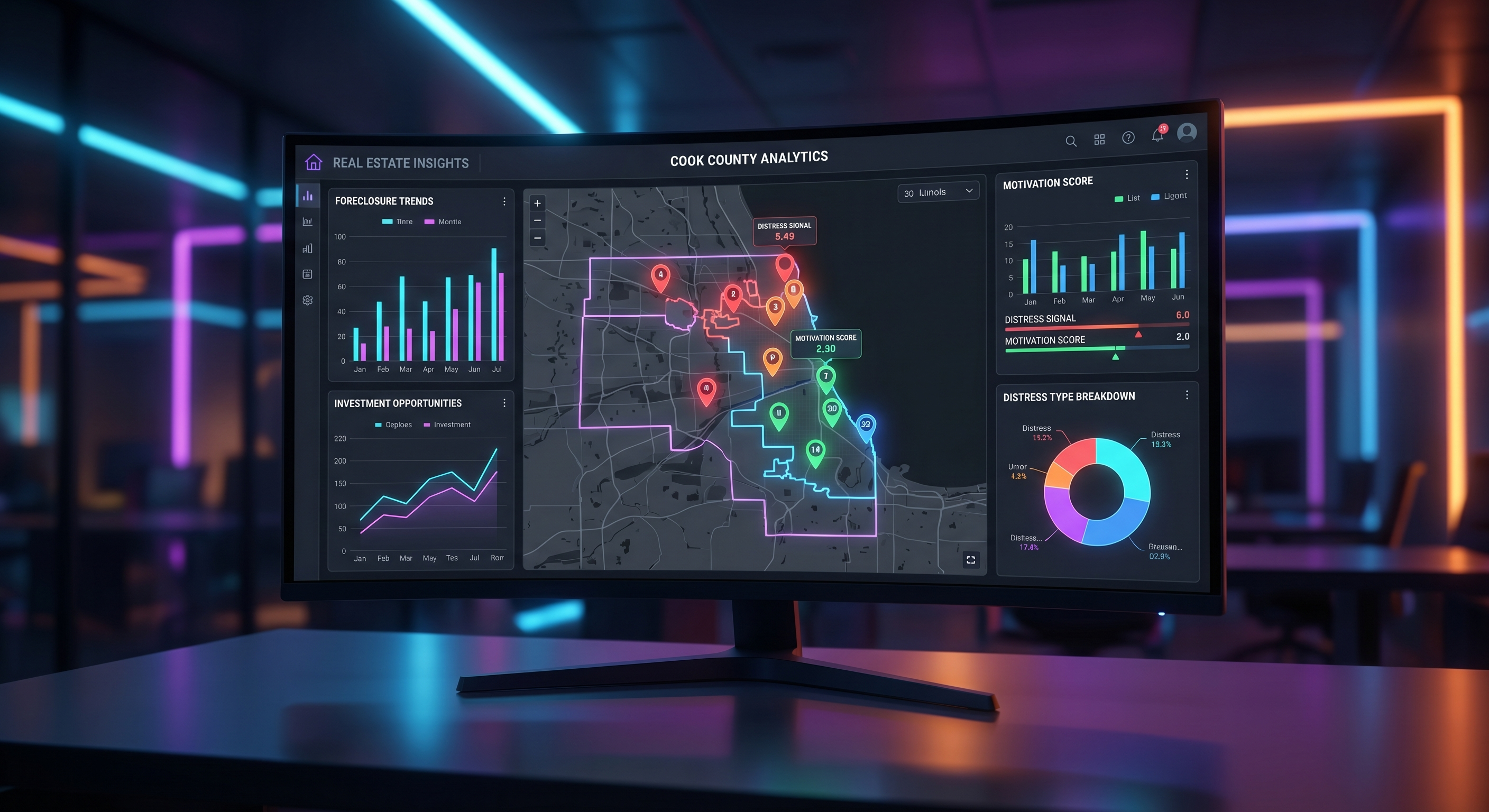
DistressIQ Aggregated Platform. DistressIQ pulls pre-foreclosure signals across Cook County townships and cross-references them with tax delinquency records, code enforcement filings, and absentee owner indicators. The platform updates daily from county records, so pre-foreclosure leads reflect recent filings rather than weekly or monthly batch data. Filters let investors narrow by township, distressed property type, and estimated equity position.
For investors working Cook County systematically, the choice is not really between these methods. It is about how much time they want to spend on manual record tracking versus how much they want to delegate to a platform that monitors the docket continuously.
Evaluating Cook County Pre-Foreclosure Properties
Once a pre-foreclosure lead is identified, the evaluation process follows the same logic as any distressed property acquisition, with specific Cook County considerations.
Start with the county assessor's data. Cook County publishes property record cards that include assessed value, tax history, and ownership information. The assessed value is not the same as market value, but it provides a baseline for estimating the owner's equity position.
Then pull the mortgage data available through public records. The original loan amount, any secondary liens, and whether the loan has been modified since origination all affect what a direct purchase offer might look like and whether the numbers work for a flip or a hold.
The neighborhood context in Cook County is unusually important because property values vary dramatically across townships and neighborhoods. A three-flat in Humboldt Park has a fundamentally different value profile than a single-family home in Oak Park or a high-rise condo in Streeterville. Investors should use comparable sales from the same neighborhood, not county-wide averages, when estimating ARV.
Finally, consider the rehab scope. Pre-foreclosure properties in Cook County run the full spectrum from well-maintained homes in transitioning neighborhoods to distressed buildings with deferred maintenance across all price points. An accurate rehab estimate is the difference between a deal that pencils and one that does not.
Frequently Asked Questions
How long does pre-foreclosure last in Cook County, Illinois?
The pre-foreclosure window in Cook County typically runs 90 to 180 days from the initial foreclosure filing to the scheduled sheriff sale date. Illinois judicial foreclosure requires court involvement at every step, which adds time compared to non-judicial states. Cases that are contested, involve bankruptcy filings, or include active loss mitigation negotiations can extend this to a year or longer. Court docket backlogs in high-volume Cook County districts contribute to timeline variability.
Is Illinois a judicial or non-judicial foreclosure state?
Illinois uses judicial foreclosure, meaning every foreclosure goes through the circuit court system. The lender must file a lawsuit, serve the homeowner, obtain a judgment, and receive a court order before the sheriff can schedule a sale. This creates the public docket record that investors use to track pre-foreclosure cases. It also means longer timelines than non-judicial states like Texas or Georgia, where lenders can set auction dates without court involvement.
How do I find pre-foreclosure properties in Cook County before the auction?
The most direct method is tracking the Cook County Circuit Court clerk's online docket for newly filed foreclosure complaints. The sheriff's office auction list provides a secondary view of cases that have progressed to a scheduled sale date. Aggregated platforms like DistressIQ consolidate both signals and cross-reference them with other distress indicators, updating daily so pre-foreclosure leads reflect recent filings rather than stale weekly reports.
What is the Cook County sheriff sale process?
After a judgment of foreclosure is entered, the Cook County Sheriff's Office schedules a public auction. Properties are sold to the highest bidder. The winning bidder must post 10 percent of the bid amount immediately and the balance within seven days. Sheriff sales in Cook County are held online through the sheriff's official auction portal. Properties that do not receive a minimum bid sufficient to cover the judgment are rescheduled for a subsequent sale date.
Can a homeowner sell their home during pre-foreclosure in Cook County?
Yes. During the pre-foreclosure window, the homeowner retains legal title and can sell the property outright. The proceeds of the sale pay off the foreclosing lender first, with any surplus returned to the homeowner. This is the math that makes pre-sale negotiations viable: the owner nets more from a negotiated sale before auction than from a sheriff sale where the property often sells below market value after legal fees and auction costs.
What distinguishes Cook County pre-foreclosure leads from other Chicago-area counties?
Cook County contains theCity of Chicago plus 130 suburban municipalities, making it by far the highest-volume foreclosure market in Illinois. Neighboring counties like Lake, DuPage, and Will have significantly fewer filings. Cook County's diversity of property types, from low-rise bungalows to high-rise condos to multi-unit apartment buildings, means pre-foreclosure leads span a wide value range, giving both wholesale and flip investors access to inventory that matches their acquisition criteria.
Find Cook County Pre-Foreclosure Leads Updated Daily
DistressIQ tracks pre-foreclosure filings across Cook County townships alongside other verified distress signals, including tax delinquency, code violations, and absentee owner indicators. Browse by township, filter by distress signal type, and build a targeted Cook County pre-foreclosure list without navigating multiple court docket systems. Property records include assessor-verified data from Cook County, the same records used by title companies and lenders.
See distressed properties in Cook County on DistressIQ
DistressIQ covers 3,200+ counties nationwide, updated daily from county records.
The data behind this article
DistressIQ Monitors These Signals in Real Time
Pre-Foreclosures
NOD + NTS filings
Tax Delinquency
County treasurer records
Code Violations
Municipal inspection filings
Probate Filings
Superior Court records
Every lead is scored 0–100 for seller motivation based on signal type, duration, severity, and stacking. Nationwide coverage — every US county, updated daily.
Ready to find deals in your market?
See Live Distress Signals in Your County
Stop calling dead leads. Every lead in DistressIQ is scored 0–100 for seller motivation, with verified contact info included. Browse the free tier to see what's active in your market right now.
Browse Free Leads — No Credit Card