How to Find Foreclosure Leads in Ohio (2026 Investor Guide)
How to Find Foreclosure Leads in Ohio (2026 Investor Guide)
Ohio requires every residential foreclosure to pass through the courts of common pleas, producing a public paper trail that stretches six to eighteen months from the initial complaint to the sheriff's sale. The lis pendens filing at the start of that process is the earliest reliable signal an investor can act on. Counties such as Cuyahoga, Franklin, and Hamilton generate the highest volume of leads, while Rust Belt cities like Cleveland and Toledo offer persistent distress that rewards investors who stack multiple signals against each property.
Ohio has spent more than a decade as one of the most active foreclosure states in the country, and the structural reasons have not changed. Every residential foreclosure passes through the judicial system, generating public records from the moment a lender files a complaint in the county court of common pleas. For investors, those records are the raw material. Knowing how to read them and which counties produce the best opportunities is what separates consistent deal flow from wasted effort.
How the Ohio Judicial Foreclosure Process Works
Ohio Revised Code § 2323 governs mortgage foreclosures and establishes the framework every lender must follow. Because Ohio is a judicial foreclosure state, no property can be sold at auction without a court order. The process unfolds in a predictable sequence of milestones.
Complaint and Lis Pendens. The process begins when the lender files a foreclosure complaint with the court of common pleas in the county where the property is located. Simultaneously, the lender records a lis pendens with the county recorder, signaling that litigation affecting title is now pending. For investors, this filing is the key early signal. It enters the public record before the borrower has been served, making it the earliest reliable indicator that a property has entered the foreclosure pipeline.
Service of Process and Answer Period. Once the complaint is filed, the borrower must be formally served with notice of the lawsuit. After service, the borrower has 28 days to file an answer with the court. Most borrowers do not file a substantive response, which leads the court to enter a default judgment. Those who do answer may contest the foreclosure or raise affirmative defenses, and the case proceeds to a hearing before a judge.
Judgment and Order of Sale. If the court finds in favor of the lender, it enters a judgment of foreclosure and issues an Order of Sale directing the county sheriff to sell the property at public auction. The total timeline from complaint to Order of Sale typically runs six to eighteen months, depending on the county's docket backlog and whether the borrower contests the case.
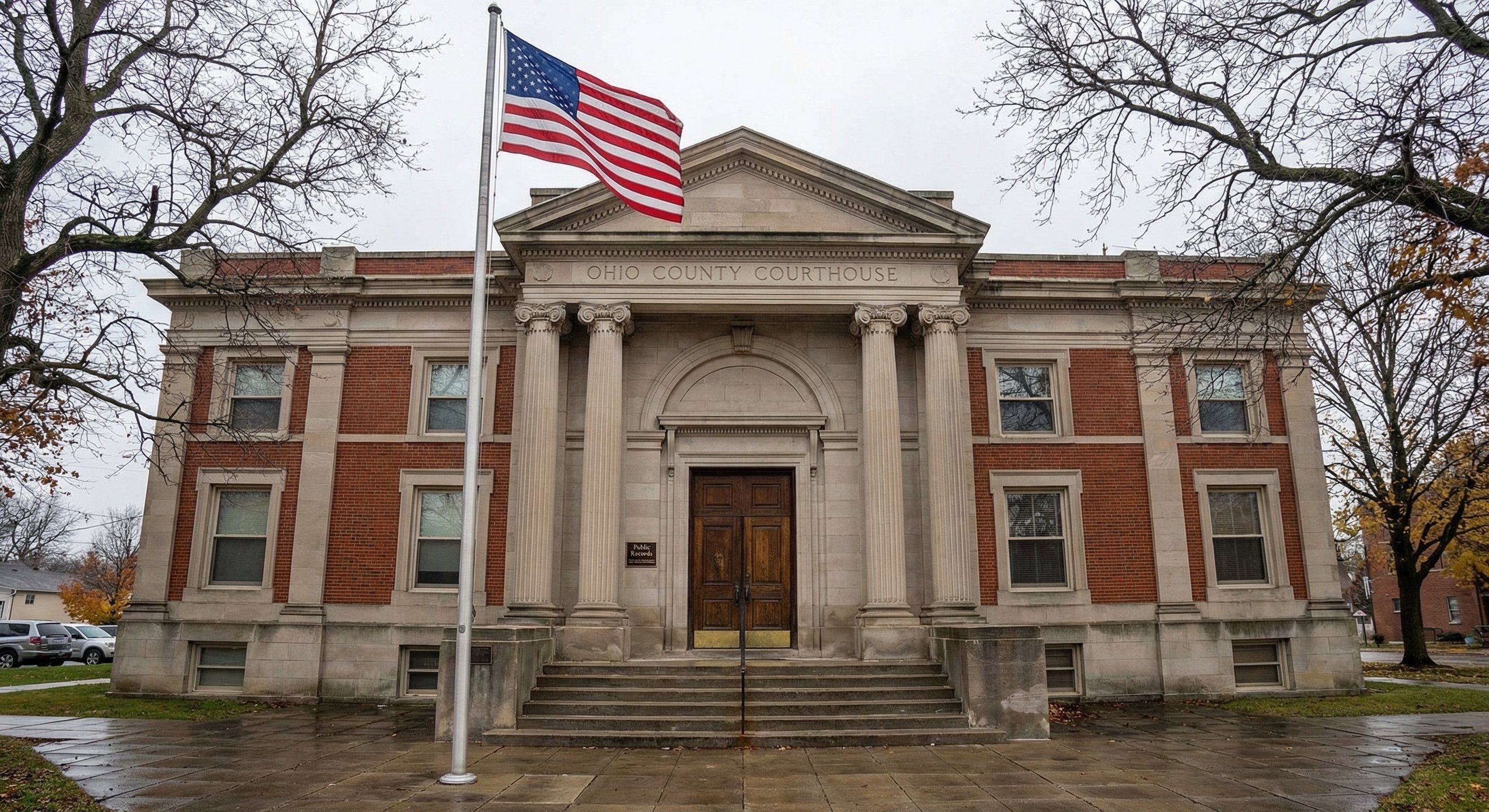
Sheriff's Sale and Minimum Bid Rules. The sheriff's sale is conducted by the county sheriff. The property is sold to the highest bidder, but Ohio law sets the minimum opening bid at two-thirds of the property's appraised value. If no bidder meets that threshold, the county schedules a second sale where there is no minimum bid at all. That two-tier system matters for investors because the second sale is where the deepest discounts tend to appear. Properties that fail to attract competitive bidding in the first round can be acquired at a fraction of appraised value in the second.
Redemption Rights in Ohio
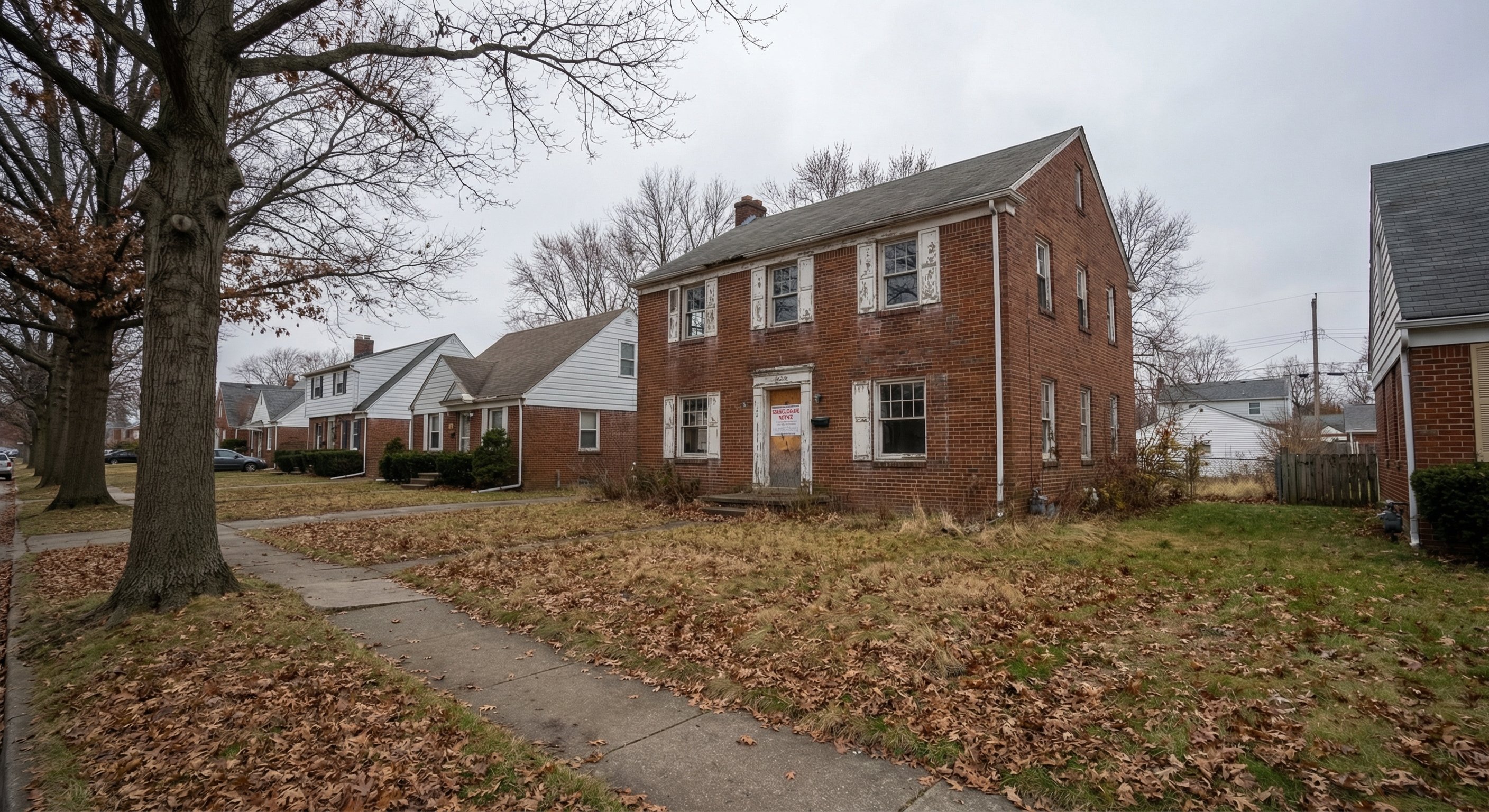
Ohio provides a statutory right of redemption that allows the borrower to reclaim the property by paying the full amount owed, including costs and interest, up to the day of the sheriff's sale. Some lenders will waive the deficiency judgment if the owner agrees to vacate before the sale date.
Once the sale is confirmed by the court, redemption rights end entirely. There is no post-sale redemption period in Ohio. The sale is final once the court signs the confirmation order.
Where Ohio Foreclosure Leads Are Concentrated
The highest volume of foreclosure activity clusters in six counties, each with a distinct investor profile.
Cuyahoga County (Cleveland). The most active foreclosure county in the state by volume. Cleveland was at the center of the subprime crisis, and large sections of the city's east side and inner-ring suburbs have never fully recovered. The Cuyahoga Land Bank absorbs many of the most distressed parcels, making pre-foreclosure engagement critical. Target areas include East Cleveland, Garfield Heights, and Maple Heights.
Franklin County (Columbus). Columbus is the fastest-growing metro in Ohio, and its foreclosure profile is different. Many properties entering pre-foreclosure here have positive equity because home values have risen significantly. These equity-rich pre-foreclosures are attractive because the seller can walk away with cash rather than face a deficiency judgment.
Hamilton County (Cincinnati). Cincinnati follows a pattern similar to Columbus, with stronger home-price appreciation creating a pool of pre-foreclosure leads where borrowers have equity to protect.
Montgomery County (Dayton), Summit County (Akron), and Lucas County (Toledo). Legacy industrial economies, elevated vacancy rates, and established investor communities. Out-of-state investors tend to overlook these counties in favor of Columbus or Cleveland, creating less competition for local operators.
Rust Belt Persistence. Cities such as Youngstown and Canton maintain persistent distress levels that reward deep local knowledge. Cleveland, Toledo, and Youngstown in particular have attracted significant investor activity because distress levels remain above national averages year after year.
Free Weekly Alerts
See What's Distressed in Your Market
Get free weekly alerts — new distressed properties, motivation scores, and hot neighborhoods in your area. Addresses and contact info available inside DistressIQ.
Free forever · No credit card · Unsubscribe anytime
Finding Leads at Each Stage of the Process
Pre-Filing. Before the lis pendens is recorded, no public foreclosure record exists. Investors working this stage rely on proxy signals: tax delinquency, code violations, utility shutoffs, and vacancy indicators. A property showing two or more of these signals is statistically more likely to enter the foreclosure pipeline.
Post-Lis Pendens. Once the lis pendens appears in the county recorder's database, the property is publicly identified as in foreclosure. The 28-day answer period and the months of case proceedings that follow give investors six to eighteen months to reach the seller and structure a deal. This is the most productive outreach stage because the seller still has options.
Post-Judgment. After the court enters judgment and issues the Order of Sale, the timeline compresses. The sheriff's sale could be scheduled within weeks. Investors need financing lined up and must move fast. The advantage is that seller motivation peaks and the legal outcome is nearly certain.
Sheriff's Sale. Properties are sold to the highest bidder at the county courthouse. The minimum bid in the first round is two-thirds of appraised value. Properties that fail to attract a qualifying bid go to a second sale with no minimum. Auction buyers need certified funds and should run title searches in advance, because Ohio sheriff's sales do not include title insurance.
Stacking Signals for Better Conversion
Single-signal lead lists produce high noise and low contact rates. A property with a lis pendens filing might have an owner who is current on taxes, living in the home, and working with an attorney to contest the foreclosure. That lead is low-urgency and unlikely to convert.
A property where the lis pendens overlaps with tax delinquency, a code violation, and an absentee ownership flag is a different situation entirely. That owner is managing multiple financial pressures simultaneously and is significantly more likely to respond to a purchase offer. Stacking three or more signals against a single property produces contact rates two to three times higher than working from a single-signal list.
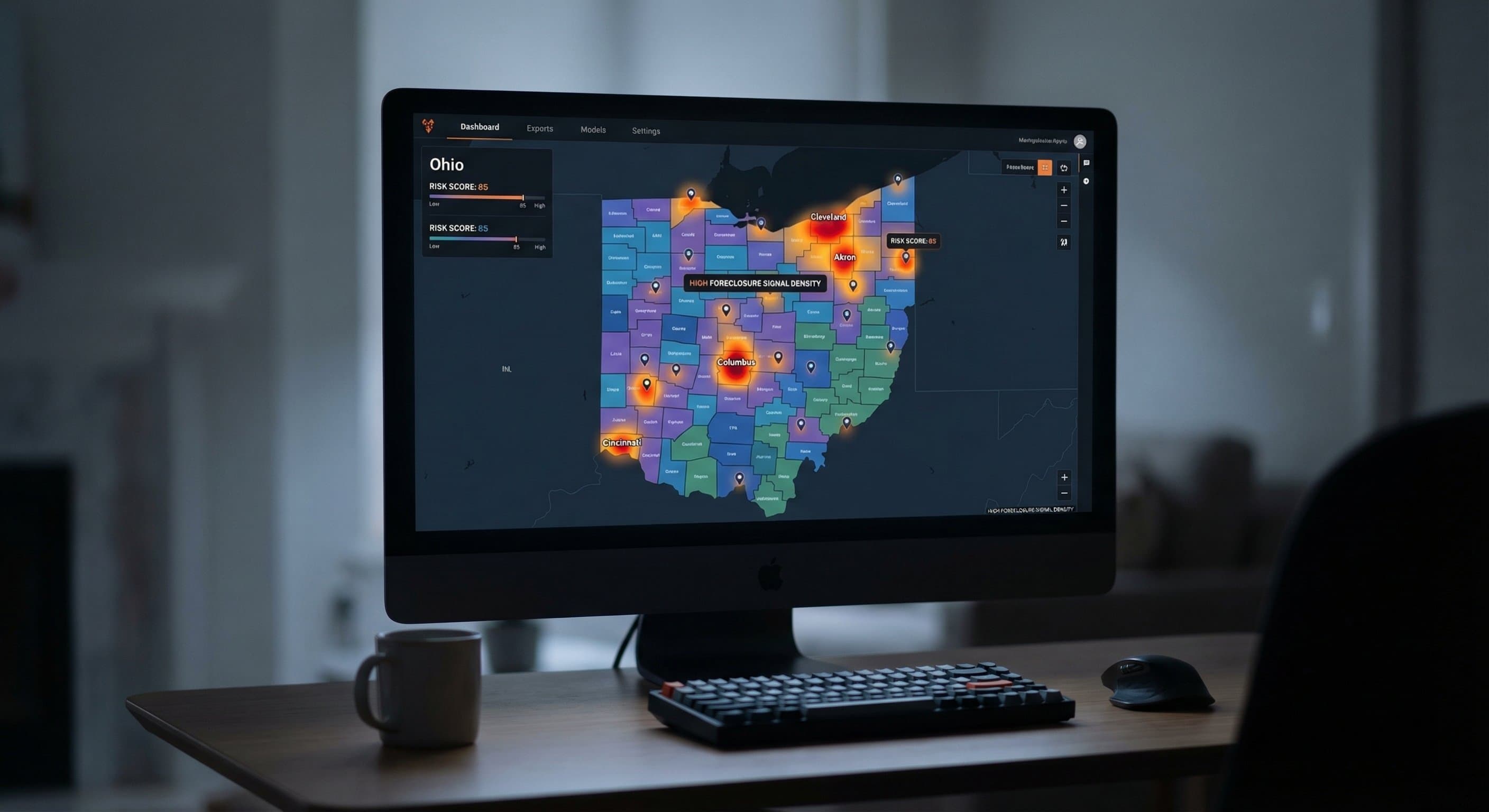
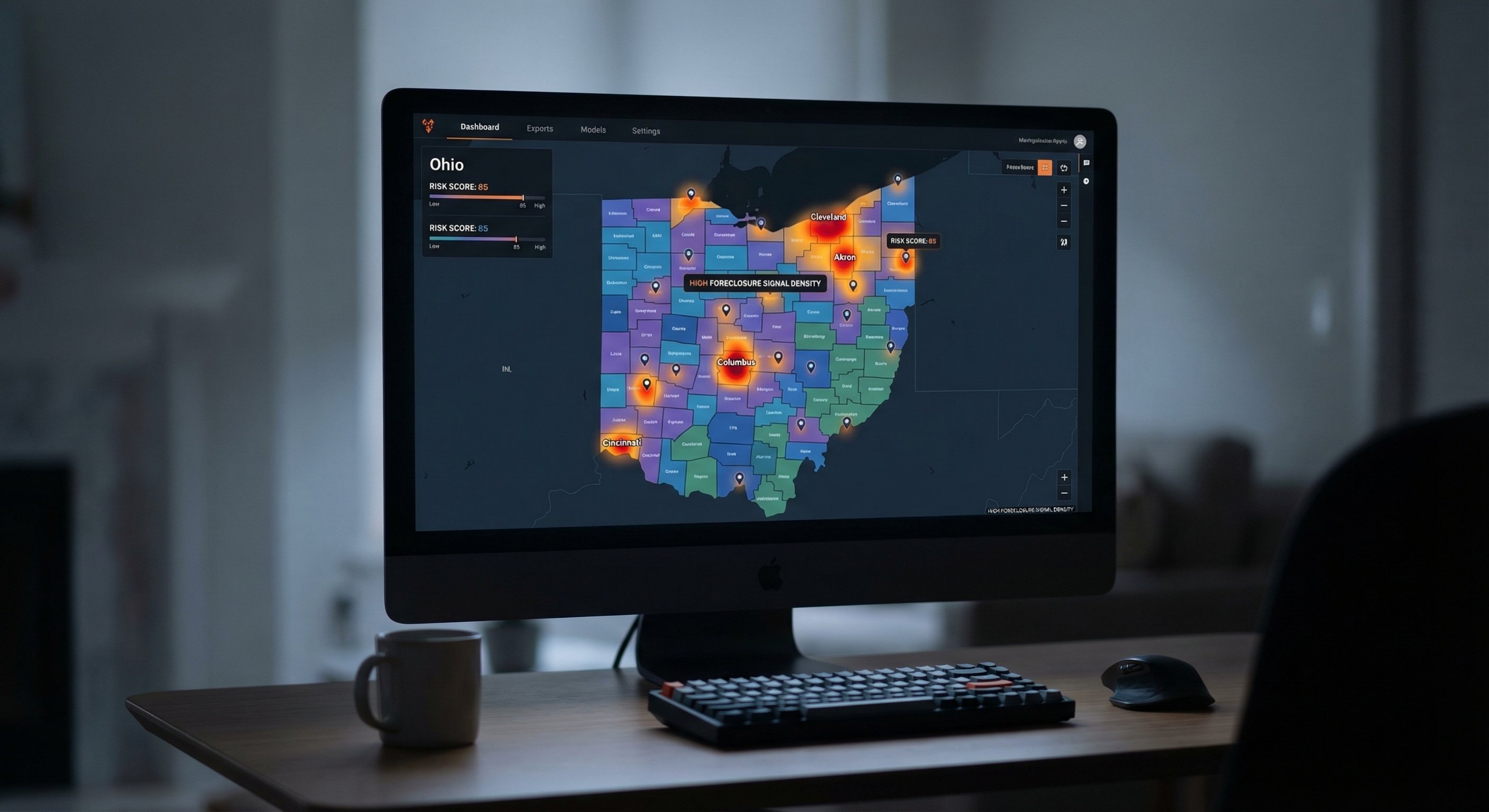
DistressIQ aggregates lis pendens, tax delinquency, code violations, vacancy indicators, probate filings, and absentee ownership data into a single interface, updated daily from county assessor and recorder sources across Ohio's 88 counties. Each property includes Street View imagery, aerial photos, assessor data, and a full signal breakdown.
Ready to see Ohio's stacked foreclosure signals? Start a free trial at DistressIQ.

Key Takeaways
- Ohio is a judicial foreclosure state where every case goes through the county court of common pleas, producing a public record trail from the first filing
- The lis pendens is the earliest public signal and provides six to eighteen months of lead time before the sheriff's sale
- Sheriff's sales require a minimum bid of two-thirds of appraised value in the first round, with no minimum in the second round
- Borrowers can redeem the property up to the day of the sale, but there is no post-sale redemption period
- Cuyahoga, Franklin, Hamilton, Montgomery, Summit, and Lucas counties produce the highest lead volume
- Stacking multiple distress signals against a single property produces dramatically higher contact and conversion rates than single-signal lists
Frequently Asked Questions
How long does the foreclosure process take in Ohio?
The full timeline from a lender filing the initial complaint to the sheriff's sale typically runs six to eighteen months. Counties with heavy case backlogs, such as Cuyahoga, tend to run closer to the longer end of that range, while more efficient courts like Franklin County may resolve cases in six to nine months. Borrowers who contest the foreclosure or participate in court-ordered mediation can extend the timeline further. Investors should plan outreach cadence around each county's typical processing speed rather than assuming a single statewide average.
What is the minimum bid at an Ohio sheriff's sale?
Ohio law requires the opening bid at a sheriff's sale to equal at least two-thirds of the property's appraised value. If no bidder meets that threshold, the county schedules a second sale with no minimum bid. The two-sale structure means properties failing to attract competitive bidding in the first round can be acquired at significant discounts in the second. Investors targeting the second sale should monitor sheriff's office listings regularly, because the interval between sales varies by county.
Can a homeowner redeem a property after the sheriff's sale in Ohio?
No. Ohio does not provide a post-sale redemption period. Once the court confirms the sheriff's sale, the former owner's interest in the property is terminated completely. Before the sale, however, the borrower retains the right to redeem the property by paying the full outstanding balance plus costs and interest, and that right extends up to the day of the auction. Some lenders will also agree to waive a deficiency judgment if the borrower cooperates by vacating before the sale date. This pre-sale window is the period when investors have the most leverage to negotiate a direct purchase with the homeowner.
Which Ohio counties should investors focus on for foreclosure leads?
The highest-volume counties are Cuyahoga (Cleveland), Franklin (Columbus), Hamilton (Cincinnati), Montgomery (Dayton), Summit (Akron), and Lucas (Toledo). Cuyahoga leads the state in total filings year after year, while Franklin and Hamilton offer more equity-rich pre-foreclosures due to stronger home-price appreciation over the past several years. The Rust Belt counties surrounding Dayton, Akron, and Toledo produce consistent distress inventory with less competition from out-of-state buyers. Mahoning County (Youngstown) and Stark County (Canton) are secondary markets worth monitoring for investors with strong local knowledge and reliable contractor relationships.
What is a lis pendens and why is it important for Ohio investors?
A lis pendens is a legal notice recorded with the county recorder indicating that a property is subject to pending litigation. In foreclosure cases, the lender records the lis pendens at the same time the complaint is filed with the court of common pleas. It is the earliest publicly available signal that a property has entered the foreclosure pipeline. Because the judicial process takes six to eighteen months to reach the sheriff's sale, a lis pendens gives investors a long runway to contact the owner and structure an offer. Monitoring lis pendens filings consistently is the single most effective habit an Ohio foreclosure investor can develop.
Is it legal to contact homeowners who are in pre-foreclosure in Ohio?
Yes. Pre-foreclosure records, including lis pendens filings and court case dockets, are public information, and contacting the property owner is legal. However, Ohio's consumer protection statutes require that written communications clearly identify the sender and accurately represent the offer. Deceptive or misleading materials can create legal liability under state and federal law. Investors running large-scale campaigns should have materials reviewed by a licensed Ohio real estate attorney.
Sources: Ohio Revised Code § 2323 (mortgage foreclosure); Ohio Supreme Court Residential Foreclosure Prevention Guidelines; ATTOM Data Solutions 2025 U.S. Foreclosure Market Report
The data behind this article
DistressIQ Monitors These Signals in Real Time
Pre-Foreclosures
NOD + NTS filings
Tax Delinquency
County treasurer records
Code Violations
Municipal inspection filings
Probate Filings
Superior Court records
Every lead is scored 0–100 for seller motivation based on signal type, duration, severity, and stacking. Nationwide coverage — every US county, updated daily.
Ready to find deals in your market?
See Live Distress Signals in Your County
Stop calling dead leads. Every lead in DistressIQ is scored 0–100 for seller motivation, with verified contact info included. Browse the free tier to see what's active in your market right now.
Browse Free Leads — No Credit Card