Divorce Leads in Florida: How to Find Motivated Sellers Before They Hit the MLS

Divorce Leads in Florida: How to Find Motivated Sellers Before They Hit the MLS
TL;DR: Florida's high divorce rate, community property laws, and mandatory asset division rules create a steady stream of motivated sellers who need to sell quickly. Divorce leads in Florida are generated from dissolution of marriage filings at the county clerk's office. Investors who find these properties early — before the seller lists with an agent — can negotiate off-market deals at significant discounts. This guide explains the Florida-specific process, where to find filings, and how to work these leads ethically and effectively.

Florida ranks among the top five U.S. states for divorce rates, with roughly 3.4 divorces per 1,000 residents annually according to the CDC. That's not a statistic to gloat over — divorce is genuinely painful. But it creates a real and consistent pattern: two people who owned a home together now need to divide an asset that can't be split in half. The house has to go.
For real estate investors, that "house has to go" moment is an opportunity to solve a real problem. A divorcing couple doesn't want to wait four months to sell through an agent and then negotiate repair requests at closing. They often want clean, fast, and done — and a cash offer from an investor can be exactly that.
The question is: how do you find these sellers before they call a Realtor?
What Makes Florida Divorce Leads Different
Florida is an equitable distribution state, not a community property state. That means marital assets — including real estate — are divided "fairly" but not necessarily 50/50. Judges have discretion, and that discretion often produces delays, contested valuations, and drawn-out proceedings that leave both parties wanting out of the shared property as fast as possible.
A few Florida-specific factors make divorce leads particularly active here:
High volume. Florida's population of 22+ million and its transient, migration-heavy demographics mean more marriages — and statistically, more divorces. Miami-Dade, Broward, Palm Beach, Hillsborough, and Orange counties each process thousands of dissolution filings annually.
Dual-income property appreciation. Florida property values surged 30–50% in many metros between 2020 and 2024. Divorcing couples often have significant equity they need to liquidate — and they'd rather keep that equity in cash than fight over a house.
Snowbird and seasonal complexity. Florida has a large population of second-home owners and part-year residents. Divorce proceedings involving vacation properties or investment condos create additional complexity and urgency for both parties.
No redemption period after sale. Unlike some states with post-sale redemption windows, Florida's real estate transactions are clean. Once the property closes, it's done — which makes the "sell it now" calculation easier for divorcing sellers.
Where Divorce Filings Are Public Record in Florida
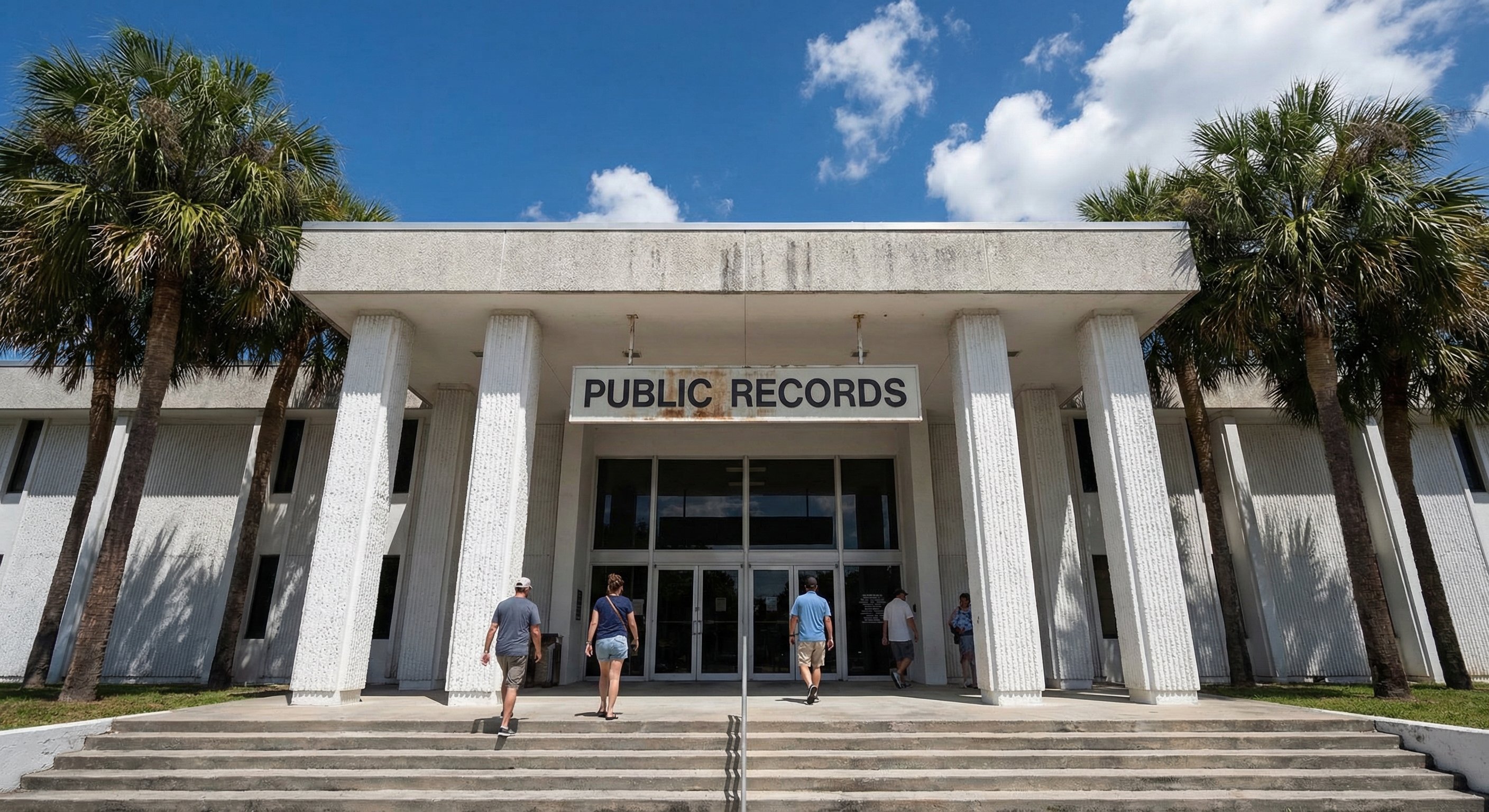
In Florida, all dissolution of marriage proceedings are filed with the Clerk of Court in the county where the divorce is petitioned. These are public records under Florida Statute § 28.222.
The key document you're looking for is the Petition for Dissolution of Marriage. It typically includes:
- The names of both parties
- County of filing
- Whether there are minor children (affects property division timeline)
- Whether real property is involved (listed as a marital asset)
The Final Judgment of Dissolution is what actually orders the sale or transfer of real property — but savvy investors don't wait that long. The early filing is your signal that a motivated seller is coming.
Where to search by county:
| County | Records Portal |
|---|---|
| Miami-Dade | Miami-Dade Clerk of Courts — online case search |
| Broward | Broward Clerk of Courts — Public Access Portal |
| Palm Beach | Palm Beach Clerk — online civil case search |
| Hillsborough | Hillsborough Clerk HCFLPA.net |
| Orange | Orange County Clerk — e-filing search |
| Pinellas | Pinellas Clerk — Official Records search |
| Duval | Duval Clerk — countywide case search |
| Polk | Polk County Clerk — public case inquiry |
Most Florida counties have moved to online portals with some level of public access. Case types for divorce are typically filed under "Family Law" or "Dissolution of Marriage" and can be filtered by date range to find recent filings.
According to the Florida Courts website, the state processes approximately 70,000–75,000 dissolution filings per year statewide — making it one of the highest-volume states for this signal type.
How to Identify Properties Attached to Divorce Cases
Not every divorce involves real estate — but many do, especially in Florida where homeownership rates are high and equity positions are strong. Here's how to connect a dissolution filing to a specific property:
Step 1: Find the filing. Pull recent dissolution petitions from the county clerk portal. You'll see party names, case number, and filing date.
Step 2: Cross-reference with property records. Search the county property appraiser's database (every Florida county has one) using the party names. If either spouse is listed as an owner, you've connected the filing to a property.
Step 3: Check for additional signals. A divorce filing alone is a lead — but a divorce filing combined with tax delinquency, a lis pendens, or a code violation notice is a much stronger motivated seller signal. That combination tells you the parties are financially stressed AND legally entangled.
Step 4: Check ownership type. Florida properties held as tenancy by the entirety (the standard married-couple ownership form) automatically pass to the other spouse on death but require both parties' consent to sell. In a divorce, neither party can force a unilateral sale while the case is pending — which creates urgency to settle and sell.
Free Weekly Alerts
See What's Distressed in Your Market
Get free weekly alerts — new distressed properties, motivation scores, and hot neighborhoods in your area. Addresses and contact info available inside DistressIQ.
Free forever · No credit card · Unsubscribe anytime
Working Divorce Leads: The Human Element First
Divorce is hard. Every investor who works this lead type professionally will tell you the same thing: lead with empathy, not tactics.
A divorce seller has been through an emotionally exhausting process. They're often stressed about money, living situations, children, and timelines. An investor who shows up with a lowball offer and high-pressure tactics will get the door slammed. An investor who shows up with a clear explanation of how a cash offer works, a realistic timeline, and genuine respect for the seller's situation will get invited inside.
Practical principles for working Florida divorce leads:
- Never contact both spouses together unless you have written consent from both. They may not be on speaking terms.
- Be upfront about who you are. "I'm a real estate investor and I'd like to talk about whether a cash offer might help your situation" is both honest and effective.
- Acknowledge the situation neutrally. You don't need to reference the divorce explicitly — "I understand you may be going through some changes with the property" is plenty.
- Give them time. Divorce sellers rarely need to make an immediate decision. A low-pressure follow-up sequence over 30–60 days often outperforms aggressive early outreach.
- Be ready with a real number. Don't waste their time with a "we'll see" offer. Know your ARV, know your MAO (Maximum Allowable Offer), and be ready to make a real decision.
Why Stacked Signals Produce the Best Divorce Deals

A single divorce filing is a lead. A divorce filing combined with multiple additional distress indicators is a deal.
The most actionable divorce leads share additional characteristics that amplify motivation:
Divorce + Tax Delinquency: When a divorcing couple stops paying property taxes — often because neither party is accepting responsibility — the tax delinquency clock starts. Florida's tax certificate sale happens annually (typically in June), and properties approaching the two-year lien redemption deadline become even more urgent to sell.
Divorce + Mortgage Default: If either party stopped making mortgage payments during the proceedings, a Notice of Default or lis pendens may be filed. A couple with an active foreclosure AND a pending divorce is under maximum pressure — and maximum negotiating flexibility for an investor.
Divorce + Code Violations: Florida municipalities actively issue code violation notices for maintenance issues — overgrown landscaping, exterior damage, inoperative vehicles. A divorcing couple who has let the property deteriorate often receives multiple notices, adding HOA pressure and municipal fines on top of the legal situation.
Divorce + Long Ownership: A couple who bought their home in 2005 or earlier may have significant equity even after market fluctuations. Long-held properties are more likely to be mortgage-free or near-payoff, which makes the seller more flexible on price.
DistressIQ stacks 31 signal types — including divorce filings, tax delinquency, lis pendens, code violations, and assessor-verified equity — to surface properties where multiple indicators overlap. A single signal might produce a marginal deal. Three or four signals stacked produce your best opportunities.

Florida Divorce Timeline: What It Means for Investors
Understanding the legal timeline helps investors target their outreach at the right moment:
- Day 1: Petition for Dissolution filed. This is when the lead becomes public. This is your earliest intervention point.
- Day 20+: Respondent is served. The case formally begins. Both parties are now legally in proceedings.
- 30–90 days: Discovery and asset disclosure. Parties must disclose financial assets, including real property. This is when "what do we do with the house?" becomes a real conversation.
- 90–180 days: Mediation. Florida requires mediation in most contested divorces. Real estate is typically central to mediation negotiations.
- 180–365+ days (contested): If parties can't agree on property, a judge orders it sold or assigns it to one party. This is the least favorable scenario for investors — court-ordered timelines are unpredictable.
- Simple (uncontested) cases: Can close in 90 days. These are your best leads — both parties want out quickly and cleanly.
Investor timing tip: Target your outreach 45–90 days after filing. By then, parties have had the property valuation conversation and have started to understand their options. They're mentally ready to consider a sale but haven't yet listed with an agent.

Key Takeaways
- Florida generates 70,000+ dissolution filings annually — one of the nation's highest-volume states for this lead type
- All filings are public record — accessible via county clerk portals in every Florida county
- The best leads combine multiple signals — divorce + tax delinquency + lis pendens = maximum motivation
- Equitable distribution means properties must be valued and divided — often forcing a sale neither party originally intended
- Lead with empathy — investors who treat divorce sellers with respect close more deals and get more referrals
- Target outreach 45–90 days post-filing — parties are mentally ready but haven't called a Realtor yet
If you're building a Florida investor operation, divorce leads deserve a dedicated pipeline — not as an afterthought, but as a structured signal type you monitor weekly.
DistressIQ pulls county-verified divorce filings across all 67 Florida counties and stacks them with tax delinquency, lis pendens, code violations, and assessor data — so you see only the properties where motivation is real and verifiable. Founding members lock in 30% off for life: Starter $89, Pro $174, Elite $349/mo. Fewer than 50 spots remain.
Start Your Free Trial at DistressIQ →
Frequently Asked Questions
Q: Are divorce filings public record in Florida?
Yes. Florida Statute § 28.222 makes dissolution of marriage petitions public records, accessible through each county clerk's office. Most counties offer online search portals. Some documents within a case may be sealed (particularly those involving minors), but the existence of the filing and basic case information are public.
Q: How do I find divorce leads in Florida without a data service?
Search each county clerk's online case search for "Dissolution of Marriage" filings within the last 30–90 days. Cross-reference party names against the county property appraiser's database to identify associated real estate. This is time-consuming but free. A data platform like DistressIQ automates this process across all 67 Florida counties.
Q: Is it legal to contact divorcing sellers about their property?
Yes, contacting property owners is legal. Florida has no specific restrictions on investor outreach to people in divorce proceedings. Standard Do-Not-Call rules apply for phone contact. Mailer campaigns are unrestricted. Always be honest about who you are and what you're offering.
Q: How quickly do divorce-related properties usually sell?
Uncontested divorces with motivated sellers can result in a property closing within 90–120 days of the initial filing. Contested divorces may take 12–24 months. The fastest deals come from cases where both parties agree on selling, often identified by mutual signatures on the listing consent early in the proceedings.
Q: What's the difference between a divorce lead and a pre-foreclosure lead?
A divorce lead identifies sellers who WANT to sell because they need to divide an asset. A pre-foreclosure lead identifies sellers who MUST sell to avoid losing the property. Divorce leads are often cleaner — the sellers have equity, are making rational decisions, and are open to negotiation. Pre-foreclosure involves more urgency but also more complexity (lender involvement, mortgage payoffs).
Q: Which Florida counties have the most divorce leads?
Miami-Dade, Broward, Palm Beach, Hillsborough (Tampa), and Orange (Orlando) counties generate the highest raw volume of dissolution filings based on population. However, smaller counties often have less investor competition — Polk, Volusia, Lee, and Sarasota counties can yield high-quality leads with fewer competing investors.
Q: How do I approach a seller who is in the middle of a divorce?
Lead with empathy and transparency. Introduce yourself as a real estate investor who buys properties directly, and acknowledge that you understand they may be going through a transition. Ask open-ended questions about their timeline and what outcome would feel best to them. Never pressure or rush. A relaxed, informational first call often results in a callback weeks later when the seller is ready.
Sources: CDC National Center for Health Statistics — Marriage and Divorce Data (2023); Florida Courts — Annual Workload Statistics; Florida Statute § 28.222 (Clerk of Courts Public Records); Florida Department of Revenue — Tax Certificate Sale Information.
The data behind this article
DistressIQ Monitors These Signals in Real Time
Pre-Foreclosures
NOD + NTS filings
Tax Delinquency
County treasurer records
Code Violations
Municipal inspection filings
Probate Filings
Superior Court records
Every lead is scored 0–100 for seller motivation based on signal type, duration, severity, and stacking. Nationwide coverage — every US county, updated daily.
Ready to find deals in your market?
See Live Distress Signals in Your County
Stop calling dead leads. Every lead in DistressIQ is scored 0–100 for seller motivation, with verified contact info included. Browse the free tier to see what's active in your market right now.
Browse Free Leads — No Credit Card