Absentee Owner List Ohio: Where Out-of-State Landlords Are Selling in 2026
Absentee Owner List Ohio: Where Out-of-State Landlords Are Selling in 2026
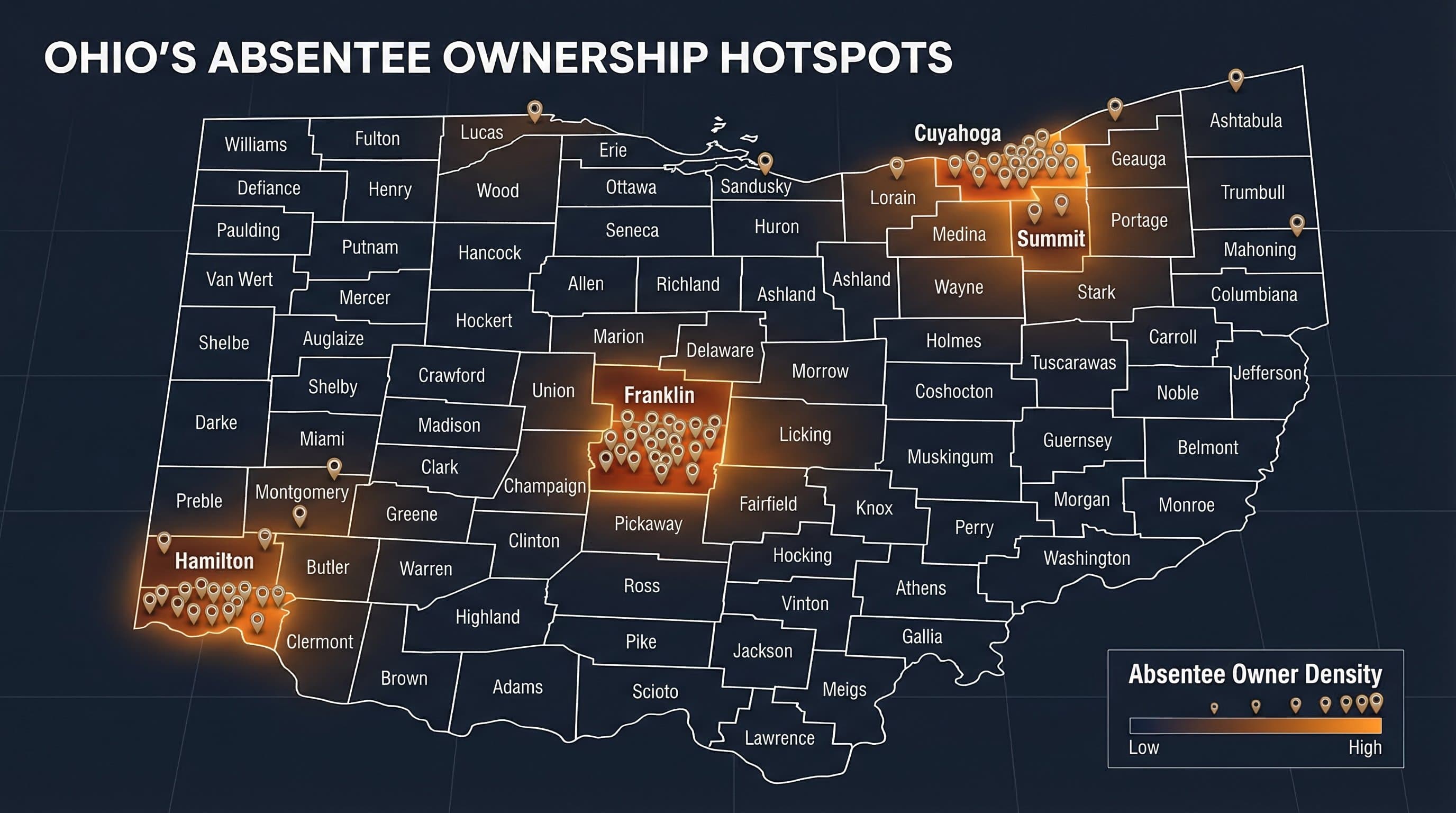
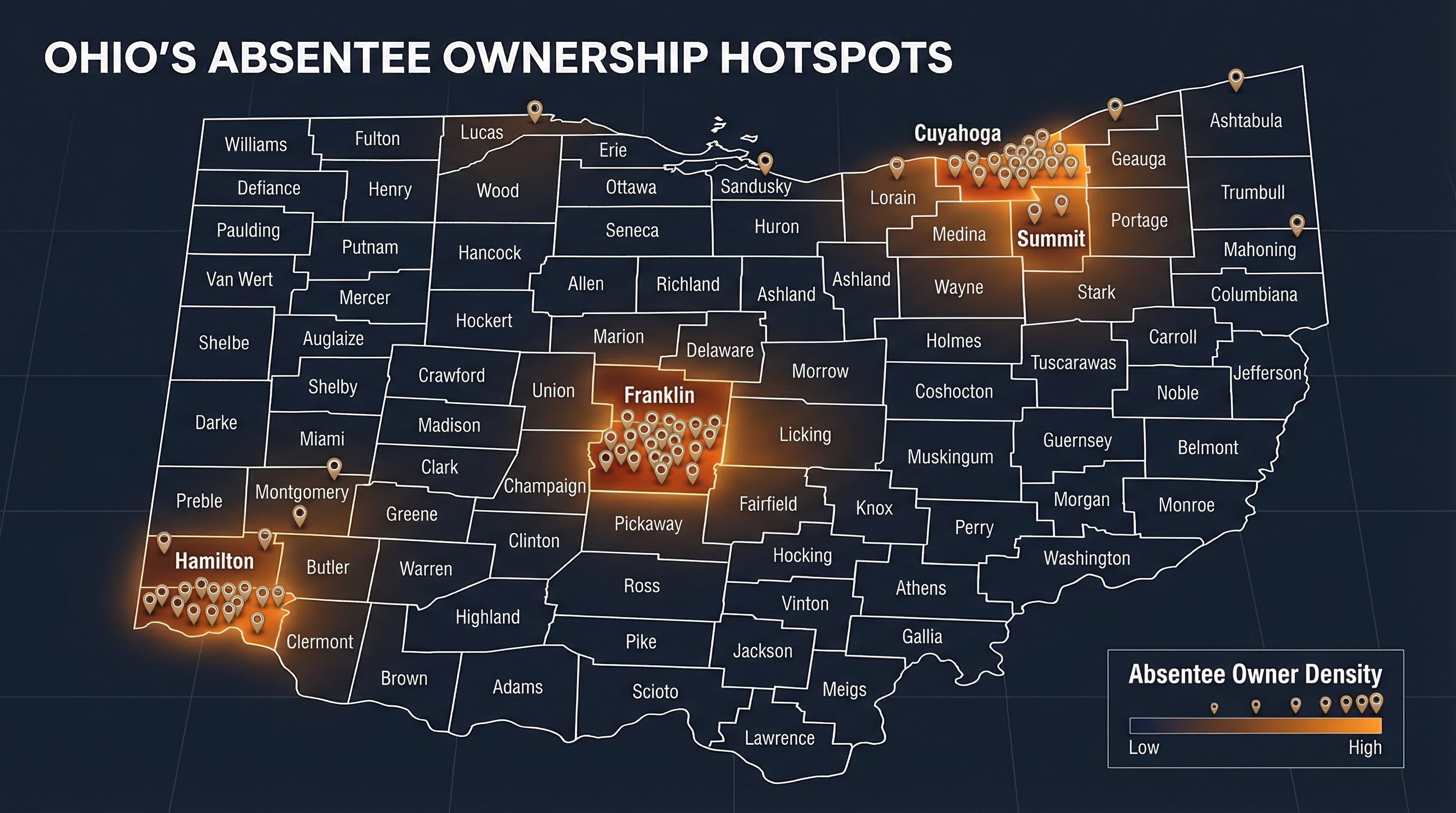
TL;DR: Ohio's absentee owner list covers hundreds of thousands of properties where the owner's mailing address is outside the county or state — a reliable indicator of lower attachment and higher seller motivation. The biggest concentrations are in Cuyahoga (Cleveland), Franklin (Columbus), Hamilton (Cincinnati), and Summit (Akron) counties. Ohio's flat real estate market and challenging landlord environment are pushing out-of-state owners toward the exit. Investors who cross-reference absentee status with tax delinquency, code violations, and vacancy signals find the highest-quality motivated seller leads.
Ohio doesn't get the same hype as Texas or Florida, but ask any experienced Midwest wholesaler where they find their most motivated sellers — they'll point you to the absentee owner lists running through Cleveland's East Side, Columbus's Linden neighborhood, and Cincinnati's older rental corridors.
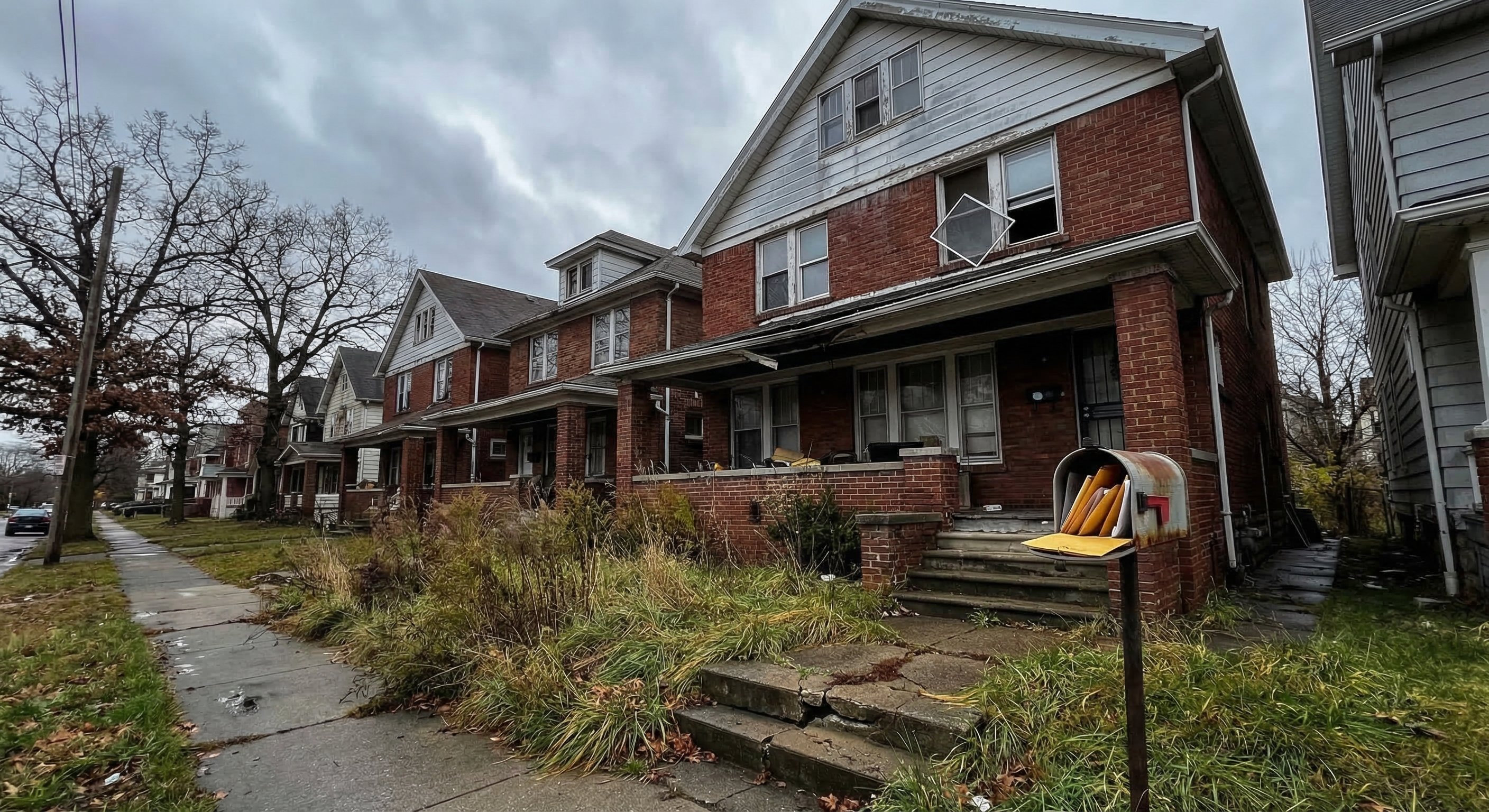
Here's why: Ohio has one of the highest absentee landlord concentrations of any state in the country. Decades of steel industry decline, suburban white flight, and rust belt repositioning left behind a huge stock of single-family rentals owned by out-of-state investors who bought cheap and are now dealing with the grind of distance management. Many of them are done.
This guide breaks down where Ohio's absentee owner opportunities concentrate, what signals amplify their motivation, and how to build the most actionable list.
What Is an Absentee Owner List and Why Does It Matter in Ohio?
An absentee owner is anyone whose property tax billing address differs from the property address. In practice, this means one of two things: the owner lives somewhere else in Ohio (in-state absentee) or they're an out-of-state landlord altogether.
Both categories are worth targeting. Both carry motivations that on-market sellers don't have:
- Distance friction. Managing a rental 500 miles away is expensive and exhausting. A leaking roof in Cleveland when you're in New York is a different problem than if you live five minutes away.
- Weaker emotional attachment. When you've never lived in the home, it's an asset, not a memory. Sellers detach faster.
- Market fatigue. Ohio's single-family rental market has tightened — vacancy rates are down in Columbus but eviction timelines remain unpredictable. A lot of accidental landlords bought during the 2008-2012 foreclosure wave and have been managing from a distance ever since.
The most motivated absentee owners in Ohio aren't the ones who just bought recently. They're the ones who inherited, bought at the bottom of the foreclosure cycle, or followed a "passive income" strategy that hasn't panned out. When their tenant situation deteriorates and they can't sell on the MLS at their hoped-for price, that's when you get the call.
Ohio's Absentee Owner Hot Spots by County
Ohio has 88 counties, but absentee owner lead volume concentrates heavily in the urban cores. Here's where investors actually focus:
Cuyahoga County (Cleveland)
Cuyahoga is the ground zero of Ohio's absentee owner market. Cleveland's East Side neighborhoods — Glenville, Mount Pleasant, Hough, Collinwood — have some of the highest absentee owner rates of any major metro in the country. Many of these properties were scooped up by out-of-state investors post-2008 for $5,000–$30,000. Some have appreciated. Many haven't kept pace with maintenance costs.
Key investor dynamics in Cuyahoga:
- High code violation rates signal owners who've stopped maintaining
- Large number of properties with tax payment gaps (delinquency)
- Active Cuyahoga County Land Reutilization Corporation (land bank) — absentee owners sometimes try to donate problem properties
- Significant portfolio landlords from the 2010–2015 institutional investor wave who are now trimming
If you're working an absentee owner list in Ohio, start with Cuyahoga. Volume is high, competition is real but manageable, and motivated sellers are identifiable by stacking signals.
Franklin County (Columbus)
Columbus has been growing — and that growth is now pushing absentee owners out in two ways. First, appreciation in core Columbus neighborhoods has created exit opportunities. Second, Ohio's eviction law changes post-COVID created new compliance headaches that out-of-state landlords didn't anticipate.
Best submarkets within Franklin County for absentee leads:
- Linden — high absentee rate, significant deferred maintenance
- South Linden — overlapping code violation density with absentee status
- Whitehall / Reynoldsburg — suburban transition zone where absentee condo and SFR owners are more common
- Franklinton — gentrifying; some absentee owners holding properties bought below value are now getting solicited by developers
Franklin County's absentee list is better quality (higher likelihood of actual sales) than Cuyahoga's in terms of exit motivation, because Columbus appreciation has given owners real equity to cash out. The problem: everyone else is working Columbus too. You need to stack signals to find the true motivated segment.
Hamilton County (Cincinnati)
Cincinnati's absentee owner picture is shaped by the city's neighborhood renaissance. Over-the-Rhine went from a distressed rental corridor to one of the hottest neighborhoods in the Midwest. But surrounding neighborhoods — Bond Hill, Avondale, Evanston, Roselawn — still carry heavy absentee owner concentrations where owners have watched OTR appreciation pass them by.
Hamilton County investors should focus on:
- Properties with long absentee ownership tenure (10+ years often correlates with motivated sellers)
- Out-of-state owners in areas where local appreciation has been minimal
- Multi-family properties with absentee owners — small apartment building operators often face the toughest distance-management problems
Summit County (Akron) and Stark County (Canton)
Akron and Canton are overlooked but highly productive absentee owner markets. Both cities have large stocks of affordable single-family rentals (median absentee-owned properties often priced $40K–$120K). Exit motivations are high because rents are moderate and maintenance costs are rising.
Summit County's absentee list tends to be more concentrated in Akron proper — especially the North Hill, West Hill, and Kenmore neighborhoods. Stark County has significant absentee activity in Canton's southeast quadrant.
For investors working with tighter budgets, these markets offer real wholesale spreads without the competition intensity of Columbus or Cleveland.
Montgomery County (Dayton) and Lucas County (Toledo)
Dayton and Toledo are both experiencing similar dynamics: population loss, strong absentee landlord concentration, and owners who've been holding rental properties for years without significant appreciation. The exit motivation is high — but so is the vacancy rate, which can complicate ARV calculations.
Montgomery County's absentee list is worth filtering aggressively. The most actionable leads are in the $50K–$120K ARV range in Dayton's near-east and west sides. Toledo's East Side and South End carry the most absentee landlord density in Lucas County.
How to Build the Most Actionable Ohio Absentee Owner List
Not all absentee owners are motivated to sell. The ones who are have additional signals beyond just a different mailing address. Here's how to filter:
Layer 1: Geographic Absentee Status
Start with any property where the owner's mailing address is more than 50 miles from the property or is out-of-state entirely. Out-of-state absentees are your highest-priority segment — they face the most friction.
Layer 2: Tax Delinquency
An absentee owner who's also missing property tax payments is facing real pressure. Ohio's county tax collection system is aggressive — counties can move toward tax lien sale and eventually tax deed proceedings. An out-of-state landlord who's two to three years behind on taxes is in problem-solving mode, not "I'll hold forever" mode.
Ohio is a tax deed state (not a tax lien certificate state), meaning the path from delinquency to property loss is direct. This urgency shows up in seller motivation.
Layer 3: Code Violations
Ohio municipalities — especially Cleveland, Columbus, Cincinnati, and Akron — actively issue code violation orders to absentee-owned properties. An absentee owner with active violations is now facing compliance costs AND regulatory attention. If they're also delinquent on taxes, you have a highly motivated seller.
Access code violation data through:
- City of Cleveland Building & Housing Department
- Columbus Code Enforcement Division
- Cincinnati Department of Buildings and Inspections
- Summit Metro Code Authority (Akron)
Layer 4: Vacancy Signals
An absentee-owned property that's also sitting vacant is an asset burning cash. The owner is paying taxes (or accumulating delinquency), covering insurance, and getting zero rental income. Every month of vacancy increases their motivation.
Layer 5: Long Ownership Tenure with No Equity Activity
Owners who've held a property for 10+ years with no refinancing, no HELOC, and no sales history are often in "accidental landlord" mode. They inherited the property or bought it as a one-time investment and never built a real real estate portfolio. When they want out, they really want out.

Free Weekly Alerts
See What's Distressed in Your Market
Get free weekly alerts — new distressed properties, motivation scores, and hot neighborhoods in your area. Addresses and contact info available inside DistressIQ.
Free forever · No credit card · Unsubscribe anytime
Ohio Absentee Owner List Sources
County Auditor Databases: Every Ohio county maintains a searchable property database through the county auditor's office. Most allow you to filter by mailing address vs. property address to identify absentee owners. Cuyahoga, Franklin, Hamilton, and Summit counties all have functional online search portals. Some will allow data exports; others require more manual work.
Ohio Secretary of State: For LLC-owned properties (which include a large chunk of institutional and out-of-state investor holdings), you can cross-reference the registering entity's address to identify out-of-state operators.
DistressIQ: The platform aggregates absentee owner data county-verified from assessor records across 3,200+ counties, including all 88 Ohio counties. What you get beyond raw absentee status is stacked signal scoring — each property's absentee flag sits alongside its tax delinquency status, code violation history, vacancy indicators, and distress score. Instead of manually pulling and crossing county databases, you're working a pre-filtered, scored list from day one.
DistressIQ pulls from assessor-verified data updated multiple times daily, so when Ohio's January and July tax payment deadlines pass and delinquency statuses update, the platform reflects it quickly. For Ohio investors who are timing outreach around tax sale pressure windows, that freshness matters.
Ohio-Specific Laws Absentee Owner Investors Need to Know
Ohio Tax Collection Timeline
Ohio property taxes are paid in two installments (January and July). After non-payment, counties can certify delinquency and pursue tax lien sale, and ultimately tax deed proceedings. Ohio's timeline is more aggressive than many states — investors who understand when delinquency pressure peaks can time outreach to coincide with maximum seller motivation.
Eviction Moratorium Legacy and Current Law
Ohio's courts returned to normal eviction processing post-2021, but case backlogs remain in some counties. For out-of-state landlords dealing with non-paying tenants, the time and cost of eviction processing has pushed some to prefer selling to an investor over fighting an eviction proceeding.
Ohio LLC Registration
Many out-of-state absentee owners hold Ohio properties in Ohio LLCs. The registered agent address on the LLC may not be the owner's actual mailing address. For skip tracing purposes, you'll often need to go through the entity's registered agent or use a dedicated skip tracing tool to find the actual decision-maker behind the LLC.
Ohio's Abandoned Land Program
Cuyahoga County's land bank (CLRC) and several other county land banks (Summit, Lucas, Montgomery) actively acquire abandoned and tax-delinquent properties from private owners. This creates a backstop that makes some absentee sellers believe they can just "give it to the land bank" — which is actually true for the worst properties. Know this when you're making offers: your competition isn't just other investors; it's the county land bank offer sitting in their inbox.
What to Offer Ohio Absentee Sellers
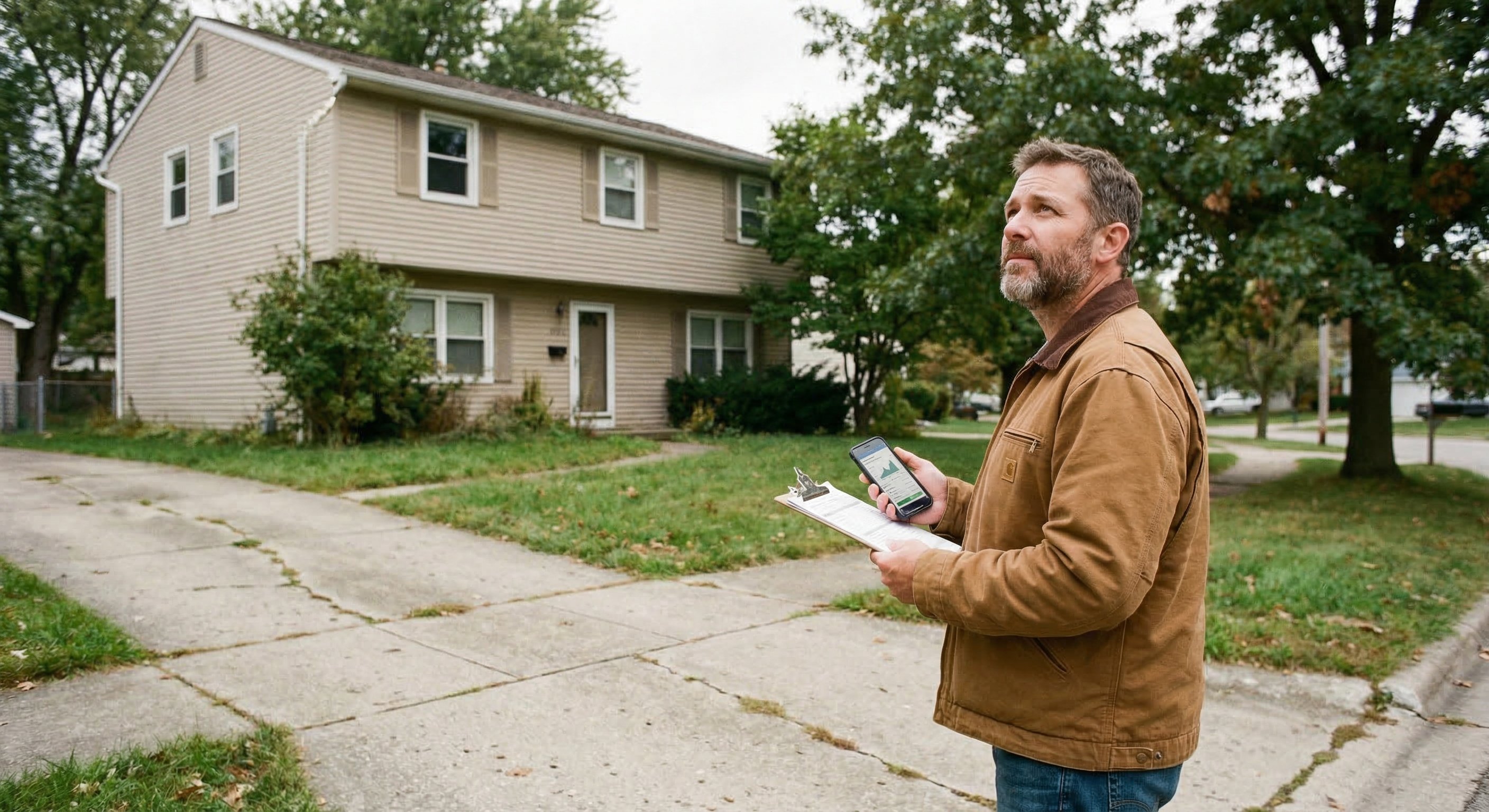
Ohio absentee owners respond best to offers that address their actual pain points, not just a price number:
Speed and certainty beat maximum price. An absentee owner managing a problem property from out of state is not running a real estate sales process. They want the problem to stop. A cash offer with a 14-21 day close and no inspection contingency beats a higher offer with conventional financing and unknowns.
Handle the details. Offer to manage the closeout process, coordinate with their tenant if there is one, and deal with any remaining personal property. The less they have to do from 500 miles away, the better.
Acknowledge the situation without exploiting it. Your first conversation should acknowledge that managing a property from a distance is genuinely difficult — not because you're fishing for motivation, but because it builds trust. Absentee sellers who feel respected respond better than those who feel like you're picking over their problem.
Key Takeaways
- Ohio's best absentee owner markets are Cuyahoga (Cleveland), Franklin (Columbus), Hamilton (Cincinnati), Summit (Akron), Montgomery (Dayton), and Lucas (Toledo)
- Motivation multiplies when you stack absentee status with tax delinquency, code violations, and vacancy signals
- Ohio's tax deed process (not tax lien certificate) creates real pressure for owners who miss payment cycles
- Out-of-state owners are your highest-priority segment — they face maximum friction managing a problem from a distance
- County auditor databases are public starting points; platforms like DistressIQ provide pre-stacked, scored lead lists without manual multi-source assembly
If you're tired of cold-calling unverified lists and want to start with Ohio absentee owners who already have stacked distress signals, DistressIQ pulls assessor-verified data from all 88 Ohio counties — updated multiple times daily. Founding member pricing locks in at 30% off for life: Starter $89, Pro $174, Elite $349/mo with fewer than 50 spots remaining.
Frequently Asked Questions
Q: What is an absentee owner list in Ohio?
An absentee owner list is a list of properties where the owner's mailing address is different from the property address. In Ohio, you can pull this data from individual county auditor portals for all 88 counties. Platforms like DistressIQ aggregate and score this data across all counties, making it easier to find motivated sellers without manually querying each county.
Q: Where are Ohio's best absentee owner markets for real estate investors?
The highest-volume markets are Cuyahoga County (Cleveland), Franklin County (Columbus), Hamilton County (Cincinnati), and Summit County (Akron). For investors seeking less competition and still-viable wholesale spreads, Montgomery County (Dayton) and Lucas County (Toledo) are strong secondary markets.
Q: How do I find out-of-state absentee owners in Ohio specifically?
Filter by owners whose mailing address is outside Ohio entirely. Most county auditor portals allow address-based filtering, though some require manual review. Data aggregators like DistressIQ tag out-of-state absentee status at the property level across all Ohio counties.
Q: Is Ohio a tax lien or tax deed state for delinquent properties?
Ohio is a tax deed state. Counties can move delinquent properties through the tax sale process directly to tax deed issuance — there is no tax lien certificate investment layer as in Florida or Illinois. For absentee owner outreach, this means delinquent owners face real property loss risk, which increases motivation to sell to an investor before the county acts.
Q: What signals should I stack with absentee owner status in Ohio?
Prioritize: (1) tax delinquency — especially owners 1+ years behind on Ohio's January/July payment cycles; (2) active code violations from Cleveland, Columbus, Cincinnati, or Akron code enforcement; (3) vacancy indicators; and (4) long ownership tenure (10+ years with no refinancing). Each additional signal increases seller motivation significantly.
Q: How long does it take Ohio counties to move on delinquent absentee-owned properties?
Ohio's timeline from delinquency to potential tax deed varies by county, but the process typically begins 2-3 years after initial delinquency. Cuyahoga and Franklin counties are known for running efficient tax sale calendars. An owner who's already 18-24 months behind is feeling real pressure — that's your outreach window.
Q: Do LLC-owned properties show up on Ohio absentee owner lists?
Yes, but the registered agent address on the LLC may not match the actual owner's location. For LLC-owned absentee properties, you'll need skip tracing to identify the actual decision-maker behind the entity. Ohio Secretary of State filings are publicly searchable and give you the registered agent and sometimes the organizer's address as a starting point.
External sources: Ohio Department of Taxation — Property Tax Overview | Cuyahoga Land Reutilization Corporation | Ohio Revised Code — Delinquent Tax Proceedings, ORC §5721
The data behind this article
DistressIQ Monitors These Signals in Real Time
Pre-Foreclosures
NOD + NTS filings
Tax Delinquency
County treasurer records
Code Violations
Municipal inspection filings
Probate Filings
Superior Court records
Every lead is scored 0–100 for seller motivation based on signal type, duration, severity, and stacking. Nationwide coverage — every US county, updated daily.
Ready to find deals in your market?
See Live Distress Signals in Your County
Stop calling dead leads. Every lead in DistressIQ is scored 0–100 for seller motivation, with verified contact info included. Browse the free tier to see what's active in your market right now.
Browse Free Leads — No Credit Card