Absentee Owner List Florida: Where Out-of-State Landlords Are Selling in 2026
Absentee Owner List Florida: Where Out-of-State Landlords Are Selling in 2026
TL;DR: Florida has one of the highest concentrations of absentee-owned properties in the U.S. — snowbirds, vacation rental investors, and out-of-state landlords who bought at 2020-2022 peak prices and now face some of the steepest insurance, HOA, and non-homestead tax increases in the country. A Florida absentee owner list is built from county property appraiser homestead exemption records, which are fully public in all 67 counties. The best leads stack absentee ownership with at least one additional distress signal. DistressIQ aggregates absentee data statewide, updated daily from county sources.
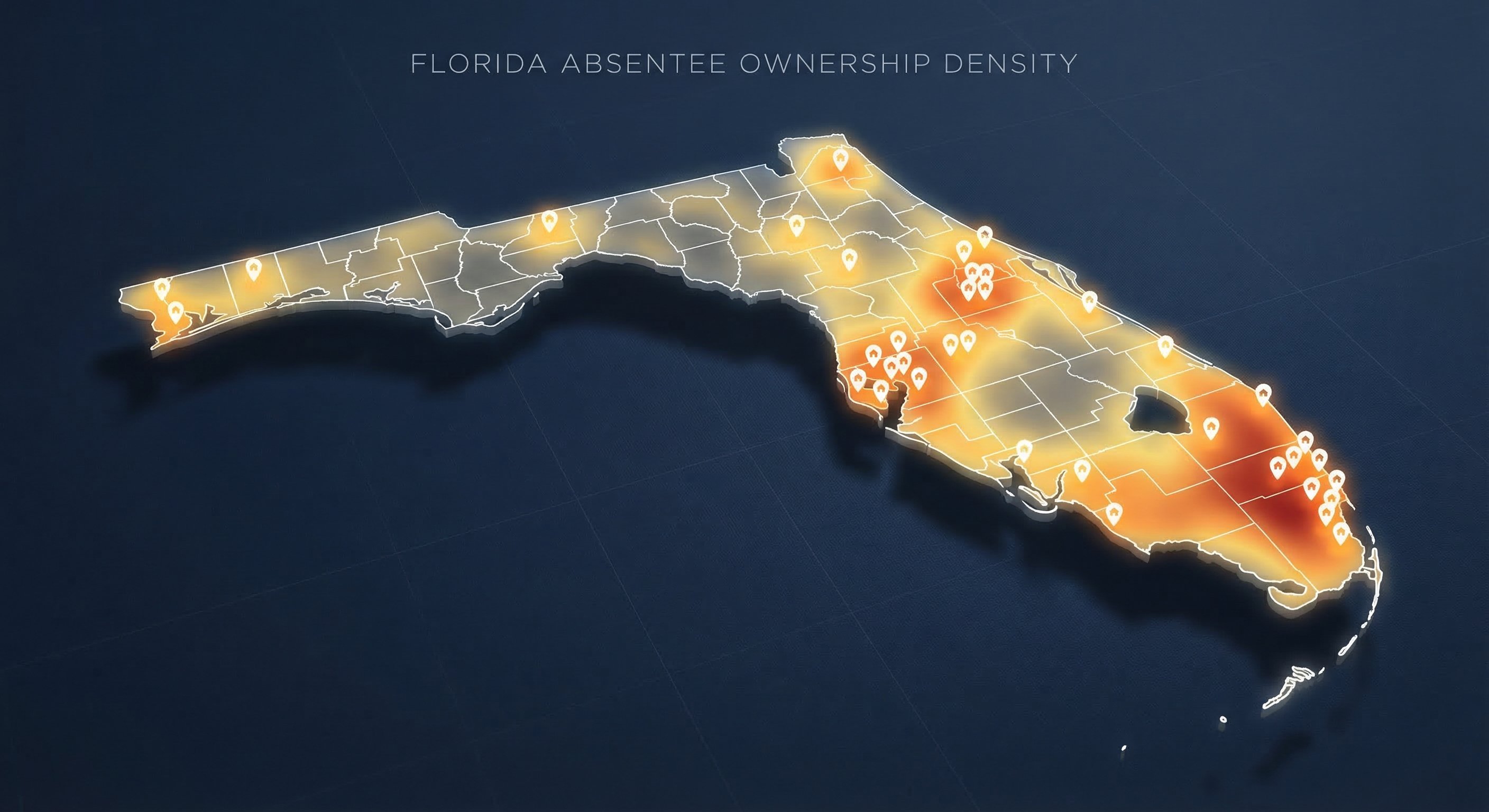
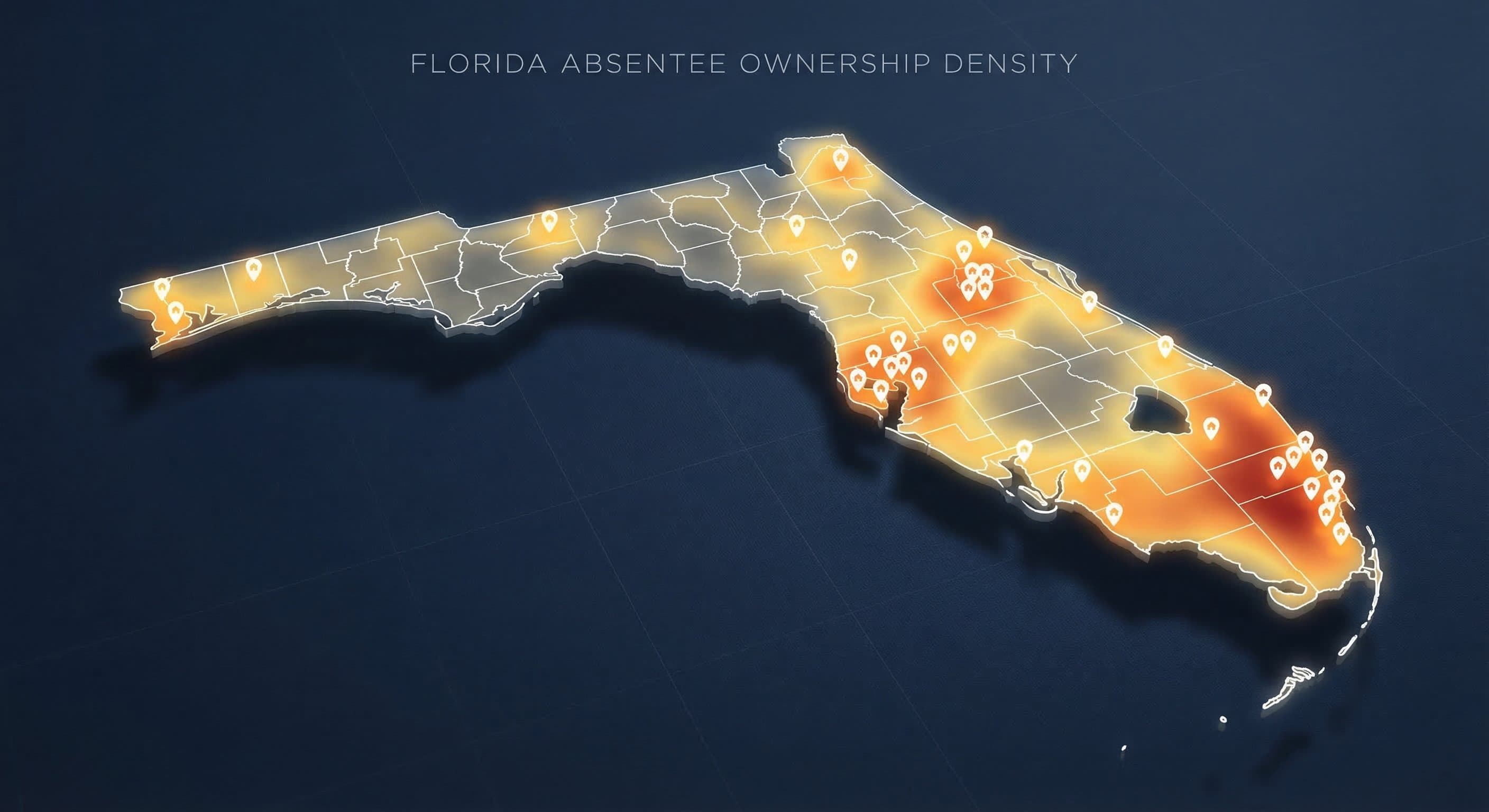
Florida doesn't just have a lot of real estate — it has a lot of other people's real estate. Roughly 30-40% of Florida properties are owned by someone who doesn't live there as their primary residence. Snowbirds from the Northeast and Midwest. Condo investors from New York and California. Short-term rental operators from everywhere. Landlords who own units across the state but live in a different county altogether.
That's a massive pool of potential sellers. And in 2026, the squeeze is on.
What Is an Absentee Owner (and Why Florida Has So Many)
An absentee owner is any property owner whose mailing address doesn't match the property address. In Florida, county property appraiser offices track this precisely — because a property without a homestead exemption pays significantly higher property taxes than one with it.
If someone owns a home in Broward County but claims homestead in Ohio, it shows in the public records. The county knows it. And that information is freely accessible.
Florida's absentee owner concentration is among the highest in the nation for three structural reasons:
Snowbird culture is deeply embedded. Retirees and near-retirees from cold-weather states own second homes in Florida but maintain primary residences up north. They use the property 3-4 months a year, rent it out the rest, or let it sit. Estimates put snowbird-owned properties statewide at 800,000+.
Short-term rental investment boomed — then cooled. The 2020-2022 Airbnb and VRBO frenzy pushed out-of-state investors into Florida beach towns, tourist corridors, and theme park-adjacent markets at record prices. The STR market has since compressed significantly — especially post-2024 municipal regulations in cities like Orlando, Kissimmee, and Miami Beach.
Investor landlord activity remains heavy. Florida's landlord-tenant laws and in-migration story historically made it attractive for out-of-state rental investors. Many own 1-5 units and manage remotely. Distance creates problems. Problems create sellers.
Why Florida's Absentee Owners Are Under More Pressure in 2026
This is what matters for investors right now: the economic squeeze on Florida's absentee owners is real and accelerating.
Insurance costs. Florida's property insurance market has been in near-collapse for several years. Major carriers have exited the state; Citizens Property Insurance (the state-backed insurer of last resort) has raised rates aggressively. For a non-homestead property — one without a primary resident discount — annual premiums can run 2-3x national averages. A non-homestead property worth $400K in South Florida may be paying $8,000-$15,000+ per year in insurance alone. Many absentee owners didn't underwrite for this when they bought, and the math no longer works.
Property taxes. Florida's Save Our Homes cap limits how fast a homestead property's assessed value can increase — capped at 3% per year or CPI, whichever is lower. Non-homestead properties have no such protection beyond a 10% cap. In markets where values spiked 30-50% over 2020-2022, absentee owners absorbed the full assessment increase. Out-of-state owners watching a tax bill that's doubled in three years while rental income hasn't kept pace are actively reconsidering their position.
HOA fees and delinquencies. Florida has more HOA-governed properties than any other state — approximately 3.3 million units across 50,000+ associations. Post-Surfside (the 2021 Champlain Towers collapse), condo reserve funding requirements became legally mandatory for buildings three stories or taller. The result: owners in older condo buildings are being handed special assessments for structural repairs that can reach five to six figures per unit. For absentee condo investors who are already cash-flow neutral, this is existential.
Short-term rental regulation. Cities across Florida have tightened or outright banned short-term rentals in residential zones. Investors who bought specifically for Airbnb income — projecting $60-80K annual revenue — are now clearing $30-40K in the best markets, which doesn't cover their mortgage, insurance, and HOA. Properties bought as cash-flow machines are becoming cash drains.
The result is a substantial pool of financially stressed absentee owners with strong motivation to sell quickly and quietly — often before they ever call a traditional agent.
How Florida's Property Data Makes Finding Them Easier
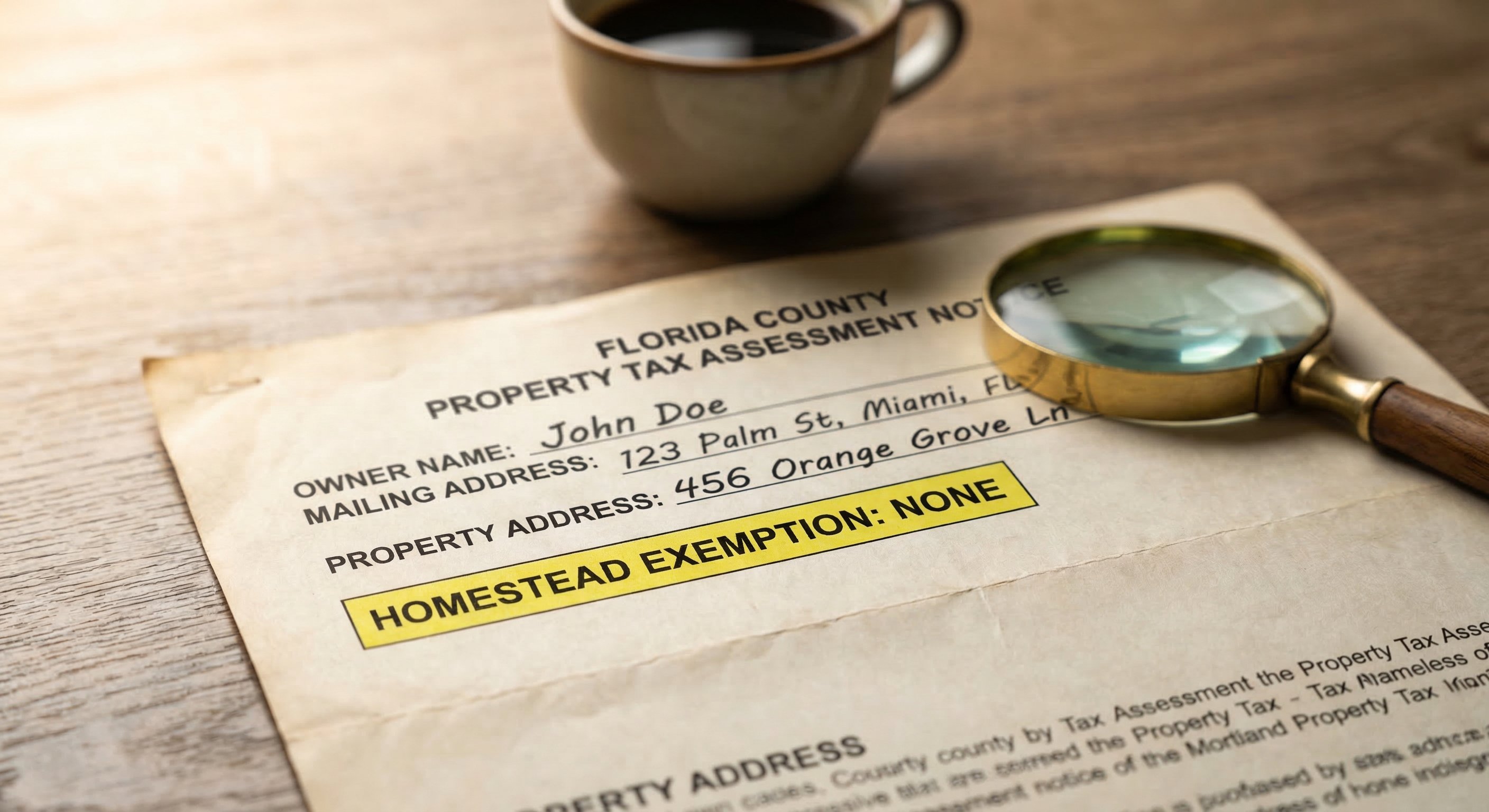
Florida is one of the most investor-friendly states for public property data. Every county maintains a property appraiser's website with ownership and exemption data. Homestead exemption status is publicly recorded, making it straightforward to identify absentee properties — any parcel without a homestead exemption that's owned by an individual (not a corporate entity) is a potential target.
Key data fields from Florida county property appraisers:
- Owner mailing address vs. property address — a mismatch is the primary absentee flag
- Homestead exemption status — no exemption on a residential parcel = absentee or investment ownership
- Owner mailing state — identifies out-of-state owners specifically (highest priority tier for investors)
- Property type and condition class — single-family, condo, multi-unit carry different motivation profiles
- Tax status — delinquent taxes stacked on absentee ownership dramatically increases urgency
- Years owned — long-hold absentee owners often have significant equity and lower urgency thresholds
Florida's 67 county property appraisers operate on different systems, but the data is structurally consistent. Major counties — Miami-Dade, Broward, Palm Beach, Hillsborough, Orange, Pinellas, Duval — have robust online search tools and bulk data available under Florida Statute 193.074, which makes all property appraiser records public record with no opt-out mechanism.
Free Weekly Alerts
See What's Distressed in Your Market
Get free weekly alerts — new distressed properties, motivation scores, and hot neighborhoods in your area. Addresses and contact info available inside DistressIQ.
Free forever · No credit card · Unsubscribe anytime
The Best Counties for Absentee Owner Leads in Florida
Not all Florida counties deliver equal results for absentee owner outreach. Here's where investors are focusing:
South Florida: Miami-Dade, Broward, Palm Beach
The highest density of absentee-owned condos in the state. Foreign investors (Latin American, European, Canadian), Northeastern second-home buyers, and short-term rental operators. Post-Surfside condo legislation has forced older associations to fund reserves they don't have, creating a wave of special assessments. Owners who bought pre-2000 condos that now need major structural work and face six-figure special assessments are among the most motivated sellers in the state.
Miami-Dade alone has tens of thousands of absentee-owned units in its condo stock. The opportunity is concentrated in older buildings (1970s-1990s) in coastal zip codes.
Central Florida: Orange, Osceola, Polk
Theme park proximity drove explosive short-term rental investment in the early 2020s. Kissimmee and areas around Celebration and Champions Gate are saturated with non-homestead investment properties. STR occupancy has compressed significantly. Investors who bought on pro forma assumptions from 2021 are now cash-flow negative or barely breaking even.
Tampa Bay: Hillsborough, Pinellas, Pasco
A blend of snowbird culture and speculative buying. Pinellas County beach communities — St. Pete Beach, Clearwater, Treasure Island — have very high absentee ratios. Pasco County has become a hotspot for investors priced out of Hillsborough, with corresponding non-homestead pressure. The Tampa Bay market's 2021-2022 appreciation spike left many out-of-state investors holding at peak prices.
Northeast Florida: Duval, St. Johns, Nassau
Jacksonville's rapid appreciation attracted investor-landlords from across the country. St. Johns County has some of the highest home values and highest non-homestead ratios in the region. Investors who bought at 2022 peak prices in Ponte Vedra and surrounding areas are in the tightest position relative to current market values.
Southwest Florida: Lee, Collier, Charlotte
Hurricane Ian's 2022 impact created lasting insurance distress in Lee County (Fort Myers, Cape Coral). Non-homestead owners who didn't complete repairs, or who face ongoing insurance complications from wind/flood coverage, represent a concentrated motivated seller population. Lee County has some of the most complex non-homestead ownership patterns in the state.
How to Contact Florida Absentee Owners (What Actually Works)
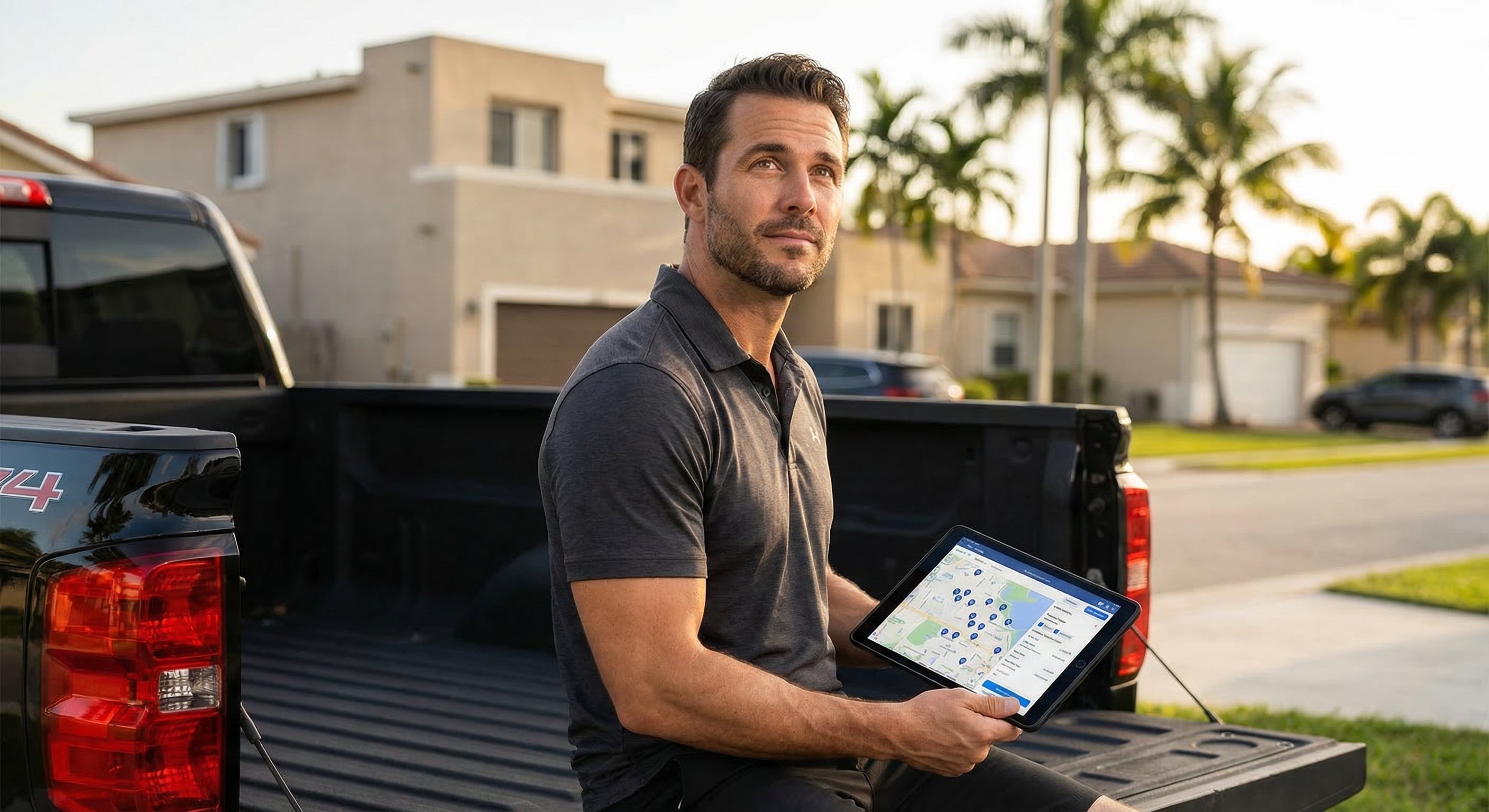
The mailing address is your primary asset. Florida absentee owner lists include the owner's actual mailing address — often in New York, Ohio, Michigan, New Jersey, or another cold-weather state. That's your contact point.
Direct mail. The most reliable channel for absentee owner outreach. Out-of-state owners receive physical mail at their primary residence, and a personalized letter referencing the specific Florida property address ("I saw you own the property at 123 Palm Ave in Cape Coral...") dramatically outperforms generic "we buy houses" postcards. Industry norms: 1-3% response rate on cold mail, 5-8% on targeted multi-touch sequences.
Phone. Absentee owners who manage property remotely are often comfortable doing business by phone. Skip tracing from the property's mailing address works well in Florida because property tax bills keep owner addresses current. An owner who's been getting tax bills for 15 years has a very stable mailing address.
Email and SMS. Where contact data is available, both channels supplement direct mail effectively. SMS open rates in real estate outreach average 90%+ — email gets through when you have a matching mailing address to work from. Use these as follow-up channels, not primary.
Timing. The most actionable Florida absentee owners are those with multiple stacked distress signals. Insurance renewal season (fall) and tax delinquency notice season (April-May) create natural pressure points. Post-hurricane — especially in Lee, Charlotte, and Sarasota counties — investor motivation spikes sharply in the 60-90 days after a major storm.
Stacking Absentee Ownership with Other Distress Signals
Absentee ownership alone is not a distress signal. It's a qualifier. The investor who owns 10 cash-flowing Tampa Bay rentals isn't your seller. You need to filter for the ones who are actually under pressure.
The combinations that consistently produce results:
Absentee + tax delinquency. An out-of-state owner who hasn't paid property taxes is your highest-priority lead. Florida's tax certificate auction process — certificates are auctioned in May, with eventual risk of tax deed sale — creates a hard deadline. Owners in this situation often respond to a fair offer within days.
Absentee + code violations. An absentee owner with an open municipal code violation is being fined daily and can't easily resolve it from across the country. These owners are motivated to sell as-is and are often willing to negotiate aggressively to make the fines stop.
Absentee + lis pendens. A pre-foreclosure filing on an absentee-owned property is a double-distress signal. The owner is in financial trouble AND isn't living there — two of the strongest individual indicators of seller motivation stacked together.
Absentee + long hold + high equity. Properties owned for 10+ years by absentee owners, particularly with significant equity built up over Florida's appreciation cycles, represent the deepest value plays. Low acquisition basis + distant owner + right offer structure = clean deal with minimal negotiation friction.
DistressIQ lets you filter any combination of these signals across all 67 Florida counties — so instead of working a raw absentee list with 50,000 names, you're working a prioritized 300-400 property list where every lead has two or more reasons to sell. Founding member pricing is still live: Starter $89, Pro $174, Elite $349/mo — 30% off locked for life, fewer than 50 spots remaining. Start your free trial →
Key Takeaways
- Florida's 30-40% absentee ownership rate creates one of the largest motivated seller pools in the U.S.
- Insurance costs, HOA special assessments, non-homestead tax exposure, and STR regulation changes are materially squeezing absentee owners in 2026
- County property appraiser records are fully public across all 67 counties — homestead exemption status identifies absentee properties precisely
- South Florida condos (post-Surfside legislation), Central Florida STR properties, and Southwest Florida hurricane-zone parcels are priority segments
- Best leads stack absentee ownership with at least one additional distress signal: tax delinquency, code violation, lis pendens, or long-hold + high equity
- Direct mail to the owner's mailing address (often out of state) remains the most reliable contact channel
Frequently Asked Questions
Q: How do I get a list of absentee owners in Florida?
Each of Florida's 67 county property appraisers maintains public ownership records accessible online. You can search by address, owner name, or exemption type. Most counties offer bulk data downloads for a nominal fee. Aggregators like DistressIQ compile and cross-reference these records statewide, saving the manual per-county work and adding distress signal layering.
Q: What is the homestead exemption and why does it matter for absentee owner research?
Florida's homestead exemption reduces the assessed value of a primary residence for property tax purposes, and also caps annual assessment increases at 3% under Save Our Homes. Only properties where the owner lives as their primary residence qualify. A residential parcel with no homestead exemption is either investment-owned or absentee-owned — making it the fastest filter for building an absentee list from Florida public records.
Q: Are Florida absentee owner records truly public?
Yes. Florida property appraiser data is public record under Florida Statute 193.074. This includes owner name, mailing address, property address, homestead status, and assessed value. There is no opt-out mechanism. This is why Florida is considered one of the most data-accessible states for real estate investors.
Q: What's the difference between a snowbird absentee owner and an investor absentee owner?
Snowbirds own Florida property as a genuine second home and live there part of the year — typically 3-4 months. They tend to have lower urgency and emotional attachment to the property. Investor absentee owners bought specifically for rental income and have a purely financial relationship with the property. Investors respond faster to financial pressure but are also more experienced negotiators. Effective outreach messaging differs significantly for each profile.
Q: Which Florida counties have the highest absentee owner concentration?
Miami-Dade, Broward, Palm Beach, Pinellas, and Collier counties consistently show the highest non-homestead ratios. These are also the counties with the most acute insurance and HOA cost pressures in 2026. Orange County (Orlando-area) has high absentee concentration driven by short-term rental investors, particularly in Osceola County ZIP codes adjacent to Walt Disney World.
Q: How often is Florida absentee owner data updated?
County property appraiser records update on varying cycles — quarterly, semi-annually, or annually depending on the county. Tax roll data typically finalizes in November with interim updates through the year. DistressIQ pulls from county sources multiple times daily and flags status changes as they're filed, so new absentee flags appear within hours of county recording.
Q: What should I say in my outreach to a Florida absentee owner?
Lead with the specific property address — not a generic "I buy houses" pitch. Acknowledge that managing Florida property from another state has challenges. Offer a fast, as-is transaction. Avoid pressure language. Many absentee owners respond to letters that feel personal and property-specific rather than obviously mass-mailed. If you can reference something specific about the property or its situation (tax delinquency, code violation, insurance difficulty), response rates increase significantly.
Sources: Florida Department of Revenue (homestead exemption guidelines and Save Our Homes documentation), Florida Office of Insurance Regulation (carrier withdrawal filings and Citizens rate increases), Florida Department of Business and Professional Regulation (HOA reserve requirement legislation), National Association of Realtors 2025 Investment and Vacation Home Buyers Survey, American Resort Development Association Florida data.
Ready to stop working cold absentee lists and start working targeted Florida leads with multiple distress signals? DistressIQ stacks absentee ownership with 30 additional signal types across all 67 Florida counties — so every lead you call has two or three reasons to sell, not just one.
The data behind this article
DistressIQ Monitors These Signals in Real Time
Pre-Foreclosures
NOD + NTS filings
Tax Delinquency
County treasurer records
Code Violations
Municipal inspection filings
Probate Filings
Superior Court records
Every lead is scored 0–100 for seller motivation based on signal type, duration, severity, and stacking. Nationwide coverage — every US county, updated daily.
Ready to find deals in your market?
See Live Distress Signals in Your County
Stop calling dead leads. Every lead in DistressIQ is scored 0–100 for seller motivation, with verified contact info included. Browse the free tier to see what's active in your market right now.
Browse Free Leads — No Credit Card